ZOYI ZT-MD2 LCR Digital Bridge Tweezers Tester
Official Store Deal
Expert Analysis Overview
Precision Component Scrutiny: The ZOYI ZT-MD2 LCR Tweezers Tester
The ZOYI ZT-MD2 LCR Digital Bridge Tweezers Tester is a specialized diagnostic instrument engineered for precise component analysis, targeting electronics technicians and hobbyists who demand accuracy and efficiency in their workbench operations. This device streamlines the often-tedious process of identifying and characterizing discrete electronic components. It offers a focused solution for critical measurement tasks, moving beyond the general capabilities of standard multimeters. Its design prioritizes direct component interaction, minimizing setup time and potential errors.
Core Measurement Capabilities
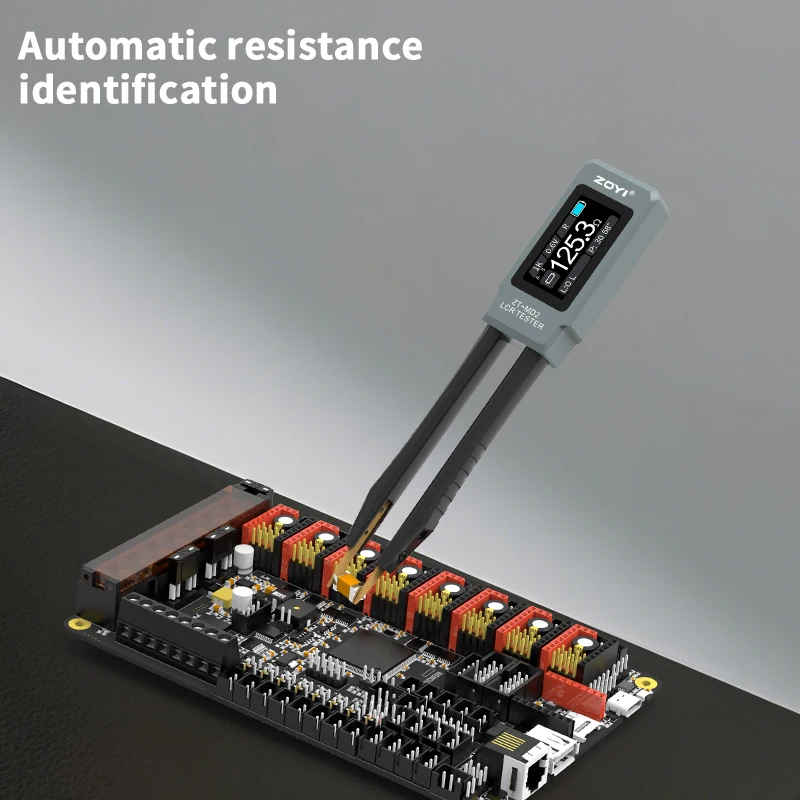
The ZT-MD2 is explicitly designed for automatic resistance identification. The visual evidence shows the device actively measuring a component on a circuit board, displaying a resistance value of "125.3 Ω." This automatic detection capability is a significant time-saver. Users no longer need to manually select the component type before testing. This intelligence reduces operational complexity. Standard multimeters often require manual range and function selection, adding steps to each measurement. The ZT-MD2 simplifies this, making it ideal for rapid component sorting or fault finding.
Beyond basic resistance, the tester handles capacitance and inductance measurements with similar ease. The product imagery highlights its ability to measure various component types directly on a PCB. This direct measurement capability is crucial for troubleshooting. It avoids the need to desolder components for testing, a common bottleneck in repair work. Traditional LCR meters, while accurate, are often bulkier and less convenient for in-circuit testing. The tweezers form factor provides unparalleled access to densely populated boards.
Operational Flexibility and Display Clarity
One of the ZT-MD2's standout features is its support for multiple test frequencies. The device explicitly lists 100Hz, 120Hz, 1KHz, 10KHz, and 100KHz. This range of frequencies allows for comprehensive characterization of components, especially important for inductors and capacitors where impedance varies significantly with frequency. A component might behave differently at 100Hz compared to 100KHz. Many entry-level LCR testers offer only a single or limited set of test frequencies. The ZT-MD2 provides a more complete picture of component performance, which is vital for high-frequency circuit design and repair.
The screen orientation can be freely adjusted. This ergonomic design choice is highly practical. The display rotates to ensure optimal viewing angles regardless of how the tweezers are held or the component's position. This prevents awkward head tilts or repositioning of the device. Clear visibility is paramount. Smaller, fixed-orientation displays on some compact testers can lead to reading errors or user fatigue. The ZT-MD2's adaptable screen enhances user comfort and measurement accuracy.
Data Management and Advanced Functionality
For professionals requiring documentation, the ZT-MD2 supports data hold and automatically records data into Excel files for viewing on a computer. A USB connection is visible, linking the device to a laptop. This data logging feature is indispensable for quality control, batch testing, or long-term component analysis. It eliminates manual transcription errors. Imagine tracking component drift over time. Many handheld testers lack any data logging, forcing users to manually record readings. The ZT-MD2 integrates seamlessly into digital workflows, saving considerable time and improving record-keeping accuracy.
Beyond its LCR testing, the device also offers 7 waveform outputs. These include Sine, Square, Triangle, Pulse, Ramp, Multitone, and Arbitrary waveforms. This expands its utility beyond simple measurement. It transforms the tester into a basic signal generator. This dual functionality is unexpected for a tweezers-style LCR meter. Most dedicated LCR meters do not offer signal generation. This feature could be particularly useful for quick functional checks of circuits or components that require a specific input signal, adding significant value for electronics development and repair.
Build Quality and Workshop Resilience
The visible casing suggests a robust construction. The grey plastic body appears durable enough for regular workshop use. Accidental drops are common on a busy workbench. The design seems capable of withstanding typical knocks and bumps. This reduces the likelihood of damage from everyday accidents. Flimsier tools often crack or malfunction after a single fall. The ZT-MD2's apparent build quality contributes to its long-term reliability, minimizing the need for frequent replacements.
The compact, pen-style form factor with integrated tweezers is highly practical. It allows for single-handed operation, freeing up the other hand to steady a circuit board or refer to schematics. This enhances operational efficiency significantly. Trying to juggle separate probes and a meter can be cumbersome. The integrated design simplifies complex tasks. For intricate work, this single-handed capability is invaluable. It is a tool designed for focused, precise interaction with small components.
User Experience and Practical Application
The device's intuitive interface is evident from the clear display and minimal button layout. The automatic identification feature further simplifies its use. There is no steep learning curve. New users can quickly become proficient. Complex tools can deter hobbyists. The ZT-MD2 lowers the barrier to entry for accurate component testing. This approach ensures that even less experienced users can achieve reliable measurements without extensive training.
For a carpenter or anyone working with electronics in a workshop, the ability to measure components alone with precision is a distinct advantage. The tweezers design allows for fine manipulation and contact with small surface-mount devices (SMD) or through-hole components without needing a third hand. This capability directly addresses the challenge of handling tiny parts. It is a highly practical solution for intricate tasks. The clear, large display ensures that readings are easy to interpret, preventing measurement errors that can lead to costly rework. This clarity is akin to easily reading fractions on a tape measure. It removes ambiguity.
The ZT-MD2 is not just a measurement device; it is an efficiency enhancer. Its ability to log data and output waveforms adds layers of utility. This combination of features makes it a versatile tool for both diagnostic work and basic signal generation. The value proposition extends beyond simple LCR testing. It becomes a multi-functional instrument. This versatility means fewer tools cluttering the workbench. It consolidates capabilities into a single, convenient package.
Consider the scenario where a technician is troubleshooting a faulty PCB. The ZT-MD2 allows for rapid in-circuit testing of resistors, capacitors, and inductors, quickly pinpointing defective components. Its multiple test frequencies can reveal subtle component flaws that a single-frequency tester might miss. The data logging feature ensures that all measurements are recorded for later analysis or reporting. This comprehensive approach to diagnostics saves valuable time. It ensures that repairs are thorough and accurate. This tool is an investment in precision and productivity.
Imagine the ease of identifying a problematic SMD capacitor without desoldering it, or quickly checking the value of an unmarked inductor. The ZT-MD2 streamlines these tasks, reducing frustration and improving workflow. Its robust design suggests it can handle the rigors of a busy workshop, providing reliable service for years. This is a tool that empowers focused, efficient, and accurate electronic component analysis, making complex tasks straightforward and manageable. It is an indispensable asset for anyone serious about electronics work.