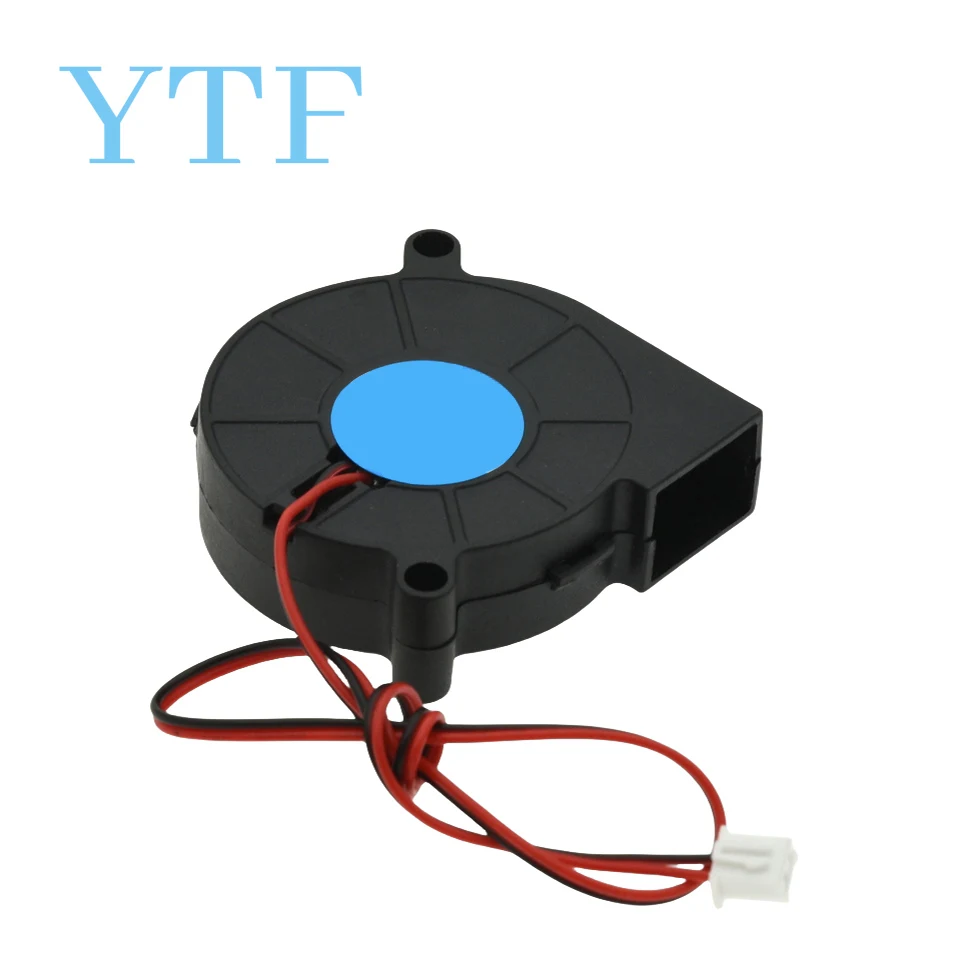
YTF 5015 DC Blower Fan for 3D Printers
Official Store Deal
Expert Analysis Overview
Precision Airflow Dynamics in 3D Printing
The YTF 5015 DC Blower Fan is a critical airflow management component engineered for precise thermal regulation within 3D printing systems. This centrifugal fan, often referred to as a squirrel cage fan, is specifically designed to provide directed, concentrated airflow, a distinct advantage over standard axial fans in applications requiring focused cooling. Its primary function is to enhance print quality by managing temperature around the hotend and printed layers, directly impacting the success rate of complex geometries and material compatibility.Unlike generic cooling solutions that disperse air broadly, this blower fan channels air through a volute housing, creating a high-pressure output stream. This focused air jet is indispensable for cooling specific areas, such as the nozzle tip to prevent heat creep, or the freshly extruded plastic to solidify layers rapidly. Rapid solidification is crucial for maintaining dimensional accuracy, especially on overhangs and bridges, where gravity and residual heat can cause warping or sagging. The fan's compact 50x50x15mm form factor allows for integration into tight spaces common in 3D printer carriages.
For users struggling with inconsistent layer adhesion or stringing, the precise cooling offered by a blower fan like the YTF 5015 can be a definitive solution. It ensures that each layer cools uniformly before the next is deposited, leading to stronger, more aesthetically pleasing prints. This capability is particularly vital when working with materials that have specific cooling requirements, such as PLA, which benefits from aggressive cooling, or ABS, which requires more controlled, but still effective, heat dissipation.
Endurance Under Extrusion
Constructed with a sleeve bearing and a brushless DC motor, the YTF 5015 fan prioritizes quiet operation and efficiency. Sleeve bearings are known for their low noise output, making them suitable for desktop 3D printers where acoustic comfort is a consideration. The fan operates with minimal vibration, which is crucial for maintaining the stability of the print head and preventing artifacts in the printed object. A stable print environment is paramount for achieving high-resolution prints.While sleeve bearings offer a quieter profile, their operational lifespan is typically shorter than that of ball bearings, especially in applications with high heat or continuous operation. This is a strategic transparency point: users should consider their operational hours and environmental conditions. For hobbyists or those with moderate printing schedules, the sleeve bearing provides an excellent balance of cost, performance, and noise reduction. Regular inspection for dust accumulation can help extend its service life.
The brushless DC motor design contributes to the fan's overall efficiency and longevity. Brushless motors eliminate the wear and tear associated with brushes, reducing maintenance requirements and improving reliability over time. This design ensures consistent rotational speed and airflow, which is critical for repeatable print quality. The motor's robust construction allows it to withstand the continuous demands of a 3D printing environment, where fans often run for many hours during a single print job.
Installation and Integration
Installation of the YTF 5015 DC Blower Fan is straightforward, typically involving mounting it to a custom-designed fan shroud or directly to the print head assembly. The fan includes a standard 2-pin connector, facilitating easy integration into most 3D printer control boards. Users must verify the correct voltage output from their printer's fan header to match the fan's specific voltage rating (5V, 12V, or 24V).Proper orientation of the fan and its shroud is essential to direct airflow precisely where needed. For hotend cooling, the fan should blow air across the heatsink to prevent heat creep from reaching the cold end, which can cause filament jams. For part cooling, the shroud should direct air just below the nozzle, targeting the freshly extruded layer without cooling the nozzle itself too much. Incorrect placement can lead to thermal runaway issues or insufficient cooling, resulting in print failures.
This fan is an ideal upgrade for many popular 3D printer models, including the RepRap and Prusa i3 platforms, which often benefit from enhanced cooling capabilities. Its standardized dimensions and electrical interface make it a versatile component for both new builds and existing printer modifications. The ability to select from multiple voltage options further broadens its compatibility across various printer architectures, ensuring a seamless fit into diverse setups.
Voltage Versatility
The availability of 5V, 12V, and 24V variants makes the YTF 5015 highly adaptable to different 3D printer power systems. This multi-voltage compatibility is a significant advantage, as it allows users to select the exact fan required for their specific printer's electrical architecture without needing additional voltage converters. Most modern 3D printers operate on either 12V or 24V, while some smaller or custom setups might utilize 5V.Choosing the correct voltage is not merely a matter of compatibility; it directly impacts the fan's performance and lifespan. An undersized voltage will result in insufficient airflow, while an oversized voltage will lead to immediate damage. The clear labeling of voltage options simplifies the selection process, reducing the risk of electrical mishaps during installation. This precision in voltage matching ensures optimal fan speed and cooling efficiency.
This broad compatibility contrasts sharply with single-voltage fans, which often necessitate complex wiring or additional power regulation modules for integration into incompatible systems. The YTF 5015 eliminates this complexity, offering a plug-and-play solution for a wide range of users. This focus on user convenience and broad applicability underscores its value as a versatile component in the 3D printing ecosystem.
Optimizing Print Environments
Investing in a dedicated blower fan like the YTF 5015 is a strategic decision for any 3D printer operator aiming for superior print quality and reliability. The fan's ability to provide consistent, directed airflow directly addresses common pain points such as poor bridging, stringing, and warping. By ensuring optimal cooling, the fan minimizes print failures, thereby saving valuable time and material costs associated with failed prints.This component allows users to confidently print with a wider array of materials, including those that are sensitive to cooling variations. For instance, achieving clean overhangs with PLA or preventing layer separation with PETG often hinges on effective part cooling. The YTF 5015 provides the capability to tackle these challenges head-on, expanding the creative possibilities for 3D printing enthusiasts and professionals alike.
Imagine completing intricate models with perfectly formed overhangs and smooth surfaces, free from the defects caused by inadequate cooling. The YTF 5015 DC Blower Fan empowers users to achieve these results consistently, transforming frustrating print failures into successful, high-quality outcomes. This fan is not merely a component; it is an enabler for precision and reliability in every 3D print. The consistent performance ensures that each project meets its design specifications, enhancing the overall utility of the 3D printer.