YCS Inductance Tester for Mobile Motherboard Fault Diagnosis
Official Store Deal
Expert Analysis Overview
The YCS Inductance Tester is a specialized diagnostic tool designed for mobile repair technicians seeking efficient and precise fault localization on smartphone motherboards. This compact device leverages electromagnetic induction to non-invasively detect anomalies in inductor circuits, a common point of failure in modern mobile devices. Its focus on rapid fault diagnosis addresses a critical need in the fast-paced mobile repair industry, offering a streamlined approach compared to traditional, more time-consuming methods.
This tester operates on the principle of electromagnetic induction. It generates a localized electromagnetic field.
When brought near an inductor on a powered motherboard, the tester's internal circuitry analyzes the induced current. This allows for a quick assessment of whether the inductor is functioning within expected parameters. Unlike traditional multimeter methods that require direct contact and often extensive circuit tracing, this inductance tester uses electromagnetic induction for non-invasive, rapid assessment. This non-contact approach minimizes the risk of accidental short circuits or damage to delicate surface-mount components, a significant advantage in high-density mobile phone circuitry.
Standard diagnostic procedures often involve power cycling, component removal, or detailed schematic analysis. This tool simplifies the initial diagnostic phase. Technicians can swiftly scan critical power delivery lines and identify problematic inductors without desoldering. It saves valuable time.
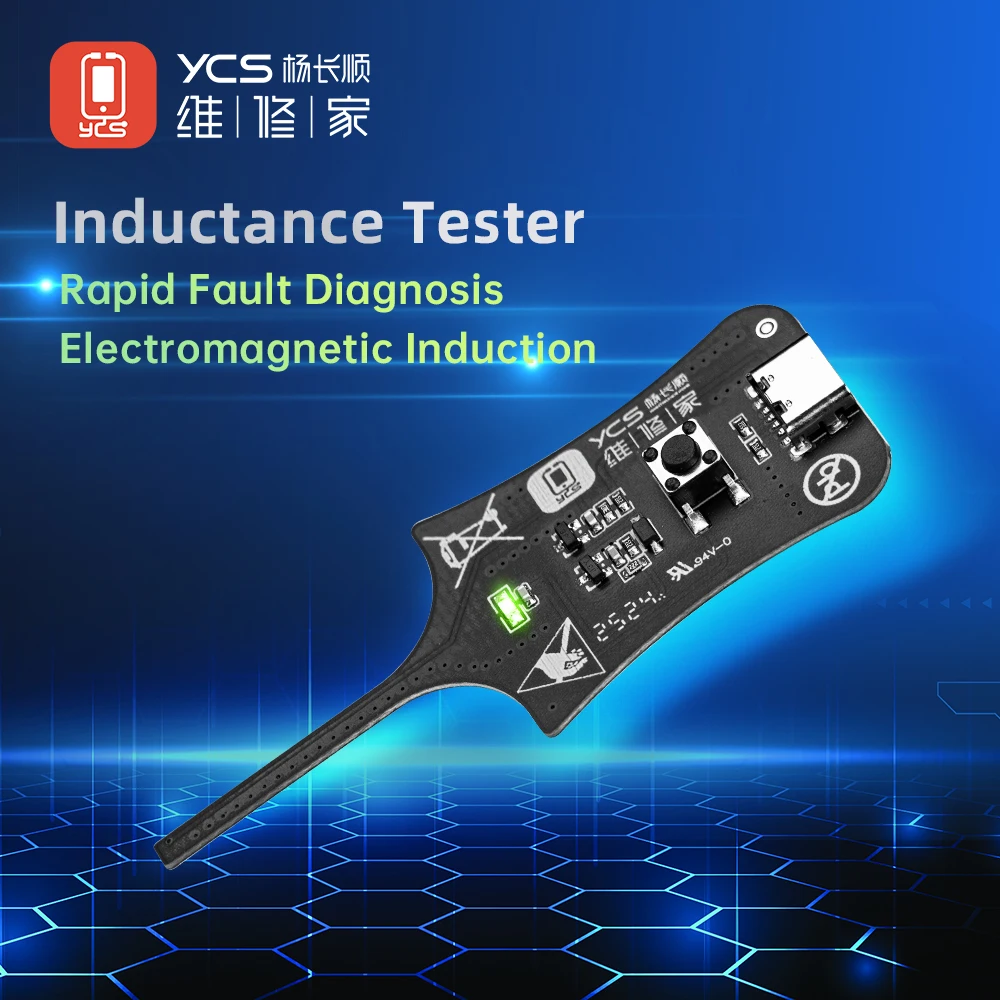
The YCS Inductance Tester features a highly integrated circuit board in a slender, probe-like design. Its dimensions are approximately 75mm in length and 29mm in width at its widest point.
This compact form factor is crucial for navigating the tight spaces on modern smartphone motherboards. The slim probe tip allows access to components nestled between ICs and connectors, areas where bulkier test equipment would struggle to reach. The design prioritizes portability and ease of handling, making it an ideal tool for on-the-go repairs or crowded workbench environments. It fits easily into any tool kit.
Power is supplied via a USB-C port, indicating modern connectivity and compatibility with common charging solutions. A single tactile button controls operation, and a green LED illuminates to signal normal operation, providing clear visual feedback. This simplicity ensures that the tool is user-friendly, even for technicians new to inductance testing.
The primary benefit of this inductance tester is its ability to provide instant fault localization. A green LED indicates normal operation.
When the LED fails to illuminate or shows an inconsistent pattern, it signals a potential issue with the inductor under test. This immediate feedback drastically reduces the time spent troubleshooting power-related issues, which are notoriously complex in mobile devices. Imagine a scenario where a phone fails to power on; instead of systematically checking every power rail with a multimeter, the technician can quickly sweep the motherboard for inductor anomalies, narrowing down the fault area within minutes. This capability is a significant upgrade from manual tracing.
This rapid diagnosis translates directly into increased repair efficiency and customer satisfaction. Faster repairs mean higher throughput for repair shops and less downtime for device owners. The tool effectively brings the diagnostic capabilities of a more extensive lab setup into a portable, handheld format, allowing technicians to perform initial assessments anywhere. It makes the diagnostic process more accessible.
Consider a common mobile phone issue: a device that won't charge or powers on intermittently. These symptoms often point to issues within the power management unit (PMU) or its associated inductor circuits.
Using the YCS Inductance Tester, a technician can quickly scan the inductors around the PMU and other power rails. If an inductor is faulty, the tester's LED will indicate an abnormality, guiding the technician directly to the problematic component. This focused approach eliminates guesswork and reduces the need for extensive schematic reading or component-by-component resistance checks. It identifies the problem source quickly.
Without such a tool, diagnosing these issues could involve hours of meticulous probing, comparing readings to known good boards, or even replacing components speculatively. The tester provides a targeted solution, making complex power fault diagnosis more manageable and less prone to human error. This capability allows technicians to address common, yet challenging, faults with greater confidence and speed.
The visible construction of the YCS Inductance Tester suggests a robust, solid-state design. The main body appears to be a single piece of PCB material, minimizing moving parts.
This design choice inherently contributes to the tool's durability. There are no delicate hinges or complex mechanical assemblies that could fail under regular use in a busy repair environment. The integrated nature of the components means it can withstand the typical knocks and drops associated with tool use, a practical consideration for any mobile mechanic. It is built for resilience.
Its simple interface, comprising a single button and an LED indicator, ensures ease of use. There is no complicated menu system or calibration required; simply connect power and begin testing. This straightforward operation reduces the learning curve for new users and allows experienced technicians to integrate it seamlessly into their existing workflows. The tool is highly intuitive.
The YCS Inductance Tester is more than just a diagnostic device; it is a strategic investment for any mobile repair professional. Its ability to quickly identify inductor faults saves significant diagnostic time.
By reducing the time spent on troubleshooting, technicians can complete more repairs daily, directly impacting profitability. The tool's non-invasive nature also protects valuable customer devices from further damage during diagnosis. This ensures a higher quality of service and builds customer trust. It is a valuable asset.
This tester is an indispensable addition to any mobile repair toolkit, offering a focused, efficient, and reliable method for diagnosing common motherboard power issues. It represents a clear upgrade from generic diagnostic approaches, providing a specialized capability that enhances overall repair efficiency. Imagine the satisfaction of quickly diagnosing a stubborn power fault, knowing you've saved hours of painstaking work, and returning a functional device to a grateful customer, all thanks to a precise and efficient tool like this. This tester empowers technicians to tackle complex issues with confidence and speed, transforming challenging repairs into routine successes.
Pinpointing Power Anomalies: The Inductance Principle
This tester operates on the principle of electromagnetic induction. It generates a localized electromagnetic field.
When brought near an inductor on a powered motherboard, the tester's internal circuitry analyzes the induced current. This allows for a quick assessment of whether the inductor is functioning within expected parameters. Unlike traditional multimeter methods that require direct contact and often extensive circuit tracing, this inductance tester uses electromagnetic induction for non-invasive, rapid assessment. This non-contact approach minimizes the risk of accidental short circuits or damage to delicate surface-mount components, a significant advantage in high-density mobile phone circuitry.
Standard diagnostic procedures often involve power cycling, component removal, or detailed schematic analysis. This tool simplifies the initial diagnostic phase. Technicians can swiftly scan critical power delivery lines and identify problematic inductors without desoldering. It saves valuable time.
Precision in a Compact Form Factor
The YCS Inductance Tester features a highly integrated circuit board in a slender, probe-like design. Its dimensions are approximately 75mm in length and 29mm in width at its widest point.
This compact form factor is crucial for navigating the tight spaces on modern smartphone motherboards. The slim probe tip allows access to components nestled between ICs and connectors, areas where bulkier test equipment would struggle to reach. The design prioritizes portability and ease of handling, making it an ideal tool for on-the-go repairs or crowded workbench environments. It fits easily into any tool kit.
Power is supplied via a USB-C port, indicating modern connectivity and compatibility with common charging solutions. A single tactile button controls operation, and a green LED illuminates to signal normal operation, providing clear visual feedback. This simplicity ensures that the tool is user-friendly, even for technicians new to inductance testing.
Streamlining the Diagnostic Workflow
The primary benefit of this inductance tester is its ability to provide instant fault localization. A green LED indicates normal operation.
When the LED fails to illuminate or shows an inconsistent pattern, it signals a potential issue with the inductor under test. This immediate feedback drastically reduces the time spent troubleshooting power-related issues, which are notoriously complex in mobile devices. Imagine a scenario where a phone fails to power on; instead of systematically checking every power rail with a multimeter, the technician can quickly sweep the motherboard for inductor anomalies, narrowing down the fault area within minutes. This capability is a significant upgrade from manual tracing.
This rapid diagnosis translates directly into increased repair efficiency and customer satisfaction. Faster repairs mean higher throughput for repair shops and less downtime for device owners. The tool effectively brings the diagnostic capabilities of a more extensive lab setup into a portable, handheld format, allowing technicians to perform initial assessments anywhere. It makes the diagnostic process more accessible.
Real-World Repair Scenarios
Consider a common mobile phone issue: a device that won't charge or powers on intermittently. These symptoms often point to issues within the power management unit (PMU) or its associated inductor circuits.
Using the YCS Inductance Tester, a technician can quickly scan the inductors around the PMU and other power rails. If an inductor is faulty, the tester's LED will indicate an abnormality, guiding the technician directly to the problematic component. This focused approach eliminates guesswork and reduces the need for extensive schematic reading or component-by-component resistance checks. It identifies the problem source quickly.
Without such a tool, diagnosing these issues could involve hours of meticulous probing, comparing readings to known good boards, or even replacing components speculatively. The tester provides a targeted solution, making complex power fault diagnosis more manageable and less prone to human error. This capability allows technicians to address common, yet challenging, faults with greater confidence and speed.
Durability and Operational Simplicity
The visible construction of the YCS Inductance Tester suggests a robust, solid-state design. The main body appears to be a single piece of PCB material, minimizing moving parts.
This design choice inherently contributes to the tool's durability. There are no delicate hinges or complex mechanical assemblies that could fail under regular use in a busy repair environment. The integrated nature of the components means it can withstand the typical knocks and drops associated with tool use, a practical consideration for any mobile mechanic. It is built for resilience.
Its simple interface, comprising a single button and an LED indicator, ensures ease of use. There is no complicated menu system or calibration required; simply connect power and begin testing. This straightforward operation reduces the learning curve for new users and allows experienced technicians to integrate it seamlessly into their existing workflows. The tool is highly intuitive.
The Technician's Essential Companion
The YCS Inductance Tester is more than just a diagnostic device; it is a strategic investment for any mobile repair professional. Its ability to quickly identify inductor faults saves significant diagnostic time.
By reducing the time spent on troubleshooting, technicians can complete more repairs daily, directly impacting profitability. The tool's non-invasive nature also protects valuable customer devices from further damage during diagnosis. This ensures a higher quality of service and builds customer trust. It is a valuable asset.
This tester is an indispensable addition to any mobile repair toolkit, offering a focused, efficient, and reliable method for diagnosing common motherboard power issues. It represents a clear upgrade from generic diagnostic approaches, providing a specialized capability that enhances overall repair efficiency. Imagine the satisfaction of quickly diagnosing a stubborn power fault, knowing you've saved hours of painstaking work, and returning a functional device to a grateful customer, all thanks to a precise and efficient tool like this. This tester empowers technicians to tackle complex issues with confidence and speed, transforming challenging repairs into routine successes.