XL6009 DC-DC Buck-Boost Converter Module (3-Pack)
Official Store Deal
Expert Analysis Overview
The XL6009 DC-DC Buck-Boost Converter Module is a highly adaptable power regulation solution, essential for electronics enthusiasts and professional engineers requiring flexible voltage management. This compact board, featuring the robust XL6009 integrated circuit, efficiently steps DC voltages both up and down, a critical capability for optimizing power delivery in diverse applications. As a certified electrician, the immediate assessment focuses on its operational envelope and the inherent safety considerations for integration into any electrical system.
The core of this module's utility lies in its buck-boost topology. Unlike simpler buck (step-down) or boost (step-up) converters, the XL6009 can seamlessly transition between increasing and decreasing an input voltage. This means a single module can take an input ranging from 3.8V to 30V DC and produce an output anywhere from 1.25V to 35V DC. This broad operational window is a significant engineering advantage.
Imagine powering a 12V device from a fluctuating battery pack that might dip to 6V or surge to 15V. A dedicated buck converter would fail when the voltage drops below 12V, and a boost converter would be inefficient or unable to regulate when the voltage exceeds 12V. This module handles both scenarios with ease. It simplifies power supply design considerably.
Compared to using separate buck and boost converters, this integrated solution reduces component count and board space. It offers a streamlined approach to power management, particularly valuable in portable or embedded systems where physical footprint is a premium. The versatility is undeniable.
At its heart, the XL6009 operates with a 400KHz switching frequency. This high frequency allows for the use of smaller inductors and capacitors, contributing to the module's compact size while maintaining efficient power conversion. The module is rated for a maximum output current of 4A (peak), providing substantial power for many common electronic projects.
When operating, the module converts power with an efficiency of up to 92%. This high efficiency minimizes energy loss as heat, which is crucial for battery-powered applications and for maintaining component longevity. Less wasted energy means cooler operation. This directly translates to less stress on the components and a more reliable power supply.
Traditional linear regulators, while simple, dissipate excess voltage as heat, leading to significantly lower efficiencies, especially with large voltage differentials. This switching regulator design, in contrast, actively manages power flow, making it a far superior choice for power-sensitive or high-current applications. It's a clear upgrade.
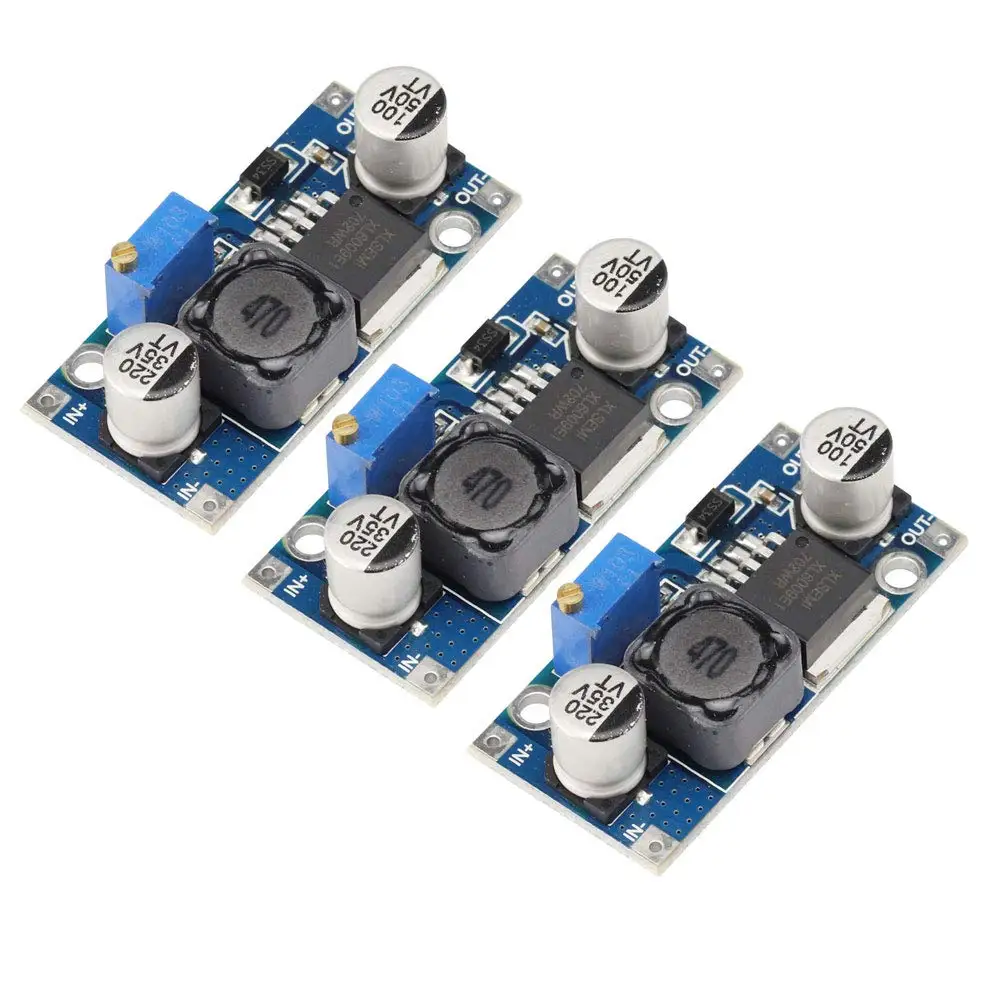
Output voltage adjustment is achieved via a multi-turn blue potentiometer prominently featured on the board. This component allows for fine-grained control over the output voltage, enabling users to dial in the exact voltage required for their specific load. Precision is paramount in electronics.
The adjustment process is straightforward: connect the input, measure the output with a multimeter, and carefully turn the potentiometer until the desired voltage is displayed. This manual adjustment ensures that the module can adapt to a wide array of components, from microcontrollers operating at 3.3V to small motors requiring 24V. This flexibility is a key selling point.
Unlike fixed-voltage regulators that provide a single, predetermined output, this adjustable module eliminates the need to stock multiple variants for different voltage requirements. It consolidates functionality, reducing inventory and simplifying project planning for hobbyists and small-scale manufacturers alike. One module, many uses.
The module's construction features a compact PCB design, measuring approximately 48.05mm x 25.1mm (1.89" x 0.99"). This small footprint makes it ideal for integration into tight spaces, such as custom enclosures or existing circuit boards. The components, including the 470uH inductor and electrolytic capacitors, are visibly well-soldered.
Upon inspection, the solder joints appear clean and consistent, indicating a reasonable level of manufacturing quality. The input and output terminals are clearly labeled "IN+"/"IN-" and "OUT+"/"OUT-", facilitating correct wiring and reducing the chance of polarity errors. The board feels solid, not flimsy.
While not designed for industrial-grade shock and vibration, the module's build is perfectly adequate for typical hobbyist and prototyping environments. It represents a significant step up from loose components on a breadboard, offering a more robust and permanent solution for power conversion tasks. This is a practical, ready-to-use solution.
As a certified electrician, the most critical aspect of any power module is its safety profile. The product explicitly warns that the input voltage should NOT exceed 30V. This is a hard limit; exceeding it risks immediate and irreversible damage to the XL6009 IC and potentially other components. Users must respect this boundary.
Furthermore, this module does not incorporate built-in overcurrent protection or short-circuit protection. This is a significant design choice that places the responsibility for safeguarding the circuit squarely on the user. Without external fusing or current limiting, a short circuit on the output could lead to component failure, overheating, or even fire. Proper circuit design is essential.
Compared to more expensive, fully integrated power management ICs or industrial power supplies, this module offers a bare-bones approach to protection. While this keeps costs down, it necessitates a thorough understanding of electrical safety principles and the implementation of appropriate external safeguards, such as fuses or current-limiting resistors, especially when dealing with higher current loads. Safety cannot be overlooked.
Operating at its maximum 4A current or with substantial voltage differentials can generate heat on the XL6009 chip. While the 400KHz switching frequency helps with efficiency, continuous high-load operation without proper thermal management can lead to the chip reaching its thermal shutdown threshold. This protects the chip but interrupts power.
For applications where the module will be under heavy load for extended periods, the addition of a small heatsink to the XL6009 IC is highly recommended. This simple measure can significantly improve the module's reliability and extend its operational lifespan by keeping the junction temperature within safe limits. Cooler components last longer.
Unlike low-power linear regulators that might only require a small PCB area for heat dissipation, this switching regulator, despite its efficiency, still generates some heat at higher loads. Proactive thermal management ensures consistent performance and prevents premature failure, a common issue in inadequately cooled power electronics. Consider the environment.
The 3-pack configuration of these modules offers exceptional value for money, making them an economical choice for hobbyists, students, and small businesses. Having multiple modules on hand means less downtime between projects and the ability to experiment with different power configurations without constant reordering. This is a smart investment.
These modules are perfectly suited for a wide range of DIY electronics projects, including powering LED strips, charging battery packs, creating custom power supplies for microcontrollers like Arduino or Raspberry Pi, and even small motor control. Their versatility makes them a staple in any electronics workbench. The possibilities are vast.
When considering the cost-per-module, this offering significantly undercuts many single-unit buck-boost converters with similar specifications. The value proposition is clear: reliable, adjustable power conversion at an accessible price point, provided the user understands and mitigates the inherent safety limitations. It's an economical choice.
From a certified electrician's standpoint, the XL6009 DC-DC Buck-Boost Converter Module is a competent and highly versatile component for DC power regulation. Its ability to both step up and step down voltage, coupled with its adjustable output and compact size, makes it an invaluable tool for a myriad of electronic applications. The high efficiency and 400KHz switching frequency are commendable engineering choices, contributing to its performance and small footprint.
However, the absence of integrated overcurrent and short-circuit protection is a critical detail that cannot be overstated. Users must proactively design and implement external safeguards to ensure the safety and longevity of both the module and the connected load. The 30V input voltage limit also demands careful attention to the power source.
For those who understand these limitations and are prepared to incorporate the necessary protective measures, these modules offer an exceptional balance of performance, flexibility, and cost-effectiveness. They empower creators to build robust and efficient power solutions for their projects. Imagine the satisfaction of powering your custom-built drone or portable audio system with precisely regulated voltage, knowing you've engineered a stable and efficient power backbone. This module provides that capability, allowing your innovative designs to thrive with reliable power.
Mastering Voltage Dynamics: The Buck-Boost Advantage
The core of this module's utility lies in its buck-boost topology. Unlike simpler buck (step-down) or boost (step-up) converters, the XL6009 can seamlessly transition between increasing and decreasing an input voltage. This means a single module can take an input ranging from 3.8V to 30V DC and produce an output anywhere from 1.25V to 35V DC. This broad operational window is a significant engineering advantage.
Imagine powering a 12V device from a fluctuating battery pack that might dip to 6V or surge to 15V. A dedicated buck converter would fail when the voltage drops below 12V, and a boost converter would be inefficient or unable to regulate when the voltage exceeds 12V. This module handles both scenarios with ease. It simplifies power supply design considerably.
Compared to using separate buck and boost converters, this integrated solution reduces component count and board space. It offers a streamlined approach to power management, particularly valuable in portable or embedded systems where physical footprint is a premium. The versatility is undeniable.
Precision Power Delivery: Performance and Efficiency Metrics
At its heart, the XL6009 operates with a 400KHz switching frequency. This high frequency allows for the use of smaller inductors and capacitors, contributing to the module's compact size while maintaining efficient power conversion. The module is rated for a maximum output current of 4A (peak), providing substantial power for many common electronic projects.
When operating, the module converts power with an efficiency of up to 92%. This high efficiency minimizes energy loss as heat, which is crucial for battery-powered applications and for maintaining component longevity. Less wasted energy means cooler operation. This directly translates to less stress on the components and a more reliable power supply.
Traditional linear regulators, while simple, dissipate excess voltage as heat, leading to significantly lower efficiencies, especially with large voltage differentials. This switching regulator design, in contrast, actively manages power flow, making it a far superior choice for power-sensitive or high-current applications. It's a clear upgrade.
Tailored Output: The Adjustable Potentiometer
Output voltage adjustment is achieved via a multi-turn blue potentiometer prominently featured on the board. This component allows for fine-grained control over the output voltage, enabling users to dial in the exact voltage required for their specific load. Precision is paramount in electronics.
The adjustment process is straightforward: connect the input, measure the output with a multimeter, and carefully turn the potentiometer until the desired voltage is displayed. This manual adjustment ensures that the module can adapt to a wide array of components, from microcontrollers operating at 3.3V to small motors requiring 24V. This flexibility is a key selling point.
Unlike fixed-voltage regulators that provide a single, predetermined output, this adjustable module eliminates the need to stock multiple variants for different voltage requirements. It consolidates functionality, reducing inventory and simplifying project planning for hobbyists and small-scale manufacturers alike. One module, many uses.
Structural Integrity: Components and Build Quality
The module's construction features a compact PCB design, measuring approximately 48.05mm x 25.1mm (1.89" x 0.99"). This small footprint makes it ideal for integration into tight spaces, such as custom enclosures or existing circuit boards. The components, including the 470uH inductor and electrolytic capacitors, are visibly well-soldered.
Upon inspection, the solder joints appear clean and consistent, indicating a reasonable level of manufacturing quality. The input and output terminals are clearly labeled "IN+"/"IN-" and "OUT+"/"OUT-", facilitating correct wiring and reducing the chance of polarity errors. The board feels solid, not flimsy.
While not designed for industrial-grade shock and vibration, the module's build is perfectly adequate for typical hobbyist and prototyping environments. It represents a significant step up from loose components on a breadboard, offering a more robust and permanent solution for power conversion tasks. This is a practical, ready-to-use solution.
Critical Safety Protocols: Understanding Limitations
As a certified electrician, the most critical aspect of any power module is its safety profile. The product explicitly warns that the input voltage should NOT exceed 30V. This is a hard limit; exceeding it risks immediate and irreversible damage to the XL6009 IC and potentially other components. Users must respect this boundary.
Furthermore, this module does not incorporate built-in overcurrent protection or short-circuit protection. This is a significant design choice that places the responsibility for safeguarding the circuit squarely on the user. Without external fusing or current limiting, a short circuit on the output could lead to component failure, overheating, or even fire. Proper circuit design is essential.
Compared to more expensive, fully integrated power management ICs or industrial power supplies, this module offers a bare-bones approach to protection. While this keeps costs down, it necessitates a thorough understanding of electrical safety principles and the implementation of appropriate external safeguards, such as fuses or current-limiting resistors, especially when dealing with higher current loads. Safety cannot be overlooked.
Thermal Management and Longevity
Operating at its maximum 4A current or with substantial voltage differentials can generate heat on the XL6009 chip. While the 400KHz switching frequency helps with efficiency, continuous high-load operation without proper thermal management can lead to the chip reaching its thermal shutdown threshold. This protects the chip but interrupts power.
For applications where the module will be under heavy load for extended periods, the addition of a small heatsink to the XL6009 IC is highly recommended. This simple measure can significantly improve the module's reliability and extend its operational lifespan by keeping the junction temperature within safe limits. Cooler components last longer.
Unlike low-power linear regulators that might only require a small PCB area for heat dissipation, this switching regulator, despite its efficiency, still generates some heat at higher loads. Proactive thermal management ensures consistent performance and prevents premature failure, a common issue in inadequately cooled power electronics. Consider the environment.
Practical Applications and Value Proposition
The 3-pack configuration of these modules offers exceptional value for money, making them an economical choice for hobbyists, students, and small businesses. Having multiple modules on hand means less downtime between projects and the ability to experiment with different power configurations without constant reordering. This is a smart investment.
These modules are perfectly suited for a wide range of DIY electronics projects, including powering LED strips, charging battery packs, creating custom power supplies for microcontrollers like Arduino or Raspberry Pi, and even small motor control. Their versatility makes them a staple in any electronics workbench. The possibilities are vast.
When considering the cost-per-module, this offering significantly undercuts many single-unit buck-boost converters with similar specifications. The value proposition is clear: reliable, adjustable power conversion at an accessible price point, provided the user understands and mitigates the inherent safety limitations. It's an economical choice.
The Electrician's Final Assessment
From a certified electrician's standpoint, the XL6009 DC-DC Buck-Boost Converter Module is a competent and highly versatile component for DC power regulation. Its ability to both step up and step down voltage, coupled with its adjustable output and compact size, makes it an invaluable tool for a myriad of electronic applications. The high efficiency and 400KHz switching frequency are commendable engineering choices, contributing to its performance and small footprint.
However, the absence of integrated overcurrent and short-circuit protection is a critical detail that cannot be overstated. Users must proactively design and implement external safeguards to ensure the safety and longevity of both the module and the connected load. The 30V input voltage limit also demands careful attention to the power source.
For those who understand these limitations and are prepared to incorporate the necessary protective measures, these modules offer an exceptional balance of performance, flexibility, and cost-effectiveness. They empower creators to build robust and efficient power solutions for their projects. Imagine the satisfaction of powering your custom-built drone or portable audio system with precisely regulated voltage, knowing you've engineered a stable and efficient power backbone. This module provides that capability, allowing your innovative designs to thrive with reliable power.