Wanptek Variable DC Bench Power Supply
Official Store Deal
Expert Analysis Overview
The Wanptek Variable DC Bench Power Supply is a robust and precise instrument designed for electronics enthusiasts, educational institutions, and professional technicians requiring controlled voltage and current sources. This unit is engineered to provide stable power delivery, crucial for sensitive circuit testing and development. Its digital interface and fine-tune controls offer a significant upgrade over older analog models, ensuring accurate and repeatable experimental conditions.
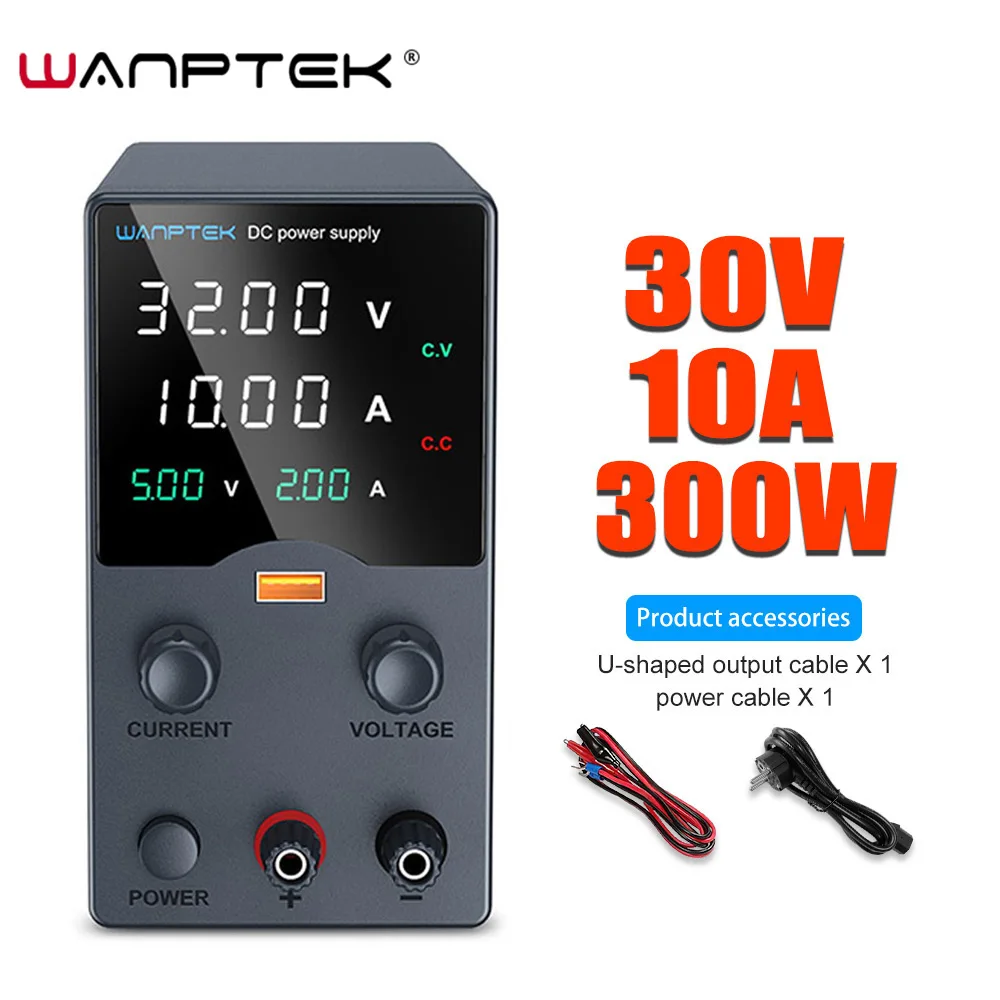
The front panel prominently displays voltage and current readings, indicating 32.00 V and 10.00 A respectively, alongside smaller readouts for USB fast charging. This multi-display configuration provides immediate feedback on output parameters. The clear, bright digital readouts minimize interpretation errors.
For users engaged in circuit design or repair, precise voltage and current regulation are non-negotiable. The ability to monitor both primary output and auxiliary charging simultaneously streamlines workflow. Unlike basic power supplies that offer only a single, often less accurate, analog meter, this unit's digital precision is a critical advantage for modern electronics work.
Two encoder adjustment knobs, labeled "CURRENT" and "VOLTAGE," are visible on the front panel. These knobs allow for granular control over the output parameters. Pressing a knob switches the digit being adjusted, enabling fine-tuning of values from 0-9.
This encoder adjustment mechanism is superior for setting exact parameters. It prevents the common frustration of overshooting desired values with coarse potentiometers. In scenarios requiring specific voltage or current thresholds, this level of control is invaluable. Many entry-level power supplies rely on less precise, single-turn potentiometers, which can lead to frustrating adjustments and potential damage to sensitive components if not handled carefully.
An integrated USB fast charging interface with a display is a notable feature, showing 5.00 V and 2.00 A output. This allows for convenient charging of mobile devices or powering USB-dependent circuits directly from the unit. This adds significant utility.
This feature eliminates the need for a separate USB power adapter on the workbench. It is particularly useful for testing portable electronics or embedded systems that draw power via USB. Standard bench power supplies typically lack this integrated convenience, requiring additional equipment and clutter on the workspace.
The unit's dimensions are approximately 190mm x 80mm x 145mm, with a weight of 1.15kg. The enclosure appears to be constructed from a durable metal, featuring ventilation slots on the sides. A cooling fan is visible on the rear panel, designed to activate automatically when internal temperatures reach a certain threshold.
Such a compact and relatively lightweight design makes the power supply suitable for various lab environments, from crowded student benches to professional repair stations. The robust metal casing offers better protection against accidental impacts compared to plastic enclosures. Effective thermal management, indicated by the cooling fan and ventilation, is critical for maintaining stable performance and extending the lifespan of internal components, especially during prolonged high-power operation. Inferior power supplies often skimp on cooling, leading to thermal throttling and reduced reliability over time.
The rear panel includes an AC input voltage selector switch, an AC power input, and a fuse box. The front panel clearly labels positive (red) and negative (black) polarity output terminals. Product accessories include a U-shaped output cable and a power cable.
These safety features are fundamental for any electrical equipment. The voltage selector switch ensures compatibility with different regional power grids, preventing damage from incorrect input voltage. The fuse box provides essential overcurrent protection, safeguarding both the unit and connected circuits. Clear polarity markings and included quality cables facilitate safe and correct connections. Many budget power supplies might omit a user-accessible fuse or a voltage selector, increasing operational risks.
This power supply offers a maximum output of 30V and 10A, translating to 300W of power. This range is suitable for a wide array of applications, from powering small microcontrollers to testing automotive electronics. The constant voltage (CV) and constant current (CC) indicators on the display confirm the operating mode.
The ability to operate in both CV and CC modes is a cornerstone of a versatile bench power supply. This allows users to protect sensitive components by limiting current, or to maintain a stable voltage regardless of load changes. This flexibility is essential for tasks like LED testing, motor control, battery charging, and general circuit debugging. Less capable power supplies often provide only basic voltage regulation, limiting their utility in diverse electrical engineering tasks.
The Wanptek DC Power Supply provides a controlled and reliable power source, essential for preventing damage to sensitive electronic components during testing and development. Its precise digital controls and integrated safety features offer a significant advantage over less sophisticated alternatives. The inclusion of a USB fast charging port further enhances its utility, consolidating workbench equipment. This unit is a valuable asset for anyone requiring consistent and adjustable power for their electrical projects. Imagine the confidence in testing a newly designed circuit, knowing the power supply delivers exactly the parameters specified, without fluctuations or unexpected surges. This level of control translates directly into more efficient troubleshooting and more reliable project outcomes, saving both time and costly component replacements in the long run.
Precision Power Delivery
The front panel prominently displays voltage and current readings, indicating 32.00 V and 10.00 A respectively, alongside smaller readouts for USB fast charging. This multi-display configuration provides immediate feedback on output parameters. The clear, bright digital readouts minimize interpretation errors.
For users engaged in circuit design or repair, precise voltage and current regulation are non-negotiable. The ability to monitor both primary output and auxiliary charging simultaneously streamlines workflow. Unlike basic power supplies that offer only a single, often less accurate, analog meter, this unit's digital precision is a critical advantage for modern electronics work.
Operational Command Center
Two encoder adjustment knobs, labeled "CURRENT" and "VOLTAGE," are visible on the front panel. These knobs allow for granular control over the output parameters. Pressing a knob switches the digit being adjusted, enabling fine-tuning of values from 0-9.
This encoder adjustment mechanism is superior for setting exact parameters. It prevents the common frustration of overshooting desired values with coarse potentiometers. In scenarios requiring specific voltage or current thresholds, this level of control is invaluable. Many entry-level power supplies rely on less precise, single-turn potentiometers, which can lead to frustrating adjustments and potential damage to sensitive components if not handled carefully.
Integrated USB Charging Capability
An integrated USB fast charging interface with a display is a notable feature, showing 5.00 V and 2.00 A output. This allows for convenient charging of mobile devices or powering USB-dependent circuits directly from the unit. This adds significant utility.
This feature eliminates the need for a separate USB power adapter on the workbench. It is particularly useful for testing portable electronics or embedded systems that draw power via USB. Standard bench power supplies typically lack this integrated convenience, requiring additional equipment and clutter on the workspace.
Enclosure Integrity and Thermal Management
The unit's dimensions are approximately 190mm x 80mm x 145mm, with a weight of 1.15kg. The enclosure appears to be constructed from a durable metal, featuring ventilation slots on the sides. A cooling fan is visible on the rear panel, designed to activate automatically when internal temperatures reach a certain threshold.
Such a compact and relatively lightweight design makes the power supply suitable for various lab environments, from crowded student benches to professional repair stations. The robust metal casing offers better protection against accidental impacts compared to plastic enclosures. Effective thermal management, indicated by the cooling fan and ventilation, is critical for maintaining stable performance and extending the lifespan of internal components, especially during prolonged high-power operation. Inferior power supplies often skimp on cooling, leading to thermal throttling and reduced reliability over time.
Safety and Connectivity Provisions
The rear panel includes an AC input voltage selector switch, an AC power input, and a fuse box. The front panel clearly labels positive (red) and negative (black) polarity output terminals. Product accessories include a U-shaped output cable and a power cable.
These safety features are fundamental for any electrical equipment. The voltage selector switch ensures compatibility with different regional power grids, preventing damage from incorrect input voltage. The fuse box provides essential overcurrent protection, safeguarding both the unit and connected circuits. Clear polarity markings and included quality cables facilitate safe and correct connections. Many budget power supplies might omit a user-accessible fuse or a voltage selector, increasing operational risks.
Operational Versatility and Application
This power supply offers a maximum output of 30V and 10A, translating to 300W of power. This range is suitable for a wide array of applications, from powering small microcontrollers to testing automotive electronics. The constant voltage (CV) and constant current (CC) indicators on the display confirm the operating mode.
The ability to operate in both CV and CC modes is a cornerstone of a versatile bench power supply. This allows users to protect sensitive components by limiting current, or to maintain a stable voltage regardless of load changes. This flexibility is essential for tasks like LED testing, motor control, battery charging, and general circuit debugging. Less capable power supplies often provide only basic voltage regulation, limiting their utility in diverse electrical engineering tasks.
The Professional's Edge
The Wanptek DC Power Supply provides a controlled and reliable power source, essential for preventing damage to sensitive electronic components during testing and development. Its precise digital controls and integrated safety features offer a significant advantage over less sophisticated alternatives. The inclusion of a USB fast charging port further enhances its utility, consolidating workbench equipment. This unit is a valuable asset for anyone requiring consistent and adjustable power for their electrical projects. Imagine the confidence in testing a newly designed circuit, knowing the power supply delivers exactly the parameters specified, without fluctuations or unexpected surges. This level of control translates directly into more efficient troubleshooting and more reliable project outcomes, saving both time and costly component replacements in the long run.