Voktta Universal USB Cable Tester
Official Store Deal
Expert Analysis Overview
Precision Cable Diagnostics for Modern Connectivity
The Voktta Universal USB Cable Tester is a critical diagnostic instrument engineered for precise verification of USB cable integrity across multiple standards. This device targets electronics technicians, hobbyists, and IT professionals who demand reliable connectivity and efficient fault isolation in a world increasingly reliant on diverse USB interfaces. Its design prioritizes rapid, visual feedback, making it an indispensable tool for maintaining optimal performance in various electronic setups.
Unpacking the Core Functionality
The primary function of this cable tester is to meticulously examine the continuity and correct pinout of USB cables. It ensures that each conductor within a cable, from power lines (VCC, GND) to data lines (D+, D-, TX/RX pairs for SuperSpeed), is properly connected and free from short circuits or open circuits. This level of detail is paramount for preventing data corruption, ensuring stable power delivery, and diagnosing charging issues.
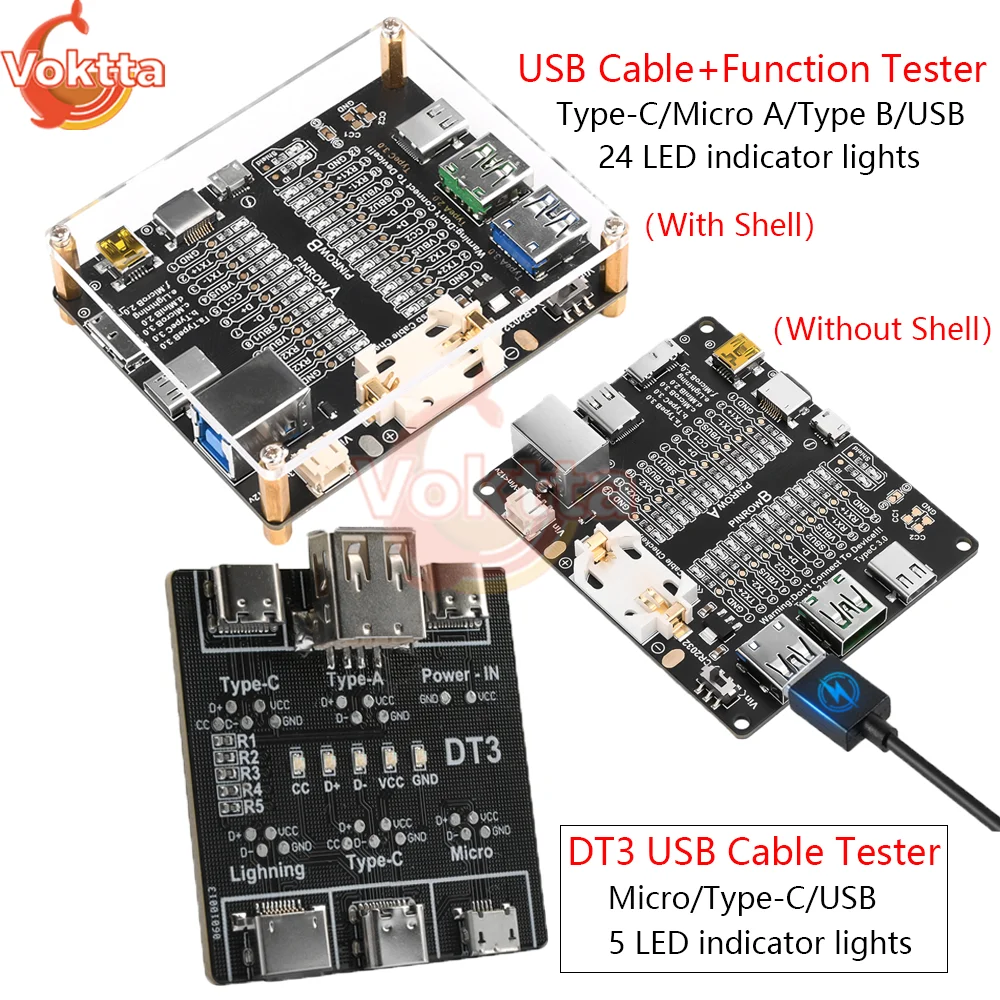
Visual indicators are key. The main testing board features 24 LED indicator lights, providing a granular view of the connection status for each individual pin. This high resolution of diagnostic feedback allows for immediate identification of specific pin failures, which is far more informative than a simple pass/fail indication. A quick glance reveals the exact nature of a cable fault.
Compared to basic continuity testers that merely confirm a circuit, this instrument offers a comprehensive pin-level analysis. It elevates the diagnostic process by providing actionable insights into the internal wiring of complex multi-conductor cables. This capability is essential for modern USB standards that involve numerous data and power pathways.
Versatility Across USB Standards
One of the most compelling aspects of the Voktta tester is its broad compatibility with a multitude of USB cable types. The main board supports Type-C, Micro A, Type B, and standard USB-A connections, encompassing both USB 2.0 and USB 3.0/3.1/3.2 specifications. This extensive port array means a single device can address the testing needs for a vast majority of contemporary electronic devices.
The inclusion of Type-C ports is particularly significant, given the increasing prevalence of this reversible connector in new hardware. Type-C cables are complex, often containing 24 pins, and their proper functioning is critical for high-speed data transfer and power delivery up to 100W. The tester's ability to verify each of these pins ensures that Type-C cables meet their demanding specifications.
Furthermore, the DT3 variant, a smaller, more portable tester, specifically addresses Micro, Type-C, and Lightning cables with 5 LED indicators. This specialized unit is ideal for quick checks of common mobile device charging and data cables. It offers focused utility for the most frequently encountered cable types in consumer electronics.
Operational Simplicity and Diagnostic Clarity
Operating the Voktta USB Cable Tester is straightforward, designed for efficiency in a busy environment. Users simply connect the cable to be tested into the appropriate input and output ports on the board. The illuminated LEDs then provide an immediate visual representation of the cable's internal connections. A fully functional cable will show all corresponding LEDs lit, indicating proper continuity across all pins.
For instance, when testing a USB 3.0 Type-A to Type-C cable, the tester will illuminate LEDs corresponding to VCC, GND, D+, D-, and the multiple SuperSpeed differential pairs (TX1+/-, TX2+/-, RX1+/-, RX2+/-). If any LED fails to light, it instantly pinpoints an open circuit. If an unexpected LED illuminates, it signals a short circuit between pins. This direct visual feedback minimizes interpretation errors.
Unlike software-based diagnostic tools that require drivers and a host computer, this hardware-based tester provides instant results. It eliminates potential software conflicts or delays, offering a pure, unadulterated assessment of the physical cable. This makes it an ideal first-line diagnostic tool before engaging more complex system-level troubleshooting.
Powering the Diagnostic Process
The main testing board can be powered via a CR2032 coin cell battery or an external 5V Vin input. This dual-power option provides flexibility for different usage scenarios. Battery power allows for portable, untethered operation, suitable for field diagnostics or quick checks away from a power outlet. The external Vin option is beneficial for prolonged testing sessions or when battery replacement is inconvenient.
Powering the device ensures the LEDs have sufficient current to illuminate clearly, providing unambiguous visual feedback. The power switch allows for conservation of battery life when the device is not in active use. Proper power management is crucial for the longevity of the device and the accuracy of its indications.
This power flexibility contrasts with some simpler testers that might rely solely on the device under test for power, potentially leading to inconclusive results if the power lines themselves are faulty. The dedicated power source ensures the tester itself is always operating optimally, providing reliable diagnostic output.
Construction and Durability Considerations
The tester boards are constructed from standard PCB materials, typically FR-4, known for its electrical insulation properties and mechanical stability. The visible components, including USB ports, LEDs, and passive components, appear to be surface-mounted, indicating a compact and robust assembly. The option for a protective acrylic shell for the main tester adds a layer of physical durability.
The acrylic shell safeguards the delicate electronic components from accidental impacts, dust, and static discharge. This is a significant advantage for tools used in workshop environments where spills or drops are common. The exposed PCB version, while more compact, requires careful handling to prevent damage to the traces and components.
Considering the typical lifespan of diagnostic tools, the inclusion of a protective shell extends the operational life of the device. It transforms a bare circuit board into a more resilient instrument, capable of withstanding the rigors of frequent use. This attention to physical protection enhances the overall value proposition.
Metrological Implications and Repeatability
From a metrological perspective, the Voktta USB Cable Tester provides a qualitative assessment of cable continuity. Its accuracy is tied to the reliability of its LED indicators and the precision of its internal wiring. Each LED represents a specific pin connection, and its illumination or lack thereof is a direct, unambiguous measurement of that pin's electrical state.
The repeatability of results is high, as the device performs a simple electrical continuity check. As long as the power supply is stable and the connections are firm, the tester will consistently report the same status for a given cable. This consistency is vital for diagnostic confidence, allowing technicians to trust the readings over multiple tests.
While this device does not offer quantitative data logging or numerical measurements (e.g., resistance in ohms, signal integrity in dB), its strength lies in rapid, qualitative fault identification. For applications requiring precise electrical parameter measurements, a dedicated multimeter or oscilloscope would be necessary. However, for quick cable verification, its visual output is highly efficient and sufficient.
Enhancing Workflow Efficiency
Integrating this cable tester into a repair or assembly workflow significantly boosts efficiency. Instead of wasting time troubleshooting a device only to discover a faulty cable, technicians can pre-test all cables before deployment. This proactive approach minimizes downtime and reduces the frustration associated with intermittent connectivity issues.
For example, in a scenario where a new peripheral is not recognized by a computer, the first step can be a quick cable test. If the cable passes, the focus can immediately shift to drivers, software, or the peripheral itself, saving valuable diagnostic time. This systematic approach streamlines the troubleshooting process.
This efficiency gain is particularly pronounced in environments dealing with a high volume of cables, such as IT departments, electronics repair shops, or manufacturing facilities. The ability to quickly sort good cables from bad ones translates directly into cost savings and improved productivity.
The Value Proposition for Technicians
For any professional or enthusiast working with electronics, reliable cables are the foundation of stable systems. This tester provides the capability to ensure that foundation is solid. It empowers users to quickly identify and replace problematic cables, preventing potential damage to sensitive equipment or loss of critical data. The low cost of the device, relative to the potential costs of troubleshooting or equipment replacement, makes it an excellent investment.
Imagine a scenario where a critical data transfer fails due to a faulty USB 3.0 cable. Without a tester, diagnosing the issue could involve swapping out multiple components. With this tool, the cable's integrity is verified in seconds, allowing for immediate corrective action. This peace of mind and operational fluidity are invaluable.
This instrument is not merely a gadget; it is a fundamental diagnostic asset. It ensures that the often-overlooked component—the cable—is never the weakest link in an electronic chain. Its ability to provide clear, repeatable results across a wide array of modern USB standards makes it an essential addition to any toolkit focused on precision and reliability.