V6 Hardened Steel Nozzle Kit
Official Store Deal
Expert Analysis Overview
The V6 Hardened Steel Nozzle Kit is a crucial upgrade component designed for serious 3D printing enthusiasts who demand durability and versatility from their extrusion system. This kit is aimed at makers and tinkerers who frequently work with abrasive filaments and seek to enhance the longevity and reliability of their printer's hotend. It represents a significant step up from standard brass nozzles, offering superior wear resistance and consistent performance across a wide range of materials.
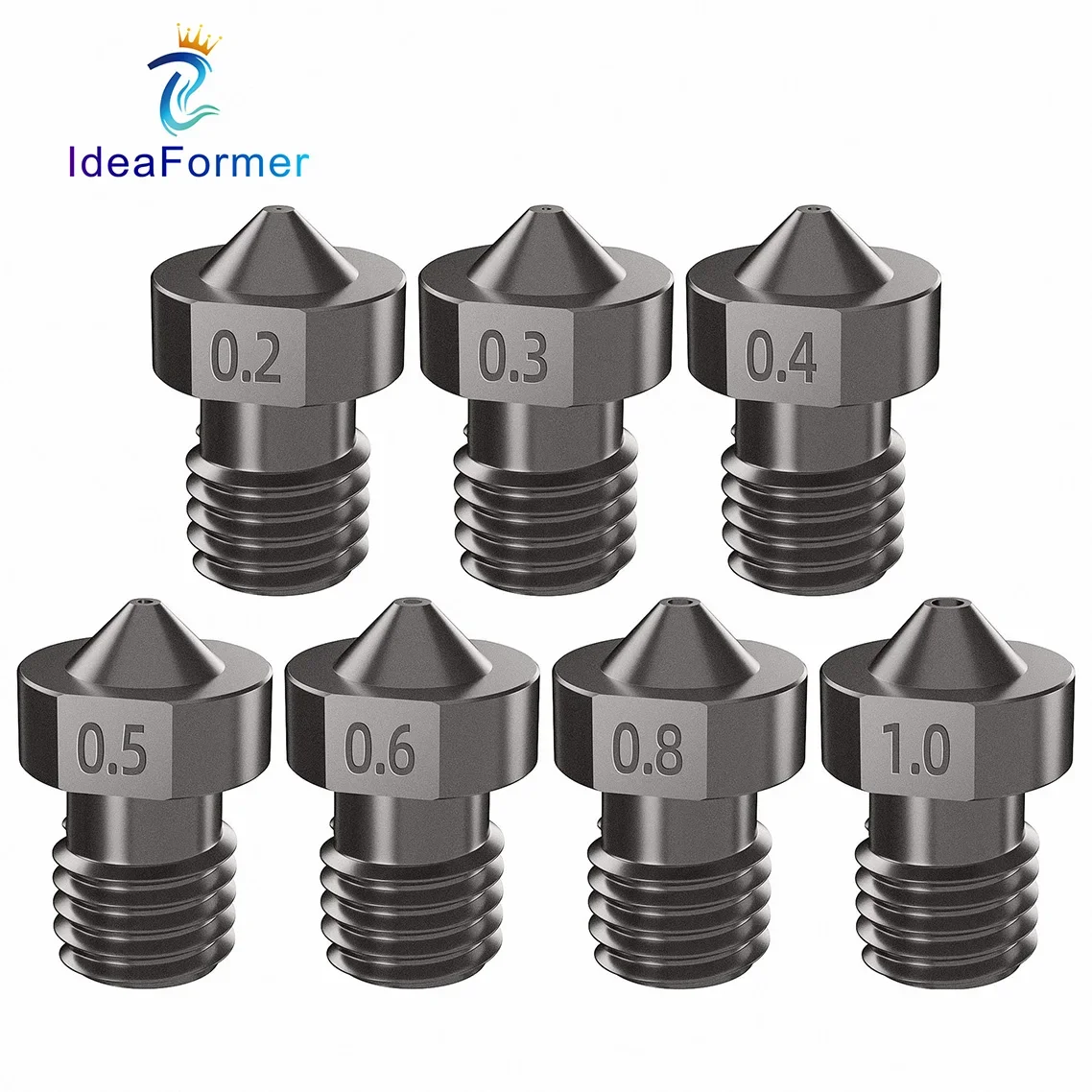
The material visible in the images is hardened steel, a robust alloy known for its exceptional resistance to abrasion. This choice of material directly addresses one of the most common frustrations in 3D printing: the rapid wear of brass nozzles when printing with composite or filled filaments. Brass, while an excellent thermal conductor, is relatively soft.
In practical terms, this means users can confidently print materials infused with carbon fiber, glass fiber, metal particles, or even glow-in-the-dark pigments. These filaments contain hard particles that act like sandpaper inside a brass nozzle, quickly enlarging the orifice and leading to inconsistent extrusion and print failures. Hardened steel maintains its precise orifice diameter over many hours of printing, ensuring consistent line width and dimensional accuracy.
Compared to standard brass nozzles, which can show noticeable wear after just a few hundred grams of abrasive filament, hardened steel offers a lifespan that is orders of magnitude greater. This translates into fewer nozzle changes, less downtime for maintenance, and a more reliable printing experience overall. It's a long-term investment.
The kit includes a comprehensive range of nozzle orifice diameters: 0.2mm, 0.3mm, 0.4mm, 0.5mm, 0.6mm, 0.8mm, and 1.0mm. This broad selection empowers users to tackle diverse printing challenges, from intricate details to rapid prototyping of large objects. Each size serves a specific purpose.
For fine detail work, such as miniatures or highly precise functional parts, the 0.2mm and 0.3mm nozzles are indispensable. These smaller orifices allow for thinner layer lines and finer feature resolution, capturing minute textures and geometries that larger nozzles simply cannot reproduce. Print times increase, but the fidelity is unmatched.
The 0.4mm nozzle is the industry standard for most FDM 3D printers, offering a balanced compromise between print speed, detail, and part strength. It is often the go-to for general-purpose printing. For faster prints or stronger parts where extreme detail is less critical, the 0.6mm nozzle is an excellent choice, enabling thicker layer heights and increased volumetric flow rates. Large objects print much faster.
When speed and structural integrity are paramount, such as for printing large prototypes, jigs, fixtures, or sculptural elements, the 0.8mm and 1.0mm nozzles come into their own. These larger diameters facilitate extremely fast printing by extruding a significant volume of plastic per second. They are also ideal for printing with less common, highly filled, or sometimes inconsistent filaments where a larger opening helps prevent clogs. Part strength increases with wider lines.
The nozzles feature an M6*1 thread, a widely adopted standard for V6-style hotends. This common threading ensures broad compatibility with a multitude of popular 3D printers and hotend assemblies, including the ubiquitous Ender 3, various Prusa i3 MK3 iterations, and systems utilizing the Titan Extruder. This standardization is a boon for the maker community.
This specific thread pitch and diameter simplify installation and interchangeability. Users do not need to worry about proprietary interfaces or hard-to-find components. The M6 thread provides a secure mechanical connection to the hotend heater block, crucial for maintaining thermal stability and preventing filament leaks.
Unlike non-standard or custom hotend designs, the M6 threading provides a reliable and familiar interface for countless printer owners. This broad compatibility means that these nozzles are a straightforward upgrade for a significant portion of the desktop 3D printing market. Many machines use this standard.
Hardened steel possesses different thermal conductivity characteristics compared to softer brass. While brass is an excellent conductor, rapidly transferring heat to the filament, hardened steel is somewhat less efficient in this regard. This difference is a known factor among experienced users.
In practical printing scenarios, this often necessitates a slight increase in printing temperature, typically in the range of 5-15°C, compared to settings used with brass nozzles. This adjustment compensates for the marginally slower heat transfer from the heater block through the hardened steel to the filament, ensuring the plastic reaches its optimal melt viscosity. Proper temperature is key.
Ignoring this thermal difference can lead to under-extrusion, poor layer adhesion, and overall print quality degradation. However, with a simple calibration print and a minor tweak to slicer settings, users can quickly dial in the perfect temperature for consistent and reliable extrusion. The community offers many guides for this. Compared to the benefits of durability, this minor adjustment is a negligible trade-off.
The primary justification for investing in hardened steel nozzles lies in their ability to process abrasive and specialty filaments. These include carbon fiber reinforced PLA, ABS, or PETG, glass fiber composites, metal-filled filaments, and glow-in-the-dark materials. These advanced materials offer enhanced mechanical properties or unique aesthetic finishes.
Printing with carbon fiber filled filaments, for example, produces parts with significantly increased stiffness and strength, making them ideal for functional prototypes or structural components. The abrasive nature of the carbon fibers would quickly destroy a brass nozzle, but the hardened steel resists this wear. This opens up new possibilities.
Glow-in-the-dark filaments, while visually appealing, contain phosphorescent pigments that are surprisingly abrasive. Metal-filled filaments, often used for aesthetic finishes that can be polished, also contain hard particles. Hardened steel ensures these materials can be printed repeatedly without compromising nozzle integrity or print quality. It's a game changer for these materials.
One of the most appealing aspects of hardened steel nozzles is their extended lifespan. Makers who frequently print with abrasive materials will find that these nozzles drastically reduce the frequency of replacements. This saves both time and money in the long run. Less downtime is always good.
Replacing a nozzle involves heating the hotend, carefully unscrewing the old nozzle, cleaning any filament residue, and then installing and tightening the new one. This process, while not overly complex, interrupts printing workflows. Hardened steel minimizes this interruption. Consistent performance means fewer failed prints due to nozzle wear, conserving filament and electricity.
For a busy workshop or a maker tackling multiple projects, the reduced maintenance overhead of hardened steel nozzles is a significant advantage. The focus shifts from constant component replacement to actual printing and design iteration. This improved uptime allows for more experimentation and production. It pays for itself over time.
These hardened steel nozzles are more than just replacement parts; they are tools that empower the maker to push the boundaries of their 3D printing capabilities. The ability to reliably print with a wider array of materials directly translates into greater freedom for design and functionality. Custom parts become more robust.
Experimentation is at the heart of the maker movement. With a durable nozzle, users can explore new filament types, experiment with different print settings, and iterate on designs without the constant worry of nozzle degradation. This encourages a more hands-on and curious approach to 3D printing. The community thrives on shared knowledge for these challenges.
Furthermore, the availability of various orifice sizes within this kit supports advanced techniques like variable line width printing or optimizing for specific mechanical properties. These nozzles facilitate a deeper understanding of extrusion dynamics and material science, turning a simple component into a catalyst for learning and innovation. It's a pathway to advanced techniques.
In the vibrant 3D printing community, sharing knowledge and troubleshooting tips is common. When using specialized components like hardened steel nozzles, makers often turn to online forums, social media groups, and dedicated websites for advice on optimal settings and common issues. This collective wisdom accelerates learning curves.
New users adopting hardened steel nozzles can find a wealth of information regarding temperature adjustments, retraction settings, and flow rate calibration for various abrasive filaments. Experienced users contribute their findings, creating a valuable resource for everyone. This collaborative spirit ensures that any initial learning curve is quickly overcome. Nobody prints alone.
This community-driven approach to problem-solving and optimization makes the transition to advanced printing materials smoother and more rewarding. The shared experience around these durable nozzles reinforces their value as a standard upgrade for anyone serious about expanding their material capabilities. It's a shared journey of innovation.
Imagine consistently producing high-strength, functional parts with carbon fiber filaments, or intricate, glowing models without the frustrating interruptions of worn-out nozzles. Picture the satisfaction of tackling challenging materials, knowing your printer's hotend is equipped to handle the task with unwavering precision. These hardened steel nozzles provide the foundation for reliable, high-performance 3D printing, allowing creative visions to become tangible realities with greater ease and fewer limitations.
The Unyielding Core: Hardened Steel Advantage
The material visible in the images is hardened steel, a robust alloy known for its exceptional resistance to abrasion. This choice of material directly addresses one of the most common frustrations in 3D printing: the rapid wear of brass nozzles when printing with composite or filled filaments. Brass, while an excellent thermal conductor, is relatively soft.
In practical terms, this means users can confidently print materials infused with carbon fiber, glass fiber, metal particles, or even glow-in-the-dark pigments. These filaments contain hard particles that act like sandpaper inside a brass nozzle, quickly enlarging the orifice and leading to inconsistent extrusion and print failures. Hardened steel maintains its precise orifice diameter over many hours of printing, ensuring consistent line width and dimensional accuracy.
Compared to standard brass nozzles, which can show noticeable wear after just a few hundred grams of abrasive filament, hardened steel offers a lifespan that is orders of magnitude greater. This translates into fewer nozzle changes, less downtime for maintenance, and a more reliable printing experience overall. It's a long-term investment.
Precision in Every Orifice: The Diameter Spectrum
The kit includes a comprehensive range of nozzle orifice diameters: 0.2mm, 0.3mm, 0.4mm, 0.5mm, 0.6mm, 0.8mm, and 1.0mm. This broad selection empowers users to tackle diverse printing challenges, from intricate details to rapid prototyping of large objects. Each size serves a specific purpose.
For fine detail work, such as miniatures or highly precise functional parts, the 0.2mm and 0.3mm nozzles are indispensable. These smaller orifices allow for thinner layer lines and finer feature resolution, capturing minute textures and geometries that larger nozzles simply cannot reproduce. Print times increase, but the fidelity is unmatched.
The 0.4mm nozzle is the industry standard for most FDM 3D printers, offering a balanced compromise between print speed, detail, and part strength. It is often the go-to for general-purpose printing. For faster prints or stronger parts where extreme detail is less critical, the 0.6mm nozzle is an excellent choice, enabling thicker layer heights and increased volumetric flow rates. Large objects print much faster.
When speed and structural integrity are paramount, such as for printing large prototypes, jigs, fixtures, or sculptural elements, the 0.8mm and 1.0mm nozzles come into their own. These larger diameters facilitate extremely fast printing by extruding a significant volume of plastic per second. They are also ideal for printing with less common, highly filled, or sometimes inconsistent filaments where a larger opening helps prevent clogs. Part strength increases with wider lines.
Universal Fit: The M6 Thread Standard
The nozzles feature an M6*1 thread, a widely adopted standard for V6-style hotends. This common threading ensures broad compatibility with a multitude of popular 3D printers and hotend assemblies, including the ubiquitous Ender 3, various Prusa i3 MK3 iterations, and systems utilizing the Titan Extruder. This standardization is a boon for the maker community.
This specific thread pitch and diameter simplify installation and interchangeability. Users do not need to worry about proprietary interfaces or hard-to-find components. The M6 thread provides a secure mechanical connection to the hotend heater block, crucial for maintaining thermal stability and preventing filament leaks.
Unlike non-standard or custom hotend designs, the M6 threading provides a reliable and familiar interface for countless printer owners. This broad compatibility means that these nozzles are a straightforward upgrade for a significant portion of the desktop 3D printing market. Many machines use this standard.
The Heat Equation: Thermal Considerations
Hardened steel possesses different thermal conductivity characteristics compared to softer brass. While brass is an excellent conductor, rapidly transferring heat to the filament, hardened steel is somewhat less efficient in this regard. This difference is a known factor among experienced users.
In practical printing scenarios, this often necessitates a slight increase in printing temperature, typically in the range of 5-15°C, compared to settings used with brass nozzles. This adjustment compensates for the marginally slower heat transfer from the heater block through the hardened steel to the filament, ensuring the plastic reaches its optimal melt viscosity. Proper temperature is key.
Ignoring this thermal difference can lead to under-extrusion, poor layer adhesion, and overall print quality degradation. However, with a simple calibration print and a minor tweak to slicer settings, users can quickly dial in the perfect temperature for consistent and reliable extrusion. The community offers many guides for this. Compared to the benefits of durability, this minor adjustment is a negligible trade-off.
Enabling Advanced Materials: Beyond Standard Filaments
The primary justification for investing in hardened steel nozzles lies in their ability to process abrasive and specialty filaments. These include carbon fiber reinforced PLA, ABS, or PETG, glass fiber composites, metal-filled filaments, and glow-in-the-dark materials. These advanced materials offer enhanced mechanical properties or unique aesthetic finishes.
Printing with carbon fiber filled filaments, for example, produces parts with significantly increased stiffness and strength, making them ideal for functional prototypes or structural components. The abrasive nature of the carbon fibers would quickly destroy a brass nozzle, but the hardened steel resists this wear. This opens up new possibilities.
Glow-in-the-dark filaments, while visually appealing, contain phosphorescent pigments that are surprisingly abrasive. Metal-filled filaments, often used for aesthetic finishes that can be polished, also contain hard particles. Hardened steel ensures these materials can be printed repeatedly without compromising nozzle integrity or print quality. It's a game changer for these materials.
Longevity and Reduced Maintenance Burdens
One of the most appealing aspects of hardened steel nozzles is their extended lifespan. Makers who frequently print with abrasive materials will find that these nozzles drastically reduce the frequency of replacements. This saves both time and money in the long run. Less downtime is always good.
Replacing a nozzle involves heating the hotend, carefully unscrewing the old nozzle, cleaning any filament residue, and then installing and tightening the new one. This process, while not overly complex, interrupts printing workflows. Hardened steel minimizes this interruption. Consistent performance means fewer failed prints due to nozzle wear, conserving filament and electricity.
For a busy workshop or a maker tackling multiple projects, the reduced maintenance overhead of hardened steel nozzles is a significant advantage. The focus shifts from constant component replacement to actual printing and design iteration. This improved uptime allows for more experimentation and production. It pays for itself over time.
The Maker's Toolkit: Empowering Customization and Experimentation
These hardened steel nozzles are more than just replacement parts; they are tools that empower the maker to push the boundaries of their 3D printing capabilities. The ability to reliably print with a wider array of materials directly translates into greater freedom for design and functionality. Custom parts become more robust.
Experimentation is at the heart of the maker movement. With a durable nozzle, users can explore new filament types, experiment with different print settings, and iterate on designs without the constant worry of nozzle degradation. This encourages a more hands-on and curious approach to 3D printing. The community thrives on shared knowledge for these challenges.
Furthermore, the availability of various orifice sizes within this kit supports advanced techniques like variable line width printing or optimizing for specific mechanical properties. These nozzles facilitate a deeper understanding of extrusion dynamics and material science, turning a simple component into a catalyst for learning and innovation. It's a pathway to advanced techniques.
The Unseen Benefit: Community and Knowledge Sharing
In the vibrant 3D printing community, sharing knowledge and troubleshooting tips is common. When using specialized components like hardened steel nozzles, makers often turn to online forums, social media groups, and dedicated websites for advice on optimal settings and common issues. This collective wisdom accelerates learning curves.
New users adopting hardened steel nozzles can find a wealth of information regarding temperature adjustments, retraction settings, and flow rate calibration for various abrasive filaments. Experienced users contribute their findings, creating a valuable resource for everyone. This collaborative spirit ensures that any initial learning curve is quickly overcome. Nobody prints alone.
This community-driven approach to problem-solving and optimization makes the transition to advanced printing materials smoother and more rewarding. The shared experience around these durable nozzles reinforces their value as a standard upgrade for anyone serious about expanding their material capabilities. It's a shared journey of innovation.
Imagine consistently producing high-strength, functional parts with carbon fiber filaments, or intricate, glowing models without the frustrating interruptions of worn-out nozzles. Picture the satisfaction of tackling challenging materials, knowing your printer's hotend is equipped to handle the task with unwavering precision. These hardened steel nozzles provide the foundation for reliable, high-performance 3D printing, allowing creative visions to become tangible realities with greater ease and fewer limitations.