Universal DC Battery Voltage & Charge Indicator
Official Store Deal
Expert Analysis Overview
Precision Power Monitoring for the Workshop
The Universal DC Battery Voltage & Charge Indicator is a compact, highly adaptable diagnostic tool engineered for discerning professionals and hobbyists who demand real-time insights into their battery systems. This unit is not merely a display; it is a critical component for maintaining the health and longevity of diverse power sources, from portable tool battery banks to intricate off-grid power setups. Unlike generic indicators that offer limited compatibility, this device stands out with its broad voltage range and support for multiple battery chemistries, making it an indispensable asset in any serious electrical or carpentry workshop.
Broad Spectrum Compatibility
This indicator boasts a remarkable operating voltage range, typically from DC 7V to 55V, with some variants specified for DC 7V to 40V. This wide input window means a single unit can monitor a vast array of battery configurations, eliminating the need for multiple specialized gauges. For a carpenter managing various cordless tool platforms, this versatility translates directly into efficiency. It simplifies inventory and ensures consistent monitoring across different voltage systems, from 12V drill packs to 48V portable power stations.
Consider a scenario where a workshop relies on a mix of 12V, 24V, and 36V battery systems for various Tools and lighting. A standard, fixed-voltage indicator would necessitate three different units, each dedicated to a specific voltage. This universal indicator, however, can be configured on the fly to accurately read any of these systems, providing immediate, clear feedback. This adaptability is a significant upgrade from less flexible alternatives, offering a consolidated solution for diverse power management needs.
Multi-Chemistry Intelligence
Beyond its voltage flexibility, the indicator supports three primary battery chemistries: Ternary Lithium (Li-ion), Lithium Iron (LiFePO4), and Lead-Acid. Each battery type has unique discharge characteristics and voltage curves, making accurate monitoring crucial for optimal performance and lifespan. The ability to precisely configure the device for these different chemistries ensures that the displayed charge percentage and voltage are genuinely reflective of the battery's state.
For instance, a LiFePO4 battery maintains a relatively flat discharge curve for much of its capacity, making simple voltage-based estimation inaccurate. This indicator allows for specific configuration (e.g., F03 for Lithium Iron), which accounts for these nuances, providing a much more reliable reading. This level of precision is vital for preventing premature battery degradation due to over-discharge or over-charge, a common issue with less sophisticated monitoring tools. Compared to basic voltmeters, which only show raw voltage, this unit provides a contextualized charge percentage, offering a more intuitive understanding of remaining power.
Intuitive Display and Readability
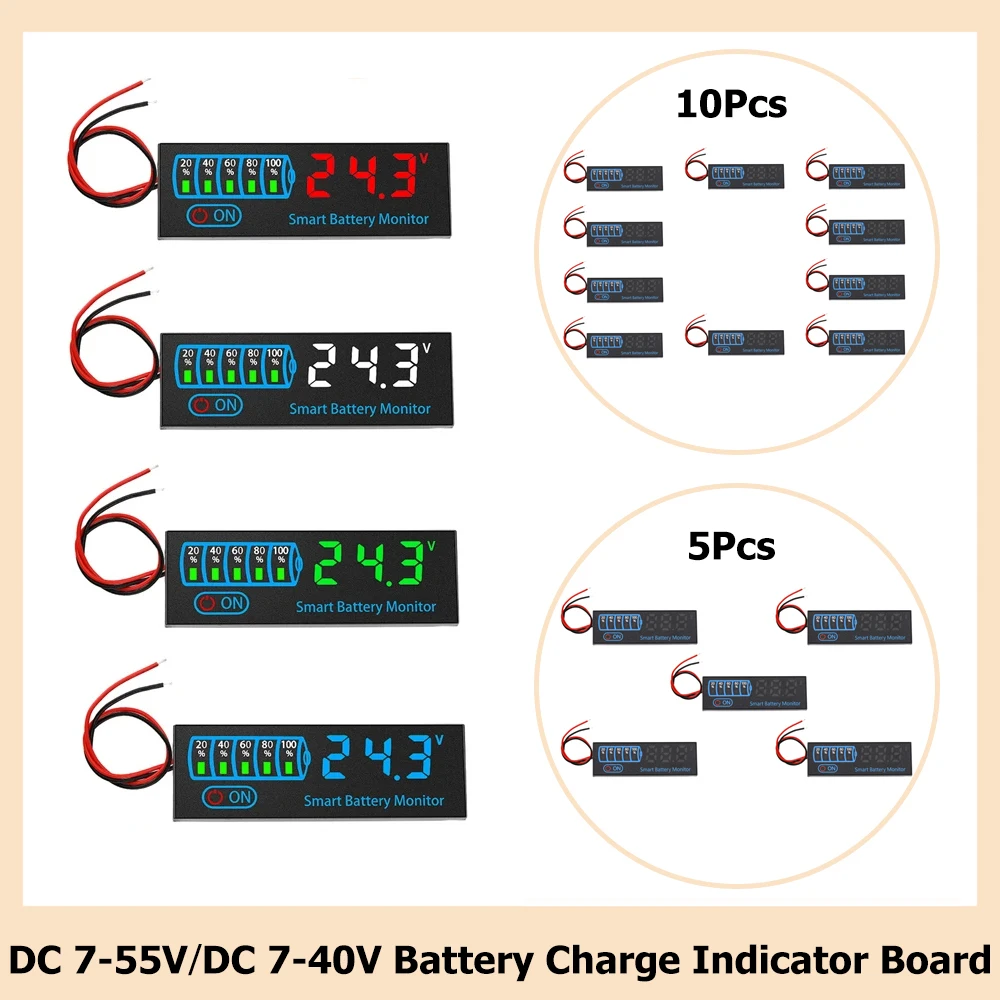
The unit features a bright LED digital display that presents both the voltage and a graphical charge percentage. The blue digits are crisp and easy to discern, even in varying light conditions, which is crucial when working in environments that might not always be perfectly lit. The graphical battery icon, segmented into percentage blocks (e.g., 20%, 40%, 60%, 80%, 100%), provides an at-a-glance understanding of the charge level. Visibility is paramount. The clear numerical readout ensures that precise voltage figures are always available, allowing for quick checks of system health.
Imagine a carpenter on a job site, needing to quickly ascertain the remaining power in a portable battery bank powering a miter saw. A glance at this display provides immediate, unambiguous information, preventing unexpected power loss mid-cut. This direct, easy-to-read format is a significant improvement over indicators that rely on vague bar graphs or require mental calculations, ensuring that critical data is always readily available. The display's clarity also helps in reading fractions easily, translating raw voltage into an understandable charge percentage.
Advanced User Configuration
The indicator's true power lies in its user-configurable settings. Accessing the setup menu by pressing and holding the button for two seconds allows for precise adjustments. For Ternary Lithium batteries, users can select between 3 to 12 battery strings (LD03-LD12). Lithium Iron batteries offer a range of 3 to 14 strings (F03-F14). For Lead-Acid batteries, the selection is simplified to common nominal voltages: 12V, 24V, 36V, and 48V (P12, P24, P36, P48). This granular control ensures that the indicator is perfectly calibrated to the specific battery pack it monitors.
This level of customization is essential for accurate monitoring. An incorrectly configured string count would lead to erroneous charge readings, potentially causing a user to prematurely recharge a half-full battery or, worse, over-discharge a nearly empty one. The setup process, while requiring a few button presses, is straightforward and clearly outlined, ensuring that even users new to battery management can achieve precise calibration. This contrasts sharply with fixed-setting indicators that offer no room for adjustment, often leading to compromises in accuracy.
Custom Voltage Thresholds and Backlight Management
Another critical feature is the ability to set custom high and low voltage alarms. This allows users to define their own operational limits, receiving an alert if the battery voltage deviates outside these parameters. For instance, setting a low voltage threshold can prevent deep discharge, which is detrimental to battery health, especially for lithium chemistries. A high voltage threshold can signal an overcharging condition, protecting against potential damage or even safety hazards.
Furthermore, the indicator offers adjustable backlight time settings (B-0 to B-6). This feature allows users to optimize visibility while conserving power. Options range from an always-on display to automatic turn-off after 10, 20, 30, 40, 50, or 60 seconds. This is particularly useful in applications where constant illumination is unnecessary, or where battery life of the monitoring system itself is a concern. The ability to manage backlight duration is a thoughtful addition, providing flexibility that simpler indicators often lack, enhancing both usability and efficiency.
Build Quality and Integration
The product, as depicted, is an exposed Printed Circuit Board (PCB) with the display and control button integrated. While this design keeps the unit compact and cost-effective, it implies that the user is expected to integrate it into a suitable enclosure. The small form factor and simple two-wire connection (red for positive, black for negative) make it easy to embed within existing battery boxes, control panels, or custom-built power solutions. The connections are clearly marked, simplifying installation.
This open-board approach is a deliberate design choice, catering to those who prefer to customize their setups. It allows for creative mounting solutions and protection tailored to the specific application, whether it's a dust-proof box for a construction site or a water-resistant housing for a marine application. Unlike fully enclosed units that might not fit specific spaces, this bare board offers maximum flexibility. However, it also means that the unit is not inherently rugged; dropping it off a ladder without protection would likely damage it, underscoring the need for proper installation within a robust housing.
The Value Proposition for the Tradesman
For the price, this battery charge indicator offers exceptional value and return on investment. The cost of replacing damaged batteries due to improper charging or deep discharge far outweighs the minimal investment in this monitoring device. By providing accurate, real-time data, it empowers users to make informed decisions about battery usage and maintenance, thereby extending the lifespan of expensive battery packs and tools. This is not just a gadget; it is a preventative maintenance tool that saves money in the long run.
Imagine the peace of mind knowing the exact state of charge of your portable power station before heading to a remote job site. No more guessing, no more unexpected downtime. This indicator provides the critical data needed to manage power resources effectively, ensuring that projects proceed without interruption. It allows a carpenter to confidently monitor their power sources, focusing on the task at hand rather than worrying about battery life.
Picture this: your workshop is humming, tools are running efficiently, and every battery pack is performing optimally because you have precise, real-time data at your fingertips. This indicator integrates seamlessly into your workflow, becoming an invisible yet indispensable guardian of your power systems. It provides the confidence to push your equipment to its limits, knowing you have full visibility into its energy reserves. This is the difference between reactive problem-solving and proactive, efficient power management, ensuring your projects are always powered for success.
Operational Insights
Initial Setup and Calibration
The initial setup process for this indicator is straightforward, yet critical for accuracy. Upon connecting the two-wire harness to the battery, the display will illuminate. To enter the setting page, a long press of the 'ON' button for 2 seconds is required. From there, navigating through the battery type settings (Ternary Lithium, Lithium Iron, or Lead-Acid) is done by subsequent long presses. For Ternary and Lithium Iron, the number of battery strings needs to be selected, ensuring the display accurately interprets the voltage range. Lead-Acid batteries require selecting the nominal voltage (12V, 24V, etc.). A final long press confirms the selection, and the settings are saved, ensuring the monitor provides precise readings tailored to the specific battery chemistry and configuration. This granular control is a key differentiator from simpler, fixed-setting indicators.
Customizing Voltage Alarms
Setting custom high and low voltage alarms is a feature that significantly enhances battery protection. After entering the main setting page, users can navigate to the custom voltage setting page. Here, the low voltage threshold can be adjusted first. The digits will flash, allowing for incremental changes with short presses of the 'ON' button. A long press confirms the low voltage setting. The process is then repeated for the high voltage threshold. This customization allows users to define safe operating windows specific to their applications, preventing both over-discharge, which can permanently damage batteries, and over-charge, which poses safety risks. This proactive monitoring capability is a major advantage for preserving battery health.
Backlight Management for Efficiency
Optimizing the backlight settings contributes to both visibility and power efficiency. Within the setting menu, a dedicated backlight page (B-0) allows users to choose from various auto-off timers or an always-on mode. For instance, selecting 'B-1' will turn off the display after 10 seconds of inactivity, while 'B-6' extends this to 60 seconds. An 'always on' option (B-0) is also available for continuous monitoring. This thoughtful feature ensures that the display is only active when needed, conserving the small amount of power the indicator itself consumes, which can be critical in long-term, low-power applications. It’s a small detail that makes a big difference in practical use.
Integration and Protection
Given its open PCB design, proper integration into an enclosure is not just recommended, but essential for durability and safety. The compact nature of the board allows it to fit into small project boxes or be flush-mounted behind a panel, with only the display visible. For a carpenter working on job sites, protecting this delicate electronic component from dust, moisture, and accidental impact is paramount. A simple plastic project box, perhaps with a clear window for the display, would provide adequate protection. This integration step transforms the bare board into a robust, field-ready monitoring solution. This contrasts with consumer-grade products that come pre-packaged, offering less flexibility for custom installations but greater immediate durability.
Long-Term Monitoring Benefits
The long-term benefit of using such a precise indicator lies in the extended lifespan of expensive battery assets. By consistently monitoring voltage and charge levels, users can avoid the common pitfalls of battery management: deep cycling, prolonged storage at full or empty states, and overcharging. These practices are known to degrade battery capacity and cycle life. This indicator provides the data necessary to implement best practices, ensuring that batteries deliver their maximum potential over many years. It's a small investment that yields significant returns in equipment longevity and operational reliability, ultimately reducing replacement costs and downtime. This capability is a clear upgrade from simply guessing battery status based on tool performance.