Type-C Lithium Battery Charging & Boost Module
Official Store Deal
Expert Analysis Overview
The Type-C Lithium Battery Charging & Boost Module is a highly versatile and compact power management solution, specifically engineered for integrating safe and efficient battery charging and voltage boosting into small electronic projects and repairs. This module addresses the critical need for reliable power delivery in custom builds and device rehabilitation, offering a significant upgrade over older, less robust charging solutions. Its design prioritizes both functionality and footprint, making it an indispensable component for electronics enthusiasts and professional repair technicians alike. The board's meticulous layout ensures optimal performance even in constrained environments. It is a fundamental building block for portable power.
This series of modules offers distinct charging voltage outputs: 4.2V, 4.35V, and 5V, catering to various lithium-ion battery chemistries and application requirements. The 4.2V variant is the standard for conventional single-cell lithium-ion (Li-ion) and lithium-polymer (LiPo) batteries, ensuring a safe and complete charge cycle without overcharging. For those utilizing high-voltage lithium-ion (LiHV) cells, the 4.35V option provides the necessary higher termination voltage to extract maximum capacity, a crucial detail often overlooked by generic chargers. The 5V integrated charging and discharging module, on the other hand, incorporates a boost converter, transforming the battery's voltage into a stable 5V output, ideal for powering microcontrollers, USB-powered devices, or creating miniature power banks. Each module is designed with specific charging ICs to manage these voltage profiles precisely.
When powering a custom IoT sensor node or a portable audio amplifier, selecting the correct voltage is paramount. An incorrect charging voltage can severely degrade battery life or, worse, pose a safety hazard. The dedicated 4.2V module ensures longevity for standard 18650 cells. Imagine building a custom portable speaker; the 4.2V module handles the battery charging, while the 5V integrated module could simultaneously power the amplifier and a small microcontroller. This dual-purpose capability streamlines complex power architectures. Compared to older, single-function charging boards, these specialized voltage options offer tailored performance.
For instance, a standard TP4056 module typically only offers 4.2V charging. While effective for common Li-ion cells, it falls short for LiHV applications. The availability of a 4.35V option directly addresses this niche, allowing hobbyists and professionals to leverage the higher energy density of LiHV batteries without resorting to complex external circuitry. This specialization minimizes component count.
A standout feature across these modules is the inclusion of a Type-C USB connector. This modern interface offers several significant advantages over the aging Micro-USB standard, which is still prevalent on many budget charging boards. The Type-C port is reversible, eliminating the frustration and potential damage associated with incorrect plug orientation. Its physical construction is inherently more robust, designed for a higher number of insertion cycles, making it far more durable in applications where the charging port sees frequent use. This is a critical upgrade for long-term reliability.
The tactile feedback of inserting a Type-C cable is noticeably more secure than Micro-USB. The connector's internal design, with its multiple pins, allows for higher current delivery capabilities, although the specific current limits of these small modules will be dictated by the charging IC and board traces. For a repair technician, the Type-C port means fewer return repairs due to damaged charging ports, a common failure point in portable electronics. This saves time and resources.
Compared to the ubiquitous Micro-USB modules, the Type-C integration significantly enhances the user experience and the longevity of the device it powers. Micro-USB ports are notorious for their fragility, often bending or breaking off the PCB with repeated use, leading to costly and time-consuming repairs. By contrast, the Type-C connector provides a more stable and resilient connection, reducing mechanical stress on the board and extending the operational life of the entire assembly. This is a clear step forward in design.
The 5V module distinguishes itself by integrating both charging and discharging functionalities, effectively serving as a miniature power bank management unit. This module incorporates a boost converter, a crucial component that steps up the battery's nominal voltage (typically 3.7V) to a stable 5V output. This 5V output is then accessible via dedicated pads, allowing it to power external circuits or charge other USB-powered devices. The integration simplifies system design.
Imagine powering a Raspberry Pi Zero or an ESP32 microcontroller from a single 18650 battery. The 5V boost capability makes this straightforward, eliminating the need for a separate boost converter board. This reduces complexity and board space, which is invaluable in compact projects. The module manages both the input charging current and the output discharge current, often including basic over-discharge protection for the connected battery. This protects the battery.
Unlike simple charging-only boards, which merely replenish the battery, the integrated charge/discharge module provides a complete power solution. Many DIY projects require both battery charging and a stable output voltage. Historically, this meant combining a charging module with a separate boost converter, adding bulk and wiring complexity. This integrated design streamlines the process, offering a cleaner and more efficient solution for portable applications. It's a true all-in-one package.
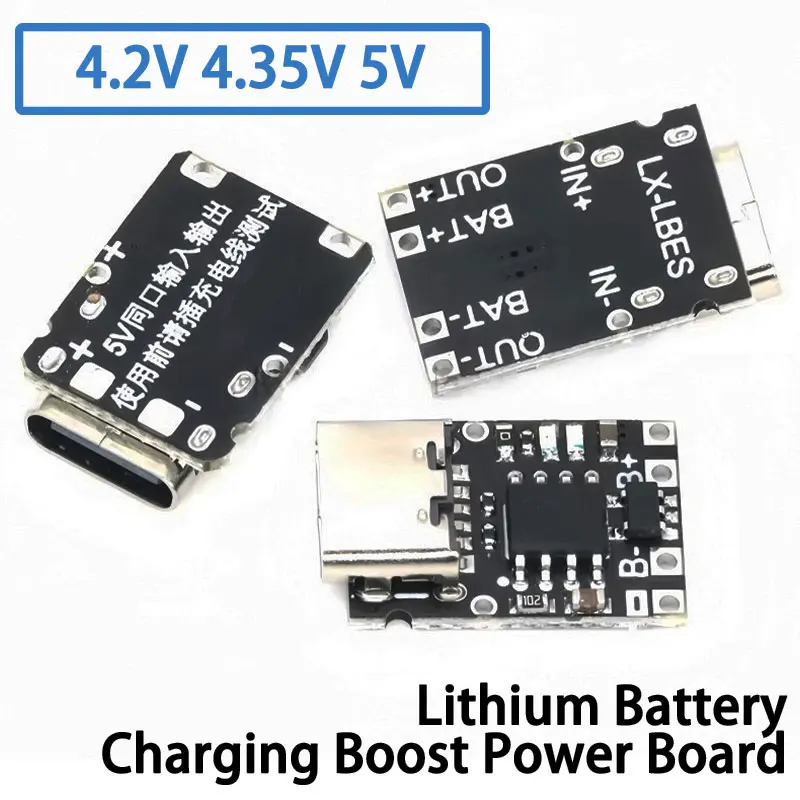
Upon visual inspection, the modules exhibit clean soldering points and a generally well-organized component layout, especially considering their diminutive size. The Type-C connectors appear to be securely mounted, with sufficient solder pads to withstand moderate mechanical stress. The presence of identifiable charging ICs (e.g., FS4057AB on the 4.35V module, LX-LBES on another) indicates specific design choices rather than generic, unbranded solutions, which often lack proper specifications or protection features. Component selection is key.
Given the compact dimensions, thermal management is an important consideration, particularly for the 5V boost module which will generate some heat during discharge. While no large heatsinks are present, the board design likely relies on the PCB traces for heat dissipation. For applications involving continuous high current draw, external cooling or careful current limiting might be necessary to prevent overheating and ensure long-term reliability. A small footprint has its trade-offs.
Compared to the cheapest, often poorly manufactured modules found on the market, these boards demonstrate a higher standard of assembly. The visible components, such as inductors and capacitors, appear to be of reasonable quality for their intended purpose. While not industrial-grade, they are certainly suitable for hobbyist projects and light-duty commercial applications, offering a dependable foundation for power management. This attention to detail is reassuring.
These modules are invaluable for a wide array of practical applications. They are perfect for repairing vintage portable electronics that rely on single-cell lithium batteries, allowing for a modern Type-C charging port upgrade. Custom-built power banks, portable LED lighting solutions, IoT devices requiring battery power, and even small robotics projects can all benefit from the compact and efficient power management these boards offer. Their small size makes integration easy.
For the electronics repair technician, these modules represent a cost-effective solution for bringing dead devices back to life. Instead of sourcing expensive, proprietary battery management boards, a technician can integrate one of these modules, often for less than a dollar, to restore charging functionality. This significantly reduces repair costs for the end-user and increases the viability of repairing otherwise discarded items. It's an economical repair strategy.
Unlike attempting to salvage or repair a damaged charging circuit on an existing PCB, which can be time-consuming and require specialized Tools, these modules offer a clean, drop-in replacement. The straightforward wiring (BAT+, BAT-, IN+, IN-, OUT+, OUT-) makes integration relatively simple for anyone with basic soldering skills. This capability allows for quick turnaround times on repairs, enhancing productivity.
Imagine completing a repair where a client's favorite gadget, deemed irreparable due to a faulty charging port, springs back to life with a modern Type-C connection. Picture building a custom smart home sensor that runs for weeks on a single charge, powered by a reliable and efficiently managed lithium battery. This module empowers creators and repairers to extend the life of electronics and innovate new portable solutions. The possibilities are vast.
Precision Power Delivery: Understanding the Voltage Options
This series of modules offers distinct charging voltage outputs: 4.2V, 4.35V, and 5V, catering to various lithium-ion battery chemistries and application requirements. The 4.2V variant is the standard for conventional single-cell lithium-ion (Li-ion) and lithium-polymer (LiPo) batteries, ensuring a safe and complete charge cycle without overcharging. For those utilizing high-voltage lithium-ion (LiHV) cells, the 4.35V option provides the necessary higher termination voltage to extract maximum capacity, a crucial detail often overlooked by generic chargers. The 5V integrated charging and discharging module, on the other hand, incorporates a boost converter, transforming the battery's voltage into a stable 5V output, ideal for powering microcontrollers, USB-powered devices, or creating miniature power banks. Each module is designed with specific charging ICs to manage these voltage profiles precisely.
When powering a custom IoT sensor node or a portable audio amplifier, selecting the correct voltage is paramount. An incorrect charging voltage can severely degrade battery life or, worse, pose a safety hazard. The dedicated 4.2V module ensures longevity for standard 18650 cells. Imagine building a custom portable speaker; the 4.2V module handles the battery charging, while the 5V integrated module could simultaneously power the amplifier and a small microcontroller. This dual-purpose capability streamlines complex power architectures. Compared to older, single-function charging boards, these specialized voltage options offer tailored performance.
For instance, a standard TP4056 module typically only offers 4.2V charging. While effective for common Li-ion cells, it falls short for LiHV applications. The availability of a 4.35V option directly addresses this niche, allowing hobbyists and professionals to leverage the higher energy density of LiHV batteries without resorting to complex external circuitry. This specialization minimizes component count.
The Robustness of Type-C Connectivity
A standout feature across these modules is the inclusion of a Type-C USB connector. This modern interface offers several significant advantages over the aging Micro-USB standard, which is still prevalent on many budget charging boards. The Type-C port is reversible, eliminating the frustration and potential damage associated with incorrect plug orientation. Its physical construction is inherently more robust, designed for a higher number of insertion cycles, making it far more durable in applications where the charging port sees frequent use. This is a critical upgrade for long-term reliability.
The tactile feedback of inserting a Type-C cable is noticeably more secure than Micro-USB. The connector's internal design, with its multiple pins, allows for higher current delivery capabilities, although the specific current limits of these small modules will be dictated by the charging IC and board traces. For a repair technician, the Type-C port means fewer return repairs due to damaged charging ports, a common failure point in portable electronics. This saves time and resources.
Compared to the ubiquitous Micro-USB modules, the Type-C integration significantly enhances the user experience and the longevity of the device it powers. Micro-USB ports are notorious for their fragility, often bending or breaking off the PCB with repeated use, leading to costly and time-consuming repairs. By contrast, the Type-C connector provides a more stable and resilient connection, reducing mechanical stress on the board and extending the operational life of the entire assembly. This is a clear step forward in design.
Integrated Boost Conversion and Discharge Capability
The 5V module distinguishes itself by integrating both charging and discharging functionalities, effectively serving as a miniature power bank management unit. This module incorporates a boost converter, a crucial component that steps up the battery's nominal voltage (typically 3.7V) to a stable 5V output. This 5V output is then accessible via dedicated pads, allowing it to power external circuits or charge other USB-powered devices. The integration simplifies system design.
Imagine powering a Raspberry Pi Zero or an ESP32 microcontroller from a single 18650 battery. The 5V boost capability makes this straightforward, eliminating the need for a separate boost converter board. This reduces complexity and board space, which is invaluable in compact projects. The module manages both the input charging current and the output discharge current, often including basic over-discharge protection for the connected battery. This protects the battery.
Unlike simple charging-only boards, which merely replenish the battery, the integrated charge/discharge module provides a complete power solution. Many DIY projects require both battery charging and a stable output voltage. Historically, this meant combining a charging module with a separate boost converter, adding bulk and wiring complexity. This integrated design streamlines the process, offering a cleaner and more efficient solution for portable applications. It's a true all-in-one package.
Component Quality and Thermal Management
Upon visual inspection, the modules exhibit clean soldering points and a generally well-organized component layout, especially considering their diminutive size. The Type-C connectors appear to be securely mounted, with sufficient solder pads to withstand moderate mechanical stress. The presence of identifiable charging ICs (e.g., FS4057AB on the 4.35V module, LX-LBES on another) indicates specific design choices rather than generic, unbranded solutions, which often lack proper specifications or protection features. Component selection is key.
Given the compact dimensions, thermal management is an important consideration, particularly for the 5V boost module which will generate some heat during discharge. While no large heatsinks are present, the board design likely relies on the PCB traces for heat dissipation. For applications involving continuous high current draw, external cooling or careful current limiting might be necessary to prevent overheating and ensure long-term reliability. A small footprint has its trade-offs.
Compared to the cheapest, often poorly manufactured modules found on the market, these boards demonstrate a higher standard of assembly. The visible components, such as inductors and capacitors, appear to be of reasonable quality for their intended purpose. While not industrial-grade, they are certainly suitable for hobbyist projects and light-duty commercial applications, offering a dependable foundation for power management. This attention to detail is reassuring.
Practical Applications and Value Proposition
These modules are invaluable for a wide array of practical applications. They are perfect for repairing vintage portable electronics that rely on single-cell lithium batteries, allowing for a modern Type-C charging port upgrade. Custom-built power banks, portable LED lighting solutions, IoT devices requiring battery power, and even small robotics projects can all benefit from the compact and efficient power management these boards offer. Their small size makes integration easy.
For the electronics repair technician, these modules represent a cost-effective solution for bringing dead devices back to life. Instead of sourcing expensive, proprietary battery management boards, a technician can integrate one of these modules, often for less than a dollar, to restore charging functionality. This significantly reduces repair costs for the end-user and increases the viability of repairing otherwise discarded items. It's an economical repair strategy.
Unlike attempting to salvage or repair a damaged charging circuit on an existing PCB, which can be time-consuming and require specialized Tools, these modules offer a clean, drop-in replacement. The straightforward wiring (BAT+, BAT-, IN+, IN-, OUT+, OUT-) makes integration relatively simple for anyone with basic soldering skills. This capability allows for quick turnaround times on repairs, enhancing productivity.
Imagine completing a repair where a client's favorite gadget, deemed irreparable due to a faulty charging port, springs back to life with a modern Type-C connection. Picture building a custom smart home sensor that runs for weeks on a single charge, powered by a reliable and efficiently managed lithium battery. This module empowers creators and repairers to extend the life of electronics and innovate new portable solutions. The possibilities are vast.