TUYA WiFi Smart RCBO Circuit Breaker with Overcurrent & Leakage Protection
Official Store Deal
Expert Analysis Overview
Intelligent Circuit Governance: The TUYA WiFi Smart RCBO
The TUYA WiFi Smart RCBO is an advanced smart circuit breaker designed for modern electrical systems requiring precise remote control and enhanced safety protocols. This device integrates residual current protection with overcurrent capabilities, offering a comprehensive solution for safeguarding electrical installations. Its smart features, enabled by Wi-Fi connectivity, position it as a significant upgrade from conventional circuit breakers.
Core Functionality: Integrated Protection Mechanisms
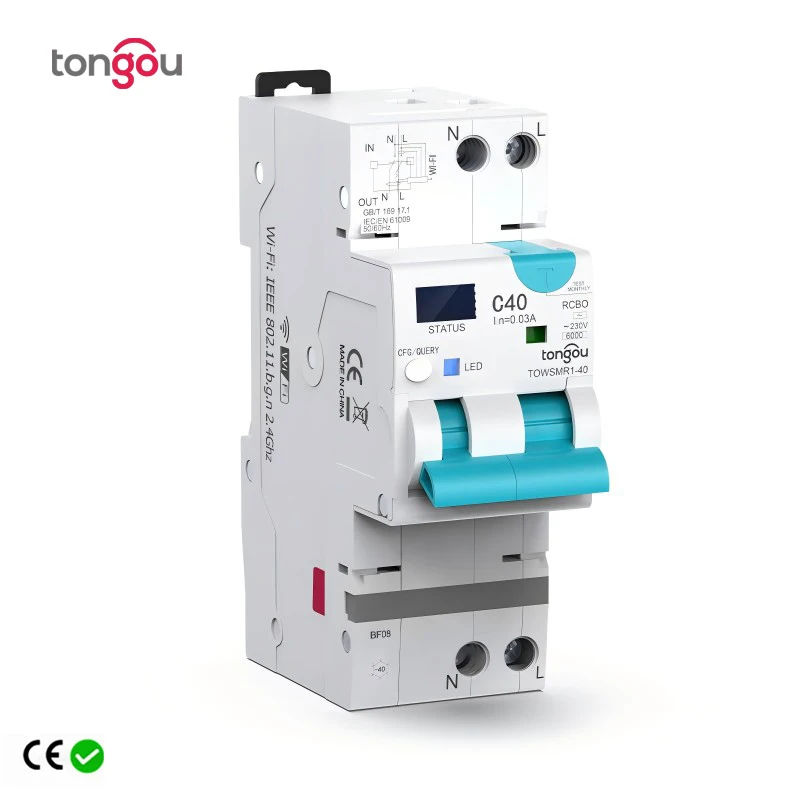
The primary function of this RCBO is to provide dual-layer protection against electrical faults. It combines the functions of a Miniature Circuit Breaker (MCB) and a Residual Current Device (RCD). The visible C40 marking indicates a C-curve tripping characteristic with a nominal current rating of 40 Amperes. This rating signifies its capacity to handle significant electrical loads before tripping.
This integrated design means a single unit manages both overcurrents—caused by overloads or short circuits—and earth leakage faults. Such consolidation simplifies wiring diagrams and reduces the physical footprint within a distribution board. Traditional installations often require separate MCB and RCD units, increasing complexity.
Compared to standalone MCBs and RCDs, an RCBO offers a more compact and streamlined protective solution. It saves valuable space in consumer units. This efficiency is a notable advantage for crowded electrical panels.
Remote Power Management and Monitoring
A key differentiator for the TUYA WiFi RCBO is its integrated Wi-Fi module, supporting IEEE 802.11 b/g/n on the 2.4GHz band. This connectivity enables remote control and monitoring via the TUYA smart home platform. Users can switch the circuit breaker on or off from anywhere with an internet connection.
The ability to remotely manage power circuits offers significant convenience and control. Imagine needing to reset a tripped breaker in a remote property or wanting to power down specific appliances while away. This device makes it possible. It provides real-time status updates.
Standard circuit breakers lack any form of remote interaction. They require manual intervention at the physical panel. The smart capabilities of this RCBO represent a substantial leap in electrical system management, moving beyond simple fault protection.
Visual Feedback and Adjustable Settings
The device features an LED display and indicator lights, providing immediate visual feedback on its operational status. The display likely shows current consumption or other critical parameters, while the LEDs indicate power, Wi-Fi connectivity, and trip status. This visual interface is crucial for quick diagnostics.
Adjustable settings are another advanced feature, allowing users to fine-tune certain parameters. This could include leakage current thresholds or delay times, adapting the protection to specific load requirements. Such customization enhances system flexibility. Precise control is valuable.
In contrast, most conventional RCBOs offer fixed trip characteristics and no user-adjustable settings. The flexibility provided by the TUYA model allows for optimization based on the connected load and environment, potentially reducing nuisance tripping while maintaining safety standards.
Construction and Installation Standards
From the visual inspection, the RCBO appears to be constructed for DIN rail mounting, a standard practice in modern electrical installations. The robust plastic casing suggests durability and insulation properties. The terminal blocks are designed for secure wire connections.
DIN rail compatibility ensures straightforward integration into existing consumer units or distribution boards. The clear markings for input (IN) and output (OUT), along with live (L) and neutral (N) connections, guide correct installation. Proper wiring is essential for safety.
Generic circuit breakers also utilize DIN rail mounting, but the overall fit and finish, along with the quality of the terminal screws, can vary. The visible CE marking indicates compliance with European safety, health, and environmental protection standards, offering a baseline assurance of quality.
The Electronics Repair Tech's Perspective: Internal Components and Reliability
An exploded view of the RCBO reveals its internal complexity, showcasing the electronic control board, the mechanical switching mechanism, and the current sensing coils. The integration of the Wi-Fi module on a dedicated PCB highlights the smart functionality. Component layout appears organized.
The electronic components, including microcontrollers and communication chips, are critical for the smart features. The quality of soldering points and the robustness of the PCB traces directly impact long-term reliability. Clean signal transmission is paramount for accurate fault detection.
Many smart electrical devices can suffer from poorly integrated electronics, leading to intermittent connectivity or premature failure. The visible internal structure suggests a considered design, though without a physical inspection, assessing the quality of individual components and their thermal management remains speculative. The mechanical components, such as the spring-loaded trip mechanism, must endure repeated operations.
Overcurrent Protection: The C-Curve Characteristic
The C-curve characteristic, denoted by 'C' in C40, indicates that the breaker will trip instantaneously at 5 to 10 times its rated current. This makes it suitable for general-purpose circuits with moderate inrush currents, such as lighting circuits, socket outlets, and some motor loads. Rapid response is crucial.
Understanding the tripping curve is vital for proper circuit design. An incorrectly chosen curve could lead to nuisance tripping or, worse, inadequate protection for sensitive equipment. The C-curve is a common and versatile choice for residential and light commercial applications.
Unlike B-curve breakers, which trip at lower multiples of their rated current (3-5x), or D-curve breakers (10-20x), the C-curve strikes a balance. This balance prevents unnecessary interruptions while still offering robust protection against significant overcurrent events, protecting wiring and connected devices.
Residual Current Protection: Safeguarding Against Leakage
Residual current protection is the RCBO's defense against earth leakage faults, which can cause electric shock or fire. It continuously monitors the current balance between the live and neutral conductors. Any imbalance, indicating current leaking to earth, triggers a trip. This is a life-saving feature.
The sensitivity of the residual current detection is a critical parameter, often adjustable in smart RCBOs. A typical sensitivity for domestic use is 30mA. This level ensures protection against indirect contact and fire hazards. Fast tripping is essential.
Standard circuit breakers, such as MCBs, do not offer residual current protection. Relying solely on MCBs leaves occupants vulnerable to electric shock from faulty appliances or wiring. The RCBO's combined protection offers a superior safety standard compared to an MCB-only setup.
The Value Proposition: Smart Safety for Modern Homes
The TUYA WiFi Smart RCBO offers a compelling value proposition by combining advanced safety features with smart home integration. Its ability to provide both overcurrent and residual current protection in a single, remotely manageable unit streamlines electrical safety. This integration simplifies system design.
For homeowners or property managers looking to upgrade their electrical systems, this device represents a significant enhancement in control and peace of mind. The initial investment is offset by the long-term benefits of enhanced safety, remote diagnostics, and potential energy management capabilities. It is a cost-effective upgrade.
Compared to installing separate MCBs and RCDs, and then attempting to add smart functionality through external modules, the integrated RCBO offers a cleaner, more reliable, and often more affordable solution. It provides a comprehensive, future-ready approach to electrical circuit protection and management.
Imagine the convenience of receiving an alert on a smartphone when a circuit trips, instantly knowing the cause, and potentially being able to reset it without physically visiting the electrical panel. This level of control and insight transforms electrical system management from a reactive chore into a proactive, intelligent process. The ability to monitor energy consumption and identify potential issues before they become critical failures adds another layer of utility. This smart RCBO empowers users with unprecedented command over their electrical infrastructure, ensuring both safety and efficiency in a connected world.