TP300 Digital Food Probe Thermometer
Official Store Deal
Expert Analysis Overview
The TP300 Digital Food Probe Thermometer is a precise diagnostic instrument designed for culinary applications, offering critical temperature insights for home cooks and professional kitchens alike. This device aims to eliminate the guesswork inherent in traditional cooking methods, providing objective data for optimal food safety and quality. Its core function is to measure internal food temperatures accurately and rapidly.
The primary role of any food thermometer is to deliver accurate temperature readings. The TP300 is engineered to provide a resolution of 0.1°C/°F and an accuracy of ±1°C/°F. This level of detail is crucial. Many home cooks struggle with inconsistent results, often due to undercooking or overcooking. A common pain point is the uncertainty of whether a roast chicken has reached a safe internal temperature or if a steak is truly medium-rare. This thermometer addresses that directly. It provides the exact numbers needed to make informed decisions, preventing foodborne illnesses and culinary disappointments.
Unlike older, less precise analog thermometers, which often rely on a bimetallic strip and can be slow to react, the TP300 utilizes a digital sensor. Analog models typically offer readings in larger increments, making fine-tuning temperature difficult. This digital precision means that a user can confidently gauge the exact moment food reaches its ideal state. Imagine preparing a delicate custard where a few degrees can make the difference between silky smooth and curdled. The TP300 makes this possible.
The physical design of a diagnostic tool significantly impacts its utility. The TP300 features a compact, elongated form factor with a clear LCD digital display. The overall length is approximately 241mm, with a 140mm stainless steel probe. This length is a practical consideration. It allows users to safely measure temperatures in hot ovens or deep pots without risking burns. The display itself is straightforward. It presents large, legible numbers.
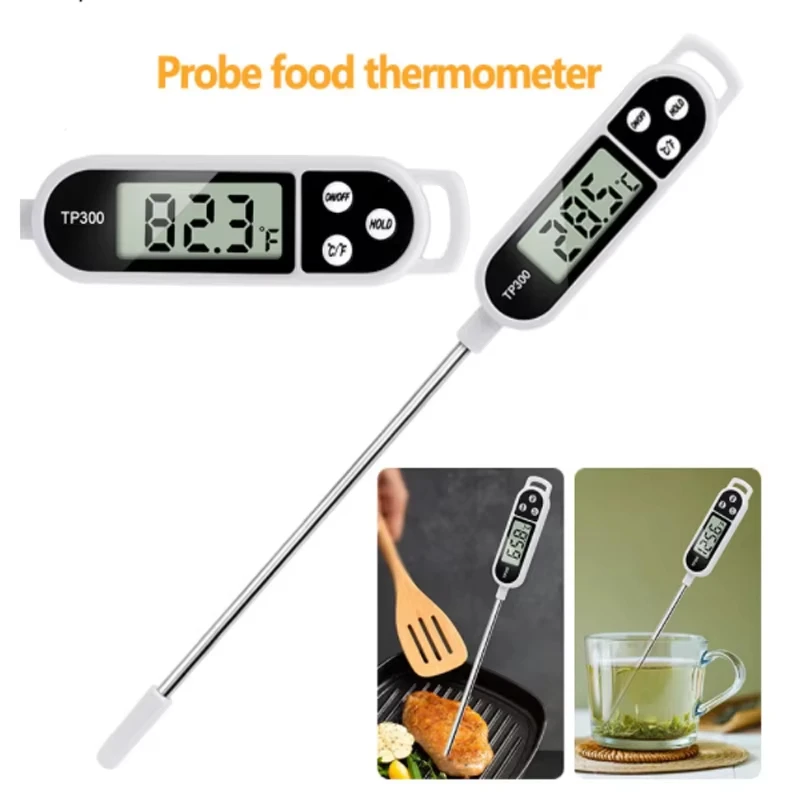
The operational clarity is a distinct advantage. Users often face frustration with complex kitchen gadgets that require extensive manual reading. This device avoids that. It offers dedicated buttons for power on/off, Celsius/Fahrenheit conversion, and a numeric lock (HOLD) function. The HOLD function is particularly useful. It allows a user to remove the probe from the heat source and still view the last stable reading. This prevents the need to squint into a steaming pot or hot oven.
Compared to bulkier, multi-function kitchen tools, the TP300 focuses on its primary task. Its streamlined design means less clutter and a more direct user experience. Simplicity often translates to greater reliability in a busy kitchen environment.
The probe is the critical interface between the thermometer and the food. The TP300 incorporates a stainless steel probe. Stainless steel is chosen for several key properties: its corrosion resistance, durability, and food-grade safety. This material ensures that the probe can be repeatedly inserted into various foods, from acidic marinades to dense meats, without degrading or affecting flavor. The probe's slender design allows for minimal disruption to the food's structure.
The implication of a robust stainless steel probe is significant for a home inspector. It suggests longevity. A flimsy probe would bend or break easily, leading to premature replacement. This material choice indicates a focus on sustained performance. It can withstand the rigors of frequent use.
Many generic thermometers use lower-grade metals that can corrode over time, potentially introducing metallic tastes or even contaminants into food. The use of food-grade stainless steel, while standard for quality kitchen tools, is a crucial differentiator from cheaper, less reliable alternatives. This material choice is not merely an aesthetic one; it is a functional imperative for food safety.
A thermometer's utility is defined by its operational range. The TP300 boasts a wide temperature range, from -50°C to +300°C (-58°F to +572°F). This extensive span covers virtually all common cooking and food storage temperatures. From checking the internal temperature of a freezer to ensuring a deep-fried turkey reaches 165°F, this device is capable. It handles extreme cold and high heat with equal proficiency.
This broad capability means the user doesn't need multiple specialized thermometers. One device can handle a chilled beverage, a simmering sauce, a roasting joint, or even candy making. Imagine the convenience. This versatility translates directly into value. It reduces the need for additional purchases.
Unlike single-purpose thermometers, such as candy thermometers with limited upper ranges or refrigerator thermometers with restricted lower ranges, the TP300 provides a comprehensive solution. This broad application spectrum makes it a practical choice for a diverse set of culinary tasks, from baking to BBQ.
The TP300 is powered by a single 1.5V LR44 button cell battery. This power source is compact. While LR44 batteries are not as ubiquitous as AA or AAA, they are readily available online and in many hardware stores. The battery compartment is designed for easy access, allowing for quick replacement when needed. The low power consumption of the LCD display ensures a reasonable battery life.
From a maintenance perspective, the battery choice is a minor trade-off. It's not a rechargeable unit. However, the simplicity of a replaceable battery means no downtime waiting for a charge. It's ready when needed.
Many modern kitchen gadgets are moving towards integrated rechargeable batteries, which can be convenient but also lead to device obsolescence when the battery eventually fails. The TP300's reliance on a standard, albeit specific, replaceable battery ensures its long-term usability, provided the user keeps spare batteries on hand. This is a pragmatic design choice.
While the TP300 is designed for ease of use, adherence to specific operational guidelines is paramount for both device longevity and user safety. The most critical warning pertains to water exposure. The main unit, containing the digital display and circuitry, is not waterproof. Only the stainless steel probe is designed for immersion. Attempting to wash the entire unit under running water or submerging it will inevitably lead to damage. This is a common oversight. Users must wipe the main unit clean with a damp cloth.
Another crucial aspect involves battery safety. The 1.5V LR44 button cell battery, while small, poses a risk if ingested, particularly by children. It is imperative to keep spare batteries and the device itself out of reach of young children. Proper disposal of depleted batteries is also important. They contain chemicals that should not enter the general waste stream.
Finally, the thermometer's temperature range must be respected. While capable of handling high temperatures up to 300°C, the plastic housing of the main unit is not designed for prolonged exposure to extreme heat, such as being left inside a hot oven during cooking. The probe is heat-resistant, but the body is not. Using it outside its intended parameters can lead to irreversible damage to the electronics or the plastic casing. This is a diagnostic tool, not a permanent fixture in a hot environment.
Understanding user concerns is vital for any product. The FAQs section addresses common points of confusion or inquiry. For instance, the question of Celsius/Fahrenheit conversion is frequently asked. The dedicated C/F button simplifies this. It removes any ambiguity. This immediate conversion capability caters to global users and diverse recipe requirements.
Another common query relates to oven use. Many users wonder if the probe can remain in the oven. The answer is clear: the TP300 is for quick checks. It is not an oven-safe, leave-in thermometer. This distinction is important. It prevents misuse and potential damage.
The battery type (LR44) and cleaning instructions are also critical. Knowing the battery type beforehand allows users to stock up. Clear cleaning instructions ensure hygiene and device longevity. These simple answers prevent frustration. They enhance the user experience.
The provided images offer a comprehensive visual overview of the TP300. Each image serves a specific purpose in conveying product features and use cases. For instance, the first image showcases the thermometer in both its compact and extended forms, demonstrating its versatility across different food items and liquids. This visual immediately communicates its primary function. It shows the device in action.
The second image focuses on the precision and accuracy, highlighting the 0.1°C/°F resolution and ±1°C/°F accuracy. This reinforces the product's technical capabilities. It provides concrete numbers. The visual context of a bowl of shrimp soup suggests its application in diverse culinary settings.
A technical diagram in the third image provides exact dimensions. This is crucial for practical considerations. Knowing the probe length (140mm) and total length (241mm) helps users assess if it meets their specific needs, for example, for deep pots or large roasts. It offers tangible data.
The fourth image details the battery compartment and specifications. This transparency is valuable. It allows potential buyers to understand the power requirements and other technical data before purchase. It builds trust.
The fifth image, showing the thermometer in a splash of milk, emphasizes its suitability for liquid temperature measurement. This expands the perceived utility beyond just solid foods. It highlights its versatility. Finally, the sixth image acts as a product information graphic, labeling key features like the power button, C/F conversion, numeric lock, and probe cover. This serves as a quick visual guide. It simplifies understanding.
From a home inspector's viewpoint, the TP300 presents as a functional, purpose-built instrument. The visible materials imply a focus on utility over luxury. The plastic housing for the main unit is typical for handheld electronics in this price range. It suggests adequate protection for internal components under normal kitchen conditions. The stainless steel probe is the workhorse. Its integration into the main body appears robust. There are no obvious weak points in the visible construction.
The overall build quality, while not "ruggedized" for industrial abuse, seems perfectly adequate for home kitchen use. The buttons are clearly defined. The LCD display is recessed, offering some protection from incidental bumps. This design choice prioritizes readability.
Compared to professional-grade industrial thermometers, which might feature rubberized casings, IP-rated waterproofing, and more robust connectors, the TP300 is clearly positioned for the consumer market. Its design reflects a balance between cost-effectiveness and essential functionality. It's not designed to detect hidden leaks behind walls or electrical hotspots, but it excels at its stated purpose: food temperature.
Even the most reliable tools can encounter minor issues. Effective troubleshooting ensures continuous functionality. For instance, inaccurate readings are a common concern. The primary cause is often improper probe insertion. The probe must penetrate at least 1-2 inches into the thickest part of the food, avoiding bones or fat, which can give misleading readings. Allowing a few seconds for the temperature to stabilize is also critical. Impatience can lead to incorrect assumptions.
If the display is not working, the first step is always the battery. Checking for correct polarity and replacing a depleted 1.5V LR44 battery often resolves this. This is a simple fix. A dead battery is not a faulty device.
Slow temperature response can be frustrating. A clean probe tip is essential for optimal thermal conductivity. Food residue can insulate the tip, delaying readings. A quick wipe-down before use can prevent this. This ensures peak performance.
If the unit fails to turn on, a firm press of the "ON/OFF" button is the initial action. If unresponsive, battery replacement is the next logical step. These are basic diagnostic checks. They empower the user.
Finally, the numeric lock (HOLD) function can sometimes be mistakenly activated. If the temperature reading appears stuck, simply pressing the "HOLD" button again will release it, allowing for new measurements. This is a feature, not a fault. Understanding its operation prevents unnecessary concern.
The TP300 Digital Food Probe Thermometer, at its price point, represents a significant investment in culinary confidence. The cost of ruined meals, whether due to undercooking (food safety risk) or overcooking (texture and flavor loss), far outweighs the modest price of this device. It provides a tangible return on investment by ensuring consistent, high-quality results. This is not just a gadget. It is a tool for mastery.
Unlike relying on visual cues or guesswork, which often lead to inconsistent outcomes, this thermometer provides objective data. It removes the anxiety from cooking. For those who frequently grill, roast, or bake, the ability to precisely monitor internal temperatures is invaluable. It transforms cooking from an art of estimation into a science of precision.
Imagine the satisfaction of serving perfectly cooked meals every single time, knowing they are both delicious and safe. This thermometer empowers home cooks to achieve professional-level results. It is an essential upgrade for any kitchen, offering peace of mind and elevating the entire cooking experience. The TP300 is more than a thermometer; it is a gateway to culinary excellence.
Precision in Culinary Diagnostics
The primary role of any food thermometer is to deliver accurate temperature readings. The TP300 is engineered to provide a resolution of 0.1°C/°F and an accuracy of ±1°C/°F. This level of detail is crucial. Many home cooks struggle with inconsistent results, often due to undercooking or overcooking. A common pain point is the uncertainty of whether a roast chicken has reached a safe internal temperature or if a steak is truly medium-rare. This thermometer addresses that directly. It provides the exact numbers needed to make informed decisions, preventing foodborne illnesses and culinary disappointments.
Unlike older, less precise analog thermometers, which often rely on a bimetallic strip and can be slow to react, the TP300 utilizes a digital sensor. Analog models typically offer readings in larger increments, making fine-tuning temperature difficult. This digital precision means that a user can confidently gauge the exact moment food reaches its ideal state. Imagine preparing a delicate custard where a few degrees can make the difference between silky smooth and curdled. The TP300 makes this possible.
Ergonomics and Operational Clarity
The physical design of a diagnostic tool significantly impacts its utility. The TP300 features a compact, elongated form factor with a clear LCD digital display. The overall length is approximately 241mm, with a 140mm stainless steel probe. This length is a practical consideration. It allows users to safely measure temperatures in hot ovens or deep pots without risking burns. The display itself is straightforward. It presents large, legible numbers.
The operational clarity is a distinct advantage. Users often face frustration with complex kitchen gadgets that require extensive manual reading. This device avoids that. It offers dedicated buttons for power on/off, Celsius/Fahrenheit conversion, and a numeric lock (HOLD) function. The HOLD function is particularly useful. It allows a user to remove the probe from the heat source and still view the last stable reading. This prevents the need to squint into a steaming pot or hot oven.
Compared to bulkier, multi-function kitchen tools, the TP300 focuses on its primary task. Its streamlined design means less clutter and a more direct user experience. Simplicity often translates to greater reliability in a busy kitchen environment.
The Stainless Steel Probe: A Deep Dive
The probe is the critical interface between the thermometer and the food. The TP300 incorporates a stainless steel probe. Stainless steel is chosen for several key properties: its corrosion resistance, durability, and food-grade safety. This material ensures that the probe can be repeatedly inserted into various foods, from acidic marinades to dense meats, without degrading or affecting flavor. The probe's slender design allows for minimal disruption to the food's structure.
The implication of a robust stainless steel probe is significant for a home inspector. It suggests longevity. A flimsy probe would bend or break easily, leading to premature replacement. This material choice indicates a focus on sustained performance. It can withstand the rigors of frequent use.
Many generic thermometers use lower-grade metals that can corrode over time, potentially introducing metallic tastes or even contaminants into food. The use of food-grade stainless steel, while standard for quality kitchen tools, is a crucial differentiator from cheaper, less reliable alternatives. This material choice is not merely an aesthetic one; it is a functional imperative for food safety.
Temperature Range and Versatility
A thermometer's utility is defined by its operational range. The TP300 boasts a wide temperature range, from -50°C to +300°C (-58°F to +572°F). This extensive span covers virtually all common cooking and food storage temperatures. From checking the internal temperature of a freezer to ensuring a deep-fried turkey reaches 165°F, this device is capable. It handles extreme cold and high heat with equal proficiency.
This broad capability means the user doesn't need multiple specialized thermometers. One device can handle a chilled beverage, a simmering sauce, a roasting joint, or even candy making. Imagine the convenience. This versatility translates directly into value. It reduces the need for additional purchases.
Unlike single-purpose thermometers, such as candy thermometers with limited upper ranges or refrigerator thermometers with restricted lower ranges, the TP300 provides a comprehensive solution. This broad application spectrum makes it a practical choice for a diverse set of culinary tasks, from baking to BBQ.
Power Source and Maintenance Considerations
The TP300 is powered by a single 1.5V LR44 button cell battery. This power source is compact. While LR44 batteries are not as ubiquitous as AA or AAA, they are readily available online and in many hardware stores. The battery compartment is designed for easy access, allowing for quick replacement when needed. The low power consumption of the LCD display ensures a reasonable battery life.
From a maintenance perspective, the battery choice is a minor trade-off. It's not a rechargeable unit. However, the simplicity of a replaceable battery means no downtime waiting for a charge. It's ready when needed.
Many modern kitchen gadgets are moving towards integrated rechargeable batteries, which can be convenient but also lead to device obsolescence when the battery eventually fails. The TP300's reliance on a standard, albeit specific, replaceable battery ensures its long-term usability, provided the user keeps spare batteries on hand. This is a pragmatic design choice.
Safeguarding Your Culinary Endeavors: Warnings and Best Practices
While the TP300 is designed for ease of use, adherence to specific operational guidelines is paramount for both device longevity and user safety. The most critical warning pertains to water exposure. The main unit, containing the digital display and circuitry, is not waterproof. Only the stainless steel probe is designed for immersion. Attempting to wash the entire unit under running water or submerging it will inevitably lead to damage. This is a common oversight. Users must wipe the main unit clean with a damp cloth.
Another crucial aspect involves battery safety. The 1.5V LR44 button cell battery, while small, poses a risk if ingested, particularly by children. It is imperative to keep spare batteries and the device itself out of reach of young children. Proper disposal of depleted batteries is also important. They contain chemicals that should not enter the general waste stream.
Finally, the thermometer's temperature range must be respected. While capable of handling high temperatures up to 300°C, the plastic housing of the main unit is not designed for prolonged exposure to extreme heat, such as being left inside a hot oven during cooking. The probe is heat-resistant, but the body is not. Using it outside its intended parameters can lead to irreversible damage to the electronics or the plastic casing. This is a diagnostic tool, not a permanent fixture in a hot environment.
Addressing Common Queries: FAQs and User Support
Understanding user concerns is vital for any product. The FAQs section addresses common points of confusion or inquiry. For instance, the question of Celsius/Fahrenheit conversion is frequently asked. The dedicated C/F button simplifies this. It removes any ambiguity. This immediate conversion capability caters to global users and diverse recipe requirements.
Another common query relates to oven use. Many users wonder if the probe can remain in the oven. The answer is clear: the TP300 is for quick checks. It is not an oven-safe, leave-in thermometer. This distinction is important. It prevents misuse and potential damage.
The battery type (LR44) and cleaning instructions are also critical. Knowing the battery type beforehand allows users to stock up. Clear cleaning instructions ensure hygiene and device longevity. These simple answers prevent frustration. They enhance the user experience.
The Visual Narrative: Image Alt Texts and Product Presentation
The provided images offer a comprehensive visual overview of the TP300. Each image serves a specific purpose in conveying product features and use cases. For instance, the first image showcases the thermometer in both its compact and extended forms, demonstrating its versatility across different food items and liquids. This visual immediately communicates its primary function. It shows the device in action.
The second image focuses on the precision and accuracy, highlighting the 0.1°C/°F resolution and ±1°C/°F accuracy. This reinforces the product's technical capabilities. It provides concrete numbers. The visual context of a bowl of shrimp soup suggests its application in diverse culinary settings.
A technical diagram in the third image provides exact dimensions. This is crucial for practical considerations. Knowing the probe length (140mm) and total length (241mm) helps users assess if it meets their specific needs, for example, for deep pots or large roasts. It offers tangible data.
The fourth image details the battery compartment and specifications. This transparency is valuable. It allows potential buyers to understand the power requirements and other technical data before purchase. It builds trust.
The fifth image, showing the thermometer in a splash of milk, emphasizes its suitability for liquid temperature measurement. This expands the perceived utility beyond just solid foods. It highlights its versatility. Finally, the sixth image acts as a product information graphic, labeling key features like the power button, C/F conversion, numeric lock, and probe cover. This serves as a quick visual guide. It simplifies understanding.
Beyond the Surface: Home Inspector's Perspective on Build and Reliability
From a home inspector's viewpoint, the TP300 presents as a functional, purpose-built instrument. The visible materials imply a focus on utility over luxury. The plastic housing for the main unit is typical for handheld electronics in this price range. It suggests adequate protection for internal components under normal kitchen conditions. The stainless steel probe is the workhorse. Its integration into the main body appears robust. There are no obvious weak points in the visible construction.
The overall build quality, while not "ruggedized" for industrial abuse, seems perfectly adequate for home kitchen use. The buttons are clearly defined. The LCD display is recessed, offering some protection from incidental bumps. This design choice prioritizes readability.
Compared to professional-grade industrial thermometers, which might feature rubberized casings, IP-rated waterproofing, and more robust connectors, the TP300 is clearly positioned for the consumer market. Its design reflects a balance between cost-effectiveness and essential functionality. It's not designed to detect hidden leaks behind walls or electrical hotspots, but it excels at its stated purpose: food temperature.
Troubleshooting: Ensuring Consistent Performance
Even the most reliable tools can encounter minor issues. Effective troubleshooting ensures continuous functionality. For instance, inaccurate readings are a common concern. The primary cause is often improper probe insertion. The probe must penetrate at least 1-2 inches into the thickest part of the food, avoiding bones or fat, which can give misleading readings. Allowing a few seconds for the temperature to stabilize is also critical. Impatience can lead to incorrect assumptions.
If the display is not working, the first step is always the battery. Checking for correct polarity and replacing a depleted 1.5V LR44 battery often resolves this. This is a simple fix. A dead battery is not a faulty device.
Slow temperature response can be frustrating. A clean probe tip is essential for optimal thermal conductivity. Food residue can insulate the tip, delaying readings. A quick wipe-down before use can prevent this. This ensures peak performance.
If the unit fails to turn on, a firm press of the "ON/OFF" button is the initial action. If unresponsive, battery replacement is the next logical step. These are basic diagnostic checks. They empower the user.
Finally, the numeric lock (HOLD) function can sometimes be mistakenly activated. If the temperature reading appears stuck, simply pressing the "HOLD" button again will release it, allowing for new measurements. This is a feature, not a fault. Understanding its operation prevents unnecessary concern.
The Value Proposition: An Investment in Culinary Confidence
The TP300 Digital Food Probe Thermometer, at its price point, represents a significant investment in culinary confidence. The cost of ruined meals, whether due to undercooking (food safety risk) or overcooking (texture and flavor loss), far outweighs the modest price of this device. It provides a tangible return on investment by ensuring consistent, high-quality results. This is not just a gadget. It is a tool for mastery.
Unlike relying on visual cues or guesswork, which often lead to inconsistent outcomes, this thermometer provides objective data. It removes the anxiety from cooking. For those who frequently grill, roast, or bake, the ability to precisely monitor internal temperatures is invaluable. It transforms cooking from an art of estimation into a science of precision.
Imagine the satisfaction of serving perfectly cooked meals every single time, knowing they are both delicious and safe. This thermometer empowers home cooks to achieve professional-level results. It is an essential upgrade for any kitchen, offering peace of mind and elevating the entire cooking experience. The TP300 is more than a thermometer; it is a gateway to culinary excellence.