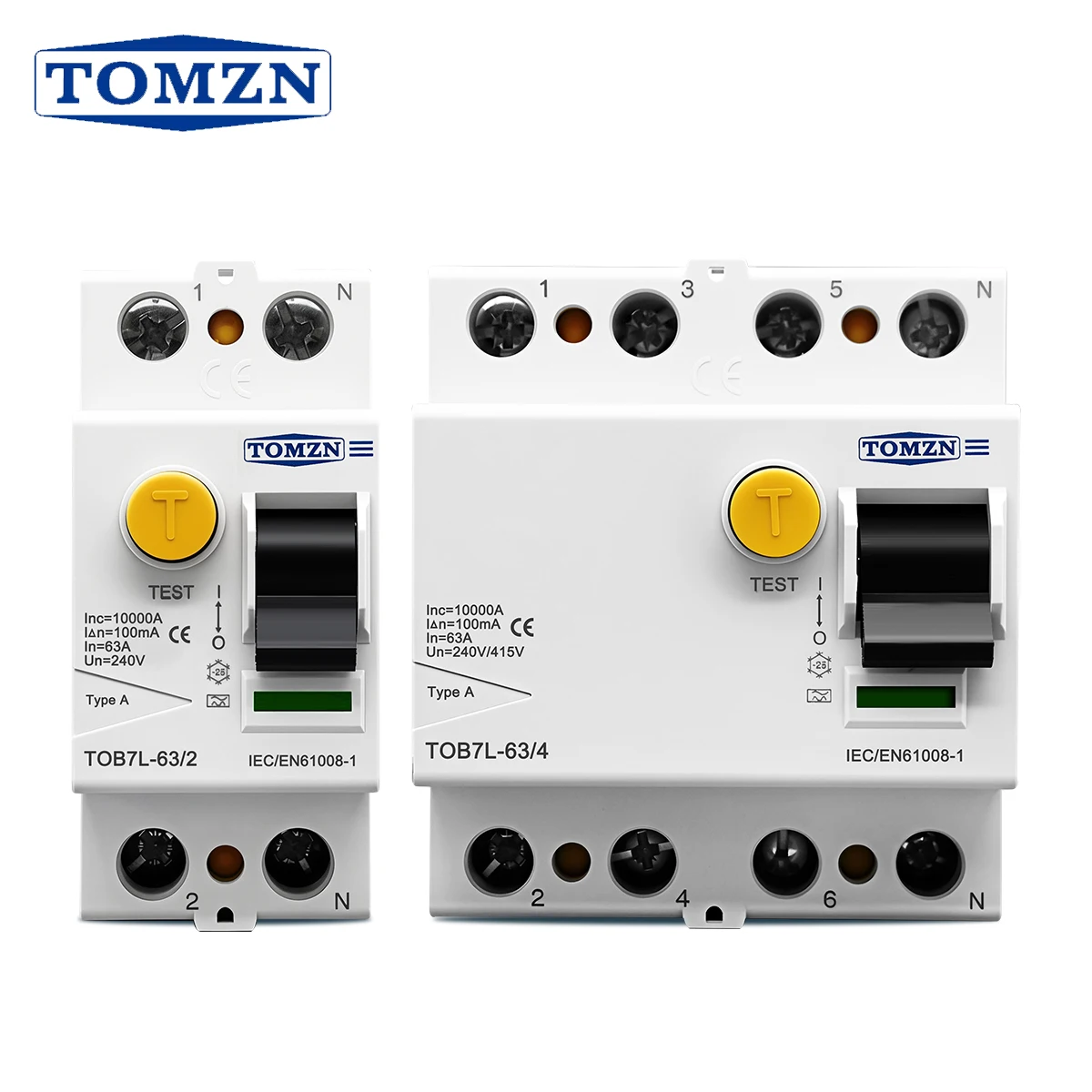
TOMZN RCCB Residual Current Circuit Breaker
Official Store Deal
Expert Analysis Overview
Precision Earth Leakage Protection: The TOMZN RCCB
The TOMZN RCCB Residual Current Circuit Breaker is a critical safety device designed for advanced electrical fault detection in diverse installations. This unit focuses exclusively on identifying and interrupting residual currents, commonly known as earth leakage, which pose significant risks of electric shock and fire. Unlike standard circuit breakers that primarily protect against overcurrents, the RCCB provides a specialized layer of defense, ensuring human safety and equipment integrity by rapidly disconnecting power upon detecting even minute leakage currents.Core Functionality and Electromagnetic Tripping
At its operational heart, the TOMZN RCCB employs an electromagnetic tripping mechanism. This design choice is paramount for reliability and speed. When a residual current is detected by the internal current transformer, it generates a magnetic field that actuates the tripping mechanism, physically opening the circuit contacts. This process occurs with exceptional swiftness, often within milliseconds, which is crucial for minimizing the duration of exposure to hazardous currents.The electromagnetic principle ensures consistent performance, even under varying ambient temperatures, which can sometimes affect purely electronic tripping circuits. Its operation is purely mechanical once triggered, offering a robust and dependable response to fault conditions. This rapid disconnection capability is a non-negotiable feature for safety-critical applications.
Compared to thermal-magnetic circuit breakers, which react to heat generated by sustained overcurrents, the electromagnetic RCCB responds to an imbalance in current flow. This fundamental difference highlights its specialized role: detecting leakage paths to ground that might not manifest as an overcurrent but are still extremely dangerous. The precision of this detection is what sets dedicated RCCBs apart from combined devices.
Versatility in Application: Type A, AC, B, and F
One of the most significant features of the TOMZN RCCB range is its availability in multiple types: AC, A, B, and F. This broad spectrum caters to the increasingly complex nature of modern electrical loads.Type AC RCCBs are the most common, designed to detect sinusoidal alternating residual currents. They are suitable for general-purpose circuits with purely AC loads, such as lighting and heating elements. For many residential and commercial applications, Type AC provides adequate protection.
Type A RCCBs offer enhanced detection capabilities, responding to both sinusoidal AC and pulsating DC residual currents. This makes them indispensable for circuits supplying equipment with electronic components that might produce pulsating DC leakage currents, such as computers, washing machines, and variable speed drives. The ability to detect these more complex waveforms significantly broadens the scope of protection.
Type F RCCBs are specifically engineered for circuits with single-phase frequency converters or equipment with a high-frequency component in the leakage current. They provide improved resistance to nuisance tripping from transient surges and offer protection against pulsating DC residual currents up to 10mA, in addition to sinusoidal AC. This type is particularly relevant for modern appliances with advanced motor controls.
Type B RCCBs represent the highest level of residual current protection, capable of detecting sinusoidal AC, pulsating DC, and smooth DC residual currents. These are essential for applications involving three-phase rectifiers, electric vehicle charging stations, photovoltaic systems, and other installations where smooth DC leakage currents can occur. Smooth DC currents are particularly hazardous as they can blind standard AC or A type RCCBs, preventing them from tripping. The inclusion of Type B options positions this TOMZN series as a comprehensive solution for demanding industrial and renewable energy contexts.
This comprehensive range of types ensures that installers can select the precise level of protection required for specific load characteristics, preventing both under-protection and nuisance tripping. Choosing the correct type is a critical aspect of system design.
Current Ratings and Sensitivity Options
The TOMZN RCCB is offered with rated currents of 40A and 63A, accommodating a wide range of circuit capacities. The 40A variant is suitable for smaller sub-circuits or main incoming lines in compact installations, while the 63A option handles higher current demands, often found in main distribution boards or larger industrial applications. These ratings define the maximum continuous current the device can safely carry without tripping.Beyond current capacity, the residual current sensitivity is a critical parameter, available in 30mA, 100mA, and 300mA. A 30mA sensitivity is typically mandated for circuits where direct human contact is possible, such as socket outlets in bathrooms or outdoor areas, providing protection against lethal electric shock. This low threshold ensures rapid disconnection before a dangerous amount of current can flow through a person.
100mA sensitivity is often used for additional protection against electric shock where the risk is lower, or for fire protection in specific industrial settings. It offers a balance between sensitivity and avoiding nuisance tripping in less critical environments. 300mA sensitivity is primarily employed for general fire protection of buildings and equipment, where the primary concern is preventing sustained leakage currents that could lead to overheating and ignition. This higher threshold is less about direct human protection and more about preventing property damage.
The ability to choose from these sensitivities allows for a tailored approach to electrical safety, optimizing protection levels according to the specific risks and regulatory requirements of each circuit. Incorrect sensitivity selection can lead to either inadequate protection or frustrating nuisance trips.
Robust Construction and Installation
Visually, the TOMZN RCCBs exhibit a clean, modular design consistent with modern electrical components. The white plastic housing appears to be a durable, flame-retardant material, essential for safety in electrical enclosures. The DIN rail mountable design is a standard feature, allowing for quick and secure installation within consumer units or distribution boards. This snap-on mechanism simplifies the installation process for electricians.The terminal blocks, visible at the top and bottom of the units, are designed for secure wire connections. The screws appear robust, suggesting they can withstand the necessary torque for a reliable electrical connection. Proper tightening of these terminals is crucial for preventing hot spots and ensuring long-term electrical integrity. Poor connections are a common cause of electrical failures and hazards.
The presence of a **yellow