TOMZN Din Rail Automatic Transfer Switch
Official Store Deal
Expert Analysis Overview
Uninterrupted Power Management: The TOMZN Din Rail ATS
The TOMZN Din Rail ATS is a critical component for any robust power system, offering automatic and seamless switching between primary and secondary power sources. This device is specifically engineered for users seeking reliable, uninterrupted power delivery, whether integrating a generator, a grid connection, or a sophisticated solar energy setup. Its design prioritizes operational stability and ease of integration into existing electrical panels.
The Core Mechanism: Seamless Power Transition Mechanics
At its essence, an Automatic Transfer Switch (ATS) acts as an intelligent gatekeeper for electrical supply. It continuously monitors the primary power source, typically the utility grid. Should this primary source fail or drop below acceptable parameters, the ATS automatically switches the load to a designated secondary power source, such as a backup generator or a solar inverter system.
This automatic action prevents any significant interruption to critical loads. Imagine a sudden grid outage during a crucial work meeting or while running essential medical equipment. The ATS ensures these vital systems remain powered.
Compared to manual transfer switches, which require human intervention and can introduce delays and operational hazards, the TOMZN ATS performs this transition within milliseconds, offering true peace of mind and operational continuity.
Architectural Versatility: Pole Configurations and Current Ratings
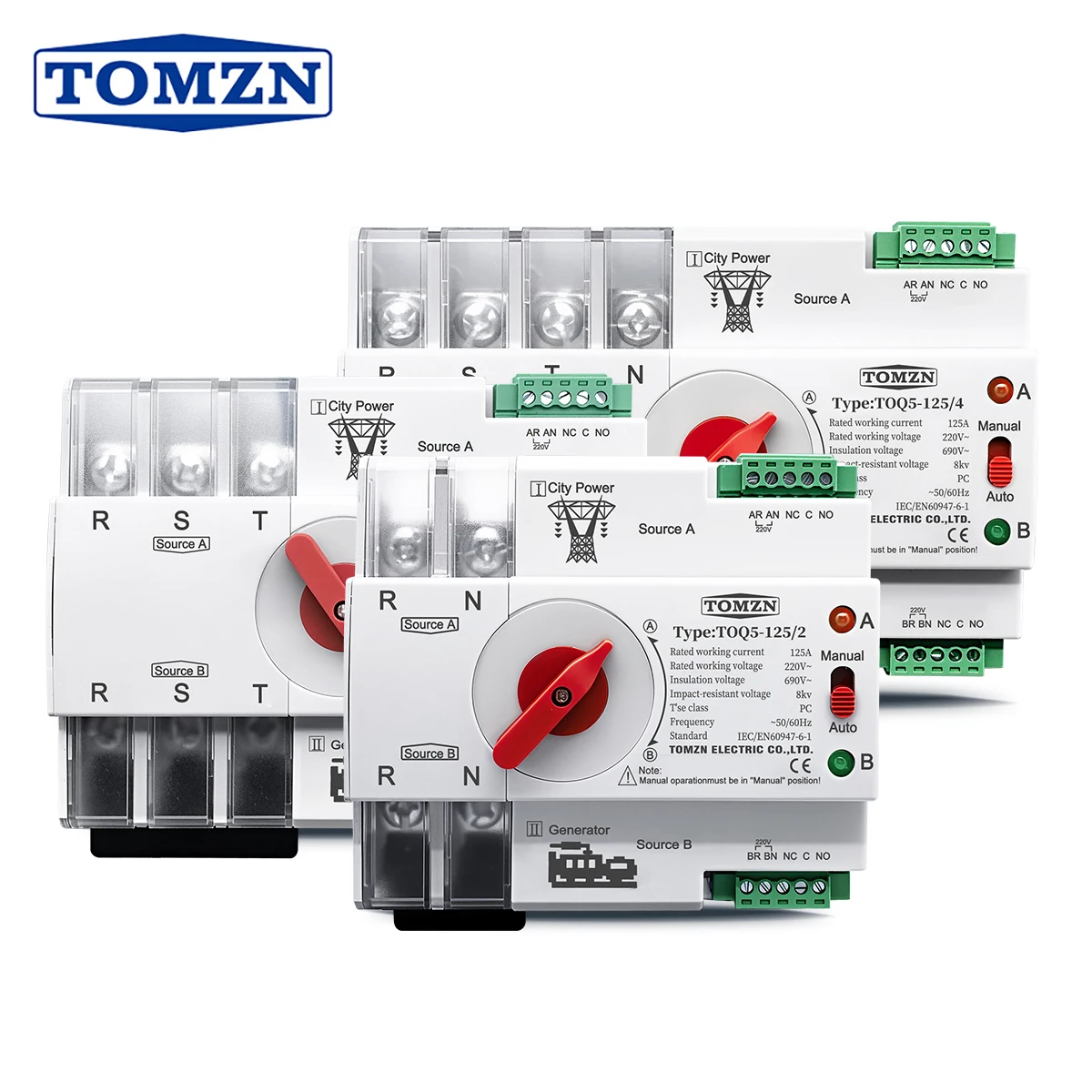
This ATS is available in multiple pole configurations: 2P (two-pole), 3P (three-pole), and 4P (four-pole). The choice of configuration is paramount for matching the specific electrical system requirements.
The 2P version is ideal for single-phase applications, commonly found in residential settings where a live (R) and neutral (N) conductor are managed. It ensures both poles are switched simultaneously, maintaining safety and preventing dangerous backfeeding.
For more complex commercial or industrial applications, or larger residential systems, the 3P and 4P models become essential. The 3P variant handles three-phase power without a neutral connection, while the 4P model manages three phases and a neutral (RSTN), crucial for balanced loads and safety in many modern installations. Each configuration ensures comprehensive isolation between sources.
Amperage Endurance: Matching System Demands
The TOMZN ATS is offered in various current ratings: 63A, 100A, and 125A. This range allows for precise selection based on the anticipated electrical load of the connected circuits.
Selecting the correct amperage rating is vital for both safety and performance. An undersized ATS could overheat and fail, potentially causing a fire hazard or system damage. Conversely, an oversized unit might be an unnecessary expense, though it offers a greater margin for future expansion.
Consider a typical residential solar setup with a 10kW inverter. Such a system might draw maximum currents that necessitate a 63A or 100A ATS, depending on the specific voltage and load distribution. Always verify the maximum continuous current draw of all connected loads.
Integrating the Power Backbone: Installation and Build Quality
The Din Rail mounting mechanism is a significant advantage for this ATS. Din Rail components snap easily into standard electrical enclosures, simplifying installation and creating a clean, organized panel layout.
The plastic housing feels dense and durable, suggesting a robust construction capable of withstanding the rigors of an electrical panel environment. The terminals appear to be of substantial gauge, designed for secure wire connections and high current loads without excessive heat buildup. Secure connections are vital.
Unlike many generic transfer switches that use flimsy plastic clips, the TOMZN unit's Din Rail clips provide a firm, positive lock, ensuring the device remains securely in place even under vibration or during maintenance. The red rotary switch for manual override offers a positive, tactile click, indicating a precise mechanical action.
Operational Modes: Manual and Automatic Control
This ATS provides both automatic and manual operating modes, offering flexibility for various scenarios. The automatic mode is the primary function, continuously monitoring the main power source and initiating transfers as needed.
In automatic mode, the system handles power transitions without human intervention, ideal for maintaining uptime in critical applications. This automation is particularly beneficial for remote installations or situations where immediate response to power fluctuations is impractical.
The manual override, actuated by the prominent red rotary switch, allows for deliberate control. This feature is indispensable during system testing, maintenance, or in emergency situations where specific power source selection is required. It provides an essential layer of control.
Compatibility with Renewable Energy Systems
For the solar energy hobbyist, the TOMZN ATS presents a compelling solution for integrating renewable power into a home or business. It facilitates seamless switching between grid power and an inverter's output, ensuring continuous operation even when the grid is down.
When connecting a solar inverter to Source B (Generator/Secondary Power), the ATS ensures that the inverter's output is only connected to the load when the grid (Source A) is unavailable or manually switched off. This prevents backfeeding into the grid, which is a critical safety and regulatory requirement.
Verifying compatibility with existing solar setups involves matching the ATS's AC voltage and current ratings with the inverter's output specifications. Most residential solar inverters produce 230V AC, making the 230V/400V AC rated TOMZN units suitable. The ability to manage both single-phase and three-phase systems further broadens its applicability across diverse solar installations.
Efficiency and Reliability in Practice
While the ATS itself does not directly convert energy, its role in maintaining power continuity significantly contributes to the overall efficiency and reliability of an energy system. Preventing power interruptions means sensitive electronics are not subjected to sudden shutdowns, extending their lifespan and reducing data loss.
The rapid transfer time minimizes the impact of outages on connected devices. For systems with battery backup and solar generation, the ATS ensures that the stored energy is utilized effectively when grid power fails, maximizing the return on investment for the solar installation.
Consider a scenario where a hybrid solar system is providing power. When the grid is active, the ATS can prioritize grid power or allow the inverter to feed specific loads. If the grid fails, the ATS instantly switches to the inverter, drawing power from batteries and solar panels. This ensures continuous operation.
Safety and Protection Features
Safety is paramount in any electrical installation, and the TOMZN ATS incorporates features designed to protect both the system and its users. The physical separation of contacts for Source A and Source B ensures that both sources can never be connected to the load simultaneously, eliminating the risk of short circuits or dangerous backfeeding.
The automatic operation reduces the need for manual intervention during power events, minimizing human exposure to live electrical components. Clear labeling on the unit, indicating