TOMZN DC Mini Circuit Breaker for Solar Systems
Official Store Deal
Expert Analysis Overview
The TOMZN DC Miniature Circuit Breaker (MCB) is a critical safety component designed for solar energy enthusiasts and off-grid system builders requiring robust overcurrent protection in direct current applications. This device is specifically engineered to safeguard photovoltaic (PV) arrays, battery banks, and other DC circuits from damaging overloads and short circuits, a necessity often overlooked by those accustomed to AC electrical standards. Its specialized design ensures reliable operation where standard AC breakers would be insufficient or hazardous. This breaker provides an essential layer of security for any DC power infrastructure, from small residential setups to more extensive off-grid installations.
Direct current (DC) circuits, particularly those found in solar power systems, present unique challenges for electrical protection compared to alternating current (AC) systems. DC faults, especially arc faults, are notoriously difficult to extinguish due to the continuous flow of current, unlike AC where the current naturally crosses zero. The TOMZN DC MCB addresses this fundamental difference with its dedicated design. It is rated for 500V DC and offers interrupting capacities up to 6KA, indicating a substantial ability to safely break fault currents without sustaining damage or causing further hazards. This high voltage rating makes it suitable for series-connected solar panels, where string voltages can easily exceed 100V and often reach 400V or 500V in larger configurations. Proper protection is paramount.
This circuit breaker is available in a wide range of current ratings, from 3A to 63A. This versatility allows for precise matching to various components within a solar energy system. For example, lower amperage breakers (3A-10A) might protect individual strings of solar panels, while higher amperage units (32A-63A) could safeguard the main DC busbar connecting multiple strings to a charge controller or inverter. The availability of both 1P (single pole) and 2P (double pole) configurations further enhances its adaptability. A 1P breaker interrupts a single conductor, typically the positive line in a ungrounded DC system, while a 2P breaker interrupts both the positive and negative conductors, providing a more comprehensive isolation. For critical applications, 2P breakers are often preferred for their enhanced safety in completely disconnecting the circuit.
Unlike generic electrical protection devices, these DC MCBs are purpose-built. They manage the unique characteristics of DC arcs effectively.
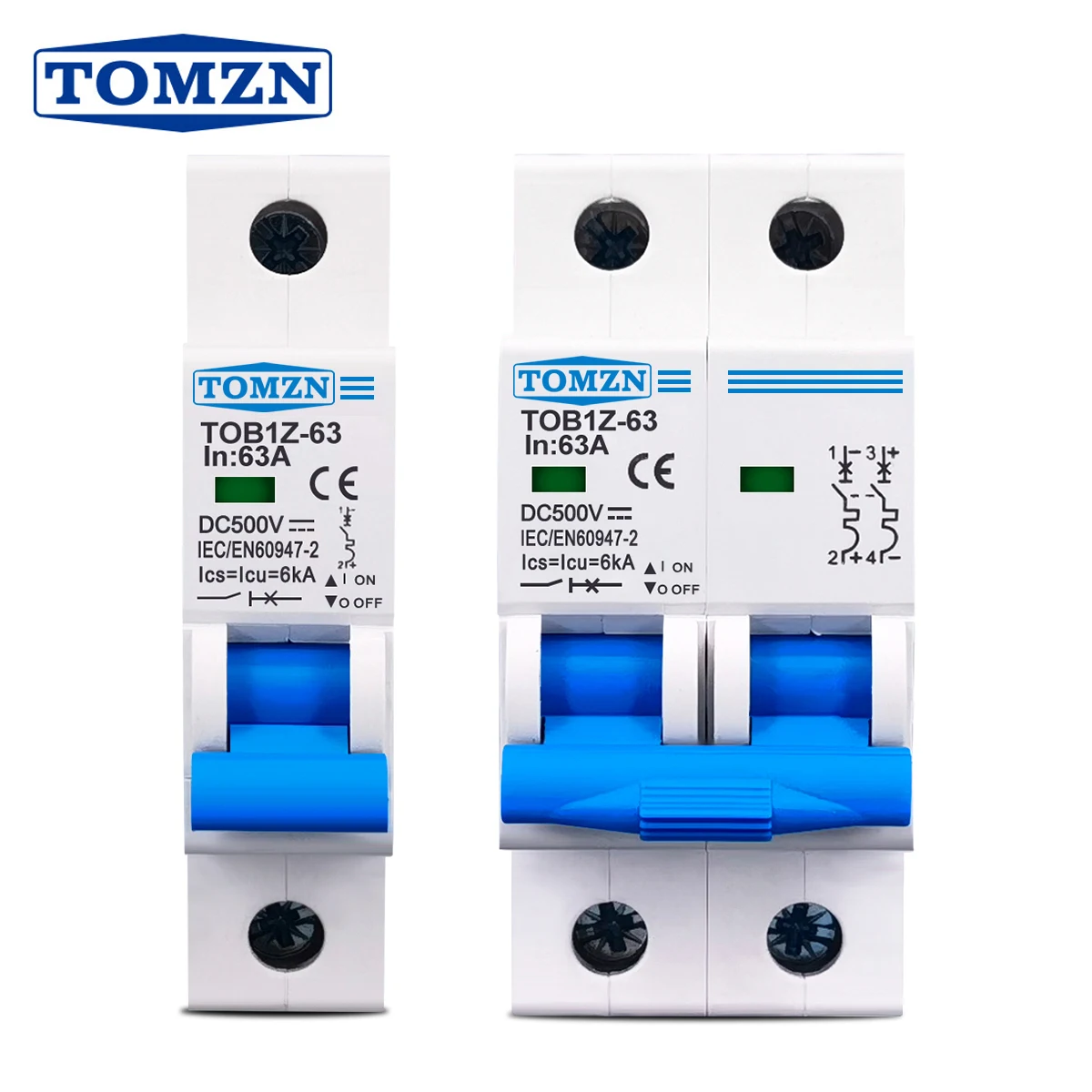
Visually, the TOMZN DC MCB features a compact, modular design, typical of DIN rail-mountable components. The white plastic casing appears robust, suggesting a durable construction suitable for installation within electrical enclosures. The blue toggle switch provides a clear visual indication of the breaker's status (on/off) and offers an ergonomic grip for manual operation. The terminals are clearly marked, and the presence of screw terminals indicates a secure and reliable connection method for various wire gauges. The images show a clean finish, implying good manufacturing quality for its price point. Installation on a standard 35mm DIN rail is straightforward, a common practice in modern electrical panel setups, simplifying system integration. This ease of mounting is a significant advantage for DIY installers.
Operational reliability is paramount for circuit breakers, especially in critical power systems like solar installations. The 6KA interrupting capacity means this breaker can safely handle short-circuit currents up to 6,000 amperes. This capability is essential for preventing catastrophic damage to expensive solar equipment, such as inverters or batteries, during a fault event. The 500V DC rating ensures it can operate effectively in higher voltage solar arrays, which are becoming increasingly common for efficiency gains and reduced wiring costs. The specified compliance with IEC/EN60947-2 standards indicates adherence to international safety and performance benchmarks for low-voltage switchgear and control gear. This provides confidence in its protective function.
Compared to using AC-rated breakers in a DC system, which can lead to dangerous arc flash incidents and failure to clear faults, this dedicated DC MCB offers superior safety. It is a specialized tool for a specialized job.
Integrating these DC MCBs into a solar energy system involves careful planning to maximize efficiency and ensure safety. Placing these breakers strategically allows for isolation of different sections of the PV array or battery bank. This facilitates maintenance and troubleshooting without de-energizing the entire system. For instance, a breaker on each solar string allows for individual string shutdown if a panel needs inspection or replacement. Similarly, a main DC breaker between the charge controller and the battery bank provides a critical disconnect point for battery maintenance or system upgrades. Such modular protection enhances system resilience.
While circuit breakers are primarily safety devices, their impact on system efficiency is minimal when properly selected. A well-chosen breaker with appropriate current ratings will introduce negligible resistance into the circuit, thus preventing any significant power loss. Oversizing a breaker offers no benefit and can compromise safety by failing to trip on smaller overloads. Undersizing, conversely, leads to nuisance tripping and system downtime. The wide range of available amperages for the TOMZN DC MCB allows installers to select the exact rating needed, optimizing both safety and efficiency for their specific load requirements. This precision is a key benefit.
Unlike poorly matched or generic protective devices, these breakers are designed to be an invisible part of the power path during normal operation.
Compatibility is a key concern for solar energy hobbyists expanding or upgrading existing systems. The DIN rail mounting standard ensures broad compatibility with most modern electrical enclosures and distribution boards. The clear terminal markings for input and output, along with the 'Y Connection' indication on the product label, suggest a straightforward wiring process. The 'Y Connection' often refers to parallel string connections or specific inverter input configurations, which are common in solar installations. Verifying the voltage and current requirements of existing solar panels, charge controllers, and inverters against the breaker's specifications is crucial for seamless integration. This ensures the breaker functions as intended within the larger system architecture. It is a flexible component.
The long-term value of a DC MCB extends beyond its initial purchase price. Its primary function is to protect expensive components like solar panels, charge controllers, and battery banks from damage due to electrical faults. The cost of replacing these components far outweighs the investment in quality circuit protection. The durability implied by its construction and compliance with international standards suggests a long operational lifespan, reducing the need for frequent replacements. Regular inspection of the breaker for signs of wear, discoloration, or loose connections is good practice, especially in systems exposed to environmental stressors.
Troubleshooting issues related to a DC MCB typically involves checking for nuisance tripping, which might indicate an undersized breaker or an underlying system fault. If the breaker consistently trips under normal load, it warrants investigation. Conversely, if a fault occurs and the breaker fails to trip, it suggests a faulty unit or an incorrectly specified rating. The visible blue toggle makes it easy to identify a tripped state. Proper wire termination, ensuring tight connections and appropriate torque, is vital for preventing hot spots and maintaining the breaker's longevity. These simple checks can extend the life of the entire system. It is a low-maintenance device.
The TOMZN DC Mini Circuit Breaker provides an accessible and reliable solution for protecting direct current circuits in solar power systems. Its specialized design for DC voltage, broad current rating options, and adherence to safety standards make it a compelling choice for both new installations and system upgrades. This breaker empowers users to build safer, more resilient, and more efficient solar energy infrastructures. Imagine the peace of mind knowing your valuable solar components are safeguarded against unforeseen electrical faults, allowing your off-grid system to operate reliably for years to come, contributing to a sustainable and self-sufficient energy future. It is a small investment for significant protection.
Safeguarding DC Power Infrastructures
Direct current (DC) circuits, particularly those found in solar power systems, present unique challenges for electrical protection compared to alternating current (AC) systems. DC faults, especially arc faults, are notoriously difficult to extinguish due to the continuous flow of current, unlike AC where the current naturally crosses zero. The TOMZN DC MCB addresses this fundamental difference with its dedicated design. It is rated for 500V DC and offers interrupting capacities up to 6KA, indicating a substantial ability to safely break fault currents without sustaining damage or causing further hazards. This high voltage rating makes it suitable for series-connected solar panels, where string voltages can easily exceed 100V and often reach 400V or 500V in larger configurations. Proper protection is paramount.
Current Handling and Configuration Flexibility
This circuit breaker is available in a wide range of current ratings, from 3A to 63A. This versatility allows for precise matching to various components within a solar energy system. For example, lower amperage breakers (3A-10A) might protect individual strings of solar panels, while higher amperage units (32A-63A) could safeguard the main DC busbar connecting multiple strings to a charge controller or inverter. The availability of both 1P (single pole) and 2P (double pole) configurations further enhances its adaptability. A 1P breaker interrupts a single conductor, typically the positive line in a ungrounded DC system, while a 2P breaker interrupts both the positive and negative conductors, providing a more comprehensive isolation. For critical applications, 2P breakers are often preferred for their enhanced safety in completely disconnecting the circuit.
Unlike generic electrical protection devices, these DC MCBs are purpose-built. They manage the unique characteristics of DC arcs effectively.
Visual Build Quality and Installation
Visually, the TOMZN DC MCB features a compact, modular design, typical of DIN rail-mountable components. The white plastic casing appears robust, suggesting a durable construction suitable for installation within electrical enclosures. The blue toggle switch provides a clear visual indication of the breaker's status (on/off) and offers an ergonomic grip for manual operation. The terminals are clearly marked, and the presence of screw terminals indicates a secure and reliable connection method for various wire gauges. The images show a clean finish, implying good manufacturing quality for its price point. Installation on a standard 35mm DIN rail is straightforward, a common practice in modern electrical panel setups, simplifying system integration. This ease of mounting is a significant advantage for DIY installers.
Operational Reliability in DC Systems
Operational reliability is paramount for circuit breakers, especially in critical power systems like solar installations. The 6KA interrupting capacity means this breaker can safely handle short-circuit currents up to 6,000 amperes. This capability is essential for preventing catastrophic damage to expensive solar equipment, such as inverters or batteries, during a fault event. The 500V DC rating ensures it can operate effectively in higher voltage solar arrays, which are becoming increasingly common for efficiency gains and reduced wiring costs. The specified compliance with IEC/EN60947-2 standards indicates adherence to international safety and performance benchmarks for low-voltage switchgear and control gear. This provides confidence in its protective function.
Compared to using AC-rated breakers in a DC system, which can lead to dangerous arc flash incidents and failure to clear faults, this dedicated DC MCB offers superior safety. It is a specialized tool for a specialized job.
System Integration and Efficiency Considerations
Integrating these DC MCBs into a solar energy system involves careful planning to maximize efficiency and ensure safety. Placing these breakers strategically allows for isolation of different sections of the PV array or battery bank. This facilitates maintenance and troubleshooting without de-energizing the entire system. For instance, a breaker on each solar string allows for individual string shutdown if a panel needs inspection or replacement. Similarly, a main DC breaker between the charge controller and the battery bank provides a critical disconnect point for battery maintenance or system upgrades. Such modular protection enhances system resilience.
Mitigating Efficiency Losses
While circuit breakers are primarily safety devices, their impact on system efficiency is minimal when properly selected. A well-chosen breaker with appropriate current ratings will introduce negligible resistance into the circuit, thus preventing any significant power loss. Oversizing a breaker offers no benefit and can compromise safety by failing to trip on smaller overloads. Undersizing, conversely, leads to nuisance tripping and system downtime. The wide range of available amperages for the TOMZN DC MCB allows installers to select the exact rating needed, optimizing both safety and efficiency for their specific load requirements. This precision is a key benefit.
Unlike poorly matched or generic protective devices, these breakers are designed to be an invisible part of the power path during normal operation.
Compatibility with Existing Solar Setups
Compatibility is a key concern for solar energy hobbyists expanding or upgrading existing systems. The DIN rail mounting standard ensures broad compatibility with most modern electrical enclosures and distribution boards. The clear terminal markings for input and output, along with the 'Y Connection' indication on the product label, suggest a straightforward wiring process. The 'Y Connection' often refers to parallel string connections or specific inverter input configurations, which are common in solar installations. Verifying the voltage and current requirements of existing solar panels, charge controllers, and inverters against the breaker's specifications is crucial for seamless integration. This ensures the breaker functions as intended within the larger system architecture. It is a flexible component.
Long-Term Value and Maintenance
The long-term value of a DC MCB extends beyond its initial purchase price. Its primary function is to protect expensive components like solar panels, charge controllers, and battery banks from damage due to electrical faults. The cost of replacing these components far outweighs the investment in quality circuit protection. The durability implied by its construction and compliance with international standards suggests a long operational lifespan, reducing the need for frequent replacements. Regular inspection of the breaker for signs of wear, discoloration, or loose connections is good practice, especially in systems exposed to environmental stressors.
Troubleshooting and Longevity
Troubleshooting issues related to a DC MCB typically involves checking for nuisance tripping, which might indicate an undersized breaker or an underlying system fault. If the breaker consistently trips under normal load, it warrants investigation. Conversely, if a fault occurs and the breaker fails to trip, it suggests a faulty unit or an incorrectly specified rating. The visible blue toggle makes it easy to identify a tripped state. Proper wire termination, ensuring tight connections and appropriate torque, is vital for preventing hot spots and maintaining the breaker's longevity. These simple checks can extend the life of the entire system. It is a low-maintenance device.
Conclusion: Empowering Your Solar Journey
The TOMZN DC Mini Circuit Breaker provides an accessible and reliable solution for protecting direct current circuits in solar power systems. Its specialized design for DC voltage, broad current rating options, and adherence to safety standards make it a compelling choice for both new installations and system upgrades. This breaker empowers users to build safer, more resilient, and more efficient solar energy infrastructures. Imagine the peace of mind knowing your valuable solar components are safeguarded against unforeseen electrical faults, allowing your off-grid system to operate reliably for years to come, contributing to a sustainable and self-sufficient energy future. It is a small investment for significant protection.