tinySA ULTRA Handheld Spectrum Analyzer
Official Store Deal
Expert Analysis Overview
Precision in the Palm: The tinySA ULTRA Spectrum Analyzer
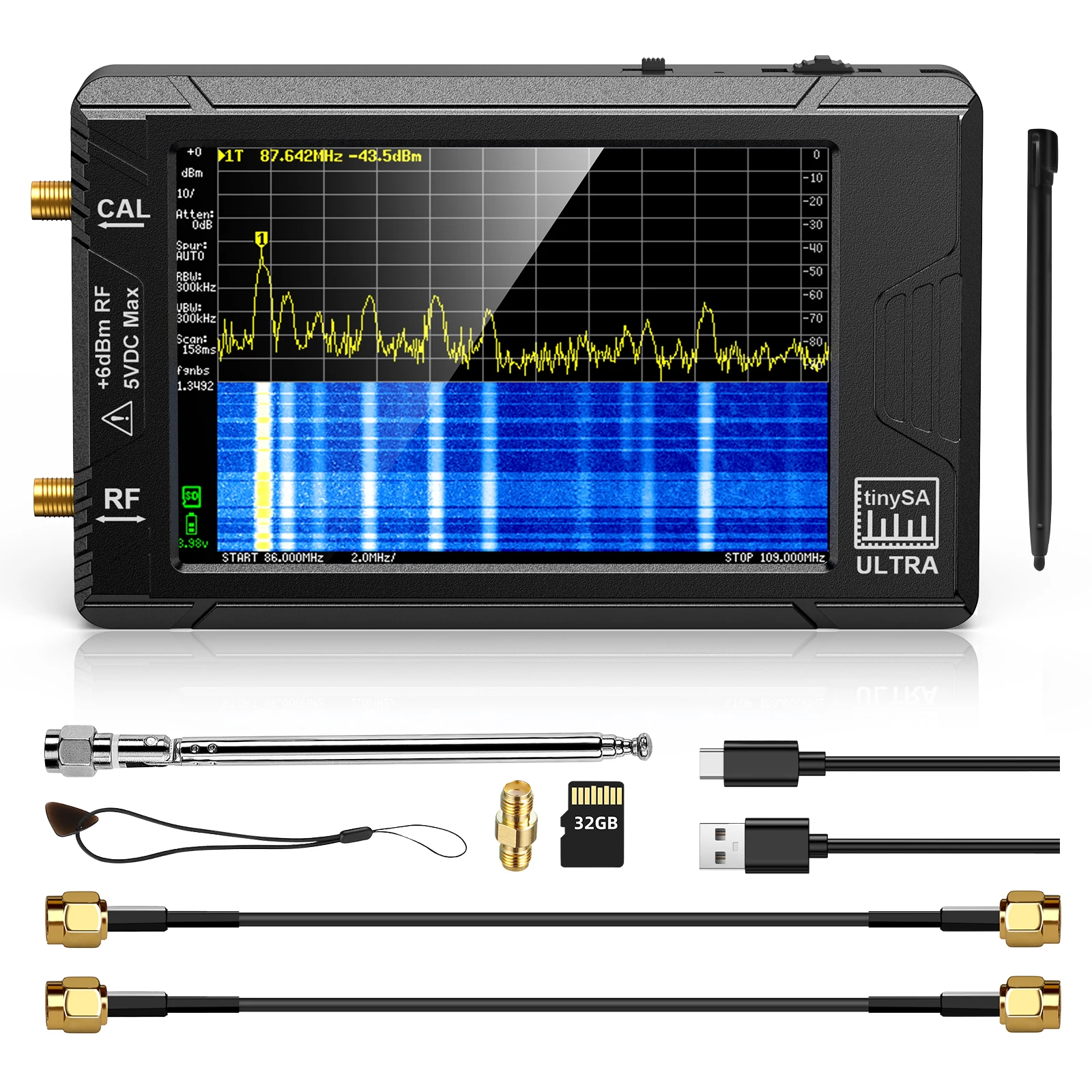
The tinySA ULTRA is a compact, high-frequency spectrum analyzer engineered for radio frequency (RF) diagnostics and signal analysis, targeting hobbyists, field technicians, and educational institutions requiring portable yet capable measurement tools. This device offers a significant upgrade over entry-level analyzers, providing an extended frequency range and enhanced measurement capabilities crucial for accurate spectral assessment.
Expanding the Spectral Horizon
The core capability of the tinySA ULTRA lies in its impressive frequency range, spanning from 100kHz to 5.3GHz. This broad coverage allows for the analysis of a vast array of RF signals, from low-frequency audio harmonics to high-frequency wireless communications. Such a wide operational band is not typically found in devices of this form factor or price point.
For instance, analyzing signals across multiple bands, such as amateur radio, Wi-Fi, and cellular frequencies, becomes a unified task. This eliminates the need for multiple specialized instruments. The ability to sweep such a wide spectrum quickly provides a comprehensive overview of the RF environment.
Compared to standard entry-level spectrum analyzers, which often cap out at a few hundred MHz, the ULTRA's 5.3GHz ceiling represents a substantial leap. This extended range is critical for modern wireless applications, where higher frequencies are increasingly prevalent.
Granular Resolution Bandwidth
Resolution Bandwidth (RBW) is a critical parameter for distinguishing closely spaced signals. The tinySA ULTRA offers a selectable RBW from 200Hz to 850kHz. This range allows for both fine-grained analysis of narrow-band signals and rapid sweeps of broader spectrum segments.
Observing subtle interference or identifying specific modulation characteristics requires a narrow RBW. Conversely, a wider RBW facilitates faster scanning for general signal presence. This flexibility is paramount for diverse measurement scenarios.
Many basic analyzers provide fixed or limited RBW options, hindering detailed signal separation. The variable RBW of the tinySA ULTRA ensures that users can optimize their measurements for precision or speed, depending on the task at hand.
Integrated RF Generation
Beyond its analysis capabilities, the tinySA ULTRA incorporates an RF Generator with an output range of 100kHz to 5.4GHz. This dual functionality is exceptionally valuable for testing and calibrating other RF components. A signal source is essential.
Engineers can inject known signals into circuits to measure their response, characterize filters, or test antenna performance. This integrated generator streamlines the testing process, reducing the need for separate, bulky equipment. It is a powerful diagnostic aid.
Unlike dedicated spectrum analyzers that require an external signal generator, the tinySA ULTRA's built-in source offers a compact and convenient solution. This integration significantly enhances its utility for field work and bench testing alike.
Mitigating Signal Noise: LNA and Attenuator
Accurate RF measurements depend heavily on managing signal levels. The tinySA ULTRA includes both a Low Noise Amplifier (LNA) and an Attenuator. The LNA boosts weak signals, allowing for the detection of low-power transmissions. The attenuator prevents strong signals from overloading the input, preserving measurement integrity.
Detecting distant or faint signals, such as those from remote sensors, is made possible by the LNA. Conversely, analyzing high-power transmitters requires the attenuator to prevent damage and ensure linearity. Proper signal conditioning is vital.
Many portable analyzers omit these crucial components, leading to compromised accuracy at the extremes of signal strength. The inclusion of both an LNA and an attenuator positions the tinySA ULTRA as a more robust and versatile instrument for varied RF environments.
Quantifying Signal Purity: Phase Noise and DANL
Key indicators of measurement quality are the Phase Noise and Displayed Average Noise Level (DANL). The tinySA ULTRA specifies a phase noise of -92dBc@10kHz and a DANL of -166dBm/Hz. These figures indicate the instrument's ability to resolve weak signals and maintain spectral purity.
Low phase noise is critical for analyzing modulated signals, where frequency stability is paramount. A low DANL means the analyzer can detect very weak signals, even those buried deep within the noise floor. These are professional-grade metrics.
Compared to many budget-friendly options, these specifications are highly competitive, suggesting a superior internal architecture for signal processing. This level of performance allows for more reliable identification of spurious emissions and subtle signal characteristics.
Data Logging and Portability
Equipped with a built-in 32GB Micro SD Card, the tinySA ULTRA facilitates extensive data logging and storage. This feature is indispensable for capturing long-term signal behavior, performing comparative analysis, or documenting compliance measurements. Data retention is effortless.
Users can record spectrum sweeps, waterfall displays, and other measurement data directly to the card for later review on a PC. This capability transforms the device from a real-time monitor into a powerful data acquisition tool. Sharing results becomes simple.
Many portable analyzers lack integrated storage, requiring constant connection to a computer for data capture. The tinySA ULTRA's onboard SD card offers true standalone operation, enhancing its utility for field diagnostics and remote monitoring.
Visualizing the RF Landscape
The 4-inch display on the tinySA ULTRA provides a clear and sufficiently large interface for visualizing complex spectral data. A larger screen improves readability, especially when observing detailed waterfall plots or multiple trace lines. Visual clarity is enhanced.
Interpreting signal patterns, identifying transient events, and navigating menus are all made easier with a generous display. The touch interface, complemented by a multi-functional knob, offers intuitive control over the instrument's settings. User interaction is streamlined.
While smaller 2.8-inch versions exist, the 4-inch screen of the ULTRA model significantly improves the user experience for detailed analysis. This larger visual canvas is a distinct advantage for prolonged observation and precise adjustments.
Powering Extended Operations
An integrated 3000mAh battery ensures substantial operational time, making the tinySA ULTRA suitable for extended field use without constant recharging. This capacity supports multiple hours of continuous measurement, crucial for troubleshooting intermittent issues or conducting site surveys. Long-duration tasks are supported.
Reliable power is a fundamental requirement for any portable test equipment. The substantial battery capacity minimizes downtime and maximizes productivity in environments where power outlets are scarce. This ensures uninterrupted workflow.
Many smaller devices compromise on battery life to achieve compactness. The tinySA ULTRA strikes a balance, offering a robust power source that aligns with its advanced capabilities, providing confidence during critical measurements.
Connectivity and Integration
The device features a Type-C interface for modern connectivity, an SD Card Interface for data transfer, and a 3.5mm jack for potential audio output or external control. These interfaces ensure seamless integration with other systems and peripherals. Versatility is key.
Connecting to a PC via Type-C allows for advanced control, data transfer, and firmware updates. The SD card interface facilitates easy data offloading. The 3.5mm jack could be used for monitoring demodulated audio or triggering external events. System interoperability is high.
This comprehensive suite of connectivity options surpasses many basic handheld devices, which often offer only a single USB port. The tinySA ULTRA's design prioritizes user convenience and system integration, making it a more adaptable tool for various technical workflows.
The Metrologist's Edge
For professionals and enthusiasts alike, the tinySA ULTRA offers a compelling blend of performance, portability, and value. Its ability to measure down to fine spectral details, provide repeatable results, and log extensive data makes it an indispensable tool. Imagine effortlessly identifying elusive interference sources in a crowded RF environment, or precisely characterizing the performance of a newly designed antenna. This instrument empowers users to gain a deeper understanding of their RF systems, ensuring optimal performance and compliance. The robust feature set, including the wide frequency range, flexible RBW, integrated generator, and comprehensive data logging, positions the tinySA ULTRA as a superior choice for anyone serious about accurate and efficient RF analysis. It is an investment in enhanced diagnostic capability and operational efficiency.