TC1 Multi-function Transistor Tester
Official Store Deal
Expert Analysis Overview
Precision Component Analysis for the Modern Technician
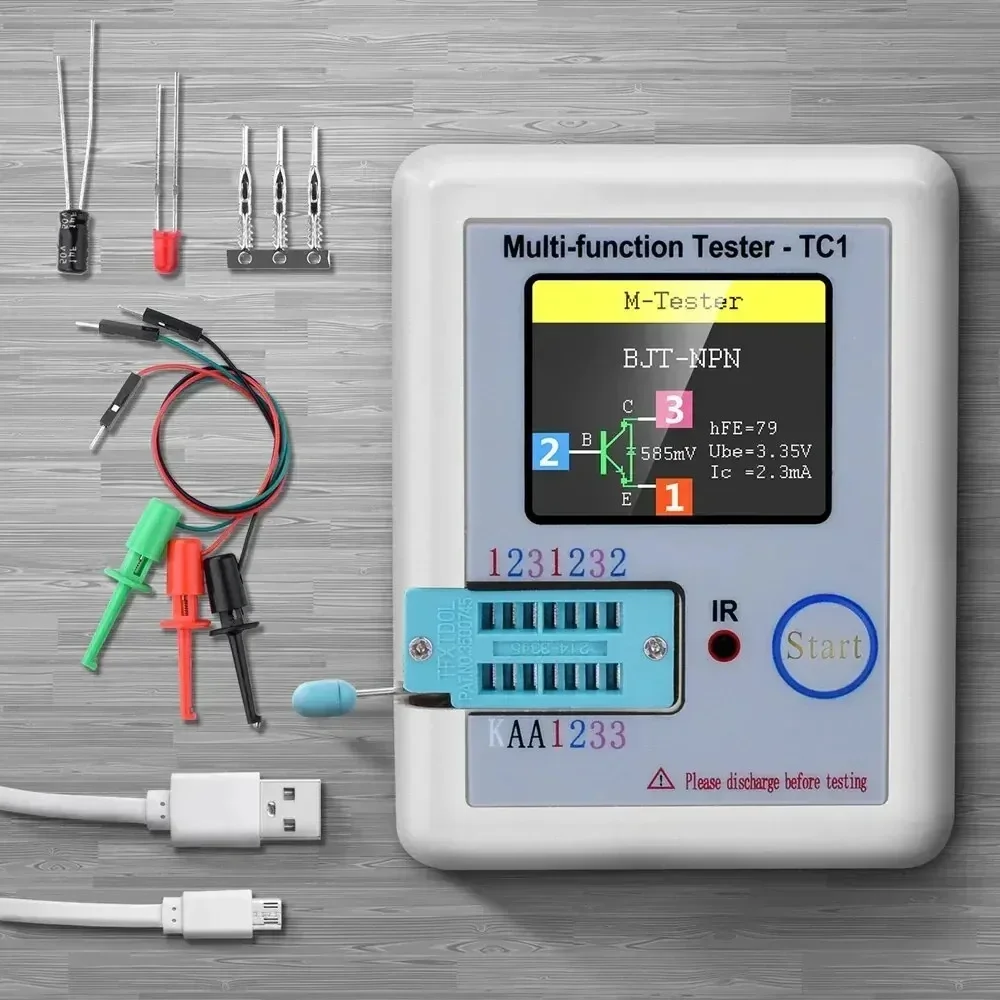
The TC1 Multi-function Transistor Tester is a compact, yet remarkably capable, diagnostic instrument engineered for electronics enthusiasts and professional technicians requiring precise characterization of discrete components. This device streamlines the often-tedious process of identifying and testing transistors, diodes, capacitors, and resistors, offering a significant upgrade over traditional, less automated methods. Its integrated design and intuitive interface position it as an indispensable tool for rapid circuit debugging and component verification.
Unveiling Component Characteristics
The primary function of the TC1 is to accurately identify and measure the parameters of various electronic components. It automatically detects NPN and PNP bipolar transistors, N-channel and P-channel MOSFETs, JFETs, diodes (including dual diodes), thyristors, and triacs. The device displays pin configuration, which is crucial for correct circuit integration. This automatic detection capability saves considerable time.
Traditional multimeters often require manual range selection and specific test setups for each component type. The TC1 eliminates this complexity. It provides a streamlined workflow.
For instance, when testing a bipolar junction transistor (BJT), the TC1 not only identifies its type (NPN or PNP) but also measures the current amplification factor (hFE) and the base-emitter voltage (Uf). These parameters are vital for understanding a transistor's performance in amplification or switching applications. The ability to quickly obtain these values ensures that components meet design specifications before integration into a circuit.
Capacitance and Resistance Metrology
Capacitors and resistors are fundamental building blocks in virtually all electronic circuits, and their accurate measurement is paramount. The TC1 offers precise capacitance measurement, including the equivalent series resistance (ESR) for capacitors larger than 2µF. ESR is a critical parameter, especially for electrolytic capacitors, as high ESR can indicate component degradation and lead to circuit malfunction. This level of detail is often absent in basic multimeters.
Resistance measurements are performed with high resolution, allowing for the identification of resistor values from 0.01Ω up to 50MΩ. The device's ability to measure resistance with such granularity ensures that even small deviations from expected values are detected. This precision is essential for sensitive analog circuits. It prevents costly errors.
Unlike many entry-level testers that provide only a nominal resistance value, the TC1's measurement accuracy helps in identifying subtle component drifts. Such drifts can significantly impact circuit performance over time. The instrument's internal calibration routines contribute to repeatable results across multiple tests.
Diode and Zener Diode Analysis
Diode testing is a core capability, with the TC1 able to identify the forward voltage drop and junction capacitance. For Zener diodes, a dedicated test area is provided, allowing for the measurement of Zener breakdown voltage up to 4.5V. This specialized function is particularly useful for power supply design and voltage regulation circuits. Accurate Zener voltage is critical.
Many general-purpose multimeters offer only a basic diode test mode, which typically measures forward voltage drop but lacks the ability to characterize Zener diodes effectively. The TC1's specialized Zener test area simplifies this process. It provides direct, actionable data. This capability enhances the utility of the device for more advanced diagnostic tasks.
Infrared Remote Control Decoding
A unique feature of the TC1 is its integrated IR receiver window, which allows it to decode infrared remote control signals. When a remote control signal is directed at the IR receiver, the tester displays the user code and data code. This functionality is invaluable for troubleshooting remote controls or reverse-engineering IR communication protocols. It offers diagnostic insight.
This goes beyond standard component testing, adding a layer of utility for hobbyists working with home automation or repair technicians dealing with consumer electronics. The visual representation of the IR codes simplifies verification. It confirms remote control functionality. This feature is a clear differentiator from typical component testers.
Operational Efficiency and Display Clarity
The device features a 1.8-inch TFT LCD display with a resolution of 160x128 pixels. This color display provides clear, concise information, including component type, pinout, and measured parameters, often with graphical representations. The visual feedback is immediate and easy to interpret. This enhances user experience.
Operation is simplified by a single multi-function key, which initiates tests and navigates menus. This one-button operation minimizes complexity, making the device accessible even to those new to electronics testing. The automatic power-off design conserves battery life. It is a practical consideration.
Power is supplied via a rechargeable internal battery, charged through a Micro USB interface. This modern charging solution ensures compatibility with common power adapters. A charge indicator LED provides status updates. The portability afforded by the internal battery makes the TC1 suitable for fieldwork or bench use without tethering to a power outlet.
Build Quality and Portability
The visible casing suggests a durable plastic construction, designed to withstand the rigors of a workshop environment. Its compact form factor makes it highly portable, easily fitting into a toolkit or lab coat pocket. The inclusion of various test leads, including alligator clips and probe hooks, enhances its adaptability to different testing scenarios. The design prioritizes practical use.
Compared to bulkier, bench-top component testers, the TC1 offers a significant advantage in terms of space efficiency and mobility. Its lightweight nature does not compromise its functional breadth. This makes it an ideal companion for on-site repairs or educational settings where space is at a premium. The robust construction implies longevity.
The Metrologist's Perspective on Value
From a metrological standpoint, the TC1 offers a compelling balance of capability and cost. While not a certified laboratory instrument, its ability to provide repeatable results for common component parameters is highly valuable for diagnostics and hobbyist projects. The resolution displayed on the TFT screen, particularly for resistance and capacitance, allows for fine-grained analysis. This is crucial for precision work.
For technicians who frequently encounter unknown components or need to quickly verify parts from a bin, the TC1 significantly reduces diagnostic time. Its automated nature minimizes human error. The device's internal calibration, while not user-adjustable, ensures a baseline level of accuracy. This is a practical tool.
Imagine effortlessly identifying a faulty transistor in a vintage radio, or quickly sorting through a batch of unmarked capacitors to find the exact value needed for a filter circuit. The TC1 empowers users to perform these tasks with confidence and efficiency, transforming what could be hours of manual testing into mere seconds. This instrument provides the capability to maintain project momentum, ensuring that component verification is a quick step, not a bottleneck. It allows for more time spent on design and less on troubleshooting. The precision it offers, down to the detection of subtle component characteristics, ensures that projects are built on a solid foundation of verified parts. This is true efficiency. The TC1 is a smart investment for anyone serious about electronics work.