SUNLU PLA+ 2.0 High-Speed 3D Filament
Official Store Deal
Expert Analysis Overview
Precision Prototyping with SUNLU PLA+ 2.0 Filament
SUNLU PLA+ 2.0 is an advanced 3D printing filament engineered for demanding additive manufacturing applications. This material targets users requiring enhanced mechanical properties and higher print speeds than conventional PLA.
Material Composition and Enhanced Properties
The SUNLU PLA+ 2.0 filament is derived from corn starch, positioning it as an eco-friendly option within the 3D printing material landscape. This bio-based origin contributes to its biodegradability, a significant advantage for environmentally conscious users. The material's formulation has been significantly upgraded from standard PLA, resulting in a filament that exhibits superior impact strength and elongation at break. This makes printed parts more resilient.
Compared to ordinary PLA+, the PLA+ 2.0 variant demonstrates an impact strength of 8 KJ/M, nearly double the 3.9 KJ/M of its predecessor. This substantial increase in toughness means components are less prone to fracturing under stress or accidental drops. The improved elongation at break, at 19.725% versus 18.5%, indicates a greater capacity for the material to deform before breaking, which is crucial for parts requiring a degree of flexibility or resistance to sudden impacts. Such characteristics are vital for functional prototypes or end-use parts that experience moderate mechanical loads. The material is designed for durability.
Traditional PLA often presents limitations in terms of part strength and brittleness, making it less suitable for applications where components might endure physical stress. The SUNLU PLA+ 2.0 directly addresses these shortcomings, offering a material that bridges the gap between standard PLA's ease of use and the mechanical robustness of more technical filaments like ABS, without the associated printing complexities. This upgrade provides a compelling alternative for users seeking improved performance without transitioning to more challenging materials. It's a clear step forward.
Dimensional Accuracy and Print Consistency
A critical aspect of successful 3D printing is the dimensional accuracy of the filament. The SUNLU PLA+ 2.0 maintains a precise diameter of 1.75mm with a tight tolerance of +/-0.02mm. This stringent manufacturing standard ensures a consistent material flow through the printer's hotend.
Consistent filament diameter directly translates to more reliable extrusion and, consequently, higher print quality. Fluctuations in filament diameter can lead to inconsistent layer lines, under-extrusion, or over-extrusion, all of which compromise the structural integrity and aesthetic finish of a printed object. With such tight tolerances, users can expect smooth printing operations, excellent layer adhesion, and minimal issues like stringing or warping. This precision is paramount for intricate designs. Bubbles and tangles are also significantly reduced, contributing to a smoother printing experience and fewer failed prints. It minimizes print failures.
Many generic filaments on the market often exhibit wider diameter tolerances, sometimes up to +/-0.05mm or more. While seemingly minor, these variations can accumulate over a print, leading to noticeable defects and wasted material. The SUNLU PLA+ 2.0's superior dimensional accuracy positions it as a reliable choice for creating dimensionally accurate engineering parts and high-quality prototypes where precision is non-negotiable. This level of consistency is a hallmark of premium filament. It ensures reliable results.
High-Speed Printing Capabilities
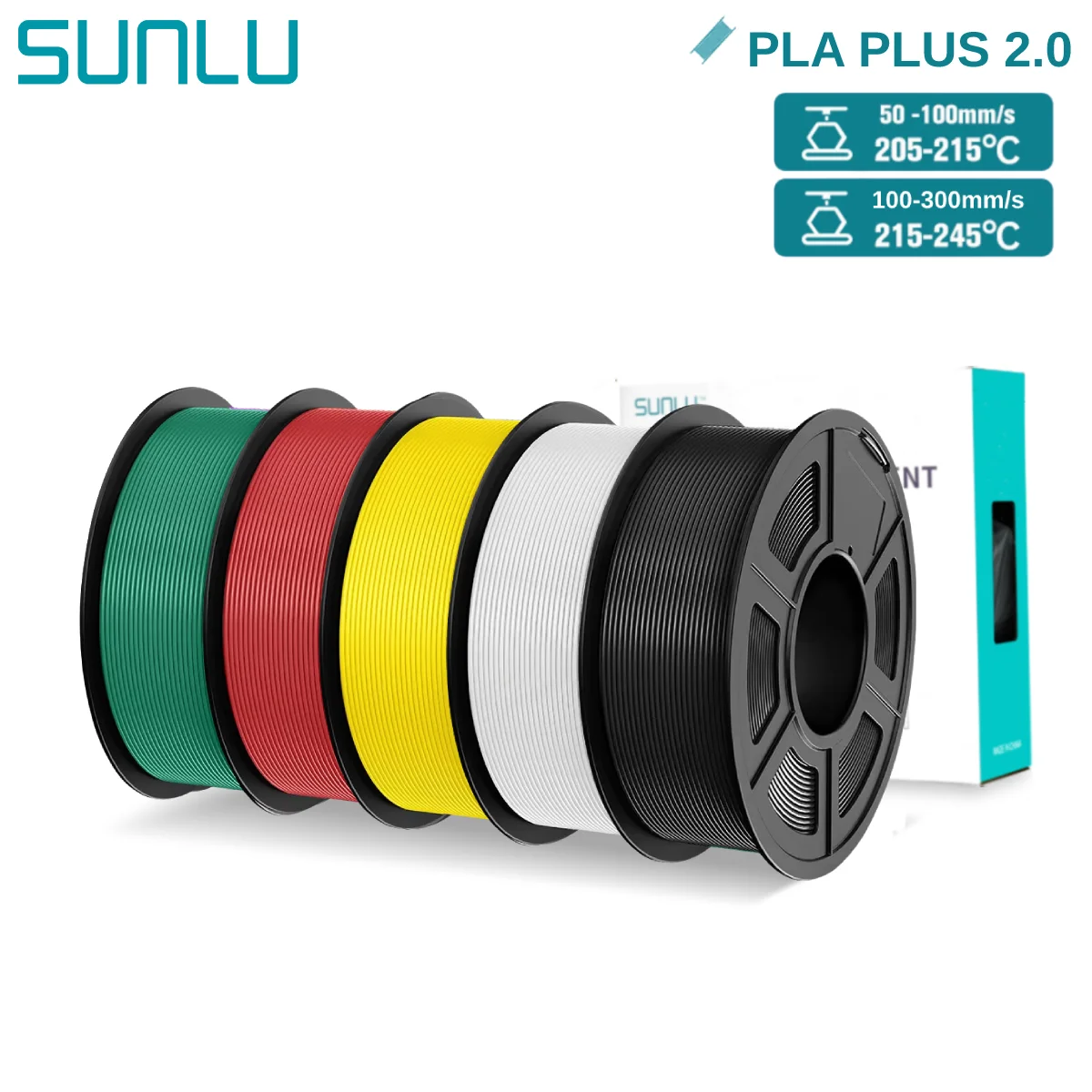
One of the most significant advancements of the SUNLU PLA+ 2.0 is its compatibility with high-speed 3D printing. The filament supports print speeds ranging from 50-300mm/s, depending on the chosen temperature profile. For speeds between 50-100mm/s, a print temperature of 205-215°C is recommended, while for faster speeds up to 300mm/s, the temperature range extends to 215-245°C.
This broad speed compatibility allows users to significantly reduce print times, a crucial factor for both hobbyists and professional users with high production demands. The ability to print at 300mm/s represents a substantial increase over standard PLA filaments, which typically max out around 100mm/s. This efficiency gain does not come at the expense of quality, as the material's formulation is optimized to maintain print integrity even at elevated speeds. Faster prints mean quicker iterations. This capability is particularly beneficial for large models or batch production, where every hour saved translates into increased output. It prints difficult materials reliably.
Traditional PLA often struggles with maintaining print quality at higher speeds, leading to issues like poor layer adhesion, ghosting, or ringing. The SUNLU PLA+ 2.0's formulation is specifically designed to overcome these challenges, making it suitable for modern FDM printers equipped with high-speed capabilities. This positions the filament as an ideal choice for users looking to maximize the throughput of their 3D printers without compromising on the mechanical properties or surface finish of their prints. It's built for speed.
User Experience and Compatibility
The SUNLU PLA+ 2.0 filament is designed for wide compatibility with all FDM 3D printers on the market. This universal compatibility simplifies material selection for users, regardless of their printer brand or model. The neatly wound spools prevent tangles and snags during printing, ensuring uninterrupted operation.
An untangled spool is a small but significant detail that greatly enhances the printing experience. Filament tangles are a common cause of print failures, leading to wasted material, time, and frustration. The careful winding of SUNLU spools minimizes this risk, allowing for unattended printing with greater confidence. The material's good adhesion properties further contribute to a positive user experience, ensuring that prints stick reliably to the build plate. This reduces the likelihood of prints detaching mid-process. It adheres well.
Many filaments, especially those from less reputable manufacturers, often come poorly wound, leading to frequent interruptions and the need for constant supervision. The SUNLU PLA+ 2.0, with its focus on consistent winding and broad compatibility, offers a hassle-free printing solution that allows users to focus on design and innovation rather than troubleshooting material feed issues. This commitment to user convenience sets it apart. It works with many machines.
Value Proposition and Long-Term Benefits
Investing in a high-quality filament like SUNLU PLA+ 2.0 offers significant long-term value beyond its initial purchase price. The enhanced strength and reliability reduce print failures, minimizing material waste and saving valuable printing time. The ability to print at higher speeds further boosts productivity, making the overall cost-per-part more economical.
Consider a scenario where a user frequently prints functional prototypes or small batch production runs. The increased impact strength means fewer broken parts during testing or use, reducing the need for reprints. The higher print speeds allow for more iterations or a greater volume of finished products within the same timeframe. This efficiency directly translates into cost savings and faster project completion. It's an investment in productivity.
Compared to cheaper, lower-quality filaments that might offer a lower upfront cost, the SUNLU PLA+ 2.0 provides a superior return on investment through reduced waste, increased reliability, and higher throughput. The improved mechanical properties also mean that printed parts are more durable and functional, extending their lifespan and utility. This makes it a cost-effective choice for serious 3D printing enthusiasts and professionals alike. It saves money over time.
Imagine completing complex projects in a fraction of the time, knowing your prints will withstand real-world use. Visualize a workshop where failed prints are a rare occurrence, and every spool of filament contributes efficiently to your creative or professional goals. This filament empowers creators to push the boundaries of what's possible with FDM 3D printing, delivering consistent, high-quality results with every layer.