SUNLU PETG 3D Printer Filament with Reusable Spool
Official Store Deal
Expert Analysis Overview
The Foundation of Form and Function: SUNLU PETG Filament
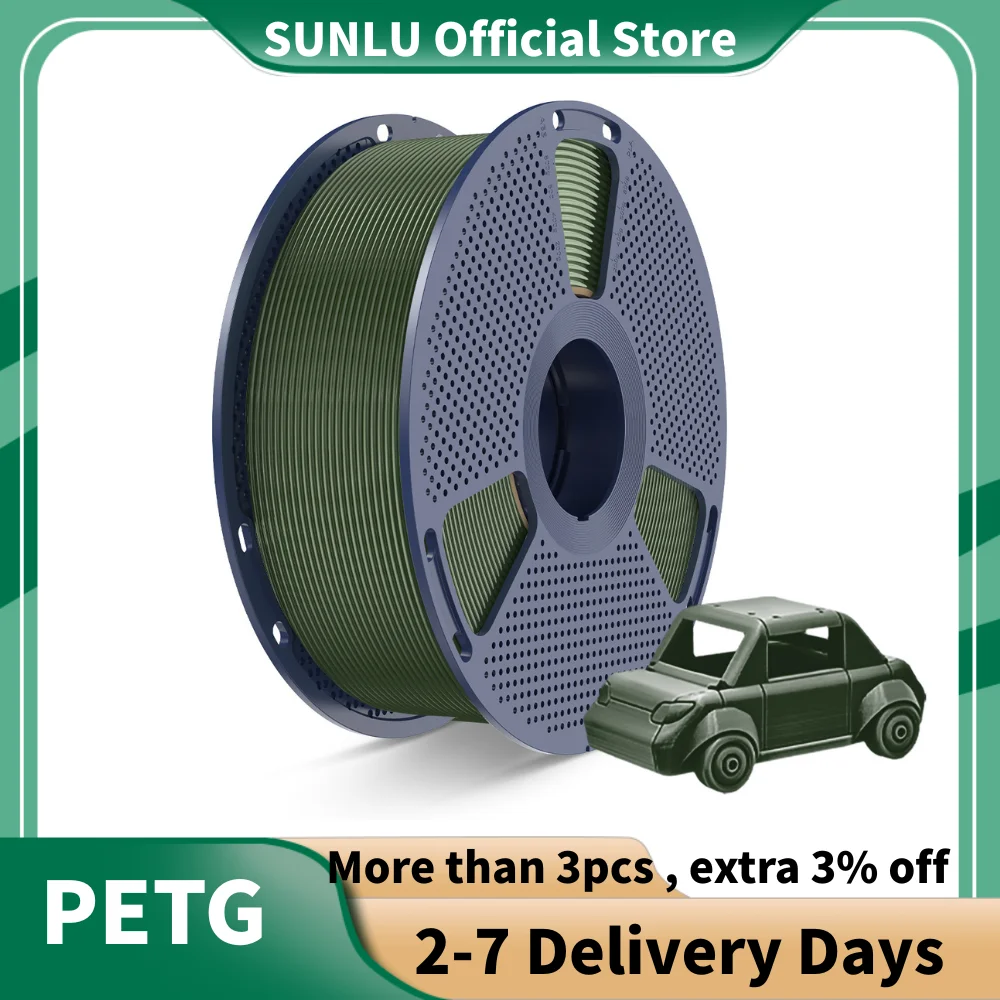
The SUNLU PETG 3D Printer Filament is a versatile and robust material engineered for makers who demand both strength and printability for their functional prototypes and custom upgrades. This offering is tailored for enthusiasts and professionals who regularly iterate on designs and require a material that stands up to real-world use.Visible from the product imagery, the filament presents a consistent diameter on its spool. This consistency is paramount for reliable extrusion.
For makers, consistent filament diameter directly translates to predictable print quality, reducing nozzle clogs and extrusion inconsistencies. This enables more successful long prints.
Compared to entry-level PLA filaments, which can vary in diameter more significantly, this tighter tolerance minimizes print failures and material waste, a critical factor for project budgets.
Spooling Smarter, Not Harder: The Reusable Design
A standout feature is the reusable filament spool, explicitly designed for compatibility with Bambulab Refill Filament. This modular approach is a significant shift in the 3D printing consumables market.This design allows users to purchase filament refills without the plastic spool, reducing environmental impact and long-term costs. Spool assembly appears straightforward.
Many standard filaments come on single-use plastic spools, which accumulate quickly in a busy workshop. The reusable system directly addresses this waste.
The images detail a rotary locking mechanism that clicks into place, ensuring the refill is securely housed within the reusable spool. This secure fit prevents wobbling during printing.
A stable spool ensures smooth filament feeding into the extruder, preventing snags or uneven tension that can lead to print artifacts. Smooth feeding is essential.
Traditional spools, once empty, are often discarded, contributing to plastic waste. This reusable model provides a sustainable alternative, aligning with modern maker ethics.
Precision in Every Layer: Neatly Wound Filament
The filament boasts a neatly wound spool, with machine winding preventing tangles. This detail is often overlooked but profoundly impacts print success.Machine winding ensures that the filament unwinds smoothly without snags or knots, which are common culprits for failed prints or mid-print interruptions. No more tangled messes.
Unlike poorly wound generic filaments, where overlaps and knots can cause the printer to jam, a precisely wound spool offers peace of mind during long print jobs.
This meticulous winding contributes to a smoother printing experience, allowing the user to focus on design and post-processing rather than troubleshooting filament delivery. Less downtime means more creation.
Consistent filament flow is critical for achieving accurate dimensions and surface finishes, particularly for parts requiring tight tolerances or intricate details. Every layer counts.
For complex mechanical parts or multi-part assemblies, where dimensional accuracy is non-negotiable, the reliability offered by a neatly wound spool is a significant advantage over cheaper, less consistent alternatives.
Beyond the Build Plate: PETG Strength and Durability
PETG (Polyethylene Terephthalate Glycol) is highlighted for its stronger and high toughness properties, delivering a durable print with strong impact resistance and flexibility. This material bridges the gap between PLA and ABS.This material choice makes the filament ideal for functional parts that will experience stress, impacts, or require some flexibility without breaking. PETG offers a balance of properties.
Compared to PLA, which is more brittle, or ABS, which can be challenging to print without an enclosure, PETG offers a more forgiving printing experience with superior mechanical properties.
Visual demonstrations show hooks under load and material bending strength. These real-world examples illustrate the material's resilience.
Such toughness means printed parts are less prone to shattering or snapping under moderate force, making them suitable for tools, protective casings, or outdoor applications. Durability is key.
Many DIY projects demand materials that can withstand more than just static display. PETG provides the structural integrity needed for practical, everyday items, outperforming many common filaments.
The Maker's Material Choice: Balancing Ease and Performance
The product description positions PETG as offering a durable print with strong impact resistance and flexibility, akin to PLA for ease of printing but approaching ABS for strength. This is a compelling proposition.For makers, this means less time battling print settings and more time designing and iterating on robust parts. Ease of use combined with strength is powerful.
Often, makers must choose between ease of printing (PLA) and part strength (ABS). PETG aims to offer the best of both worlds, reducing the need for specialized equipment.
The filament's tolerance of +/-0.02mm further underscores its quality. Tight tolerances are crucial for consistent extrusion and precise part dimensions.
This precision ensures that layers adhere uniformly and that intricate details are reproduced accurately, which is vital for mechanical components or parts that need to fit together perfectly. Accuracy matters greatly.
When creating custom jigs, fixtures, or replacement parts for existing machinery, a filament with tight dimensional tolerance like this PETG significantly reduces the need for post-print sanding or adjustments, saving valuable time in the workshop.
Technical Specifications for the Tinkerer
Understanding the precise characteristics of a filament is crucial for any maker. The consistent 1.75mm diameter, coupled with a tight tolerance, ensures predictable flow rates and layer adhesion.This tight tolerance directly impacts the consistency of the extruded line, leading to more uniform walls and fewer visible layer lines. Precision is evident.
Many generic filaments often have wider tolerances, which can lead to variations in extrusion width and potential under or over-extrusion issues across a print, complicating calibration.
The material's inherent properties, such as its transparency in white color, offer aesthetic versatility for projects where light transmission or a clean, crisp finish is desired. Transparency can be an asset.
For projects like lamp shades, diffusers, or visual prototypes, the ability to achieve a high transparency in the white filament adds a layer of design flexibility. Creative applications are endless.
Unlike opaque materials that block light entirely, a translucent PETG can create unique visual effects and functional lighting elements, expanding the creative possibilities for custom builds.
Enhancing Your Craft: Community and Customization
For the maker community, this PETG filament, particularly with its reusable spool system, encourages experimentation and iterative design. The cost-saving from refill spools means more material for testing.More affordable material access allows for bolder experiments with custom part geometries and functional modifications without excessive financial risk. Experimentation is encouraged.
Many online communities share print settings and designs for various filaments. This product fits well into that collaborative environment.
Its robust nature makes it suitable for creating durable parts that can serve as upgrades for existing machines or components. Think long-term utility.
Imagine printing custom enclosures for electronics, reinforced brackets for workshop tools, or even replacement parts for household appliances that often break. The possibilities are vast.
This filament empowers makers to move beyond decorative prints, enabling them to truly modify and improve their surroundings with strong, reliable, self-printed components, offering a tangible return on their investment in 3D printing.
Optimizing Your Workflow
Proper filament handling is critical for achieving the best results with PETG. Due to its hygroscopic nature, storing the filament in a dry environment is highly recommended to prevent moisture absorption.Moisture in filament can lead to stringing, bubbling, and poor layer adhesion, compromising print quality. Dry filament prints best.
Many makers use dry boxes or dehydrators to maintain optimal filament conditions, ensuring consistent print performance throughout the spool's life.
When dialing in print settings, starting with the manufacturer's recommended temperatures for nozzle and bed is a good baseline. PETG often requires slightly higher temperatures than PLA.
Fine-tuning retraction settings is also crucial for minimizing stringing, a common characteristic of PETG. Small adjustments make a difference.
Each printer setup can vary, so a small calibration print, such as a temperature tower or retraction test, can quickly optimize settings for flawless results.