SUNLU High Speed Matte PETG Filament
Official Store Deal
Expert Analysis Overview
The SUNLU High Speed Matte PETG Filament is a performance-oriented 3D printing material tailored for enthusiasts and professionals seeking accelerated production cycles without sacrificing aesthetic finish or mechanical integrity. This filament represents a significant step forward for those aiming to push the boundaries of their FDM printers, offering characteristics that bridge the gap between easy-to-print PLA and the robust durability of ABS, all while enabling rapid prototyping and batch production.
Modern 3D printing often faces a bottleneck in print speed, especially with engineering-grade materials. Traditional PETG, while valued for its strength and moderate flexibility, typically requires slower print speeds to mitigate common issues like stringing and oozing. This high-speed formulation directly addresses that limitation. It is engineered to maintain optimal flow and adhesion even when extruder speeds are dramatically increased, allowing for prints that complete in a fraction of the time compared to standard PETG.
Imagine a scenario where a user needs to iterate through multiple design revisions for a custom drone frame or quickly produce a batch of functional prototypes for a new robotics project. The ability to print at speeds up to 600mm/s means that what once took hours can now be accomplished in minutes. This acceleration drastically shortens development cycles, making experimentation more feasible and less time-consuming for the dedicated maker.
Compared to conventional PETG, which often caps out around 50-100mm/s for quality results, this high-speed variant fundamentally changes the economics of production. It provides an efficiency gain that translates directly into more parts per hour or more design iterations per day. This is a crucial advantage for anyone looking to maximize the output of their 3D printing setup.
Beyond its speed capabilities, the filament offers a matte finish, a significant aesthetic departure from the glossy look often associated with standard PETG. This non-reflective surface can hide layer lines more effectively, resulting in prints with a smoother, more professional appearance. For functional parts, a matte finish can also reduce glare, which is beneficial in certain applications like camera housings or dashboard mounts.
Printing parts for display or for integration into a polished product often benefits from this subdued texture. The matte surface diffuses light rather than reflecting it directly, giving objects a sophisticated and less 'plastic-y' feel. This aesthetic choice provides an immediate visual upgrade for many projects, moving them beyond the typical hobbyist look.
Many makers often resort to post-processing techniques like sanding or painting to achieve a non-glossy finish on their prints. This filament eliminates that extra step, saving valuable time and effort. The inherent matte quality means that parts come off the print bed ready for use or assembly, streamlining the workflow for those focused on efficiency and final product presentation.
This high-speed PETG is explicitly designed to be "tough as ABS", suggesting comparable mechanical properties in terms of impact resistance and structural integrity. ABS is renowned for its strength and ability to withstand higher temperatures, making it a popular choice for demanding applications. Achieving similar toughness with the printability of PETG is a compelling proposition.
For functional components that will experience stress, impact, or regular handling, this material offers a robust solution. Think of custom tool holders, protective enclosures for electronics, or structural brackets for home automation projects. The inherent strength ensures that printed parts will stand up to real-world use without premature failure.
Unlike traditional ABS, which often requires an enclosed printer to prevent warping and can emit strong fumes, PETG generally prints with less odor and is less prone to warping on an open-frame printer. Combining ABS-like toughness with PETG's printability makes this filament an excellent choice for a wider range of users, from those with basic desktop printers to those with more advanced setups, without the need for specialized ventilation or enclosures.
The recommended print temperature range of 230-270°C and hot bed temperature of 70-80°C are critical for optimal print quality and adhesion. These settings indicate a material that requires a slightly higher extrusion temperature than PLA but remains within the capabilities of most common FDM printers. Proper temperature management is key to achieving strong layer adhesion and preventing issues like warping or poor extrusion.
Successfully melting and extruding the filament at high speeds requires precise thermal control. The hotter print temperatures ensure that the plastic flows smoothly through the nozzle, even when the extruder motor is pushing it through rapidly. This prevents under-extrusion and allows for consistent, strong layers, which are vital for the integrity of the final print.
Compared to PLA's lower temperature requirements, PETG's higher thermal demands mean users should verify their printer's hotend can consistently reach and maintain these temperatures. Printers with all-metal hotends are generally better suited for prolonged high-temperature printing. Adhering to these recommended settings helps unlock the full potential of the filament's high-speed and tough properties.
The 1.75mm filament diameter is the industry standard for most consumer and prosumer FDM 3D printers. This widespread compatibility ensures that the filament can be used across a vast array of machines without requiring modifications or adapters. Consistency in diameter is paramount for reliable extrusion and print quality.
Precise diameter tolerance ensures a consistent material flow rate through the nozzle, which directly impacts the accuracy of printed dimensions and the overall smoothness of the print's surface. Deviations in filament diameter can lead to under-extrusion, over-extrusion, or inconsistent layer lines, all of which compromise print quality.
While some industrial printers use 2.85mm filament, the 1.75mm standard dominates the desktop market. This makes the SUNLU filament a straightforward drop-in solution for the majority of users, eliminating concerns about compatibility and allowing makers to focus on their designs rather than filament specifications.
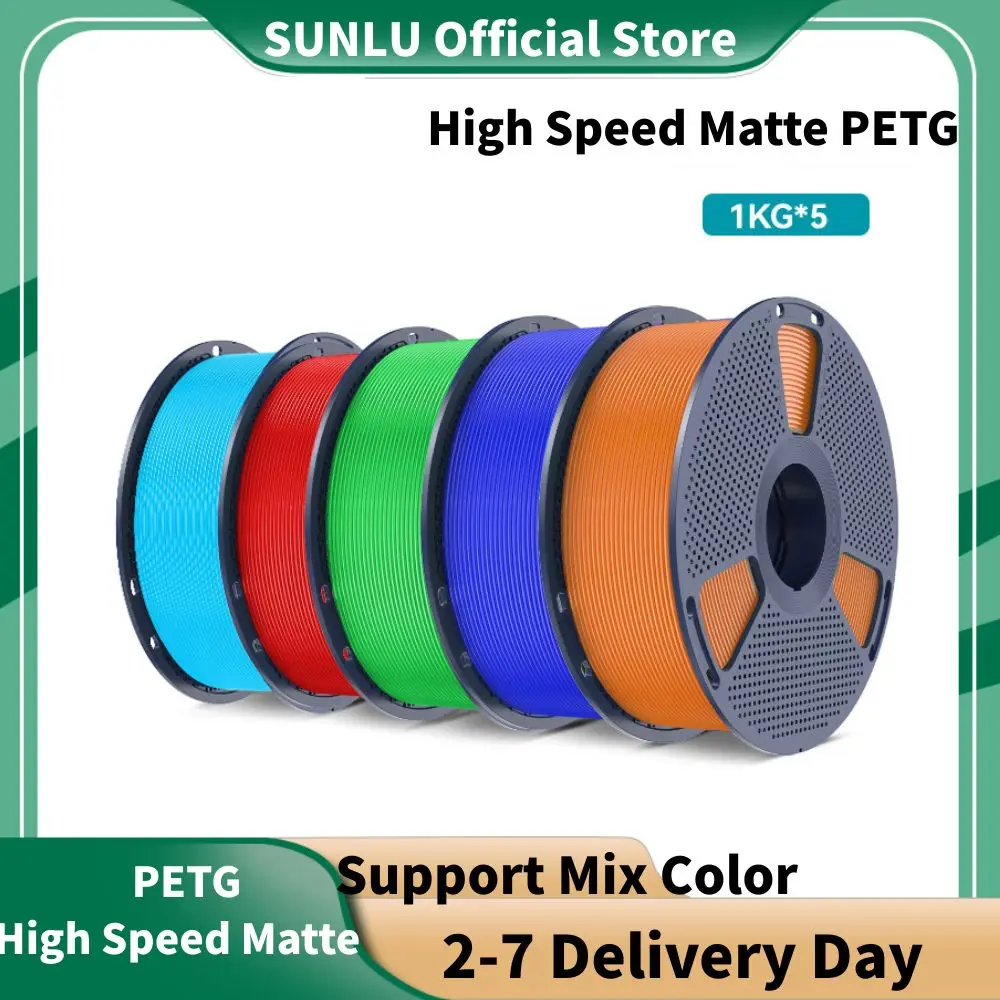
The product is offered as a 5KG bundle, consisting of five 1KG spools, allowing for mixed color support. This bulk packaging offers significant value for makers who consume a large amount of filament or who frequently experiment with different colors. Having multiple spools on hand minimizes the need for frequent reordering and ensures continuity in production.
For a maker running a small print farm or tackling a large-scale project that requires many parts, buying in bulk is a practical and economical choice. The ability to mix and match colors from the bundle encourages creative freedom and allows for the production of multi-color assemblies without the added cost of buying individual spools. It also simplifies inventory management.
This multi-spool offering contrasts with purchasing single 1KG spools, which often carry a higher per-kilogram cost. The bundle provides a cost-effective solution for consistent filament supply, particularly beneficial for users engaged in iterative design processes or small-batch manufacturing where material availability is critical. It's an investment in uninterrupted creativity and production.
For the maker community, this high-speed matte PETG opens up new avenues for custom parts and modifications. The ability to print durable components quickly means that designing and testing custom printer upgrades, specialized jigs, or unique enclosures becomes far more efficient. Users can rapidly prototype and refine parts for their machines, sharing designs and insights within online communities. The material's strength makes it suitable for functional printer parts like fan shrouds, cable chains, or even structural reinforcements.
Imagine a scenario where a user identifies a common weak point in their printer's stock design. With this filament, they can quickly design, print, and test a reinforced replacement part in a matter of hours, rather than days. This iterative process, fueled by fast printing, allows for rapid innovation and problem-solving within the community. The matte finish can also give these custom parts a professional, integrated look, rather than appearing as obvious aftermarket additions.
Furthermore, the ease of printing, described as "easy like PLA" but with "strength and resilience you crave," lowers the barrier to entry for makers wanting to experiment with more robust materials. This encourages broader participation in designing and sharing functional prints. Users can confidently contribute to community troubleshooting by quickly printing and testing solutions, knowing the material will perform reliably.
This filament facilitates community troubleshooting by enabling rapid testing of proposed solutions. When a printer issue arises, such as a need for a modified cooling duct or a more rigid part to reduce vibration, this high-speed PETG allows for quick prototyping of various designs. The collective knowledge and shared print files within online forums can be leveraged more effectively when testing new ideas is not hampered by excessively long print times.
Consider a common printer problem where a specific part consistently breaks. Community members can rapidly design and share improved versions of that part, and others can print and test them quickly using this filament. This collaborative approach to problem-solving benefits everyone, accelerating the development of robust and reliable printing solutions. The material's durability ensures that these community-driven fixes are long-lasting.
The ability to modify and improve the machine over time is a core aspect of the maker ethos, and this filament directly supports that. From printing custom tool holders for the workbench to designing specific mounts for printer accessories, the material's blend of speed and strength makes it an ideal choice. It allows users to continuously enhance their printing environment and capabilities with self-made components.
For example, a user might want to add a custom enclosure for better thermal stability or design an advanced filament dry box. This PETG provides the material properties needed for such functional upgrades, ensuring they are both durable and quick to produce. The consistent quality and performance of the filament mean that these modifications can be trusted to perform as intended, contributing to a more capable and personalized 3D printing setup.
This SUNLU High Speed Matte PETG Filament enables a new level of efficiency and aesthetic appeal for the dedicated maker. It empowers users to iterate faster, build stronger, and contribute more effectively to the vibrant 3D printing community. Imagine transforming your workshop into a high-speed fabrication hub, where ideas move from concept to tangible reality with unprecedented speed, yielding durable, professional-grade parts that elevate every project. The satisfaction of rapidly producing robust, visually appealing components for your next custom build or printer upgrade is now within reach, solidifying your position as a true tinkerer and innovator.
The Need for Speed in Filament
Modern 3D printing often faces a bottleneck in print speed, especially with engineering-grade materials. Traditional PETG, while valued for its strength and moderate flexibility, typically requires slower print speeds to mitigate common issues like stringing and oozing. This high-speed formulation directly addresses that limitation. It is engineered to maintain optimal flow and adhesion even when extruder speeds are dramatically increased, allowing for prints that complete in a fraction of the time compared to standard PETG.
Imagine a scenario where a user needs to iterate through multiple design revisions for a custom drone frame or quickly produce a batch of functional prototypes for a new robotics project. The ability to print at speeds up to 600mm/s means that what once took hours can now be accomplished in minutes. This acceleration drastically shortens development cycles, making experimentation more feasible and less time-consuming for the dedicated maker.
Compared to conventional PETG, which often caps out around 50-100mm/s for quality results, this high-speed variant fundamentally changes the economics of production. It provides an efficiency gain that translates directly into more parts per hour or more design iterations per day. This is a crucial advantage for anyone looking to maximize the output of their 3D printing setup.
The Allure of a Matte Finish
Beyond its speed capabilities, the filament offers a matte finish, a significant aesthetic departure from the glossy look often associated with standard PETG. This non-reflective surface can hide layer lines more effectively, resulting in prints with a smoother, more professional appearance. For functional parts, a matte finish can also reduce glare, which is beneficial in certain applications like camera housings or dashboard mounts.
Printing parts for display or for integration into a polished product often benefits from this subdued texture. The matte surface diffuses light rather than reflecting it directly, giving objects a sophisticated and less 'plastic-y' feel. This aesthetic choice provides an immediate visual upgrade for many projects, moving them beyond the typical hobbyist look.
Many makers often resort to post-processing techniques like sanding or painting to achieve a non-glossy finish on their prints. This filament eliminates that extra step, saving valuable time and effort. The inherent matte quality means that parts come off the print bed ready for use or assembly, streamlining the workflow for those focused on efficiency and final product presentation.
Engineering for Durability and Ease
This high-speed PETG is explicitly designed to be "tough as ABS", suggesting comparable mechanical properties in terms of impact resistance and structural integrity. ABS is renowned for its strength and ability to withstand higher temperatures, making it a popular choice for demanding applications. Achieving similar toughness with the printability of PETG is a compelling proposition.
For functional components that will experience stress, impact, or regular handling, this material offers a robust solution. Think of custom tool holders, protective enclosures for electronics, or structural brackets for home automation projects. The inherent strength ensures that printed parts will stand up to real-world use without premature failure.
Unlike traditional ABS, which often requires an enclosed printer to prevent warping and can emit strong fumes, PETG generally prints with less odor and is less prone to warping on an open-frame printer. Combining ABS-like toughness with PETG's printability makes this filament an excellent choice for a wider range of users, from those with basic desktop printers to those with more advanced setups, without the need for specialized ventilation or enclosures.
Printing Parameters and Thermal Management
The recommended print temperature range of 230-270°C and hot bed temperature of 70-80°C are critical for optimal print quality and adhesion. These settings indicate a material that requires a slightly higher extrusion temperature than PLA but remains within the capabilities of most common FDM printers. Proper temperature management is key to achieving strong layer adhesion and preventing issues like warping or poor extrusion.
Successfully melting and extruding the filament at high speeds requires precise thermal control. The hotter print temperatures ensure that the plastic flows smoothly through the nozzle, even when the extruder motor is pushing it through rapidly. This prevents under-extrusion and allows for consistent, strong layers, which are vital for the integrity of the final print.
Compared to PLA's lower temperature requirements, PETG's higher thermal demands mean users should verify their printer's hotend can consistently reach and maintain these temperatures. Printers with all-metal hotends are generally better suited for prolonged high-temperature printing. Adhering to these recommended settings helps unlock the full potential of the filament's high-speed and tough properties.
Filament Diameter and Consistency
The 1.75mm filament diameter is the industry standard for most consumer and prosumer FDM 3D printers. This widespread compatibility ensures that the filament can be used across a vast array of machines without requiring modifications or adapters. Consistency in diameter is paramount for reliable extrusion and print quality.
Precise diameter tolerance ensures a consistent material flow rate through the nozzle, which directly impacts the accuracy of printed dimensions and the overall smoothness of the print's surface. Deviations in filament diameter can lead to under-extrusion, over-extrusion, or inconsistent layer lines, all of which compromise print quality.
While some industrial printers use 2.85mm filament, the 1.75mm standard dominates the desktop market. This makes the SUNLU filament a straightforward drop-in solution for the majority of users, eliminating concerns about compatibility and allowing makers to focus on their designs rather than filament specifications.
Value Proposition: The 5KG Bundle
The product is offered as a 5KG bundle, consisting of five 1KG spools, allowing for mixed color support. This bulk packaging offers significant value for makers who consume a large amount of filament or who frequently experiment with different colors. Having multiple spools on hand minimizes the need for frequent reordering and ensures continuity in production.
For a maker running a small print farm or tackling a large-scale project that requires many parts, buying in bulk is a practical and economical choice. The ability to mix and match colors from the bundle encourages creative freedom and allows for the production of multi-color assemblies without the added cost of buying individual spools. It also simplifies inventory management.
This multi-spool offering contrasts with purchasing single 1KG spools, which often carry a higher per-kilogram cost. The bundle provides a cost-effective solution for consistent filament supply, particularly beneficial for users engaged in iterative design processes or small-batch manufacturing where material availability is critical. It's an investment in uninterrupted creativity and production.
Community Integration and Customization Potential
For the maker community, this high-speed matte PETG opens up new avenues for custom parts and modifications. The ability to print durable components quickly means that designing and testing custom printer upgrades, specialized jigs, or unique enclosures becomes far more efficient. Users can rapidly prototype and refine parts for their machines, sharing designs and insights within online communities. The material's strength makes it suitable for functional printer parts like fan shrouds, cable chains, or even structural reinforcements.
Imagine a scenario where a user identifies a common weak point in their printer's stock design. With this filament, they can quickly design, print, and test a reinforced replacement part in a matter of hours, rather than days. This iterative process, fueled by fast printing, allows for rapid innovation and problem-solving within the community. The matte finish can also give these custom parts a professional, integrated look, rather than appearing as obvious aftermarket additions.
Furthermore, the ease of printing, described as "easy like PLA" but with "strength and resilience you crave," lowers the barrier to entry for makers wanting to experiment with more robust materials. This encourages broader participation in designing and sharing functional prints. Users can confidently contribute to community troubleshooting by quickly printing and testing solutions, knowing the material will perform reliably.
This filament facilitates community troubleshooting by enabling rapid testing of proposed solutions. When a printer issue arises, such as a need for a modified cooling duct or a more rigid part to reduce vibration, this high-speed PETG allows for quick prototyping of various designs. The collective knowledge and shared print files within online forums can be leveraged more effectively when testing new ideas is not hampered by excessively long print times.
Consider a common printer problem where a specific part consistently breaks. Community members can rapidly design and share improved versions of that part, and others can print and test them quickly using this filament. This collaborative approach to problem-solving benefits everyone, accelerating the development of robust and reliable printing solutions. The material's durability ensures that these community-driven fixes are long-lasting.
The ability to modify and improve the machine over time is a core aspect of the maker ethos, and this filament directly supports that. From printing custom tool holders for the workbench to designing specific mounts for printer accessories, the material's blend of speed and strength makes it an ideal choice. It allows users to continuously enhance their printing environment and capabilities with self-made components.
For example, a user might want to add a custom enclosure for better thermal stability or design an advanced filament dry box. This PETG provides the material properties needed for such functional upgrades, ensuring they are both durable and quick to produce. The consistent quality and performance of the filament mean that these modifications can be trusted to perform as intended, contributing to a more capable and personalized 3D printing setup.
This SUNLU High Speed Matte PETG Filament enables a new level of efficiency and aesthetic appeal for the dedicated maker. It empowers users to iterate faster, build stronger, and contribute more effectively to the vibrant 3D printing community. Imagine transforming your workshop into a high-speed fabrication hub, where ideas move from concept to tangible reality with unprecedented speed, yielding durable, professional-grade parts that elevate every project. The satisfaction of rapidly producing robust, visually appealing components for your next custom build or printer upgrade is now within reach, solidifying your position as a true tinkerer and innovator.