SUNLU High Speed Matte PETG 3D Printer Filament
Official Store Deal
Expert Analysis Overview
The SUNLU High Speed Matte PETG 3D Printer Filament is a robust and efficient material designed for educators and students seeking reliable, high-speed 3D printing solutions in a classroom or lab environment. This filament offers a compelling blend of strength, ease of use, and rapid print capabilities, making complex projects accessible and efficient.
Traditional 3D printing often involves a trade-off between material strength and print speed. Many materials that offer high durability can be challenging to print, requiring specific printer settings or slower speeds. This often leads to extended print times, which can be a significant bottleneck in educational settings where multiple students might share a single machine or have limited class time for projects.
High Speed PETG addresses this challenge directly. It aims to bridge the gap between easy-to-print PLA and stronger, more demanding materials like ABS. For educators introducing students to advanced manufacturing concepts, a material that reduces frustration while maintaining structural integrity is invaluable. This filament simplifies the learning curve.
SUNLU's High Speed Matte PETG is engineered to support print speeds ranging from 30 to 600 mm/s. This wide range accommodates various FDM 3D printers, from entry-level classroom models to more advanced, high-speed machines. Such flexibility ensures that the filament can be utilized across different equipment setups.
The ability to print at significantly higher speeds means that projects can be completed in a fraction of the time compared to standard PETG. For instance, a print that might take 160 minutes at 50 mm/s can be finished in just 20 minutes at 400 mm/s. This efficiency is critical for meeting deadlines in a project-based learning curriculum.
This rapid production capability also allows for more iterative design and testing. Students can quickly print prototypes, evaluate their designs, and make necessary adjustments without waiting excessively. This accelerates the design thinking process, a core component of STEM education.
This High Speed PETG boasts strength characteristics comparable to ABS. ABS is known for its toughness and impact resistance, making it suitable for functional parts. Achieving similar mechanical properties in a more user-friendly filament is a significant advantage.
The material exhibits excellent layer adhesion. Strong layer bonding is crucial for the structural integrity of printed objects, preventing delamination and ensuring that parts can withstand intended forces. Robust durability is a key feature.
Components printed with this filament are flexible and highly impact-resistant. This makes it ideal for printing daily necessities, functional prototypes, or even parts that might experience some wear and tear. Students can create durable, real-world applications.
High Speed PETG prints with an ease similar to PLA. PLA is widely favored for its printability, low warping, and minimal odor, making it a common choice for beginners. Combining PLA-like printability with the enhanced strength of PETG offers the best of both worlds.
This ease of printing reduces common frustrations such as stringing, clogs, or poor bed adhesion. A smooth printing experience minimizes print failures, saving both time and material. Fewer failed prints lead to more successful learning outcomes.
Recommended print temperatures range from 230-240°C for speeds of 50-100 mm/s, escalating to 255-270°C for speeds of 300-600 mm/s. A hot bed temperature of 70-80°C is suggested. These settings provide clear guidance for optimal performance, simplifying the slicing workflow for educators and students alike.
The filament offers a matte finish, which can hide layer lines and minor imperfections more effectively than glossy filaments. This results in a more professional and aesthetically pleasing final product. The matte texture also provides a unique tactile experience.
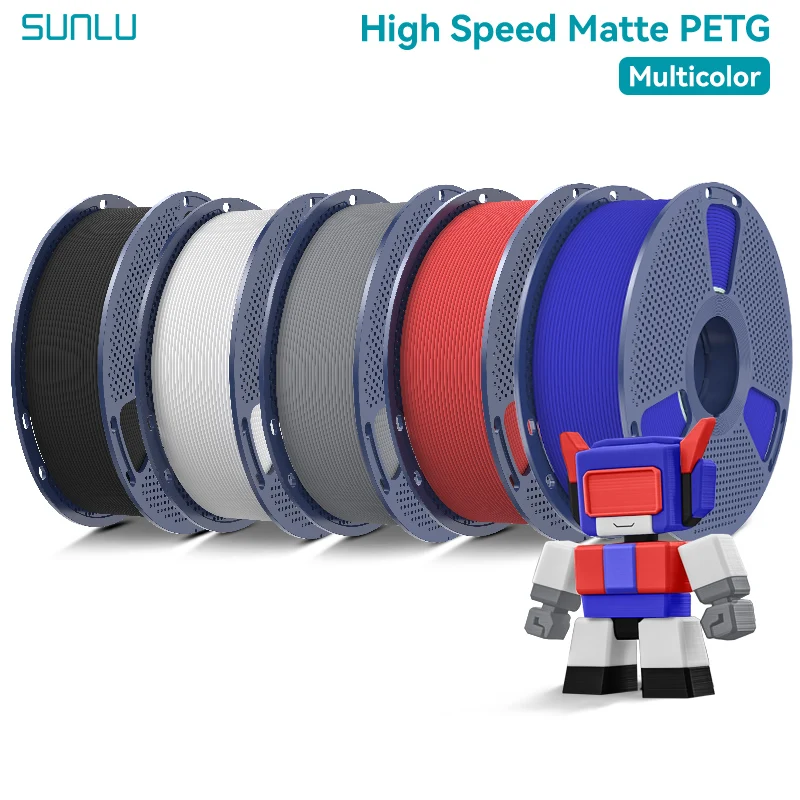
The product is available in a variety of colors, including red, white, black, blue, and orange, as seen in the product imagery. This color diversity allows for creative expression and differentiation in student projects. Visual appeal enhances engagement.
Each spool contains 1.75mm diameter filament, a standard size compatible with most FDM 3D printers. The consistent diameter is critical for reliable extrusion and accurate prints. Inconsistent filament diameter can lead to print quality issues.
For educational institutions, investing in a 5KG bulk spool offers significant cost savings over purchasing multiple smaller spools. This volume pricing makes high-quality filament more accessible for classroom budgets. Stocking up now prevents running out later.
The combination of high strength and high speed means that valuable classroom time is maximized. Students spend less time waiting for prints and more time engaged in design, iteration, and learning. This improves the return on investment for 3D printing equipment.
Furthermore, the low odor characteristic of PETG, as highlighted by the manufacturer, is a crucial safety and comfort factor for classroom environments. Unlike some other materials, it does not produce strong fumes, ensuring a more pleasant and safer workspace for students and teachers.
Imagine a classroom where students can rapidly prototype their innovative designs, moving from concept to tangible object in a single session. This filament empowers educators to foster creativity and problem-solving skills, allowing students to experience the full potential of additive manufacturing without the typical barriers of slow print times or finicky materials. The durable, high-quality results will inspire confidence and encourage further exploration into the exciting world of 3D design and engineering.
The Evolution of Printing Materials
Traditional 3D printing often involves a trade-off between material strength and print speed. Many materials that offer high durability can be challenging to print, requiring specific printer settings or slower speeds. This often leads to extended print times, which can be a significant bottleneck in educational settings where multiple students might share a single machine or have limited class time for projects.
High Speed PETG addresses this challenge directly. It aims to bridge the gap between easy-to-print PLA and stronger, more demanding materials like ABS. For educators introducing students to advanced manufacturing concepts, a material that reduces frustration while maintaining structural integrity is invaluable. This filament simplifies the learning curve.
Engineering for Accelerated Creation
SUNLU's High Speed Matte PETG is engineered to support print speeds ranging from 30 to 600 mm/s. This wide range accommodates various FDM 3D printers, from entry-level classroom models to more advanced, high-speed machines. Such flexibility ensures that the filament can be utilized across different equipment setups.
The ability to print at significantly higher speeds means that projects can be completed in a fraction of the time compared to standard PETG. For instance, a print that might take 160 minutes at 50 mm/s can be finished in just 20 minutes at 400 mm/s. This efficiency is critical for meeting deadlines in a project-based learning curriculum.
This rapid production capability also allows for more iterative design and testing. Students can quickly print prototypes, evaluate their designs, and make necessary adjustments without waiting excessively. This accelerates the design thinking process, a core component of STEM education.
Material Integrity and Structural Resilience
This High Speed PETG boasts strength characteristics comparable to ABS. ABS is known for its toughness and impact resistance, making it suitable for functional parts. Achieving similar mechanical properties in a more user-friendly filament is a significant advantage.
The material exhibits excellent layer adhesion. Strong layer bonding is crucial for the structural integrity of printed objects, preventing delamination and ensuring that parts can withstand intended forces. Robust durability is a key feature.
Components printed with this filament are flexible and highly impact-resistant. This makes it ideal for printing daily necessities, functional prototypes, or even parts that might experience some wear and tear. Students can create durable, real-world applications.
Streamlined Printing Experience
High Speed PETG prints with an ease similar to PLA. PLA is widely favored for its printability, low warping, and minimal odor, making it a common choice for beginners. Combining PLA-like printability with the enhanced strength of PETG offers the best of both worlds.
This ease of printing reduces common frustrations such as stringing, clogs, or poor bed adhesion. A smooth printing experience minimizes print failures, saving both time and material. Fewer failed prints lead to more successful learning outcomes.
Recommended print temperatures range from 230-240°C for speeds of 50-100 mm/s, escalating to 255-270°C for speeds of 300-600 mm/s. A hot bed temperature of 70-80°C is suggested. These settings provide clear guidance for optimal performance, simplifying the slicing workflow for educators and students alike.
Visual and Tactile Qualities
The filament offers a matte finish, which can hide layer lines and minor imperfections more effectively than glossy filaments. This results in a more professional and aesthetically pleasing final product. The matte texture also provides a unique tactile experience.
The product is available in a variety of colors, including red, white, black, blue, and orange, as seen in the product imagery. This color diversity allows for creative expression and differentiation in student projects. Visual appeal enhances engagement.
Each spool contains 1.75mm diameter filament, a standard size compatible with most FDM 3D printers. The consistent diameter is critical for reliable extrusion and accurate prints. Inconsistent filament diameter can lead to print quality issues.
Value Proposition for Educational Settings
For educational institutions, investing in a 5KG bulk spool offers significant cost savings over purchasing multiple smaller spools. This volume pricing makes high-quality filament more accessible for classroom budgets. Stocking up now prevents running out later.
The combination of high strength and high speed means that valuable classroom time is maximized. Students spend less time waiting for prints and more time engaged in design, iteration, and learning. This improves the return on investment for 3D printing equipment.
Furthermore, the low odor characteristic of PETG, as highlighted by the manufacturer, is a crucial safety and comfort factor for classroom environments. Unlike some other materials, it does not produce strong fumes, ensuring a more pleasant and safer workspace for students and teachers.
Imagine a classroom where students can rapidly prototype their innovative designs, moving from concept to tangible object in a single session. This filament empowers educators to foster creativity and problem-solving skills, allowing students to experience the full potential of additive manufacturing without the typical barriers of slow print times or finicky materials. The durable, high-quality results will inspire confidence and encourage further exploration into the exciting world of 3D design and engineering.