SUNLU High Speed 3D Printer Filament (PLA, PLA PLUS, Matte PETG)
Official Store Deal
Expert Analysis Overview
The SUNLU High Speed 3D Printer Filament is a performance-optimized material solution engineered for rapid prototyping and demanding additive manufacturing applications. This filament range, encompassing PLA, PLA PLUS, and Matte PETG, targets users requiring both speed and precision in their 3D printing workflow.
This filament is explicitly designed for high-speed printing, supporting speeds from 30-600mm/s. Such a broad range accommodates various printer capabilities. The material composition is optimized for rapid extrusion.
Achieving these speeds requires a filament that maintains its structural integrity under increased thermal and mechanical stress. Standard filaments often struggle with consistent flow rates at higher speeds, leading to under-extrusion or layer adhesion issues. This product aims to mitigate those common challenges.
Compared to conventional filaments, which typically perform optimally at 50-100mm/s, the SUNLU High Speed variant offers a significant increase in throughput. This directly translates to reduced print times for large batches or complex models.
SUNLU offers this high-speed filament in PLA, PLA PLUS, and Matte PETG variants. Each material provides distinct properties for different application needs. PLA is known for ease of use.
PLA PLUS offers enhanced toughness over standard PLA, making printed parts more durable and less prone to breakage. Matte PETG combines the strength and temperature resistance of PETG with a non-glossy finish, ideal for aesthetic and functional parts. This material selection covers a wide spectrum of prototyping requirements.
In scenarios requiring both speed and specific material characteristics, this range provides flexibility. For instance, a user might choose PLA PLUS for a quick, robust prototype or Matte PETG for a functional part needing better heat resistance and a professional look. The choice is yours.
Standard filament offerings often force a compromise between material properties and print speed. This line of filaments seeks to bridge that gap, allowing for faster production without sacrificing desired material attributes.
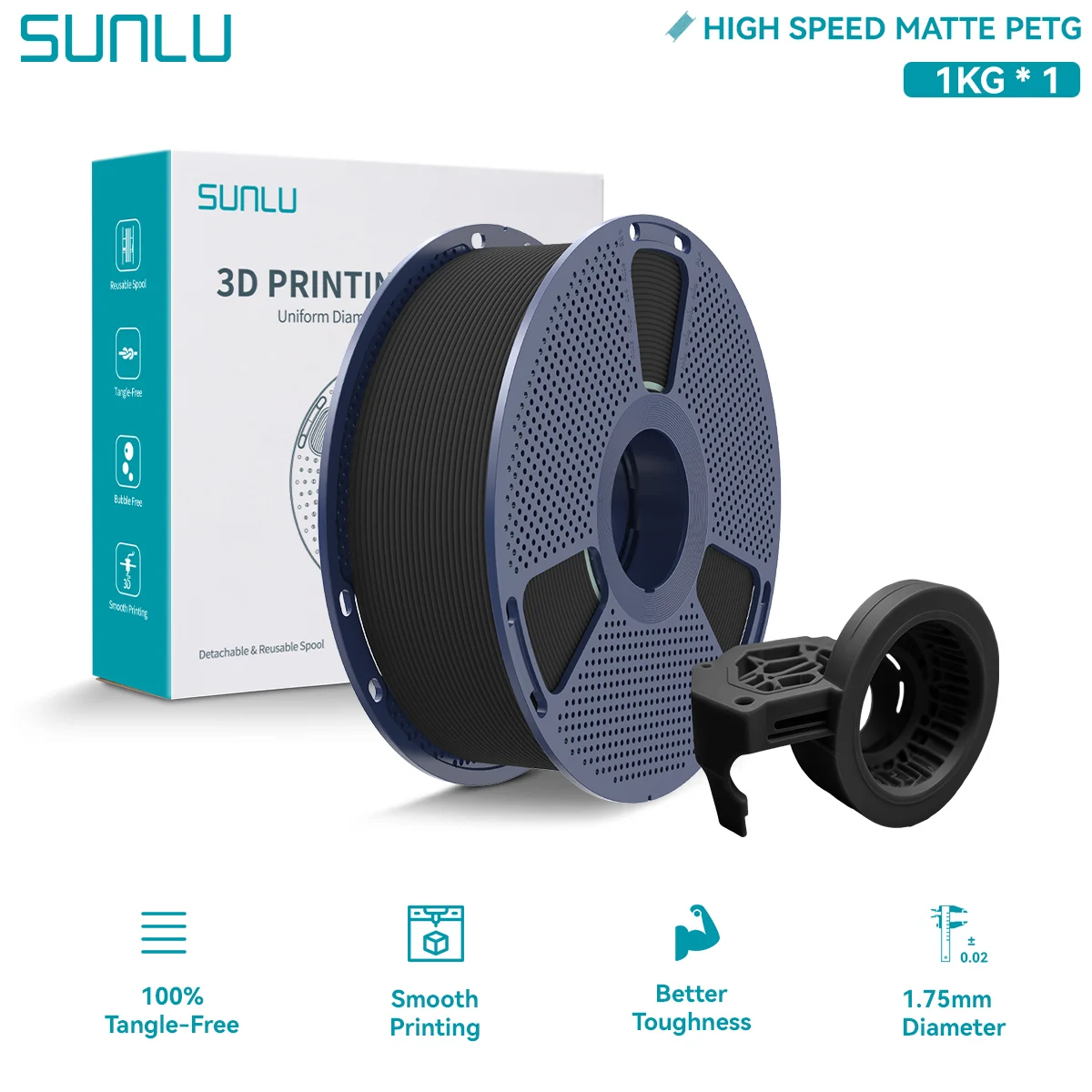
Dimensional accuracy is critical for successful 3D prints, especially for engineering parts. This filament maintains a diameter of 1.75mm with a tight tolerance of ±0.02mm. This precision ensures consistent extrusion.
Such tight tolerances minimize variations in filament flow, which is crucial for achieving dimensionally accurate parts and preventing nozzle clogging. Inconsistent filament diameter is a common cause of print failures, leading to wasted material and time. This precision is a key factor.
Unlike many generic filaments that can exhibit significant diameter fluctuations, the SUNLU High Speed filament's strict tolerance promotes reliable, repeatable print quality. This consistency is a hallmark of quality manufacturing.
The filament is neatly wound on the spool, a feature highlighted as "Neatly Wound Filament." This meticulous winding prevents tangles and snags during printing. Smooth feeding is essential.
Messy winding is a frequent cause of print failures, particularly during long prints or when unattended. A tangled spool can halt a print mid-way, leading to material waste and frustration. This careful winding ensures uninterrupted operation.
Compared to poorly wound spools that often lead to filament jams and print interruptions, the neatly wound SUNLU filament enhances print reliability. This small detail makes a big difference in user experience.
The filament is engineered for low shrinkage, which directly addresses warping issues. Warping occurs when printed layers cool unevenly, causing the part to lift from the print bed. Low shrinkage helps parts adhere better.
Minimizing shrinkage is paramount for printing large objects or parts with intricate geometries, where warping can severely compromise dimensional accuracy and structural integrity. This feature is a significant advantage. It ensures stable prints.
Many standard filaments, especially ABS, are notorious for high shrinkage rates, necessitating heated enclosures and careful bed adhesion strategies. This filament's low shrinkage simplifies the printing process and reduces the need for extensive environmental controls.
The product claims "No Layer Shift," indicating strong inter-layer adhesion. Layer shifting is a common problem where layers misalign during printing, resulting in a visually and structurally flawed part. Strong adhesion prevents this.
Consistent layer adhesion is vital for creating strong, functional parts that can withstand mechanical stress. Poor layer bonding can lead to brittle prints that easily delaminate, rendering them unusable. This ensures robust models.
Unlike filaments that may require specific temperature profiles or slower print speeds to achieve adequate layer bonding, this high-speed filament is formulated to maintain strong adhesion even at accelerated rates. This capability is crucial for reliable output.
The PLA PLUS variant is marketed as "Better Toughness" and is shown resisting impact in an illustrative test. This suggests improved mechanical properties over standard PLA. Toughness is important.
Increased toughness makes printed parts more resilient to accidental drops, impacts, and general wear and tear. This is particularly beneficial for functional prototypes, tools, or parts that will experience moderate stress. It extends part lifespan.
Traditional PLA can be quite brittle, limiting its application in parts requiring a degree of flexibility or impact resistance. The PLA PLUS formulation addresses this limitation, expanding the utility of the material for more demanding applications. This is a clear upgrade.
The filament is available in "Multiple Color Schemes," offering various colors for diverse project needs. The visual examples show red, white, black, blue, and orange. Color choice is important for aesthetics.
Having a wide array of colors allows users to print parts that are not only functional but also visually appealing, or to color-code components for organizational purposes. This flexibility supports creative expression and practical application. It enhances project outcomes.
Many entry-level filaments offer a limited color palette, restricting design choices. The availability of multiple colors, with the option for custom colors, provides greater creative freedom and utility for professional and hobbyist users alike. This broadens design possibilities.
This SUNLU High Speed 3D Printer Filament line represents a significant advancement for anyone engaged in serious additive manufacturing. Its focus on high-speed capability, combined with precise dimensional accuracy and material versatility, directly addresses the core challenges of efficient and reliable 3D printing. The meticulous winding and low shrinkage properties further contribute to a smoother, more successful printing experience, minimizing the common frustrations of warping and layer shifts. For those who demand consistent, high-quality results under accelerated production schedules, this filament offers a compelling solution. Imagine completing complex prototypes in a fraction of the time, with each part exhibiting the exact dimensions and structural integrity required, freeing up valuable printer time for even more innovative projects. This filament is designed to transform your workflow, enabling faster iteration and more robust final products, pushing the boundaries of what your 3D printer can achieve.
Engineering for Accelerated Production
This filament is explicitly designed for high-speed printing, supporting speeds from 30-600mm/s. Such a broad range accommodates various printer capabilities. The material composition is optimized for rapid extrusion.
Achieving these speeds requires a filament that maintains its structural integrity under increased thermal and mechanical stress. Standard filaments often struggle with consistent flow rates at higher speeds, leading to under-extrusion or layer adhesion issues. This product aims to mitigate those common challenges.
Compared to conventional filaments, which typically perform optimally at 50-100mm/s, the SUNLU High Speed variant offers a significant increase in throughput. This directly translates to reduced print times for large batches or complex models.
Material Versatility and Performance
SUNLU offers this high-speed filament in PLA, PLA PLUS, and Matte PETG variants. Each material provides distinct properties for different application needs. PLA is known for ease of use.
PLA PLUS offers enhanced toughness over standard PLA, making printed parts more durable and less prone to breakage. Matte PETG combines the strength and temperature resistance of PETG with a non-glossy finish, ideal for aesthetic and functional parts. This material selection covers a wide spectrum of prototyping requirements.
In scenarios requiring both speed and specific material characteristics, this range provides flexibility. For instance, a user might choose PLA PLUS for a quick, robust prototype or Matte PETG for a functional part needing better heat resistance and a professional look. The choice is yours.
Standard filament offerings often force a compromise between material properties and print speed. This line of filaments seeks to bridge that gap, allowing for faster production without sacrificing desired material attributes.
Precision and Reliability in Every Spool
Dimensional accuracy is critical for successful 3D prints, especially for engineering parts. This filament maintains a diameter of 1.75mm with a tight tolerance of ±0.02mm. This precision ensures consistent extrusion.
Such tight tolerances minimize variations in filament flow, which is crucial for achieving dimensionally accurate parts and preventing nozzle clogging. Inconsistent filament diameter is a common cause of print failures, leading to wasted material and time. This precision is a key factor.
Unlike many generic filaments that can exhibit significant diameter fluctuations, the SUNLU High Speed filament's strict tolerance promotes reliable, repeatable print quality. This consistency is a hallmark of quality manufacturing.
Optimized Winding and Feed Consistency
The filament is neatly wound on the spool, a feature highlighted as "Neatly Wound Filament." This meticulous winding prevents tangles and snags during printing. Smooth feeding is essential.
Messy winding is a frequent cause of print failures, particularly during long prints or when unattended. A tangled spool can halt a print mid-way, leading to material waste and frustration. This careful winding ensures uninterrupted operation.
Compared to poorly wound spools that often lead to filament jams and print interruptions, the neatly wound SUNLU filament enhances print reliability. This small detail makes a big difference in user experience.
Mitigating Common Print Failures
The filament is engineered for low shrinkage, which directly addresses warping issues. Warping occurs when printed layers cool unevenly, causing the part to lift from the print bed. Low shrinkage helps parts adhere better.
Minimizing shrinkage is paramount for printing large objects or parts with intricate geometries, where warping can severely compromise dimensional accuracy and structural integrity. This feature is a significant advantage. It ensures stable prints.
Many standard filaments, especially ABS, are notorious for high shrinkage rates, necessitating heated enclosures and careful bed adhesion strategies. This filament's low shrinkage simplifies the printing process and reduces the need for extensive environmental controls.
Enhanced Layer Adhesion and Structural Integrity
The product claims "No Layer Shift," indicating strong inter-layer adhesion. Layer shifting is a common problem where layers misalign during printing, resulting in a visually and structurally flawed part. Strong adhesion prevents this.
Consistent layer adhesion is vital for creating strong, functional parts that can withstand mechanical stress. Poor layer bonding can lead to brittle prints that easily delaminate, rendering them unusable. This ensures robust models.
Unlike filaments that may require specific temperature profiles or slower print speeds to achieve adequate layer bonding, this high-speed filament is formulated to maintain strong adhesion even at accelerated rates. This capability is crucial for reliable output.
Durability and Impact Resistance
The PLA PLUS variant is marketed as "Better Toughness" and is shown resisting impact in an illustrative test. This suggests improved mechanical properties over standard PLA. Toughness is important.
Increased toughness makes printed parts more resilient to accidental drops, impacts, and general wear and tear. This is particularly beneficial for functional prototypes, tools, or parts that will experience moderate stress. It extends part lifespan.
Traditional PLA can be quite brittle, limiting its application in parts requiring a degree of flexibility or impact resistance. The PLA PLUS formulation addresses this limitation, expanding the utility of the material for more demanding applications. This is a clear upgrade.
Aesthetic Options and Customization
The filament is available in "Multiple Color Schemes," offering various colors for diverse project needs. The visual examples show red, white, black, blue, and orange. Color choice is important for aesthetics.
Having a wide array of colors allows users to print parts that are not only functional but also visually appealing, or to color-code components for organizational purposes. This flexibility supports creative expression and practical application. It enhances project outcomes.
Many entry-level filaments offer a limited color palette, restricting design choices. The availability of multiple colors, with the option for custom colors, provides greater creative freedom and utility for professional and hobbyist users alike. This broadens design possibilities.
Conclusion: The Precision Prototyper's Choice
This SUNLU High Speed 3D Printer Filament line represents a significant advancement for anyone engaged in serious additive manufacturing. Its focus on high-speed capability, combined with precise dimensional accuracy and material versatility, directly addresses the core challenges of efficient and reliable 3D printing. The meticulous winding and low shrinkage properties further contribute to a smoother, more successful printing experience, minimizing the common frustrations of warping and layer shifts. For those who demand consistent, high-quality results under accelerated production schedules, this filament offers a compelling solution. Imagine completing complex prototypes in a fraction of the time, with each part exhibiting the exact dimensions and structural integrity required, freeing up valuable printer time for even more innovative projects. This filament is designed to transform your workflow, enabling faster iteration and more robust final products, pushing the boundaries of what your 3D printer can achieve.