SUNLU FilaDryer S2 Filament Dryer
Official Store Deal
Expert Analysis Overview
The SUNLU FilaDryer S2 is a crucial filament conditioning unit designed for serious 3D printing enthusiasts and professionals, specifically targeting the common challenges of moisture absorption in hygroscopic materials. This device represents a significant step forward from basic filament storage, offering active drying capabilities essential for achieving consistent, high-quality prints. For makers who frequently encounter print failures due to brittle filament or inconsistent extrusion, the FilaDryer S2 provides a targeted solution, preventing material degradation before it impacts production. Its design and feature set position it as an indispensable tool for anyone looking to maximize print success and explore a wider range of advanced materials.
The core capability of the FilaDryer S2 lies in its advanced heating system. Visible specifications highlight a maximum heating temperature of 70°C, coupled with a double heat sink design that facilitates 360° evenly distributed heating. This comprehensive approach is a direct upgrade from passive drying methods or less sophisticated dryers that might create hot and cold spots within the filament spool. It heats uniformly. Achieving 70°C allows for effective moisture removal from a broad spectrum of filaments, including standard PLA and ABS, but critically extends to more demanding engineering materials like Nylon, PC, and PVA, which require higher temperatures for thorough drying. The double heat sink ensures that air circulates efficiently, reaching all parts of the filament spool.
This uniform and high-temperature heating implies a more thorough and efficient removal of moisture from the filament, even deep within the spool's core. For materials like nylon or PVA, which are notoriously hygroscopic, this consistent internal environment is paramount. Nylon, for example, rapidly absorbs atmospheric moisture, leading to stringing, bubbling, and weak layer adhesion during printing. Polycarbonate (PC) similarly suffers from significant degradation when wet, resulting in poor mechanical properties and a visible loss of transparency. A maker experimenting with a new engineering filament can rely on the S2 to prepare it optimally, minimizing the variables introduced by moisture content. The precise temperature control ensures the filament dries without degrading its inherent material properties.
Compared to standard entry-level filament dryers or simple desiccant boxes, which often rely on basic heating elements and passive convection, the FilaDryer S2's active, 360° heating mechanism offers superior performance. Many basic solutions struggle with larger spools or densely wound filaments, leading to uneven drying and pockets of retained moisture. Desiccant boxes, while useful for storage, do not actively remove moisture once absorbed into the filament. This unit addresses that directly, ensuring every layer of filament benefits from the drying process. It's a clear advantage. The ability to actively heat and circulate air is what sets it apart, providing a controlled environment for optimal filament conditioning.
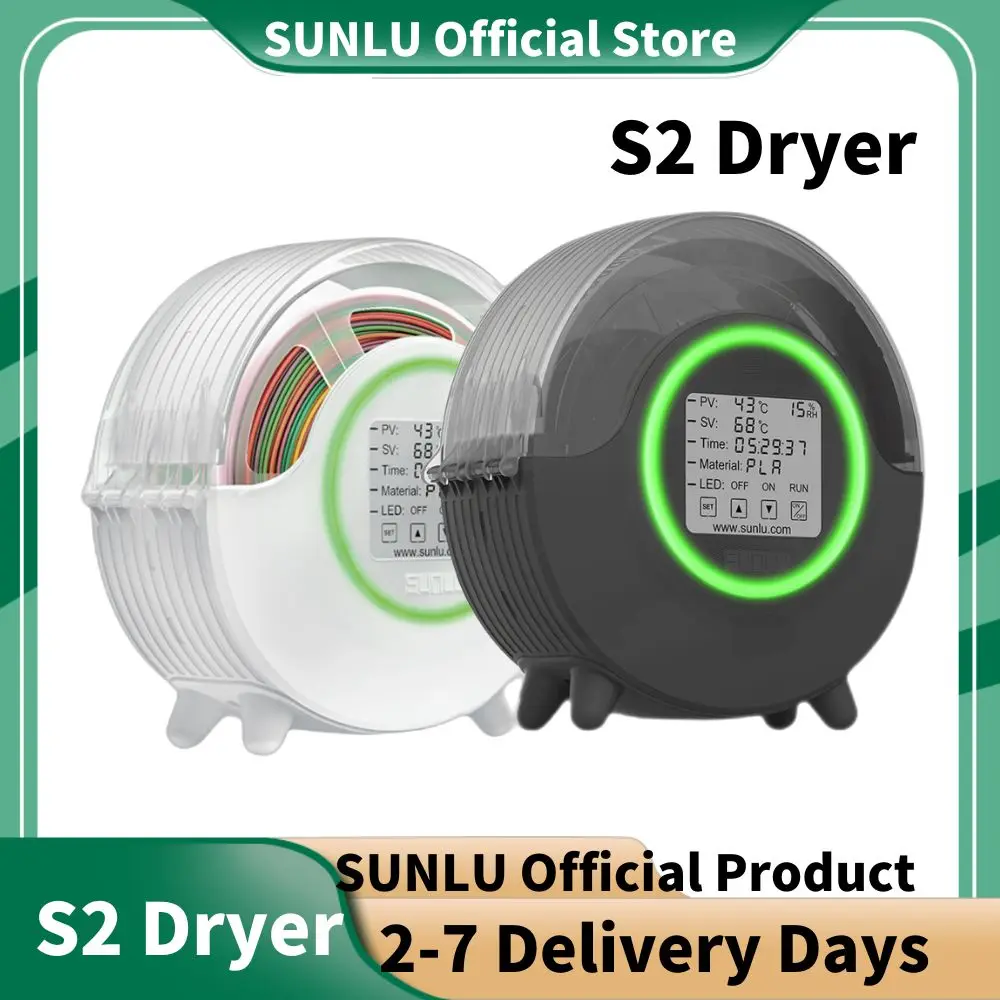
User interaction with the FilaDryer S2 is managed through a prominent 3.43x2.87 inch LCD touch screen. This display provides real-time data on temperature, humidity, and the active timer, alongside offering one-click preset choices for various filament types. The visual interface is clean and organized, presenting critical operational parameters at a glance. Such a detailed and interactive interface is not merely a convenience; it’s a critical tool for precise process control, allowing for immediate feedback on drying conditions.
The implication of such a comprehensive display is a significantly streamlined workflow for the user. Instead of guessing or relying on external hygrometers and thermometers, all critical data is immediately available on the unit itself. This allows for quick, informed adjustments to drying parameters based on current environmental conditions or the specific needs of a tricky material, ensuring optimal preparation. For instance, if the ambient humidity is unusually high, the user can easily extend the drying time or slightly increase the temperature. It simplifies operations. The real-time humidity readout is particularly beneficial, providing tangible proof of the drying process's effectiveness.
Many generic filament storage boxes or rudimentary dryers offer no feedback whatsoever, leaving users uncertain about the actual drying status or the internal environmental conditions. These older methods often involve an element of guesswork. The FilaDryer S2, with its clear, interactive screen, stands apart by providing actionable information. This level of transparency empowers the maker to confidently manage their filament inventory, moving beyond simple guesswork to data-driven conditioning. It provides confidence. The one-click presets further reduce the learning curve, allowing even novice users to quickly set appropriate drying parameters for common filament types.
The physical design of the FilaDryer S2, with its compact, rounded form factor and transparent lid, suggests a unit built for integration into an active 3D printing setup. It is explicitly advertised as being compatible with various filament diameters (1.75mm, 2.85mm, 3.00mm) and designed to facilitate drying *while* printing. The clear lid allows for visual inspection of the filament spool without interrupting the drying process, a small but significant convenience. The unit's modest footprint ensures it can sit comfortably next to most desktop 3D printers.
The ability to dry filament continuously during a print run has profound implications, especially for long prints or when using highly hygroscopic materials like Nylon or PC. It prevents the filament from re-absorbing moisture from the ambient air as it's fed into the printer, a common issue that can lead to layer delamination, stringing, and nozzle clogging. This continuous drying ensures that the filament reaching the extruder is consistently at its optimal moisture level, which is critical for maintaining print quality and dimensional accuracy over extended periods. Consistent feed is vital. This feature is particularly valuable for overnight prints or large functional prototypes.
Unlike a standalone dryer that requires filament to be dried, then transferred, and potentially re-exposed to humidity during the journey to the printer, the FilaDryer S2 maintains a dry environment throughout the entire printing process. This
Precision Thermal Management for Advanced Materials
The core capability of the FilaDryer S2 lies in its advanced heating system. Visible specifications highlight a maximum heating temperature of 70°C, coupled with a double heat sink design that facilitates 360° evenly distributed heating. This comprehensive approach is a direct upgrade from passive drying methods or less sophisticated dryers that might create hot and cold spots within the filament spool. It heats uniformly. Achieving 70°C allows for effective moisture removal from a broad spectrum of filaments, including standard PLA and ABS, but critically extends to more demanding engineering materials like Nylon, PC, and PVA, which require higher temperatures for thorough drying. The double heat sink ensures that air circulates efficiently, reaching all parts of the filament spool.
This uniform and high-temperature heating implies a more thorough and efficient removal of moisture from the filament, even deep within the spool's core. For materials like nylon or PVA, which are notoriously hygroscopic, this consistent internal environment is paramount. Nylon, for example, rapidly absorbs atmospheric moisture, leading to stringing, bubbling, and weak layer adhesion during printing. Polycarbonate (PC) similarly suffers from significant degradation when wet, resulting in poor mechanical properties and a visible loss of transparency. A maker experimenting with a new engineering filament can rely on the S2 to prepare it optimally, minimizing the variables introduced by moisture content. The precise temperature control ensures the filament dries without degrading its inherent material properties.
Compared to standard entry-level filament dryers or simple desiccant boxes, which often rely on basic heating elements and passive convection, the FilaDryer S2's active, 360° heating mechanism offers superior performance. Many basic solutions struggle with larger spools or densely wound filaments, leading to uneven drying and pockets of retained moisture. Desiccant boxes, while useful for storage, do not actively remove moisture once absorbed into the filament. This unit addresses that directly, ensuring every layer of filament benefits from the drying process. It's a clear advantage. The ability to actively heat and circulate air is what sets it apart, providing a controlled environment for optimal filament conditioning.
The Command Center: Interactive Display and Control
User interaction with the FilaDryer S2 is managed through a prominent 3.43x2.87 inch LCD touch screen. This display provides real-time data on temperature, humidity, and the active timer, alongside offering one-click preset choices for various filament types. The visual interface is clean and organized, presenting critical operational parameters at a glance. Such a detailed and interactive interface is not merely a convenience; it’s a critical tool for precise process control, allowing for immediate feedback on drying conditions.
The implication of such a comprehensive display is a significantly streamlined workflow for the user. Instead of guessing or relying on external hygrometers and thermometers, all critical data is immediately available on the unit itself. This allows for quick, informed adjustments to drying parameters based on current environmental conditions or the specific needs of a tricky material, ensuring optimal preparation. For instance, if the ambient humidity is unusually high, the user can easily extend the drying time or slightly increase the temperature. It simplifies operations. The real-time humidity readout is particularly beneficial, providing tangible proof of the drying process's effectiveness.
Many generic filament storage boxes or rudimentary dryers offer no feedback whatsoever, leaving users uncertain about the actual drying status or the internal environmental conditions. These older methods often involve an element of guesswork. The FilaDryer S2, with its clear, interactive screen, stands apart by providing actionable information. This level of transparency empowers the maker to confidently manage their filament inventory, moving beyond simple guesswork to data-driven conditioning. It provides confidence. The one-click presets further reduce the learning curve, allowing even novice users to quickly set appropriate drying parameters for common filament types.
Seamless Integration into the Print Farm
The physical design of the FilaDryer S2, with its compact, rounded form factor and transparent lid, suggests a unit built for integration into an active 3D printing setup. It is explicitly advertised as being compatible with various filament diameters (1.75mm, 2.85mm, 3.00mm) and designed to facilitate drying *while* printing. The clear lid allows for visual inspection of the filament spool without interrupting the drying process, a small but significant convenience. The unit's modest footprint ensures it can sit comfortably next to most desktop 3D printers.
The ability to dry filament continuously during a print run has profound implications, especially for long prints or when using highly hygroscopic materials like Nylon or PC. It prevents the filament from re-absorbing moisture from the ambient air as it's fed into the printer, a common issue that can lead to layer delamination, stringing, and nozzle clogging. This continuous drying ensures that the filament reaching the extruder is consistently at its optimal moisture level, which is critical for maintaining print quality and dimensional accuracy over extended periods. Consistent feed is vital. This feature is particularly valuable for overnight prints or large functional prototypes.
Unlike a standalone dryer that requires filament to be dried, then transferred, and potentially re-exposed to humidity during the journey to the printer, the FilaDryer S2 maintains a dry environment throughout the entire printing process. This