Solar Auto Light Control Charge Module
Official Store Deal
Expert Analysis Overview
Precision in Photovoltaic Automation
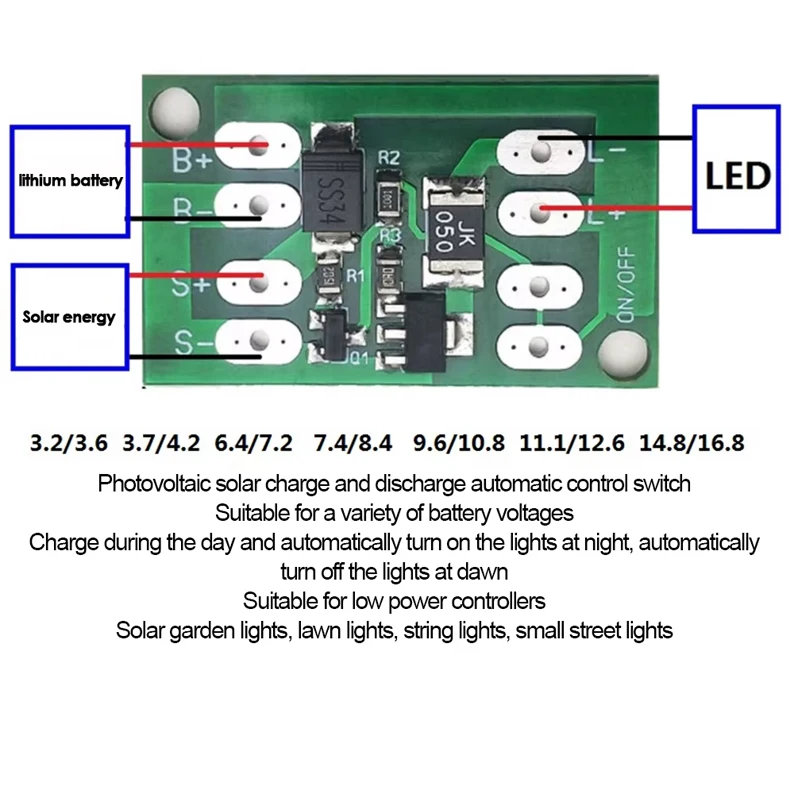
The Solar Auto Light Control Charge Module is a pragmatic compact circuit board engineered for integrating automated solar charging into DIY outdoor lighting projects. This small PCB, often referred to as a solar charge controller, is specifically designed to manage the charging of lithium batteries from a solar panel and to control LED lighting based on ambient light conditions. Its primary function is to facilitate a "charge during the day, light up at night" cycle, a fundamental requirement for self-sufficient solar-powered illumination systems. The module’s straightforward design and clear connection points make it an accessible component for hobbyists and professionals alike who are looking to construct or repair solar garden lights, lawn lights, or small street lights. It simplifies the complex task of power management and light sensing into a single, compact unit. This board offers a practical solution.
The Core of Illumination Control
At its operational heart, this module functions as a photovoltaic solar charge and discharge automatic control switch. During daylight hours, the board directs power from the connected solar panel to recharge the lithium battery. As dusk approaches, the integrated photosensitive components detect the reduction in ambient light. This triggers the module to automatically switch the output, powering the connected LED lights. Conversely, when dawn breaks and sufficient light is detected, the module cuts power to the LEDs, conserving battery life and resuming the charging cycle. This automatic switching mechanism eliminates the need for manual intervention, providing a truly set-and-forget solution for outdoor lighting. The system runs itself. Unlike traditional lighting setups that require timers or manual toggles, this module offers a seamless transition between charging and illumination, ensuring consistent performance without user oversight. Its intelligent design ensures optimal energy usage, extending the operational life of the battery and the lighting system.
Adaptability in Power Management
One of the module's significant advantages is its compatibility with a wide array of lithium battery voltages. The specifications indicate support for 3.2V, 3.7V, 6.4V, 7.4V, 9.6V, 11.1V, 12.8V, and 14.8V lithium battery configurations, encompassing both lithium iron phosphate and standard lithium battery chemistries. This broad compatibility means the module can be integrated into diverse projects without requiring specific voltage converters for the battery side. The module's input voltage from the solar panel is also flexible, adapting to suit the chosen battery voltage, typically ranging from 4.5V-7V for a 3.2V battery up to 18V-28V for a 14.8V battery. This flexibility is crucial for DIY applications where battery packs might vary. Power matching is simplified. However, it is critical to note that the stable working output current is limited to less than 600mA. This current limitation positions the module for low-power LED applications, such as decorative string lights or accent lighting, rather than high-intensity floodlights. Compared to more sophisticated Battery Management Systems (BMS) or high-current charge controllers, this module prioritizes simplicity and cost-effectiveness for smaller-scale projects. It handles basic power needs.
Physical Footprint and Integration
The physical dimensions of this charge controller are remarkably compact, measuring approximately 31mm by 18mm. The board itself has a thickness of 1.6mm, with the tallest components extending about 4mm from the surface. This minuscule footprint is a considerable asset for integration into constrained spaces, such as the housing of a garden light or a compact street light fixture. The board features clearly labeled solder pads for connections: B+ and B
Durability and Environmental Considerations
While the PCB itself is robust for its intended purpose, its application in outdoor lighting necessitates careful consideration of environmental protection. The module is not inherently waterproof. For outdoor installations, it is absolutely essential to house the board within a sealed, waterproof enclosure to protect it from moisture, dust, and extreme temperatures. A well-designed enclosure, crafted from durable materials like ABS plastic or aluminum, will significantly extend the operational lifespan of the module. Proper sealing is key. Furthermore, the small surface-mounted components are designed for reliability under normal operating conditions, but physical impact or excessive vibration should be mitigated through secure mounting within the enclosure. Unlike many off-the-shelf solar lights that come with integrated, albeit sometimes flimsy, weatherproofing, this module places the responsibility for environmental protection squarely on the installer, allowing for superior customization and potentially more durable solutions when properly executed. It requires a thoughtful approach.
Versatility in Application Scenarios
This solar charge controller is explicitly suitable for a range of low-power solar lighting applications. Its primary targets include solar garden lights, which often require only a few LEDs, lawn lights, decorative string lights for patios or pathways, and small street lights where high luminosity is not the primary objective. The module's design, focusing on automatic light control and efficient charging for lithium batteries, makes it an ideal component for anyone looking to build custom lighting solutions or repair existing ones. It serves many purposes. The module's ability to handle various battery voltages further enhances its versatility, allowing it to be adapted to different power requirements within the low-power spectrum. It is not designed for high-power applications, nor does it include a boost drive for LEDs, meaning that for brighter illumination, external components like current-limiting resistors would be necessary, and the overall power budget remains constrained by the 600mA output limit. This board is for modest projects. Compared to industrial-grade solar lighting solutions that incorporate complex power electronics and robust enclosures, this module offers a minimalist, cost-effective entry point for functional solar automation in personal or small-scale community projects.
Value Proposition for the DIYer
For the discerning carpenter or electronics hobbyist, this module represents significant value. Its low cost and specific functionality make it an attractive option for building numerous solar-powered devices without investing in more expensive, feature-rich controllers that might be overkill for simple lighting tasks. The ability to source individual components and assemble a custom solution often results in a more durable and repairable product than many mass-produced alternatives. This saves money long-term. The module's simplicity also means a faster learning curve for those new to solar electronics, allowing for quicker project completion and a greater sense of accomplishment. It empowers creation. By understanding its limitations, particularly the need for external battery protection and waterproofing, users can design robust systems that offer reliable, automated lighting for years. This approach fosters a deeper understanding of the underlying technology, making future repairs or modifications more straightforward. It is an educational tool. This module, unlike generic, pre-packaged solar light units with unknown component quality, allows the builder to select higher-grade batteries and LEDs, ensuring a superior, longer-lasting end product. The control is in the builder's hands.
Essential Considerations for Implementation
Implementing this solar charge controller effectively requires adherence to several best practices. Firstly, correct wiring polarity is paramount; reversing battery or solar panel connections can permanently damage the board. Secondly, while the module handles charging and discharge switching, it does not include overcharge or overdischarge protection for lithium batteries. This necessitates the use of a separate Battery Management System (BMS) or protection circuit board, especially for 3.7V lithium batteries or 18650 cells, to prevent battery damage or safety hazards. Thirdly, as previously mentioned, waterproofing is crucial for outdoor applications. The board must be housed in a sealed enclosure. Fourthly, for LED connections, especially with varying battery voltages, current-limiting resistors are often required to prevent overcurrent to the LEDs and ensure their longevity. The module is not a boost driver. Finally, selecting a solar panel with appropriate voltage and current output, matching the chosen battery configuration, is vital for efficient charging. Careful planning prevents issues.
Troubleshooting Common Scenarios
Even with careful installation, issues can arise. If the lights fail to activate at night, the first step involves verifying the solar panel's input voltage during daylight and the battery's charge level. A depleted battery or insufficient solar input will prevent nighttime illumination. If charging appears to be the problem, checking the solar panel's connection polarity and ensuring it receives adequate, unobstructed sunlight is essential. Should the lights remain on during the day, this typically indicates a fault with the photosensitive components or incorrect wiring that bypasses the light-sensing functionality. Weak LED output, on the other hand, often points to a mismatch between the battery voltage and the LED requirements, or the absence of a proper current-limiting resistor. For intermittent operation, a thorough inspection of all solder joints and wire connections for looseness, corrosion, or cold joints is advisable. Simple checks resolve most problems.
Your Automated Outdoor Lighting Solution
Imagine stepping into your garden as dusk settles, and your custom-built pathway lights gently illuminate, powered entirely by the sun and managed by this discreet module. Picture your DIY street light reliably turning on each evening, providing safety and ambiance without a thought from you. This module frees you from manual controls and provides a robust foundation for intelligent, energy-efficient outdoor lighting. It offers peace of mind. The satisfaction of building a functional, automated system from individual components, knowing it operates reliably day in and day out, is a reward in itself. This board makes it possible. Your outdoor spaces will transform, becoming more inviting and functional, all thanks to a small, intelligent circuit board working tirelessly behind the scenes.