SOECOPO 12V/24V 100A Solar Charge Controller
Official Store Deal
Expert Analysis Overview
The SOECOPO Solar Charge Controller is a pragmatic power management unit engineered for off-grid photovoltaic systems requiring reliable battery protection and load distribution. This device is positioned as an essential component for safeguarding battery health and optimizing energy flow in smaller to medium-sized solar installations, particularly for RVs, boats, or remote cabins. Its design prioritizes ease of use and fundamental protective functionalities, making it a suitable choice for those establishing or upgrading a basic solar power setup.
The SOECOPO controller integrates a pulse width modulation (PWM) charging algorithm, visible through its operational indicators and charging profiles. This method of charge regulation is a standard practice in many entry-level and mid-range solar charge controllers. PWM technology works by rapidly switching the solar array connection to the battery on and off, controlling the average voltage and current delivered to the battery.
This approach ensures that the battery receives a consistent, regulated charge, preventing overcharging which can significantly reduce battery lifespan. For users with lead-acid batteries, including sealed, gel, and flooded types, PWM charging is a proven and effective technique. It maintains the battery at an optimal state of charge without subjecting it to excessive stress.
Compared to more advanced Maximum Power Point Tracking (MPPT) controllers, PWM units like this SOECOPO model offer a more cost-effective solution. While MPPT controllers can extract more power from solar panels under varying conditions, especially in colder climates or when panel voltage significantly exceeds battery voltage, PWM controllers are simpler, more robust, and perfectly adequate for systems where the solar panel voltage is closely matched to the battery bank's nominal voltage. This makes the SOECOPO an excellent choice for budget-conscious installations where efficiency gains from MPPT might not justify the increased expense.
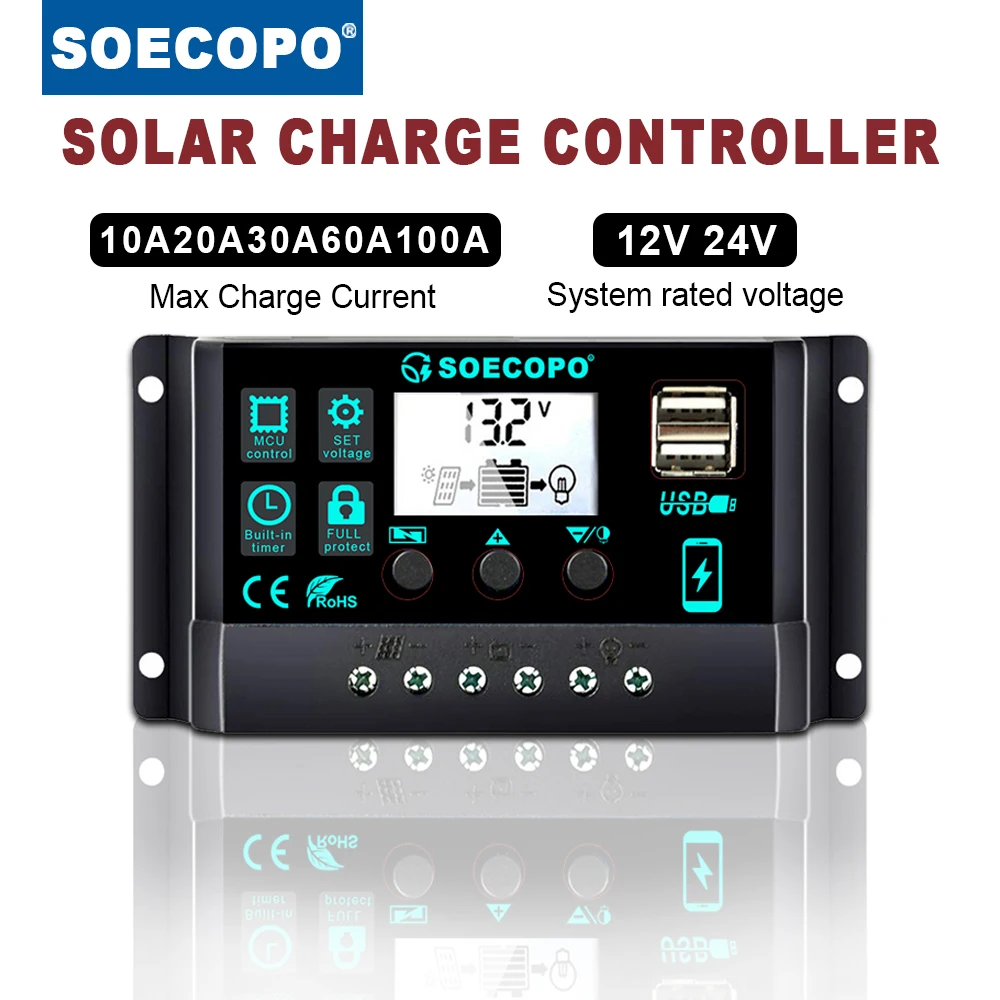
The unit features an integrated LCD, clearly displaying critical system parameters such as battery voltage, charge current, discharge current, and battery state of charge. The digital readout provides real-time feedback on the system's performance. This direct visual feedback is crucial for monitoring the health and operational status of the solar power system.
Users can easily track how much power is being generated by the solar panels and how much is being consumed by connected loads. The display also indicates the charging stage, offering insight into whether the battery is in bulk, absorption, or float charge mode. This level of transparency helps users understand their energy consumption patterns and the efficiency of their solar array.
Unlike older, more basic charge controllers that rely solely on LED indicators, the SOECOPO's LCD provides granular data. This detailed information allows for more informed decision-making regarding energy usage and system maintenance. It eliminates the guesswork often associated with simpler units, providing a clear picture of the system's electrical dynamics.
The controller is equipped with dual USB ports, providing a 5V 3A output for charging small electronic devices. This is a practical addition for off-grid applications. These ports offer direct power access for smartphones, tablets, or other USB-powered gadgets.
In remote settings, having readily available USB charging capability directly from the solar system enhances convenience and self-sufficiency. It reduces the need for additional DC-DC converters or inverters for low-power electronics. This direct integration streamlines the power delivery process.
Many standard solar charge controllers focus solely on battery management, omitting direct device charging capabilities. The inclusion of dual USB ports on the SOECOPO unit represents an upgrade in user convenience, providing a practical utility beyond its primary function of charge regulation. This feature adds significant value for users who rely on portable electronics in their off-grid environments.
Integral to its design are multiple protection features, including overcharge, over-discharge, short circuit, and reverse polarity protection. These safeguards are critical for the longevity and safety of the entire solar power system. The unit actively monitors voltage and current levels to prevent damage.
Overcharge protection ensures that batteries are not subjected to excessive voltage, which can lead to electrolyte boiling, plate corrosion, and premature failure. Over-discharge protection disconnects loads when battery voltage drops too low, preventing deep discharge cycles that permanently damage battery capacity. Short circuit protection immediately cuts power in the event of an electrical fault, preventing potential fires or component damage. Reverse polarity protection guards against incorrect wiring during installation, a common mistake that can instantly destroy unprotected electronics.
Unlike rudimentary charge controllers that might only offer basic fuse protection, the SOECOPO integrates active electronic monitoring and disconnection. This comprehensive suite of protections significantly reduces the risk of costly equipment failure and enhances user safety. It provides peace of mind, knowing that the system is guarded against common electrical mishaps.
The connection terminals are designed for secure wiring, accommodating various wire gauges commonly used in solar installations. Visual inspection suggests robust screw terminals. Proper terminal design is paramount for maintaining low resistance connections and preventing power loss or overheating.
Secure connections ensure efficient power transfer from the solar panels to the battery and from the battery to the loads. Loose or corroded terminals can lead to voltage drops, reduced system performance, and even fire hazards due to localized heat buildup. The visible terminal blocks appear to be of a standard, reliable design, capable of providing a firm grip on conductors.
Compared to quick-connect or spring-loaded terminals found on some low-cost devices, screw terminals offer a more permanent and mechanically sound connection, especially in environments subject to vibration, such as RVs or boats. Ensuring these connections are properly tightened during installation is key to the system's long-term reliability and electrical integrity. This is a simple but critical aspect of any power management device.
The controller's enclosure appears to be constructed from a durable, non-conductive material, likely ABS plastic, designed to withstand typical environmental conditions in an off-grid setup. The housing provides adequate protection for the internal electronics. Effective thermal management is crucial for the longevity of electronic components.
While passive cooling is likely employed, the internal design must facilitate heat dissipation to prevent component degradation. The unit's operating environment, especially temperature fluctuations, can impact its performance and lifespan. A well-designed enclosure protects against dust and moisture ingress, common in outdoor or semi-outdoor installations.
Unlike unsealed or poorly ventilated units, a robust enclosure helps maintain a stable internal temperature. This prevents thermal runaway in components and prolongs operational life. The visible mounting points suggest a straightforward installation process, allowing for secure placement in a ventilated area, which is essential for optimal performance and heat management.
This controller features automatic 12V/24V system voltage recognition, simplifying installation and compatibility. The auto-switching capability eliminates manual configuration. This is a significant convenience for installers.
Automatic voltage detection means the controller can adapt to either a 12-volt or 24-volt battery bank without user intervention. This flexibility makes it suitable for a broader range of small to medium-sized solar power systems. It reduces the chance of misconfiguration.
Many entry-level controllers require manual voltage selection, which can lead to errors if not set correctly. The SOECOPO's auto-switch function streamlines the setup process, making it more user-friendly than fixed-voltage alternatives. This feature enhances its appeal for both novice and experienced solar enthusiasts.
Imagine the peace of mind knowing your off-grid power system is reliably managed, your batteries are protected from common electrical faults, and your essential devices remain charged, all thanks to a robust and intelligently designed charge controller. This unit provides the foundational capability for sustained energy independence, allowing for uninterrupted power in remote locations. It ensures your investment in solar panels and batteries delivers consistent, long-term performance, freeing you to focus on the activities that matter most, without worrying about power interruptions or equipment damage. This is the core promise of a well-engineered solar charge controller: dependable power, always. It is a small investment that secures a much larger system's integrity.
Core Power Regulation Architecture
The SOECOPO controller integrates a pulse width modulation (PWM) charging algorithm, visible through its operational indicators and charging profiles. This method of charge regulation is a standard practice in many entry-level and mid-range solar charge controllers. PWM technology works by rapidly switching the solar array connection to the battery on and off, controlling the average voltage and current delivered to the battery.
This approach ensures that the battery receives a consistent, regulated charge, preventing overcharging which can significantly reduce battery lifespan. For users with lead-acid batteries, including sealed, gel, and flooded types, PWM charging is a proven and effective technique. It maintains the battery at an optimal state of charge without subjecting it to excessive stress.
Compared to more advanced Maximum Power Point Tracking (MPPT) controllers, PWM units like this SOECOPO model offer a more cost-effective solution. While MPPT controllers can extract more power from solar panels under varying conditions, especially in colder climates or when panel voltage significantly exceeds battery voltage, PWM controllers are simpler, more robust, and perfectly adequate for systems where the solar panel voltage is closely matched to the battery bank's nominal voltage. This makes the SOECOPO an excellent choice for budget-conscious installations where efficiency gains from MPPT might not justify the increased expense.
Operational Visibility and User Interface
The unit features an integrated LCD, clearly displaying critical system parameters such as battery voltage, charge current, discharge current, and battery state of charge. The digital readout provides real-time feedback on the system's performance. This direct visual feedback is crucial for monitoring the health and operational status of the solar power system.
Users can easily track how much power is being generated by the solar panels and how much is being consumed by connected loads. The display also indicates the charging stage, offering insight into whether the battery is in bulk, absorption, or float charge mode. This level of transparency helps users understand their energy consumption patterns and the efficiency of their solar array.
Unlike older, more basic charge controllers that rely solely on LED indicators, the SOECOPO's LCD provides granular data. This detailed information allows for more informed decision-making regarding energy usage and system maintenance. It eliminates the guesswork often associated with simpler units, providing a clear picture of the system's electrical dynamics.
Connectivity and Peripheral Integration
The controller is equipped with dual USB ports, providing a 5V 3A output for charging small electronic devices. This is a practical addition for off-grid applications. These ports offer direct power access for smartphones, tablets, or other USB-powered gadgets.
In remote settings, having readily available USB charging capability directly from the solar system enhances convenience and self-sufficiency. It reduces the need for additional DC-DC converters or inverters for low-power electronics. This direct integration streamlines the power delivery process.
Many standard solar charge controllers focus solely on battery management, omitting direct device charging capabilities. The inclusion of dual USB ports on the SOECOPO unit represents an upgrade in user convenience, providing a practical utility beyond its primary function of charge regulation. This feature adds significant value for users who rely on portable electronics in their off-grid environments.
Protective Circuitry and System Safeguards
Integral to its design are multiple protection features, including overcharge, over-discharge, short circuit, and reverse polarity protection. These safeguards are critical for the longevity and safety of the entire solar power system. The unit actively monitors voltage and current levels to prevent damage.
Overcharge protection ensures that batteries are not subjected to excessive voltage, which can lead to electrolyte boiling, plate corrosion, and premature failure. Over-discharge protection disconnects loads when battery voltage drops too low, preventing deep discharge cycles that permanently damage battery capacity. Short circuit protection immediately cuts power in the event of an electrical fault, preventing potential fires or component damage. Reverse polarity protection guards against incorrect wiring during installation, a common mistake that can instantly destroy unprotected electronics.
Unlike rudimentary charge controllers that might only offer basic fuse protection, the SOECOPO integrates active electronic monitoring and disconnection. This comprehensive suite of protections significantly reduces the risk of costly equipment failure and enhances user safety. It provides peace of mind, knowing that the system is guarded against common electrical mishaps.
Terminal Durability and Connection Integrity
The connection terminals are designed for secure wiring, accommodating various wire gauges commonly used in solar installations. Visual inspection suggests robust screw terminals. Proper terminal design is paramount for maintaining low resistance connections and preventing power loss or overheating.
Secure connections ensure efficient power transfer from the solar panels to the battery and from the battery to the loads. Loose or corroded terminals can lead to voltage drops, reduced system performance, and even fire hazards due to localized heat buildup. The visible terminal blocks appear to be of a standard, reliable design, capable of providing a firm grip on conductors.
Compared to quick-connect or spring-loaded terminals found on some low-cost devices, screw terminals offer a more permanent and mechanically sound connection, especially in environments subject to vibration, such as RVs or boats. Ensuring these connections are properly tightened during installation is key to the system's long-term reliability and electrical integrity. This is a simple but critical aspect of any power management device.
Thermal Management and Enclosure Design
The controller's enclosure appears to be constructed from a durable, non-conductive material, likely ABS plastic, designed to withstand typical environmental conditions in an off-grid setup. The housing provides adequate protection for the internal electronics. Effective thermal management is crucial for the longevity of electronic components.
While passive cooling is likely employed, the internal design must facilitate heat dissipation to prevent component degradation. The unit's operating environment, especially temperature fluctuations, can impact its performance and lifespan. A well-designed enclosure protects against dust and moisture ingress, common in outdoor or semi-outdoor installations.
Unlike unsealed or poorly ventilated units, a robust enclosure helps maintain a stable internal temperature. This prevents thermal runaway in components and prolongs operational life. The visible mounting points suggest a straightforward installation process, allowing for secure placement in a ventilated area, which is essential for optimal performance and heat management.
System Scalability and Voltage Auto-Switching
This controller features automatic 12V/24V system voltage recognition, simplifying installation and compatibility. The auto-switching capability eliminates manual configuration. This is a significant convenience for installers.
Automatic voltage detection means the controller can adapt to either a 12-volt or 24-volt battery bank without user intervention. This flexibility makes it suitable for a broader range of small to medium-sized solar power systems. It reduces the chance of misconfiguration.
Many entry-level controllers require manual voltage selection, which can lead to errors if not set correctly. The SOECOPO's auto-switch function streamlines the setup process, making it more user-friendly than fixed-voltage alternatives. This feature enhances its appeal for both novice and experienced solar enthusiasts.
Imagine the peace of mind knowing your off-grid power system is reliably managed, your batteries are protected from common electrical faults, and your essential devices remain charged, all thanks to a robust and intelligently designed charge controller. This unit provides the foundational capability for sustained energy independence, allowing for uninterrupted power in remote locations. It ensures your investment in solar panels and batteries delivers consistent, long-term performance, freeing you to focus on the activities that matter most, without worrying about power interruptions or equipment damage. This is the core promise of a well-engineered solar charge controller: dependable power, always. It is a small investment that secures a much larger system's integrity.