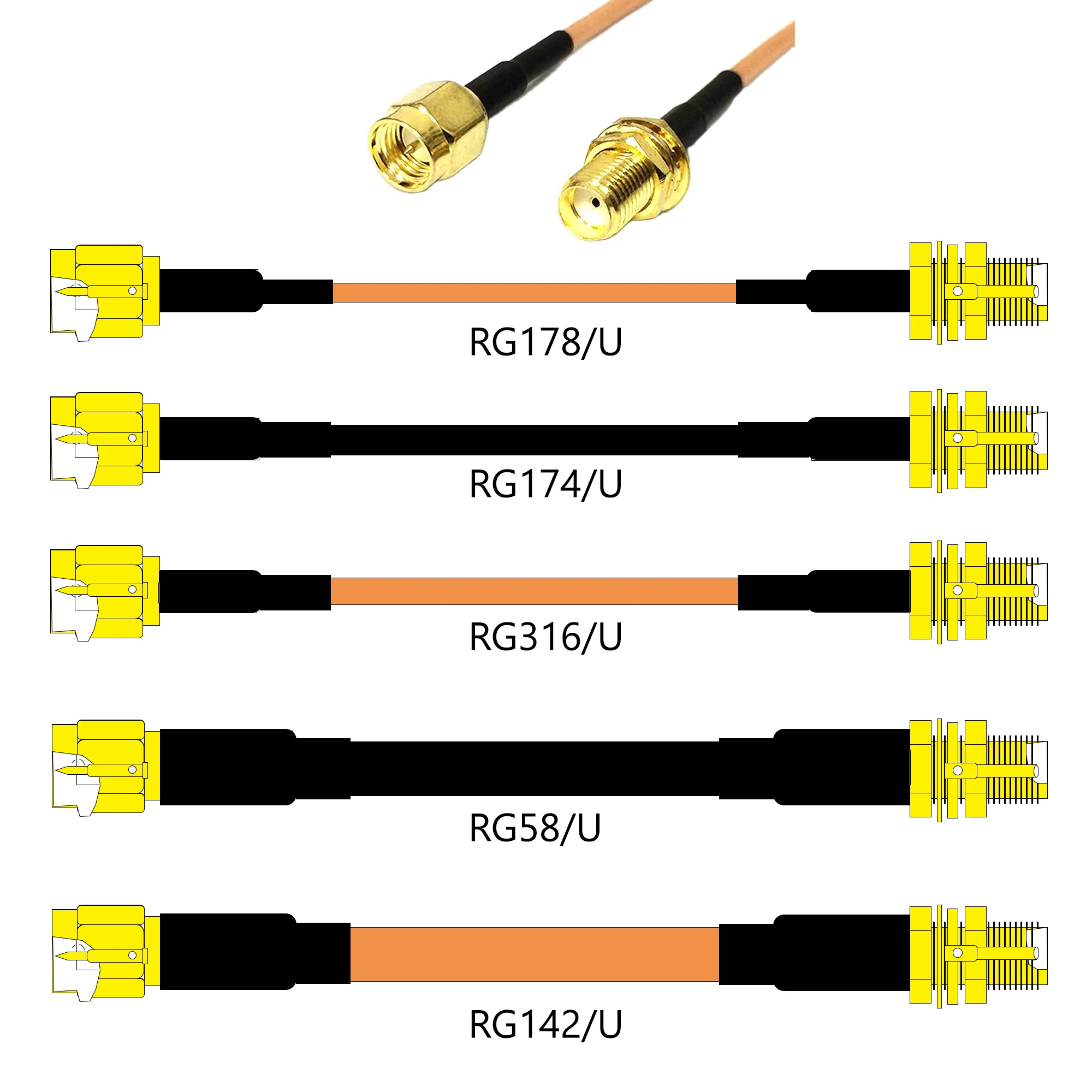
SMA RF Coaxial Pigtail Extension Cables (RG174, RG178, RG316, RG58, RG142)
Official Store Deal
Expert Analysis Overview
The RF Interconnect Standard: A Critical Assessment
The SMA Male to Female RF Plug Jack Connector Pigtail Extension Cable is a specialized interconnect solution deemed essential for maintaining signal integrity in critical radio frequency applications. This assessment, from an electrical professional's standpoint, focuses on the inherent design choices and their implications for system performance and reliability. The selection of appropriate coaxial cable and connector types is not merely a preference; it is a fundamental requirement for preventing signal degradation and ensuring compliance with operational parameters.Precision in Signal Transmission: Understanding Coaxial Cable Types
The product offers a range of standard RG-type coaxial cables, specifically RG178, RG174, RG316, RG58, and RG142. Each designation represents a distinct set of electrical and physical characteristics. RG178 and RG316, for instance, are typically smaller diameter cables, often utilizing PTFE dielectric for higher temperature resistance and lower loss at higher frequencies, making them suitable for compact assemblies or internal connections where space is at a premium. RG174 is a common, flexible cable for general-purpose RF applications, balancing performance and cost. RG58 is a thicker, more robust cable, offering better shielding and lower attenuation over longer runs, commonly found in amateur radio and some networking applications. RG142, with its double-shielded construction, provides superior interference rejection and power handling capabilities, often employed in more demanding environments.These varied cable types directly impact signal integrity. The impedance of these cables is typically 50 ohms, a standard for most RF communication systems. Mismatched impedance leads to signal reflections, reducing power transfer efficiency and potentially causing standing wave issues that can damage transmitting equipment. Selecting the correct RG type ensures that the cable's attenuation characteristics are appropriate for the frequency and length of the signal path, minimizing signal loss. This is crucial for maintaining the required signal-to-noise ratio in sensitive RF circuits.
Compared to generic, unspecifed patch cables, these RG-type offerings provide a known and predictable performance baseline. Generic cables often lack consistent impedance, proper shielding, or durable insulation, leading to intermittent connectivity and increased susceptibility to electromagnetic interference. The use of specified RG cables mitigates these risks, offering a reliable foundation for any RF system. It is a foundational choice.
Connector Integrity: The Gold Standard for RF Reliability
The cables are terminated with SMA Male to SMA Female connectors, visibly featuring gold plating. Gold plating on RF connectors is not merely aesthetic; it serves a critical functional purpose. Gold offers excellent electrical conductivity and superior corrosion resistance, particularly in environments exposed to moisture or corrosive agents. This ensures a stable, low-resistance electrical contact over time, which is paramount for high-frequency signal transmission.The benefits of gold plating extend to the longevity and reliability of the connection. A stable contact minimizes signal loss at the interface and reduces the potential for intermodulation distortion, which can be a significant issue in multi-frequency RF systems. The mechanical stability of the SMA connector, with its threaded coupling, provides a secure and vibration-resistant connection, preventing accidental disconnections or signal interruptions. Proper torque application is essential.
In contrast, connectors with lesser plating materials, such as nickel or tin, are more susceptible to oxidation and wear. This degradation can lead to increased contact resistance, signal attenuation, and intermittent performance, particularly in applications requiring frequent connection and disconnection cycles. The gold-plated SMA connectors represent an upgrade in terms of long-term performance and system reliability. They resist environmental degradation.
Application Versatility: Bridging the RF Gap
These SMA pigtail extension cables are designed to bridge connections in a multitude of RF applications. Their primary function is to extend the reach of existing SMA-terminated components or to provide flexible interconnections within a system. This includes, but is not limited to, connecting antennas to wireless routers, extending GPS receiver cables, linking test equipment, or integrating embedded RF modules into larger enclosures.Consider a scenario where an antenna needs to be relocated for optimal signal reception, but the existing cable is too short. These extension cables provide the necessary length without requiring a complete re-cabling effort. In test and measurement setups, they allow for flexible positioning of components, facilitating easier troubleshooting and experimentation. For industrial IoT devices, these cables can connect internal radio modules to external antennas, ensuring robust communication in challenging environments. Flexibility is a key advantage.
Unlike makeshift solutions involving adapters and multiple short cables, which introduce additional points of signal loss and potential failure, these dedicated extension cables offer a cleaner, more reliable path. The availability of various RG types allows for selection based on specific application requirements, such as flexibility, attenuation, or power handling. This targeted approach enhances overall system performance. It simplifies complex setups.
Durability and Construction: Engineered for Longevity
The visible construction of these cables indicates a focus on practical durability. The cable jackets, varying in thickness and material depending on the RG type, are designed to protect the internal conductors and dielectric from physical damage and environmental stressors. The strain relief at the connector-cable junction is a critical feature, preventing bending-induced damage that can lead to conductor breakage or shield compromise. This ensures a longer operational lifespan.Resistance to wear and tear is a significant factor in any electrical component. For cables used in dynamic environments, such as mobile installations or test benches with frequent reconfigurations, the robustness of the jacket and strain relief directly correlates with reliability. A well-constructed cable maintains its electrical properties even after repeated handling or exposure to moderate mechanical stress. This prevents costly replacements.
Compared to cables with minimal or absent strain relief, which are prone to premature failure at the connection point, these cables offer enhanced resilience. The robust construction minimizes the risk of internal damage, which can manifest as intermittent signals or complete circuit breaks. Investing in durable cables reduces maintenance overhead and improves system uptime. It is a practical consideration.
The Electrical Professional's Perspective: Ensuring System Harmony
From an electrical professional's viewpoint, the correct selection and implementation of these RF cables are paramount for system harmony. While these are not power cables, their role in signal transmission is critical for the proper functioning of electronic devices. Incorrect cable types, poor connections, or damaged shielding can lead to electromagnetic interference (EMI) or radio frequency interference (RFI), affecting not only the connected device but also adjacent electronic systems. This can violate regulatory compliance.The consequences of poor RF cabling extend beyond simple signal loss. In sensitive applications like medical equipment, aerospace communication, or industrial control systems, signal integrity directly impacts safety and operational reliability. A compromised RF link can lead to data errors, system malfunctions, or even complete communication failure. Proper impedance matching, as facilitated by selecting the correct RG cable, prevents standing waves that can overheat components or reduce the lifespan of RF amplifiers. Safety is always a concern.
These cables contribute to overall system stability by providing a predictable and reliable signal path. Unlike unverified cables that introduce unknown variables into an RF chain, these specified components allow for precise system design and troubleshooting. They help maintain the electromagnetic compatibility (EMC) of an installation, preventing unwanted emissions or susceptibility to external noise. This ensures predictable operation.
Optimizing Your RF Ecosystem: A Strategic Investment
Considering the price point, these SMA pigtail extension cables represent a strategic investment in the long-term reliability and performance of any RF system. The initial cost is minimal when weighed against the potential expenses associated with troubleshooting intermittent signal issues, replacing damaged components due to impedance mismatches, or dealing with system downtime caused by unreliable connections. This is a cost-effective solution.Preventing troubleshooting time is a significant benefit. Diagnosing RF issues can be complex and time-consuming, often requiring specialized equipment. By utilizing high-quality, specified cables, the likelihood of cable-related problems is drastically reduced, allowing technicians to focus on other aspects of system maintenance or development. This improves operational efficiency. It saves valuable resources.
The overall return on investment (ROI) for critical applications is substantial. For systems where consistent, high-quality RF communication is essential, such as in telecommunications infrastructure, scientific instrumentation, or security systems, the reliability offered by these cables far outweighs their modest cost. They are a foundational element for robust RF performance. They ensure system longevity.
Imagine an RF system operating with unwavering signal strength, free from the frustrating intermittency caused by inferior cabling. Picture the confidence in knowing that critical data transmission remains stable, enabling seamless communication and precise control. These SMA extension cables provide the foundational reliability necessary for such an environment, allowing for uninterrupted operation and peace of mind in demanding applications.