Silicone Insulated Copper Wire (8-24 AWG)
Official Store Deal
Expert Analysis Overview
The Silicone Insulated Copper Wire series offers a robust and flexible wiring solution for various low-voltage electrical applications, particularly where thermal resilience and ease of installation are paramount. This product line, spanning gauges from 8 AWG to 24 AWG, is specifically engineered for DIY projects, LED lamp connections, and other scenarios demanding reliable power transmission within a wide temperature spectrum. Its construction prioritizes both electrical performance and mechanical durability, setting it apart from standard PVC-insulated alternatives.
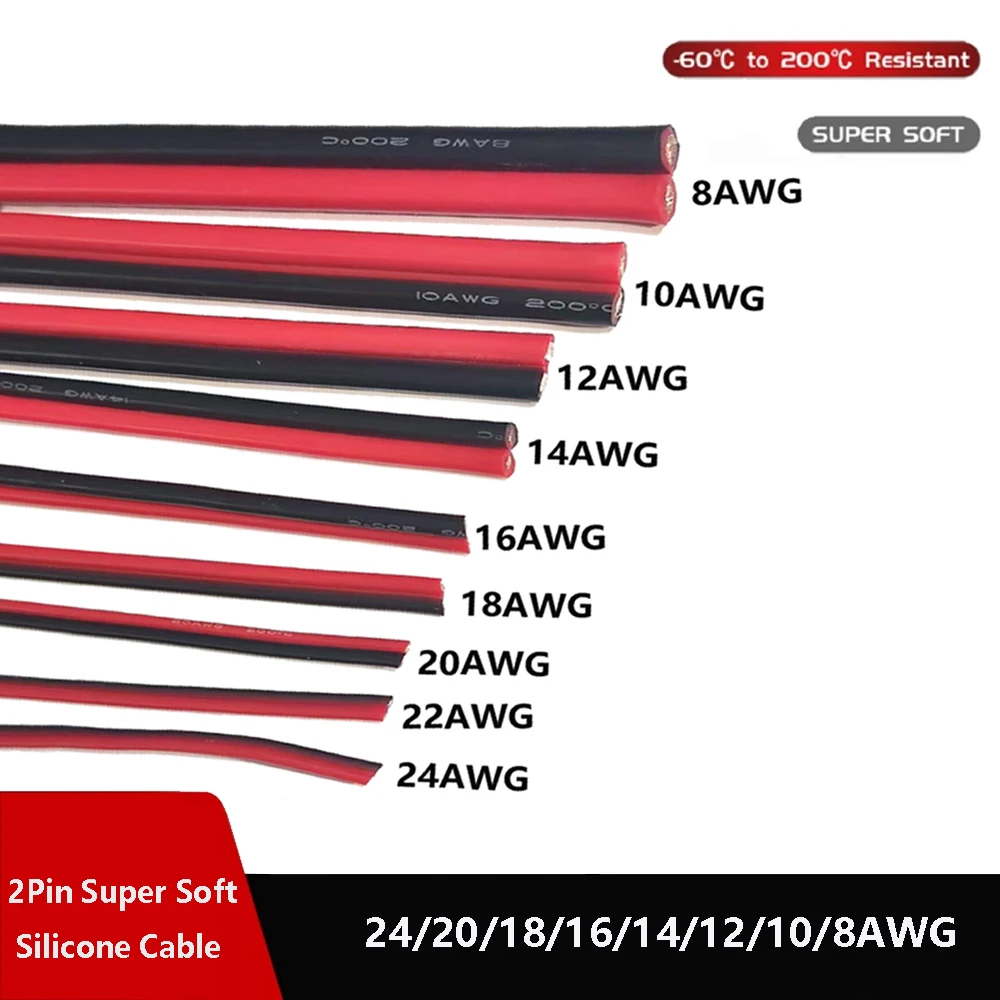
The core of this wiring system features black and red copper conductors, indicating a clear polarity for straightforward circuit identification. The range of available gauges, from 8 AWG to 24 AWG, directly dictates the wire's current carrying capacity. Selecting the appropriate gauge is critical for preventing overheating and ensuring circuit safety. An 8 AWG wire, for instance, can safely handle significantly higher amperage than a 24 AWG wire, making it suitable for higher-power applications like battery connections or main power feeds in smaller systems. Conversely, 24 AWG is ideal for signal transmission or very low-current LED circuits.
Incorrect gauge selection can lead to dangerous thermal runaway. The visible stranding process, described as an "inter-twisted winding process," is a key design choice. This method tightly twists individual copper strands together, which inherently reduces signal interference and enhances overall electrical conductivity. Unlike solid core wires, which are rigid and prone to fatigue, stranded copper offers superior flexibility, making installation in confined spaces or around tight bends considerably easier. This flexibility also contributes to the wire's longevity, as it is less likely to break under repeated movement or vibration. The tightly twisted strands ensure a more uniform current distribution, minimizing localized hot spots that can degrade insulation over time.
This wiring utilizes a silicone insulator, a material renowned for its exceptional thermal properties. The product is rated as "-60°C to 200°C Resistant," a significantly broader operating temperature range than conventional PVC insulation. This high resistance to both extreme cold and heat makes the cable suitable for environments where temperature fluctuations are common or where components generate considerable heat, such as within power supplies or high-intensity lighting fixtures. Standard PVC insulation typically degrades at much lower temperatures, becoming brittle in the cold and softening or melting when exposed to heat.
Silicone's inherent flexibility is maintained across its entire temperature range. This "super soft" characteristic simplifies routing and installation, reducing the risk of insulation damage during handling. The material's resistance to chemicals, oils, and UV radiation further extends its applicability and lifespan in various industrial and hobbyist settings. This robust insulation ensures that the conductor remains protected, preventing short circuits and maintaining electrical integrity even under challenging conditions. The superior thermal performance directly translates to enhanced safety and reliability for the entire electrical system.
The product highlights "LOW ECCENTRICITY" as a critical manufacturing advantage. Eccentricity refers to the degree to which the conductor is off-center within its insulation. High eccentricity means the insulation is thinner on one side, creating a weak point susceptible to breakdown, especially under electrical stress or physical abrasion. Low eccentricity, as claimed here, ensures a uniform insulation thickness around the conductor. This uniformity is vital for preventing current leakage and localized overheating, which are common precursors to electrical fires.
Consistent insulation thickness directly contributes to the wire's dielectric strength and overall safety. It minimizes the risk of insulation failure, ensuring a safer use of electricity over the wire's operational life. Unlike poorly manufactured wires where insulation inconsistencies are common, this product's emphasis on low eccentricity suggests a commitment to higher quality control standards. This attention to detail is particularly important in DIY applications where users might not have access to professional testing equipment to verify wire integrity. The visual inspection of the cross-section confirms a well-centered conductor, reinforcing the claim of low eccentricity.
The "super soft" nature of the silicone rubber cable is not merely a comfort feature; it is a significant functional advantage. This flexibility allows for tighter bending radii without stressing the copper conductors or cracking the insulation. For complex wiring harnesses or installations in tight enclosures, this characteristic dramatically simplifies the process and reduces installation time. The material's resilience also means it is less prone to kinking or permanent deformation, maintaining its structural integrity over time.
Compared to stiffer, less flexible wires, the silicone cable offers superior resistance to mechanical fatigue. This is crucial in applications where wires might be subjected to repeated movement or vibration, such as in robotics, RC models, or automotive wiring. The combination of high-temperature resistance and mechanical flexibility ensures that the wire performs reliably under dynamic and thermally demanding conditions. This translates to fewer maintenance issues and a longer operational lifespan for the connected devices.
Investing in high-quality silicone-insulated wire, despite a potentially higher initial cost than basic PVC wire, offers significant long-term value. The enhanced durability, superior thermal performance, and improved electrical safety reduce the likelihood of costly repairs, system failures, or even fire hazards. For hobbyists and professionals alike, this translates into peace of mind and reliable operation of their projects. The broad range of gauges available ensures that users can select the precise wire for their specific current requirements, optimizing both safety and efficiency.
This wiring is an upgrade from generic alternatives, providing a robust foundation for any electrical project. Imagine completing a complex LED lighting installation knowing that the wiring is rated for extreme temperatures and designed for maximum flexibility, minimizing future troubleshooting. The consistent performance and safety features of this silicone cable make it an indispensable component for anyone serious about the reliability and longevity of their electrical connections. This product ensures that your electrical connections are not just functional, but also secure and enduring, providing a dependable backbone for your creations.
The product's specifications, including its AWG range and temperature resistance, align with the requirements for various low-voltage DC applications. The use of pure copper conductors ensures optimal current flow and minimal voltage drop, which is particularly important for sensitive electronics and LED lighting where consistent power delivery is crucial. The inter-twisted stranding further enhances this, providing a stable and efficient electrical path. While specific UL or CE certifications are not explicitly stated in the provided information, the described properties suggest a product designed with high performance and safety standards in mind. Users should always verify specific certifications if their application requires them.
For critical applications, understanding the wire's current rating relative to its gauge and insulation type is paramount. The silicone insulation's ability to withstand high temperatures means the wire can operate closer to its maximum current capacity without immediate insulation degradation, though proper ventilation and heat dissipation are always recommended. This allows for more compact designs and greater confidence in the system's thermal management. The red and black color coding simplifies installation, reducing the chance of polarity errors in DC circuits, a common issue in DIY projects. This attention to user-friendly design elements enhances the overall utility of the product.
The Silicone Insulated Copper Wire provides a superior foundation for any electrical project requiring flexibility, thermal stability, and reliable current transmission. Its advanced material properties and manufacturing precision address common pain points associated with lesser quality wiring, such as brittleness, thermal degradation, and inconsistent performance. This product ensures that your electrical connections are not just functional, but also secure and enduring, providing a dependable backbone for your creations. The long-term value derived from its durability and safety features far outweighs the initial investment, making it a smart choice for both hobbyists and professionals. Imagine the confidence in knowing your DIY LED lamp project or intricate electronic build is powered by wiring that stands up to demanding conditions, offering consistent performance and peace of mind for years to come.
Conductor Integrity and Current Capacity
The core of this wiring system features black and red copper conductors, indicating a clear polarity for straightforward circuit identification. The range of available gauges, from 8 AWG to 24 AWG, directly dictates the wire's current carrying capacity. Selecting the appropriate gauge is critical for preventing overheating and ensuring circuit safety. An 8 AWG wire, for instance, can safely handle significantly higher amperage than a 24 AWG wire, making it suitable for higher-power applications like battery connections or main power feeds in smaller systems. Conversely, 24 AWG is ideal for signal transmission or very low-current LED circuits.
Incorrect gauge selection can lead to dangerous thermal runaway. The visible stranding process, described as an "inter-twisted winding process," is a key design choice. This method tightly twists individual copper strands together, which inherently reduces signal interference and enhances overall electrical conductivity. Unlike solid core wires, which are rigid and prone to fatigue, stranded copper offers superior flexibility, making installation in confined spaces or around tight bends considerably easier. This flexibility also contributes to the wire's longevity, as it is less likely to break under repeated movement or vibration. The tightly twisted strands ensure a more uniform current distribution, minimizing localized hot spots that can degrade insulation over time.
Advanced Insulation and Thermal Resilience
This wiring utilizes a silicone insulator, a material renowned for its exceptional thermal properties. The product is rated as "-60°C to 200°C Resistant," a significantly broader operating temperature range than conventional PVC insulation. This high resistance to both extreme cold and heat makes the cable suitable for environments where temperature fluctuations are common or where components generate considerable heat, such as within power supplies or high-intensity lighting fixtures. Standard PVC insulation typically degrades at much lower temperatures, becoming brittle in the cold and softening or melting when exposed to heat.
Silicone's inherent flexibility is maintained across its entire temperature range. This "super soft" characteristic simplifies routing and installation, reducing the risk of insulation damage during handling. The material's resistance to chemicals, oils, and UV radiation further extends its applicability and lifespan in various industrial and hobbyist settings. This robust insulation ensures that the conductor remains protected, preventing short circuits and maintaining electrical integrity even under challenging conditions. The superior thermal performance directly translates to enhanced safety and reliability for the entire electrical system.
Precision Manufacturing and Electrical Safety
The product highlights "LOW ECCENTRICITY" as a critical manufacturing advantage. Eccentricity refers to the degree to which the conductor is off-center within its insulation. High eccentricity means the insulation is thinner on one side, creating a weak point susceptible to breakdown, especially under electrical stress or physical abrasion. Low eccentricity, as claimed here, ensures a uniform insulation thickness around the conductor. This uniformity is vital for preventing current leakage and localized overheating, which are common precursors to electrical fires.
Consistent insulation thickness directly contributes to the wire's dielectric strength and overall safety. It minimizes the risk of insulation failure, ensuring a safer use of electricity over the wire's operational life. Unlike poorly manufactured wires where insulation inconsistencies are common, this product's emphasis on low eccentricity suggests a commitment to higher quality control standards. This attention to detail is particularly important in DIY applications where users might not have access to professional testing equipment to verify wire integrity. The visual inspection of the cross-section confirms a well-centered conductor, reinforcing the claim of low eccentricity.
Durability and Installation Advantages
The "super soft" nature of the silicone rubber cable is not merely a comfort feature; it is a significant functional advantage. This flexibility allows for tighter bending radii without stressing the copper conductors or cracking the insulation. For complex wiring harnesses or installations in tight enclosures, this characteristic dramatically simplifies the process and reduces installation time. The material's resilience also means it is less prone to kinking or permanent deformation, maintaining its structural integrity over time.
Compared to stiffer, less flexible wires, the silicone cable offers superior resistance to mechanical fatigue. This is crucial in applications where wires might be subjected to repeated movement or vibration, such as in robotics, RC models, or automotive wiring. The combination of high-temperature resistance and mechanical flexibility ensures that the wire performs reliably under dynamic and thermally demanding conditions. This translates to fewer maintenance issues and a longer operational lifespan for the connected devices.
Long-Term Value and Application Versatility
Investing in high-quality silicone-insulated wire, despite a potentially higher initial cost than basic PVC wire, offers significant long-term value. The enhanced durability, superior thermal performance, and improved electrical safety reduce the likelihood of costly repairs, system failures, or even fire hazards. For hobbyists and professionals alike, this translates into peace of mind and reliable operation of their projects. The broad range of gauges available ensures that users can select the precise wire for their specific current requirements, optimizing both safety and efficiency.
This wiring is an upgrade from generic alternatives, providing a robust foundation for any electrical project. Imagine completing a complex LED lighting installation knowing that the wiring is rated for extreme temperatures and designed for maximum flexibility, minimizing future troubleshooting. The consistent performance and safety features of this silicone cable make it an indispensable component for anyone serious about the reliability and longevity of their electrical connections. This product ensures that your electrical connections are not just functional, but also secure and enduring, providing a dependable backbone for your creations.
Technical Specifications and Compliance
The product's specifications, including its AWG range and temperature resistance, align with the requirements for various low-voltage DC applications. The use of pure copper conductors ensures optimal current flow and minimal voltage drop, which is particularly important for sensitive electronics and LED lighting where consistent power delivery is crucial. The inter-twisted stranding further enhances this, providing a stable and efficient electrical path. While specific UL or CE certifications are not explicitly stated in the provided information, the described properties suggest a product designed with high performance and safety standards in mind. Users should always verify specific certifications if their application requires them.
For critical applications, understanding the wire's current rating relative to its gauge and insulation type is paramount. The silicone insulation's ability to withstand high temperatures means the wire can operate closer to its maximum current capacity without immediate insulation degradation, though proper ventilation and heat dissipation are always recommended. This allows for more compact designs and greater confidence in the system's thermal management. The red and black color coding simplifies installation, reducing the chance of polarity errors in DC circuits, a common issue in DIY projects. This attention to user-friendly design elements enhances the overall utility of the product.
Conclusion: A Foundation for Reliable Electrical Work
The Silicone Insulated Copper Wire provides a superior foundation for any electrical project requiring flexibility, thermal stability, and reliable current transmission. Its advanced material properties and manufacturing precision address common pain points associated with lesser quality wiring, such as brittleness, thermal degradation, and inconsistent performance. This product ensures that your electrical connections are not just functional, but also secure and enduring, providing a dependable backbone for your creations. The long-term value derived from its durability and safety features far outweighs the initial investment, making it a smart choice for both hobbyists and professionals. Imagine the confidence in knowing your DIY LED lamp project or intricate electronic build is powered by wiring that stands up to demanding conditions, offering consistent performance and peace of mind for years to come.