SEEDGREEN TZ 3.0 All-Metal Hotend for Bambu Lab X1/P1 Series
Official Store Deal
Expert Analysis Overview
The SEEDGREEN TZ 3.0 All-Metal Hotend is a precision-engineered upgrade component designed for Bambu Lab X1 and P1 series 3D printers, specifically targeting users who demand consistent high-temperature and high-flow material extrusion. This hotend represents a significant step forward for those looking to expand their material capabilities and improve print reliability within a classroom or advanced hobbyist setting. Its construction emphasizes both thermal efficiency and long-term durability, crucial factors for demanding additive manufacturing tasks.
This hotend boasts an impressive overall maximum temperature of 350°C. Such a high thermal ceiling is not merely a number; it fundamentally broadens the spectrum of printable materials. Standard 3D printers often cap out around 250-280°C, limiting users to common filaments like PLA, PETG, and some ABS variants. The TZ 3.0, however, opens the door to engineering-grade polymers such as Nylon, Polycarbonate, and even carbon fiber-filled composites, which require significantly higher melt temperatures for proper extrusion and layer adhesion. This capability is paramount for advanced STEM projects requiring parts with superior mechanical properties or heat resistance.
The ability to reach 350°C consistently ensures that even challenging filaments melt uniformly, reducing the risk of clogs and improving print quality. Furthermore, the stated flow rate of 35mm³/s using TZ-3.0 P1 hotends signifies a substantial increase in material throughput. High flow rates are essential for rapid prototyping and large-volume prints, allowing for faster completion of projects without sacrificing structural integrity. For educators, this means more efficient use of lab time, as students can iterate designs and produce functional parts more quickly. It also allows for printing with wider lines or thicker layers, which can be advantageous for certain applications and reduce overall print duration.
Unlike many stock hotends that struggle with consistent high-speed extrusion, this upgraded unit is engineered to maintain thermal stability under pressure. The integrated heating block and radiator work in concert to manage heat efficiently, preventing heat creep into the cold end. This thermal management is critical for preventing filament premature softening and jamming, especially during long print jobs or when using materials with a narrow temperature window. Consistent performance is key.
Durability is a cornerstone of this hotend's design, evidenced by its material choices. The inclusion of chrome-zirconium copper in the heating enclosure is a strategic engineering decision. This alloy is renowned for its excellent thermal conductivity, surpassing that of standard brass or aluminum heating blocks. Superior heat transfer ensures that the filament reaches its optimal melting temperature rapidly and maintains it precisely, leading to more consistent extrusion and fewer print defects. It's a robust material selection.
The titanium alloy heat break is another critical component. Titanium offers a significantly lower thermal conductivity compared to steel, effectively creating a sharp thermal barrier between the hot end (nozzle and heating block) and the cold end (radiator). This prevents heat from migrating upwards, which is the primary cause of heat creep and subsequent filament jams. Unlike PTFE-lined heat breaks found in many entry-level hotends, an all-metal titanium heat break eliminates the risk of PTFE degradation at high temperatures, which can release toxic fumes and damage the hotend itself. This ensures safer operation, especially in educational environments where diverse materials might be used.
Furthermore, the hotend features a hardened steel nozzle. This is a crucial upgrade for printing abrasive filaments like carbon fiber, glass fiber, or metal-filled composites. Standard brass nozzles wear down quickly when exposed to these materials, leading to inconsistent extrusion and reduced print quality. Hardened steel provides exceptional wear resistance, ensuring a longer lifespan for the nozzle and consistent performance across hundreds of hours of printing with challenging materials. This reduces the frequency of nozzle replacements, saving both time and cost for schools or busy workshops.
The hotend's design emphasizes both compactness and user-friendliness. Its small size and light weight contribute to the overall performance of the 3D printer by minimizing inertia on the print head. Less mass means the printer's motors can accelerate and decelerate more quickly and accurately, potentially leading to higher print speeds and reduced ringing artifacts on prints. This is a subtle but impactful benefit for print quality.
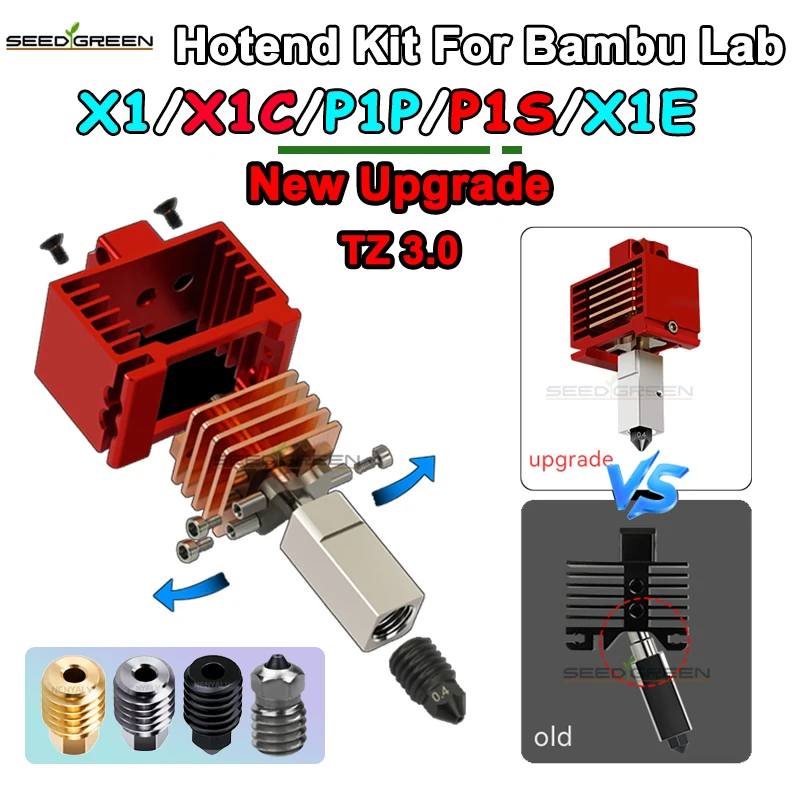
The aluminum radiator with integrated pipes is a testament to thoughtful thermal management. This integrated design optimizes the surface area for heat dissipation, ensuring the cold end remains cool even during prolonged high-temperature printing. The integrated pipes likely refer to the internal channels that facilitate efficient airflow or liquid cooling, though the visual suggests a finned air-cooled design. Efficient cooling is vital for preventing heat creep and maintaining the integrity of the filament before it reaches the melt zone. It keeps things running smoothly.
Titanium alloy screw fixation for the radiator, heat break, and heating block provides a stable and secure connection. The use of three screws on the side allows for easy disassembly and replacement of individual components. This modularity is a significant advantage, particularly in educational settings. Instead of replacing the entire hotend assembly if one part fails, users can replace just the faulty component, reducing maintenance costs and downtime. This simplified maintenance workflow is invaluable for educators managing multiple printers or for students learning about printer mechanics.
This hotend is specifically designed for Bambu Lab X1, X1C, P1P, and P1S, X1E series printers. This targeted compatibility ensures a drop-in replacement experience, minimizing the need for extensive modifications or complex calibration. Bambu Lab printers are known for their speed and enclosed printing capabilities, and this hotend is engineered to complement those strengths. The tight integration means users can leverage existing slicing profiles with minimal adjustments, ensuring a smooth transition to enhanced capabilities. It just fits.
Proper integration with the printer's firmware and motion system is crucial for optimal performance. An upgrade like the TZ 3.0 is designed to work within the parameters of the Bambu Lab ecosystem, providing a reliable path to higher performance without introducing unforeseen compatibility issues. This makes it an ideal upgrade for users already familiar with their Bambu Lab machine, seeking to push its boundaries.
For STEM educators, the SEEDGREEN TZ 3.0 hotend offers a robust platform for teaching advanced additive manufacturing concepts. Its ability to handle a wide array of engineering-grade materials allows students to experiment with different material properties and design functional prototypes that might not be possible with standard hotends. This hands-on experience with advanced materials is invaluable for preparing students for careers in engineering and manufacturing. It expands learning opportunities.
The enhanced durability from the hardened steel nozzle and titanium heat break means less frequent maintenance and fewer interruptions in the classroom. This reliability ensures that printers are available when students need them, maximizing learning time and reducing frustration for both students and instructors. The modular design also provides an excellent teaching opportunity for students to understand the internal workings of a hotend and practice component replacement in a controlled environment.
Moreover, the high-temperature capabilities, coupled with the inherent safety features of an all-metal design (no degrading PTFE), make it a safer choice for classroom use when printing with materials that require elevated temperatures. Educators can confidently introduce students to a broader range of materials, knowing the equipment is designed for demanding conditions. This hotend empowers educators to create a more dynamic and capable 3D printing curriculum.
Imagine a classroom where students are not limited by the capabilities of their 3D printers, but rather empowered to explore the full potential of additive manufacturing. With this hotend, complex engineering projects become feasible, and the transition from theoretical design to tangible, high-performance prototypes is seamless. It enables a new level of innovation and practical learning, making advanced materials and rapid production accessible for every student. This upgrade transforms a capable printer into an extraordinary educational tool, inspiring the next generation of engineers and designers to push boundaries with confidence and precision.
Advancing Thermal Dynamics and Extrusion Prowess
This hotend boasts an impressive overall maximum temperature of 350°C. Such a high thermal ceiling is not merely a number; it fundamentally broadens the spectrum of printable materials. Standard 3D printers often cap out around 250-280°C, limiting users to common filaments like PLA, PETG, and some ABS variants. The TZ 3.0, however, opens the door to engineering-grade polymers such as Nylon, Polycarbonate, and even carbon fiber-filled composites, which require significantly higher melt temperatures for proper extrusion and layer adhesion. This capability is paramount for advanced STEM projects requiring parts with superior mechanical properties or heat resistance.
The ability to reach 350°C consistently ensures that even challenging filaments melt uniformly, reducing the risk of clogs and improving print quality. Furthermore, the stated flow rate of 35mm³/s using TZ-3.0 P1 hotends signifies a substantial increase in material throughput. High flow rates are essential for rapid prototyping and large-volume prints, allowing for faster completion of projects without sacrificing structural integrity. For educators, this means more efficient use of lab time, as students can iterate designs and produce functional parts more quickly. It also allows for printing with wider lines or thicker layers, which can be advantageous for certain applications and reduce overall print duration.
Unlike many stock hotends that struggle with consistent high-speed extrusion, this upgraded unit is engineered to maintain thermal stability under pressure. The integrated heating block and radiator work in concert to manage heat efficiently, preventing heat creep into the cold end. This thermal management is critical for preventing filament premature softening and jamming, especially during long print jobs or when using materials with a narrow temperature window. Consistent performance is key.
Advanced Material Science for Enduring Performance
Durability is a cornerstone of this hotend's design, evidenced by its material choices. The inclusion of chrome-zirconium copper in the heating enclosure is a strategic engineering decision. This alloy is renowned for its excellent thermal conductivity, surpassing that of standard brass or aluminum heating blocks. Superior heat transfer ensures that the filament reaches its optimal melting temperature rapidly and maintains it precisely, leading to more consistent extrusion and fewer print defects. It's a robust material selection.
The titanium alloy heat break is another critical component. Titanium offers a significantly lower thermal conductivity compared to steel, effectively creating a sharp thermal barrier between the hot end (nozzle and heating block) and the cold end (radiator). This prevents heat from migrating upwards, which is the primary cause of heat creep and subsequent filament jams. Unlike PTFE-lined heat breaks found in many entry-level hotends, an all-metal titanium heat break eliminates the risk of PTFE degradation at high temperatures, which can release toxic fumes and damage the hotend itself. This ensures safer operation, especially in educational environments where diverse materials might be used.
Furthermore, the hotend features a hardened steel nozzle. This is a crucial upgrade for printing abrasive filaments like carbon fiber, glass fiber, or metal-filled composites. Standard brass nozzles wear down quickly when exposed to these materials, leading to inconsistent extrusion and reduced print quality. Hardened steel provides exceptional wear resistance, ensuring a longer lifespan for the nozzle and consistent performance across hundreds of hours of printing with challenging materials. This reduces the frequency of nozzle replacements, saving both time and cost for schools or busy workshops.
Integrated Design and Maintenance Simplicity
The hotend's design emphasizes both compactness and user-friendliness. Its small size and light weight contribute to the overall performance of the 3D printer by minimizing inertia on the print head. Less mass means the printer's motors can accelerate and decelerate more quickly and accurately, potentially leading to higher print speeds and reduced ringing artifacts on prints. This is a subtle but impactful benefit for print quality.
The aluminum radiator with integrated pipes is a testament to thoughtful thermal management. This integrated design optimizes the surface area for heat dissipation, ensuring the cold end remains cool even during prolonged high-temperature printing. The integrated pipes likely refer to the internal channels that facilitate efficient airflow or liquid cooling, though the visual suggests a finned air-cooled design. Efficient cooling is vital for preventing heat creep and maintaining the integrity of the filament before it reaches the melt zone. It keeps things running smoothly.
Titanium alloy screw fixation for the radiator, heat break, and heating block provides a stable and secure connection. The use of three screws on the side allows for easy disassembly and replacement of individual components. This modularity is a significant advantage, particularly in educational settings. Instead of replacing the entire hotend assembly if one part fails, users can replace just the faulty component, reducing maintenance costs and downtime. This simplified maintenance workflow is invaluable for educators managing multiple printers or for students learning about printer mechanics.
Compatibility and Seamless System Integration
This hotend is specifically designed for Bambu Lab X1, X1C, P1P, and P1S, X1E series printers. This targeted compatibility ensures a drop-in replacement experience, minimizing the need for extensive modifications or complex calibration. Bambu Lab printers are known for their speed and enclosed printing capabilities, and this hotend is engineered to complement those strengths. The tight integration means users can leverage existing slicing profiles with minimal adjustments, ensuring a smooth transition to enhanced capabilities. It just fits.
Proper integration with the printer's firmware and motion system is crucial for optimal performance. An upgrade like the TZ 3.0 is designed to work within the parameters of the Bambu Lab ecosystem, providing a reliable path to higher performance without introducing unforeseen compatibility issues. This makes it an ideal upgrade for users already familiar with their Bambu Lab machine, seeking to push its boundaries.
Educational Impact and Classroom Readiness
For STEM educators, the SEEDGREEN TZ 3.0 hotend offers a robust platform for teaching advanced additive manufacturing concepts. Its ability to handle a wide array of engineering-grade materials allows students to experiment with different material properties and design functional prototypes that might not be possible with standard hotends. This hands-on experience with advanced materials is invaluable for preparing students for careers in engineering and manufacturing. It expands learning opportunities.
The enhanced durability from the hardened steel nozzle and titanium heat break means less frequent maintenance and fewer interruptions in the classroom. This reliability ensures that printers are available when students need them, maximizing learning time and reducing frustration for both students and instructors. The modular design also provides an excellent teaching opportunity for students to understand the internal workings of a hotend and practice component replacement in a controlled environment.
Moreover, the high-temperature capabilities, coupled with the inherent safety features of an all-metal design (no degrading PTFE), make it a safer choice for classroom use when printing with materials that require elevated temperatures. Educators can confidently introduce students to a broader range of materials, knowing the equipment is designed for demanding conditions. This hotend empowers educators to create a more dynamic and capable 3D printing curriculum.
Imagine a classroom where students are not limited by the capabilities of their 3D printers, but rather empowered to explore the full potential of additive manufacturing. With this hotend, complex engineering projects become feasible, and the transition from theoretical design to tangible, high-performance prototypes is seamless. It enables a new level of innovation and practical learning, making advanced materials and rapid production accessible for every student. This upgrade transforms a capable printer into an extraordinary educational tool, inspiring the next generation of engineers and designers to push boundaries with confidence and precision.