RTL-SDR V4 Software Defined Radio Receiver + Antenna
Official Store Deal
Expert Analysis Overview
The RTL-SDR V4 Software Defined Radio Receiver is a robust diagnostic tool designed for enthusiasts and professionals requiring precise radio frequency analysis. It stands as a significant upgrade from earlier iterations, offering enhanced capabilities for signal acquisition and processing. This device provides a versatile platform for exploring the radio spectrum, from basic broadcast listening to complex signal analysis.
This SDR receiver incorporates the RTL2832U chipset, a widely recognized and supported component in the software-defined radio community. Its integration ensures broad compatibility with various SDR software packages available across different operating systems. The core chipset dictates much of the device's fundamental processing power.
For users delving into radio diagnostics or spectrum monitoring, this foundational hardware is critical. It processes raw radio frequency data into a digital format that can be interpreted by a computer. This allows for detailed analysis of signals that would otherwise be inaccessible.
Compared to generic dongles, the specific implementation here is optimized for stability and performance. Many entry-level devices often cut corners on critical components, leading to compromised signal integrity.
A standout feature of the V4 is its 1PPM TCXO (Temperature Compensated Crystal Oscillator). This component is essential for maintaining frequency accuracy across varying temperatures. A stable clock source prevents frequency drift, which is a common issue with cheaper SDRs.
Accurate frequency tuning is paramount for tasks like monitoring specific communication channels or identifying weak signals. Without a stable TCXO, frequencies can wander, making consistent reception difficult. This device holds its tune.
Standard RTL-SDR dongles often use cheaper, less accurate oscillators that can drift significantly. This drift necessitates constant manual recalibration, a frustrating hindrance for any serious user. The 1PPM TCXO eliminates this hassle, providing reliable frequency lock.
The V4 model extends its utility with HF (High Frequency) reception capabilities. This allows users to tune into frequencies below 25 MHz, opening up a vast new segment of the radio spectrum including amateur radio bands, shortwave broadcasts, and utility communications. This is a significant improvement for hobbyists and professionals alike.
Accessing HF signals requires specific hardware modifications and filtering, which are integrated into this V4 design. Users can explore a broader range of signals without needing external upconverters. This simplifies the setup considerably.
Many entry-level SDRs are limited to VHF/UHF frequencies, leaving the rich HF spectrum unexplored. This receiver bridges that gap, offering a more comprehensive listening and analysis experience. It is a capable unit.
Furthermore, the inclusion of Bias-T power provides a convenient way to power external low-noise amplifiers (LNAs) or active antennas directly through the coaxial cable. This eliminates the need for separate power injectors or additional wiring, streamlining field deployments and complex setups.
This feature simplifies antenna installations, especially for remote or outdoor applications where power outlets are scarce. A cleaner setup means less potential for interference and fewer points of failure. It is a practical addition.
Generic SDRs typically lack Bias-T functionality, forcing users to purchase and integrate separate power solutions. This adds complexity and cost, making the V4 a more integrated and user-friendly option for advanced configurations.
The device features an SMA connector for antenna input, a standard and reliable interface for radio equipment. SMA connectors offer a secure connection, minimizing signal loss and ensuring consistent performance. This is a robust connection.
Reliable antenna connectivity is crucial for optimal signal reception. A loose or poorly shielded connection can introduce noise and degrade performance. The SMA standard is a good choice.
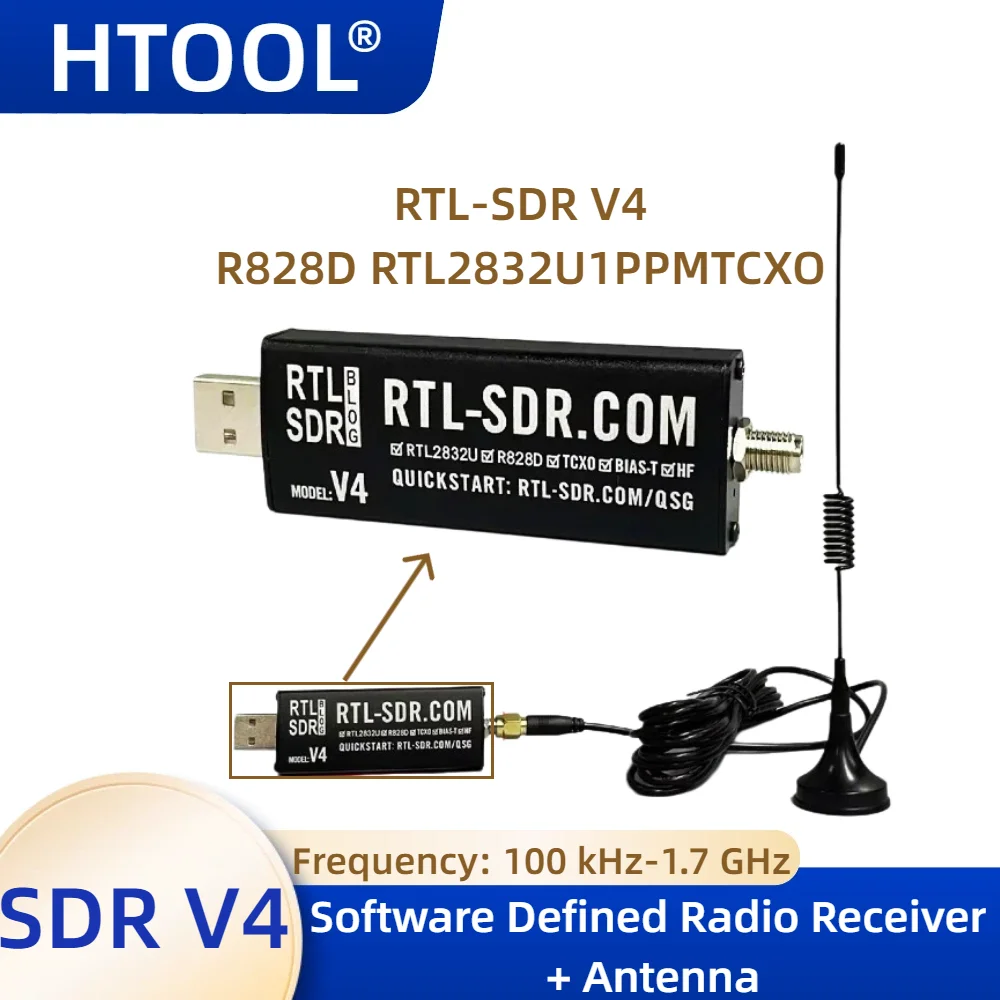
Many consumer-grade tuners use less durable connectors, prone to wear and signal degradation over time. The SMA connector on this unit suggests a focus on longevity and consistent signal integrity. Its compact form factor also suggests it can withstand minor impacts, much like a well-built tool. The metal casing visible implies a degree of physical protection, essential for a device used in various environments.
The physical construction, with its black metal casing, suggests a durable build. This is not a flimsy plastic dongle. It feels solid. The device is designed to withstand the rigors of frequent handling and transport, a critical factor for field use or workshop environments where tools might be jostled.
Unlike many fragile electronic devices, this SDR appears built to last. The robust casing protects the sensitive internal components from accidental bumps or drops. It's a tool that can take some abuse.
The RTL-SDR V4 benefits from a vast and mature software ecosystem. Compatibility with popular SDR applications like SDR# (SDRSharp), GQRX, HDSDR, and others ensures users have powerful tools at their disposal for demodulation, spectrum analysis, and recording. This broad support makes the device highly adaptable.
Operating the device involves connecting it to a computer's USB port and installing the necessary drivers and SDR software. The quickstart guide referenced on the device itself points to an online resource for setup. This streamlines the initial configuration process. It is easy to get started.
For a carpenter, the ability to quickly set up and operate a diagnostic tool is invaluable. This SDR's straightforward integration into existing computer systems allows for rapid deployment in a workshop or on a job site. It minimizes downtime.
Imagine setting up a remote monitoring station to identify sources of electromagnetic interference in a workshop. This SDR, with its precise TCXO and HF capabilities, allows for accurate frequency identification, much like a laser measure provides exact dimensions. It enables independent troubleshooting.
Consider the scenario where the device might be accidentally knocked off a workbench. Its sturdy metal housing provides a degree of protection against minor falls, similar to how a well-constructed tape measure can survive a drop from a ladder. The robust design minimizes potential damage.
When analyzing complex signal patterns, the clarity provided by the stable frequency and wide spectrum coverage is akin to easily reading precise fractional measurements on a tape. Ambiguity is reduced, and accurate interpretation becomes possible. This enhances diagnostic capability.
This SDR V4 offers a compelling blend of enhanced performance, expanded frequency coverage, and practical features for anyone serious about exploring the radio spectrum. It is a capable and reliable instrument. The durable construction and stable operation make it a sensible choice for demanding applications. This device empowers users to achieve precise signal analysis and monitoring, transforming complex RF tasks into manageable operations. It will become an indispensable part of any technical toolkit, consistently delivering accurate data and opening new avenues for radio exploration.
* Chipset: RTL2832U
* Oscillator: 1PPM TCXO
* Frequency Range: HF (below 25 MHz) to UHF
* Antenna Connector: SMA
* Power Feature: Bias-T
* Interface: USB
* Casing Material: Metal
* Model: V4
The 1PPM TCXO provides significantly improved frequency stability and accuracy, especially over varying temperatures. This means the tuned frequency will not drift, offering more reliable and precise signal reception compared to cheaper SDRs with less stable oscillators.
Yes, the RTL-SDR V4 is designed with integrated HF reception capabilities, allowing it to tune into frequencies below 25 MHz without the need for an external upconverter. This expands its utility for shortwave listening and amateur radio bands.
Bias-T is a feature that allows the SDR to supply DC power to an external device, such as a low-noise amplifier (LNA) or active antenna, directly through the antenna coaxial cable. This simplifies the setup by eliminating the need for a separate power supply for the LNA or active antenna.
This RTL-SDR V4 is compatible with a wide range of popular software-defined radio applications, including SDR# (SDRSharp), GQRX, HDSDR, SDR-Console, and others. It leverages the standard RTL2832U drivers, ensuring broad software support across Windows, Linux, and macOS.
The device features a black metal casing, which provides enhanced durability and protection for the internal components compared to plastic enclosures. This makes it more suitable for use in environments where it might be subject to minor impacts or frequent handling.
Ensure the USB port or hub supplying power to the SDR can provide sufficient current. Inadequate power can lead to unstable operation or damage to the device. Avoid using unpowered USB hubs with high-draw peripherals.
When using external antennas, especially for HF reception, ensure proper grounding to prevent static discharge and protect both the SDR and your computer. Avoid placing antennas in locations prone to lightning strikes.
Only download SDR software and drivers from reputable sources to prevent malware infections. Regularly update your operating system and security software to maintain a secure computing environment for your SDR operations.
Begin by installing the necessary drivers for the RTL-SDR V4. Typically, this involves using Zadig for Windows or following specific instructions for Linux/macOS to replace generic drivers with the WinUSB driver. A proper driver installation is foundational.
Configure your chosen SDR software (e.g., SDR# or GQRX) to recognize the RTL-SDR V4. Select the correct device from the dropdown menu and adjust settings like sample rate and gain for optimal performance. Experimentation helps find the best settings.
Select an antenna appropriate for the frequency range you intend to monitor. A general-purpose antenna is included, but specialized antennas (e.g., a dipole for HF, a discone for wideband) will yield better results for specific bands. The right antenna makes a difference.
Adjust the RF gain setting in your SDR software. Too little gain will result in weak signals, while too much can overload the receiver and introduce distortion. Find a balance for clear reception.
Utilize software filters (e.g., bandpass, lowpass, highpass) to remove unwanted signals and noise outside your target frequency range. This significantly improves the clarity of the signals you wish to analyze. Effective filtering is crucial.
The Foundation of Signal Acquisition
This SDR receiver incorporates the RTL2832U chipset, a widely recognized and supported component in the software-defined radio community. Its integration ensures broad compatibility with various SDR software packages available across different operating systems. The core chipset dictates much of the device's fundamental processing power.
For users delving into radio diagnostics or spectrum monitoring, this foundational hardware is critical. It processes raw radio frequency data into a digital format that can be interpreted by a computer. This allows for detailed analysis of signals that would otherwise be inaccessible.
Compared to generic dongles, the specific implementation here is optimized for stability and performance. Many entry-level devices often cut corners on critical components, leading to compromised signal integrity.
Precision Timing with 1PPM TCXO
A standout feature of the V4 is its 1PPM TCXO (Temperature Compensated Crystal Oscillator). This component is essential for maintaining frequency accuracy across varying temperatures. A stable clock source prevents frequency drift, which is a common issue with cheaper SDRs.
Accurate frequency tuning is paramount for tasks like monitoring specific communication channels or identifying weak signals. Without a stable TCXO, frequencies can wander, making consistent reception difficult. This device holds its tune.
Standard RTL-SDR dongles often use cheaper, less accurate oscillators that can drift significantly. This drift necessitates constant manual recalibration, a frustrating hindrance for any serious user. The 1PPM TCXO eliminates this hassle, providing reliable frequency lock.
Expanding Horizons: HF Reception and Bias-T Power
The V4 model extends its utility with HF (High Frequency) reception capabilities. This allows users to tune into frequencies below 25 MHz, opening up a vast new segment of the radio spectrum including amateur radio bands, shortwave broadcasts, and utility communications. This is a significant improvement for hobbyists and professionals alike.
Accessing HF signals requires specific hardware modifications and filtering, which are integrated into this V4 design. Users can explore a broader range of signals without needing external upconverters. This simplifies the setup considerably.
Many entry-level SDRs are limited to VHF/UHF frequencies, leaving the rich HF spectrum unexplored. This receiver bridges that gap, offering a more comprehensive listening and analysis experience. It is a capable unit.
Furthermore, the inclusion of Bias-T power provides a convenient way to power external low-noise amplifiers (LNAs) or active antennas directly through the coaxial cable. This eliminates the need for separate power injectors or additional wiring, streamlining field deployments and complex setups.
This feature simplifies antenna installations, especially for remote or outdoor applications where power outlets are scarce. A cleaner setup means less potential for interference and fewer points of failure. It is a practical addition.
Generic SDRs typically lack Bias-T functionality, forcing users to purchase and integrate separate power solutions. This adds complexity and cost, making the V4 a more integrated and user-friendly option for advanced configurations.
Connectivity and Physical Resilience
The device features an SMA connector for antenna input, a standard and reliable interface for radio equipment. SMA connectors offer a secure connection, minimizing signal loss and ensuring consistent performance. This is a robust connection.
Reliable antenna connectivity is crucial for optimal signal reception. A loose or poorly shielded connection can introduce noise and degrade performance. The SMA standard is a good choice.
Many consumer-grade tuners use less durable connectors, prone to wear and signal degradation over time. The SMA connector on this unit suggests a focus on longevity and consistent signal integrity. Its compact form factor also suggests it can withstand minor impacts, much like a well-built tool. The metal casing visible implies a degree of physical protection, essential for a device used in various environments.
The physical construction, with its black metal casing, suggests a durable build. This is not a flimsy plastic dongle. It feels solid. The device is designed to withstand the rigors of frequent handling and transport, a critical factor for field use or workshop environments where tools might be jostled.
Unlike many fragile electronic devices, this SDR appears built to last. The robust casing protects the sensitive internal components from accidental bumps or drops. It's a tool that can take some abuse.
Software Ecosystem and Operational Simplicity
The RTL-SDR V4 benefits from a vast and mature software ecosystem. Compatibility with popular SDR applications like SDR# (SDRSharp), GQRX, HDSDR, and others ensures users have powerful tools at their disposal for demodulation, spectrum analysis, and recording. This broad support makes the device highly adaptable.
Operating the device involves connecting it to a computer's USB port and installing the necessary drivers and SDR software. The quickstart guide referenced on the device itself points to an online resource for setup. This streamlines the initial configuration process. It is easy to get started.
For a carpenter, the ability to quickly set up and operate a diagnostic tool is invaluable. This SDR's straightforward integration into existing computer systems allows for rapid deployment in a workshop or on a job site. It minimizes downtime.
The Real-World Impact
Imagine setting up a remote monitoring station to identify sources of electromagnetic interference in a workshop. This SDR, with its precise TCXO and HF capabilities, allows for accurate frequency identification, much like a laser measure provides exact dimensions. It enables independent troubleshooting.
Consider the scenario where the device might be accidentally knocked off a workbench. Its sturdy metal housing provides a degree of protection against minor falls, similar to how a well-constructed tape measure can survive a drop from a ladder. The robust design minimizes potential damage.
When analyzing complex signal patterns, the clarity provided by the stable frequency and wide spectrum coverage is akin to easily reading precise fractional measurements on a tape. Ambiguity is reduced, and accurate interpretation becomes possible. This enhances diagnostic capability.
This SDR V4 offers a compelling blend of enhanced performance, expanded frequency coverage, and practical features for anyone serious about exploring the radio spectrum. It is a capable and reliable instrument. The durable construction and stable operation make it a sensible choice for demanding applications. This device empowers users to achieve precise signal analysis and monitoring, transforming complex RF tasks into manageable operations. It will become an indispensable part of any technical toolkit, consistently delivering accurate data and opening new avenues for radio exploration.
Technical Specifications at a Glance
* Chipset: RTL2832U
* Oscillator: 1PPM TCXO
* Frequency Range: HF (below 25 MHz) to UHF
* Antenna Connector: SMA
* Power Feature: Bias-T
* Interface: USB
* Casing Material: Metal
* Model: V4
Common Questions Answered
What is the primary advantage of the 1PPM TCXO?
The 1PPM TCXO provides significantly improved frequency stability and accuracy, especially over varying temperatures. This means the tuned frequency will not drift, offering more reliable and precise signal reception compared to cheaper SDRs with less stable oscillators.
Can this device receive HF (High Frequency) signals?
Yes, the RTL-SDR V4 is designed with integrated HF reception capabilities, allowing it to tune into frequencies below 25 MHz without the need for an external upconverter. This expands its utility for shortwave listening and amateur radio bands.
What is Bias-T and why is it useful?
Bias-T is a feature that allows the SDR to supply DC power to an external device, such as a low-noise amplifier (LNA) or active antenna, directly through the antenna coaxial cable. This simplifies the setup by eliminating the need for a separate power supply for the LNA or active antenna.
What software is compatible with this SDR?
This RTL-SDR V4 is compatible with a wide range of popular software-defined radio applications, including SDR# (SDRSharp), GQRX, HDSDR, SDR-Console, and others. It leverages the standard RTL2832U drivers, ensuring broad software support across Windows, Linux, and macOS.
Is the casing durable for field use?
The device features a black metal casing, which provides enhanced durability and protection for the internal components compared to plastic enclosures. This makes it more suitable for use in environments where it might be subject to minor impacts or frequent handling.
Operational Safety and Best Practices
Power Supply Considerations
Ensure the USB port or hub supplying power to the SDR can provide sufficient current. Inadequate power can lead to unstable operation or damage to the device. Avoid using unpowered USB hubs with high-draw peripherals.
Antenna Placement and Grounding
When using external antennas, especially for HF reception, ensure proper grounding to prevent static discharge and protect both the SDR and your computer. Avoid placing antennas in locations prone to lightning strikes.
Software Security
Only download SDR software and drivers from reputable sources to prevent malware infections. Regularly update your operating system and security software to maintain a secure computing environment for your SDR operations.
Optimizing Your SDR Experience
Driver Installation
Begin by installing the necessary drivers for the RTL-SDR V4. Typically, this involves using Zadig for Windows or following specific instructions for Linux/macOS to replace generic drivers with the WinUSB driver. A proper driver installation is foundational.
Software Configuration
Configure your chosen SDR software (e.g., SDR# or GQRX) to recognize the RTL-SDR V4. Select the correct device from the dropdown menu and adjust settings like sample rate and gain for optimal performance. Experimentation helps find the best settings.
Antenna Selection
Select an antenna appropriate for the frequency range you intend to monitor. A general-purpose antenna is included, but specialized antennas (e.g., a dipole for HF, a discone for wideband) will yield better results for specific bands. The right antenna makes a difference.
Gain Adjustment
Adjust the RF gain setting in your SDR software. Too little gain will result in weak signals, while too much can overload the receiver and introduce distortion. Find a balance for clear reception.
Filtering Techniques
Utilize software filters (e.g., bandpass, lowpass, highpass) to remove unwanted signals and noise outside your target frequency range. This significantly improves the clarity of the signals you wish to analyze. Effective filtering is crucial.