Raspberry Pi Pico RP2040 Development Board
Official Store Deal
Expert Analysis Overview
Precision Engineering for Embedded Measurement
The Raspberry Pi Pico RP2040 is a high-performance, low-power microcontroller development board engineered for demanding embedded applications, particularly those requiring precise timing and robust data acquisition. This compact platform targets developers and hobbyists seeking an upgrade from more basic microcontrollers, offering significant processing power and flexible I/O for complex measurement and analysis tasks.
Architectural Foundations for Accuracy
At its core, the Pico features the RP2040 microcontroller, a proprietary chip developed by Raspberry Pi. This dual-core ARM Cortex-M0+ processor operates at up to 133 MHz. The dual-core architecture is not merely about raw speed; it enables dedicated processing for time-critical operations, a fundamental requirement in metrology. One core can manage complex calculations or communication protocols, while the other handles precise sensor interfacing and data sampling, minimizing latency and jitter. This separation of tasks ensures more deterministic execution paths. Such a design is crucial for applications where microsecond-level timing accuracy is paramount.
Unlike single-core microcontrollers that must context-switch between tasks, the RP2040's dual-core setup allows for parallel execution. This capability directly translates to more reliable and repeatable measurement cycles. For instance, a system monitoring multiple analog sensors simultaneously can dedicate one core to high-frequency ADC sampling while the other processes the data or manages a display. This reduces the potential for missed samples or timing inaccuracies that can plague less capable platforms.
Programmable I/O for Custom Instrumentation
A standout feature of the RP2040 is its Programmable I/O (PIO) subsystem. This innovative hardware allows users to define custom peripheral interfaces, effectively creating bespoke hardware accelerators for specific tasks. For a metrologist, PIO is a game-changer. It enables the precise generation of waveforms, bit-banging custom communication protocols, or high-speed data capture without burdening the CPU cores. This level of hardware-level control is typically found in more expensive FPGAs or ASICs.
Consider a scenario requiring a custom pulse-width modulation (PWM) signal with nanosecond precision, or the need to interface with a non-standard sensor protocol. The PIO state machines can handle these tasks autonomously, offloading the main CPU. This ensures that the core processors remain free to perform calculations or manage higher-level application logic, leading to more efficient and accurate data processing. The ability to implement custom timing and communication protocols directly in hardware provides a significant advantage over traditional microcontrollers, which often rely on software-based bit-banging that is susceptible to timing variations.
Connectivity and Power Efficiency
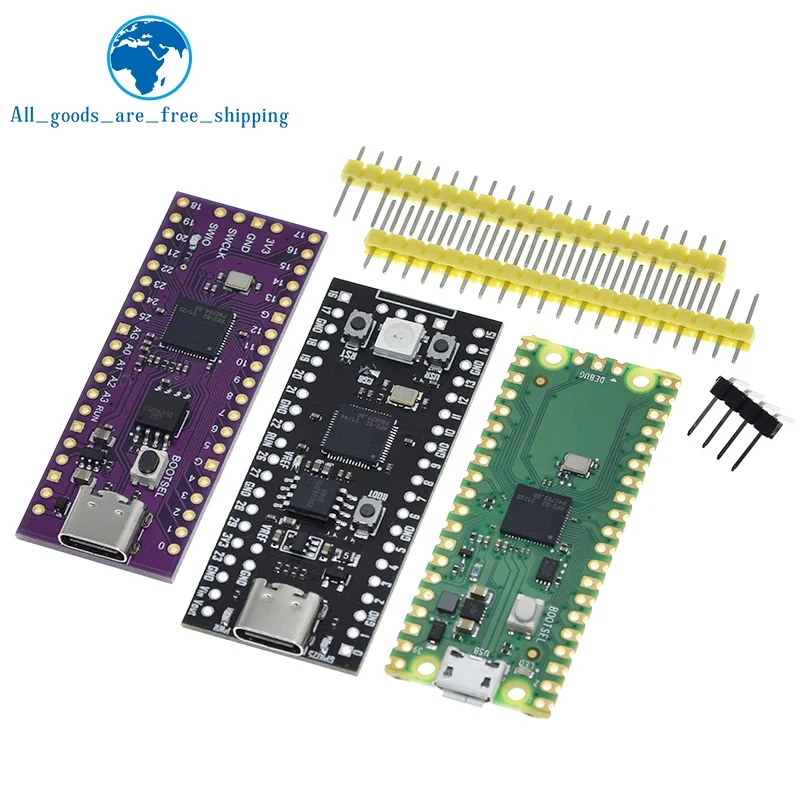
The boards are observed to offer both USB Type-C and Micro-USB connectivity options, providing flexibility for integration into various development environments. USB Type-C, in particular, offers a more robust and reversible connection, which is beneficial in frequently reconfigured test setups. The power efficiency of the ARM Cortex-M0+ cores, combined with the RP2040's low-power design, makes these boards suitable for battery-powered measurement devices or long-term data logging applications where power consumption is a critical factor. Low power consumption extends operational periods.
Power management is a key consideration for portable measurement instruments. The RP2040's architecture is optimized for low-power operation, allowing for extended field deployments without frequent recharging. This efficiency does not come at the expense of performance, as the cores can dynamically adjust clock speeds to match computational demands. The inclusion of both USB standards also simplifies integration with existing hardware, reducing the need for specialized cables or adapters. This practical consideration streamlines the development process.
Onboard Memory and Storage Capabilities
Each board integrates 264KB of SRAM and supports up to 16MB of off-chip Flash memory. This generous memory allocation is crucial for storing complex firmware, large datasets from sensors, or even implementing advanced signal processing algorithms directly on the device. The ability to store significant amounts of data locally reduces reliance on external storage solutions during data acquisition phases, enhancing system autonomy. Ample memory facilitates complex algorithms.
For applications involving high-resolution data logging or real-time analysis, the 264KB SRAM provides sufficient buffer space. The external Flash memory allows for persistent storage of calibration data, configuration settings, or even entire firmware updates. This combination of volatile and non-volatile memory ensures that the development board can handle sophisticated measurement routines and retain critical information even after power cycles. This is a significant advantage over microcontrollers with more constrained memory resources, which often necessitate offloading data to external systems prematurely.
Physical Dimensions and Integration
The visual evidence indicates compact dimensions, with boards measuring approximately 51.0mm x 21.0mm for the green and purple variants, and 53.10mm x 23.0mm for the black variant. These small form factors are ideal for embedding into custom enclosures or integrating into existing test fixtures where space is at a premium. The standard 2.54mm pin headers, visible in the images, facilitate easy prototyping on breadboards or custom PCBs. Small size aids integration.
Compactness is a critical attribute for many embedded measurement systems, particularly those designed for portable use or integration into tight spaces. The consistent pin spacing ensures compatibility with a wide range of prototyping tools and accessories, simplifying the initial development phase. The robust construction, evident from the PCB layout and component placement, suggests a durable platform suitable for repeated handling in a laboratory or field environment. These boards are designed for practical application.
Development Ecosystem and Community Support
The Raspberry Pi Pico benefits from a robust and growing development ecosystem, including official SDKs for C/C++ and MicroPython. This broad support simplifies the development of complex measurement applications, allowing engineers to choose the programming language best suited for their project requirements. The extensive documentation and active community forums provide invaluable resources for troubleshooting and sharing innovative solutions. A strong community accelerates development.
Access to comprehensive development tools and a supportive community significantly reduces the learning curve and accelerates project timelines. For specialized measurement tasks, the availability of libraries and examples for sensor interfacing, data processing, and communication protocols can be a major advantage. This ecosystem ensures that developers can quickly move from concept to functional prototype, leveraging existing knowledge and community contributions. This collective intelligence is a powerful asset.
Calibration and Repeatability Considerations
While the RP2040 itself provides precise timing capabilities, the overall accuracy and repeatability of a measurement system depend heavily on external sensor calibration and proper circuit design. The board's stable clock source and low-noise power delivery are foundational elements for achieving high-fidelity measurements. However, users must implement their own calibration routines for connected sensors and ensure environmental stability for optimal results. Repeatable results require careful system design.
The RP2040's internal timers and counters offer high resolution, which is essential for precise event timing or frequency measurement. When paired with accurately calibrated external references, these features enable the construction of highly repeatable measurement instruments. The dual-core architecture can also be leveraged to implement advanced digital filtering or error correction algorithms, further enhancing the accuracy of acquired data. This platform provides the necessary computational horsepower for sophisticated metrological applications.
Data Logging and Analysis Potential
With its ample memory and processing power, the Raspberry Pi Pico is well-suited for data logging applications. It can acquire data from multiple sensors, timestamp it accurately, and store it internally or transmit it via its communication interfaces. The ability to process data on-board before transmission reduces the bandwidth requirements and can enable real-time analysis or anomaly detection. On-board processing enhances efficiency.
For long-term monitoring or field deployments, the Pico's capabilities allow for autonomous data collection over extended periods. The RP2040's fast processing can also be used for complex data analysis, such as Fast Fourier Transforms (FFTs) for spectral analysis or statistical calculations for trend identification. This transforms the development board from a simple data collector into an intelligent measurement node, capable of providing actionable insights directly at the point of measurement. This capability is a significant advantage for advanced instrumentation.
This development board represents a significant step forward for embedded measurement and analysis. Its dual-core architecture, flexible PIO, and robust memory configuration provide a powerful foundation for creating precise, repeatable, and intelligent instrumentation. Imagine developing a custom environmental monitoring station that logs data with microsecond precision, performs real-time anomaly detection, and communicates wirelessly, all powered by a compact, energy-efficient platform. This board makes such advanced projects not just feasible, but readily achievable for a wide range of technical users.