PUMUDDSY Inline Glass Fuse Holders with 22AWG Leads
Official Store Deal
Expert Analysis Overview
Ensuring Circuit Integrity: The Role of Overcurrent Protection
The Visible Safeguard
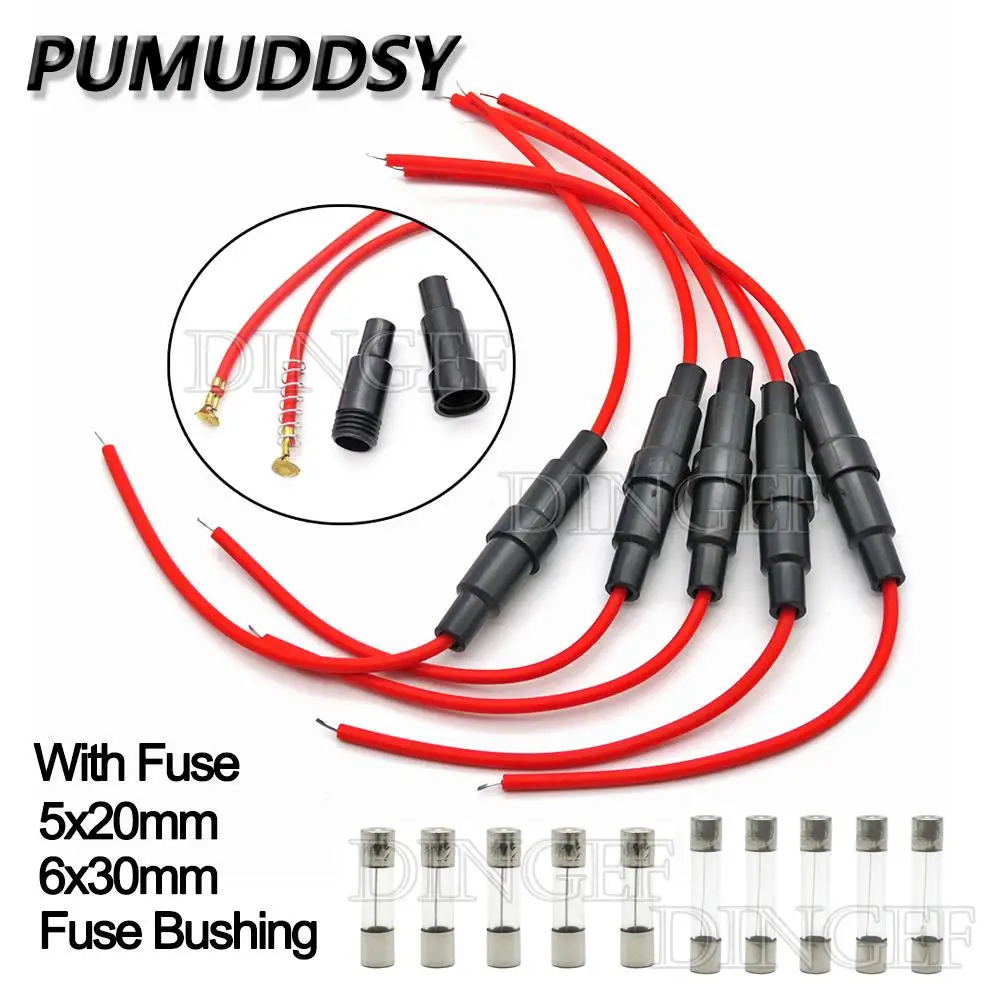
The PUMUDDSY inline glass fuse holders are visually presented as compact, pre-wired units, each featuring a black screw-type casing integrated with red 22AWG wire leads. The primary image clearly depicts multiple holders, along with a selection of both 5x20mm and 6x30mm glass fuses, indicating broad compatibility. The terminals, visible when a holder is partially disassembled, appear to be brass or gold-plated, suggesting attention to conductivity. This is a simple, effective design.These components are designed to be inserted directly into a circuit, creating an intentional weak link. When an overcurrent condition occurs, the fuse element within the glass tube melts, breaking the circuit and isolating the protected load from the power source. This prevents overheating, potential fires, and damage to expensive or sensitive downstream equipment. The visual evidence confirms a straightforward, functional approach to circuit defense.
Unlike generic, unprotected wiring harnesses, which offer no inherent defense against current spikes, these inline fuse holders provide a proactive safety measure. Standard electrical installations often rely on circuit breakers at the main panel, but for individual components or sub-circuits, localized protection is paramount. This system offers that granular control. It is a necessary layer of defense.
Wire Gauge and Current Handling Capabilities
The product explicitly states the inclusion of 22AWG wire. American Wire Gauge (AWG) is a standardized system for denoting the diameter of electrically conducting wire. A smaller AWG number indicates a larger wire diameter and, consequently, a higher current carrying capacity. Conversely, 22AWG is a relatively thin wire.This specific wire gauge dictates the practical applications for these fuse holders. A 22AWG wire is typically rated for continuous current loads in the range of 5 to 7 amperes, depending on insulation type, ambient temperature, and installation method. Exceeding this current rating can lead to excessive heat generation within the wire, degrading the insulation, increasing resistance, and posing a significant fire hazard. Proper sizing is crucial.
Compared to heavier gauge wires found in main power distribution, 22AWG is suited for signal lines, low-power LED lighting, small motors, or control circuits. Using these holders with higher current demands, such as those for power inverters or high-wattage audio amplifiers, would be a critical misapplication. The wire gauge defines its operational envelope.
Voltage Rating and Insulation Integrity
The stated 250V voltage rating for these fuse holders is a critical specification. This rating indicates the maximum potential difference that the insulation materials and physical clearances within the holder can safely withstand without breakdown or arcing. It applies to both AC and DC circuits. High voltage demands robust insulation.For users integrating these holders into systems, understanding this voltage limit is non-negotiable. Operating the fuse holder in a circuit with a voltage exceeding 250V could compromise the insulation, leading to electrical leakage, short circuits, or even arcing, which presents severe safety risks. The red insulation on the 22AWG wire visually suggests a standard PVC or similar polymer, which is common for this voltage class. This insulation must remain intact.
Many low-voltage DC applications, such as 12V automotive systems or 24V industrial controls, fall well within this 250V rating, making these holders suitable. However, for mains voltage applications (e.g., 120V or 240V AC in residential wiring), while the voltage rating is technically met, the low current capacity of the 22AWG wire often makes them impractical or unsafe for typical household loads. Always respect voltage limits.
Construction and Material Durability
The Screw-Type Mechanism
The screw-type design of these fuse holders is a deliberate choice for secure fuse retention. The holder typically consists of two threaded halves; one half contains a spring-loaded contact, and the other provides the opposing contact. The fuse is placed between these contacts, and the halves are screwed together, compressing the spring and ensuring a tight, vibration-resistant connection. This design minimizes intermittent contact.This mechanical integrity is vital in environments where vibration or movement is common, such as in vehicles, marine applications, or portable equipment. A loose fuse connection can lead to increased resistance, localized heating, and unreliable circuit operation, potentially causing intermittent power loss or even premature fuse failure. A secure connection is paramount.
In contrast to push-in or blade-type fuse holders, which prioritize quick fuse changes, the screw-type mechanism emphasizes a more permanent and robust connection. While fuse replacement might take slightly longer, the enhanced contact reliability can be a significant advantage for critical circuits where stability is prioritized over speed of service. It offers peace of mind.
Terminal Quality and Conductivity
The visible terminals, particularly in the disassembled view, appear to be brass or possibly gold-plated. Brass is a common material for electrical contacts due to its good conductivity and resistance to corrosion. Gold plating, if present, further enhances conductivity and provides superior corrosion resistance, especially in humid or corrosive environments. Good contacts are essential.High-quality terminals are fundamental to efficient power transfer. Poor quality or corroded terminals introduce unwanted resistance into the circuit, leading to voltage drop across the holder and heat generation. This reduces the effective power delivered to the load and can contribute to premature failure of the fuse holder itself. Conductivity directly impacts performance.
Unlike cheaper alternatives that might use plain steel or thinly plated contacts, the apparent quality of these terminals suggests a commitment to maintaining low resistance and long-term reliability. This attention to detail ensures that the fuse holder itself does not become a point of failure or inefficiency within the protected circuit. It's a small but important detail.
Casing Material and Environmental Considerations
The fuse holder casing is constructed from an insulated plastic material, which is standard for electrical components of this nature. This plastic serves several critical functions: it electrically isolates the fuse and its contacts from the external environment, provides mechanical protection against physical damage, and acts as a barrier against accidental contact with live parts. Insulation is key to safety.While the plastic material offers basic protection, the images do not provide explicit information regarding an IP (Ingress Protection) rating. Without such a rating, it cannot be assumed that these holders are fully waterproof or dustproof. Exposure to significant moisture, dust, or harsh chemicals could compromise the holder's integrity or lead to electrical issues. Environmental factors matter.
For applications in dry, indoor environments or within enclosed electrical boxes, the casing provides adequate protection. However, for outdoor use, marine applications, or areas prone to splashing water or heavy dust, additional enclosure or specific waterproofing measures would be necessary to ensure long-term reliability and safety. This is a crucial consideration.
Installation and Application Versatility
Simplified Integration with Pre-Wired Leads
The inclusion of pre-wired 22AWG leads significantly streamlines the installation process. Each holder comes with two red wires extending from its ends, ready for splicing into an existing circuit. This eliminates the need for users to crimp or solder wires directly to the fuse holder terminals, saving time and requiring fewer specialized tools. Installation becomes much easier.For hobbyists, DIY enthusiasts, or technicians working on quick repairs, this pre-wired configuration is a considerable advantage. It reduces the complexity of adding circuit protection, allowing for faster integration into projects such as custom LED setups, small electronic device repairs, or low-power automotive accessory installations. Time is often a factor.
Unlike bare fuse holders that require separate wire termination, these units offer a plug-and-play convenience that lowers the barrier to entry for implementing proper circuit protection. This design choice prioritizes ease of use and rapid deployment, making them accessible even to those with limited electrical wiring experience. It simplifies the task.
Dual Fuse Size Compatibility
The ability to accommodate both 5x20mm and 6x30mm glass tube fuses provides a degree of versatility. These two sizes are among the most common cylindrical fuses used in various electronic and electrical applications. This dual compatibility means users do not need to stock multiple types of fuse holders for slightly different fuse dimensions. Flexibility is a benefit.This broad compatibility is particularly useful for individuals or workshops that deal with a variety of equipment. Whether protecting a delicate circuit requiring a smaller 5x20mm fast-blow fuse or a slightly more robust application using a 6x30mm slow-blow fuse, these holders can adapt. It reduces inventory complexity.
Many fuse holders are designed for a single specific fuse size, limiting their utility. The PUMUDDSY holders, by supporting two prevalent sizes, offer an upgrade in adaptability, allowing for greater flexibility in circuit design and repair scenarios without needing to purchase different hardware. This is a practical advantage.
Application Scenarios and Value Proposition
These inline fuse holders are ideally suited for a range of low-current applications where localized circuit protection is essential. This includes protecting custom LED lighting arrays, small DC motors, automotive accessories (e.g., dash cams, USB chargers), amateur radio equipment, and various DIY electronics projects. They serve a specific niche.The value proposition of these fuse holders extends beyond their initial cost. By providing reliable overcurrent protection, they prevent potentially expensive damage to sensitive electronic components, which can far outweigh the cost of the fuse holder itself. Investing in proper fusing is an investment in the longevity and safety of the entire system. Prevention is cheaper than repair.
Compared to leaving circuits unprotected, which risks component failure, fire, or even personal injury, these fuse holders offer a cost-effective and straightforward solution. They embody the principle that a small investment in safety infrastructure can yield significant returns in terms of equipment preservation and operational reliability. They are a smart choice.
Operational Considerations and Maintenance
Fuse Selection and Amperage Matching
Correct fuse selection is paramount for effective circuit protection. The amperage rating of the fuse must be carefully matched to the maximum safe operating current of the circuit it protects, while also being lower than the current capacity of the wiring. An undersized fuse will blow prematurely, causing nuisance trips. An oversized fuse will fail to protect the circuit, allowing excessive current to flow and potentially causing damage or fire. Precision is key.Users must calculate the expected maximum continuous current draw of their load and select a fuse with a rating slightly above this operational current but below the wire's maximum capacity. For example, if a circuit draws 3 amps, a 4-amp or 5-amp fuse might be appropriate, assuming the 22AWG wire can safely handle that current. This calculation prevents both under-protection and over-protection. It requires careful thought.
Unlike simply relying on a single upstream breaker, these inline fuse holders allow for granular protection of individual components or sub-circuits. This means that a fault in one part of a system will only affect that specific branch, rather than shutting down the entire system. This targeted protection enhances overall system resilience.
Routine Inspection and Replacement
While fuses are designed to be a "one-time use" protective device, the fuse holder itself requires periodic inspection. The plastic casing should be checked for any signs of heat damage, cracking, or discoloration, which could indicate an underlying issue such as an intermittent connection or an overloaded circuit. The wires should also be inspected for fraying or compromised insulation. Regular checks are important.If a fuse blows, it is crucial to identify the root cause of the overcurrent before simply replacing the fuse. Replacing a blown fuse with one of a higher amperage rating without addressing the underlying fault is extremely dangerous and defeats the purpose of circuit protection. The fault must be rectified.
The screw-type design, while secure, means that fuse replacement involves unscrewing the holder. This process is straightforward but requires a moment of attention to ensure the new fuse is properly seated and the holder is re-tightened. This ensures continued reliable contact.
The Verdict on PUMUDDSY Inline Glass Fuse Holders
These PUMUDDSY Inline Glass Fuse Holders are a commendable solution for targeted circuit protection in low-current applications. Their pre-wired 22AWG leads, dual fuse size compatibility, and secure screw-type mechanism offer a practical and reliable method for safeguarding sensitive electronics. The 250V rating provides ample voltage headroom for most hobbyist and automotive DC systems, while the visible quality of the terminals suggests good conductivity. The emphasis on safety through dedicated overcurrent protection is evident in their design.
Imagine the peace of mind knowing that your custom LED lighting, your vehicle's dash cam, or your latest electronics project is shielded from unexpected current spikes. Visualize the ease of installation, quickly integrating these compact protectors into your wiring, confident that your components are safe from costly damage or fire hazards. These fuse holders empower you to build and maintain electrical systems with a higher degree of reliability and safety, allowing your projects to function as intended, without the looming threat of electrical failure.