Pultruded Carbon Fiber Flat Strips for Model Building
Official Store Deal
Expert Analysis Overview
The Backbone of Your Build: Economical Carbon Fiber Flat Strips
The Pultruded Carbon Fiber Flat Strips are an economical structural reinforcement solution for hobbyists and model builders seeking lightweight strength without a premium price tag. These strips provide a 'good enough' replacement or an upgrade from less robust materials, offering a practical way to extend the operational life of various models and DIY projects.Material Science for the Hobbyist
Carbon fiber is a material renowned for its exceptional strength-to-weight ratio. These strips are manufactured through a pultrusion process, which involves pulling carbon fibers through a resin bath and then a heated die to create a continuous, consistent profile. This method ensures a high fiber volume content, leading to excellent longitudinal stiffness and strength.Unlike brittle balsa wood or heavier aluminum, these carbon fiber strips offer superior stiffness-to-weight ratios. This makes them ideal for applications where minimizing mass is crucial, such as in model aircraft or drones. The inherent properties of carbon fiber mean less material is needed to achieve the same structural integrity, translating to lighter overall builds.
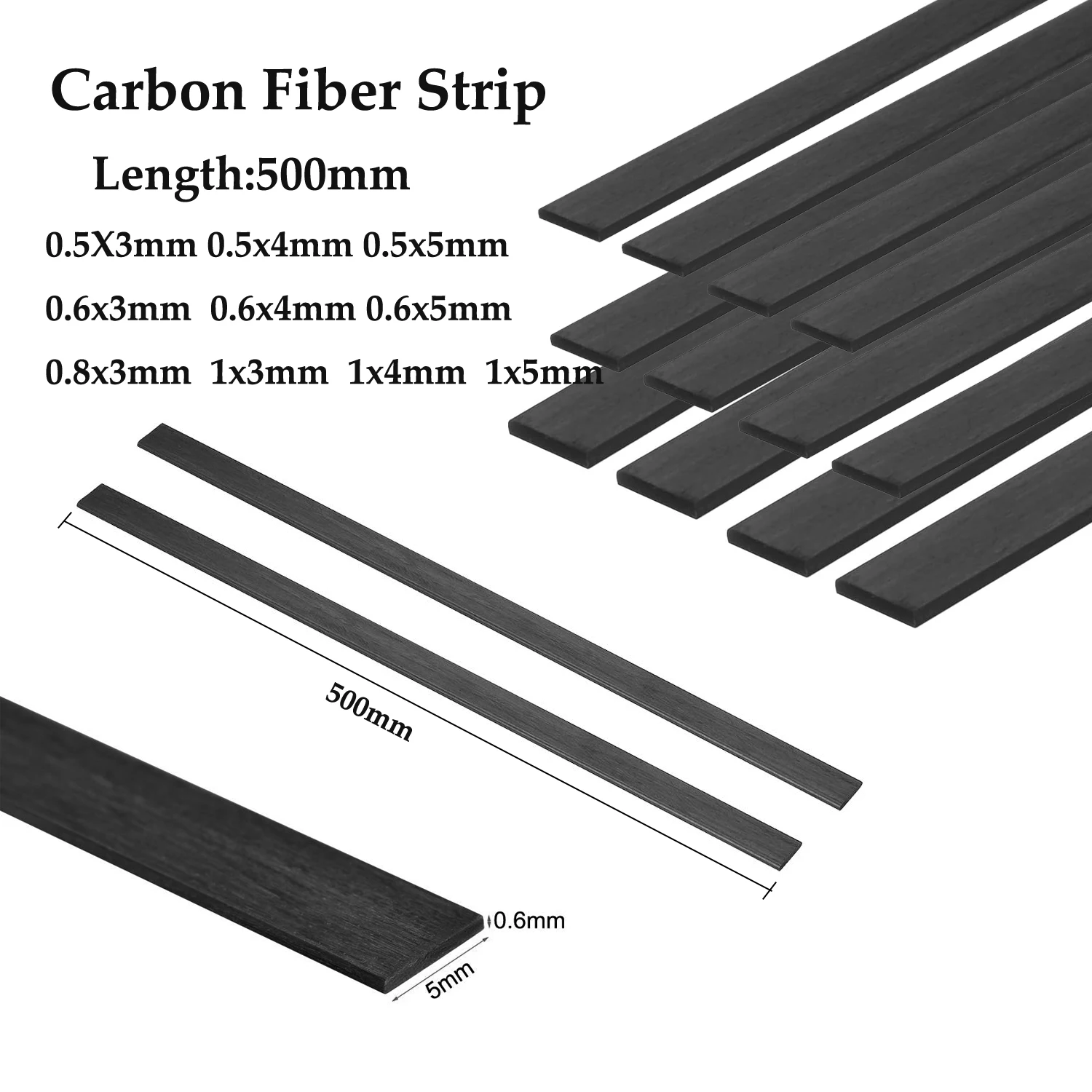
The visible uniformity of the strips in the images suggests a consistent manufacturing process. This consistency is vital for structural components, as uneven material properties can lead to unpredictable failure points. For a budget-conscious builder, consistent quality at an accessible price point is a significant advantage, ensuring that repairs and new builds maintain reliable performance.
Precision in Profile: Dimensions and Versatility
These carbon fiber strips are available in a range of precise dimensions, including thicknesses of 0.3mm, 0.5mm, 0.6mm, 0.8mm, and 1mm, with varying widths. Each strip measures 500mm (approximately 19.69 inches) in length. This variety in sizing allows for highly specific applications, catering to different structural requirements within a single project or across multiple models.For instance, the thinner 0.3mm or 0.5mm strips are perfect for light bracing or stiffening small components where minimal weight addition is critical. A model airplane wing might use these for internal spars. The wider and thicker 0.8mm or 1mm strips can serve as primary structural members, such as fuselage longerons or drone frame arms, providing substantial rigidity against bending and torsion.
Compared to cutting custom pieces from larger carbon fiber sheets, these pre-cut strips offer convenience and reduce material waste. This is particularly beneficial for hobbyists who might not have access to precision cutting tools or who want to streamline their build process. The standardized lengths also make planning and replication easier for repeated projects.
Structural Reinforcement for Longevity
The primary function of these carbon fiber strips is to provide structural reinforcement. In model airplanes, they can be used to strengthen wings, fuselages, and landing gear, absorbing stress and preventing deformation or breakage during flight or hard landings. For DIY quadcopters, they are frequently integrated into the frame to enhance rigidity and protect delicate electronic components from impacts.Imagine a scenario where a model aircraft experiences a minor crash. Instead of a complete structural failure with a less robust material, the carbon fiber reinforcement can localize the damage, making repairs simpler and less costly. This directly contributes to extending the life of the model by many months, a key objective for any budget-minded hobbyist.
Using these strips can transform a flimsy prototype into a durable, flight-worthy machine. The added rigidity improves flight characteristics, reducing flex and vibration, which in turn can lead to more stable and precise control. This upgrade in capability is significant for the modest investment required.
Applications Beyond the Air
While explicitly marketed for model airplanes and quadcopters, the utility of these carbon fiber strips extends to a broader range of DIY and repair projects. Their inherent strength and light weight make them suitable for various applications requiring stiffening or reinforcement.Consider flag stands, as depicted in one of the product images. Carbon fiber strips can provide the necessary rigidity to keep flags taut and upright, even in windy conditions, without adding excessive weight that would make the stand cumbersome. This demonstrates their versatility in non-aerospace structural applications.
Another example is kite skeletons. Traditional kite spars can be heavy or prone to breaking. Carbon fiber offers a lightweight yet strong alternative, allowing for larger, more complex kite designs with improved flight performance and durability. For any project needing a strong, thin, and light structural member, these strips present a viable, cost-effective solution.
Cost-Effectiveness and Repair Strategy
From a budget perspective, these carbon fiber strips offer exceptional value. The cost of replacing an entire model or a major component due to structural failure can be substantial. By proactively reinforcing critical areas with these affordable strips, hobbyists can significantly reduce long-term expenses.These strips are an excellent choice for repairs. Instead of discarding a damaged part, a precisely cut and bonded carbon fiber strip can restore or even enhance its original strength. This 'fixer' mentality aligns perfectly with extending the life of existing tools and models, often for a fraction of the cost of a new part.
Furthermore, the ease of cutting and bonding carbon fiber (with appropriate adhesives) means that repairs can be performed quickly and effectively at home. This reduces downtime for models and allows hobbyists to get back to their projects faster, making it an efficient solution for maintaining equipment on a tight budget.
Handling and Workability
Working with carbon fiber requires some attention to detail, particularly concerning safety. The material itself is rigid, but it can be cut with appropriate tools such as a Dremel with a cutting disc, a fine-toothed saw, or strong shears, depending on the thickness. Precision cutting ensures clean edges and optimal fitment for bonding.Once cut, the strips can be bonded using epoxy resin, CA glue (super glue), or other strong adhesives designed for composites. Proper surface preparation, such as light sanding, enhances adhesion. The material's non-conductive properties are also beneficial in certain electronic applications, though care must be taken to avoid carbon dust near electrical components.
Compared to working with metal, carbon fiber is generally lighter and easier to cut and shape for custom applications, though it does require different tools and safety precautions. Its ability to hold shape under stress makes it a reliable material once integrated into a structure, providing peace of mind for the builder.