Professional Glass Microscope Cover Slips, 18x18mm (100-Piece Pack)
Official Store Deal
Expert Analysis Overview
Precision in Optical Pathways: Maintaining Clarity for Critical Analysis
The stated thickness of these cover slips, ranging from 0.13mm to 0.17mm, represents a critically narrow specification for high-resolution microscopy. This precise tolerance is not merely a manufacturing detail; it is fundamental to the optical performance of virtually all standard compound microscopes. Most high-magnification objectives, particularly those with numerical apertures (NA) greater than 0.25, are meticulously designed and corrected for a specific cover glass thickness, typically 0.17mm (often designated as Type No. 1.5). Deviations, even slight ones, from this ideal can introduce significant optical aberrations.The primary aberration caused by incorrect cover glass thickness is spherical aberration. This phenomenon occurs when light rays passing through different parts of the objective lens do not converge at a single focal point, resulting in a blurred, hazy image with reduced contrast and resolution. For instance, a cover slip thicker than 0.17mm will cause light rays to converge too early, while a thinner one will cause them to converge too late. Such optical distortion compromises the ability to discern fine cellular structures, bacterial morphology, or material defects. Researchers rely on consistent optical paths. The ability to measure down to the micron in terms of cover slip thickness is therefore not just a desirable feature, but a prerequisite for achieving optimal image quality and extracting meaningful data.
Maintaining this precise thickness across all 100 pieces in a pack ensures that researchers can achieve consistent optical performance without needing to constantly adjust their microscope's correction collar, if their objective is even equipped with one. This uniformity is vital. Inconsistent cover slip thickness leads to variable focal planes and image quality, making comparative analysis between samples unreliable and potentially invalidating experimental results. For quantitative microscopy, where precise measurements of cell size, fluorescence intensity, or particle distribution are extracted from images, such variability is unacceptable. The integrity of the data hinges on this consistency.
Furthermore, the refractive index of the cover glass also plays a role, though less variable than thickness in standard glass. A consistent refractive index ensures predictable light bending. Any significant variation would introduce additional optical challenges. The manufacturing process for these "Professional Glass" slips implies a controlled environment where both thickness and material composition are monitored to minimize such inconsistencies. This contributes directly to repeatable results, a cornerstone of scientific methodology.
Unlike generic, unmeasured cover slips that often exhibit significant thickness variations, sometimes ranging from 0.1mm to 0.2mm or more, these slips are presented with a defined, tight range. This commitment to a specific tolerance provides a foundational level of quality assurance. It allows for more predictable light path correction and minimizes the need for post-acquisition image processing to correct for optical flaws. This consistency is an upgrade from less specified alternatives, directly contributing to more accurate and repeatable experimental results, which are crucial for reliable data logging and publication. The metrological control over this parameter is a key differentiator.
Material Integrity and Durability: The Glass Foundation for Optical Excellence
The selection of glass as the material for these cover slips is a deliberate and scientifically sound choice, balancing superior optical performance with the practical requirements of laboratory handling. Glass offers exceptional transparency across the visible spectrum and a highly stable refractive index, properties that are absolutely essential for transmitting light without introducing unwanted distortions, chromatic aberrations, or significant light loss. Its amorphous structure ensures isotropic optical properties. Its inert nature also prevents chemical reactions with most common aqueous mounting media, organic solvents, and biological samples, preserving sample integrity over time. This material choice is fundamental.While glass is inherently fragile and susceptible to breakage upon impact, its rigidity is crucial for maintaining a perfectly flat and uniform surface over the microscopic sample. A perfectly flat surface is necessary. Any warping, bowing, or unevenness in the cover slip would create an inconsistent optical path across the field of view, leading to localized blurring, distortion, or even complete loss of focus in certain areas. This flatness is particularly important for techniques like phase contrast or differential interference contrast (DIC) microscopy, which are highly sensitive to variations in optical path length. The material's hardness also provides a degree of scratch resistance, though careful handling remains paramount to preserve the pristine optical quality of the surface.
Compared to plastic alternatives, which may offer greater flexibility and resistance to breakage, glass cover slips provide a significantly higher level of optical clarity and stability. Plastic materials often exhibit birefringence, which can interfere with polarized light microscopy, or autofluorescence, which can obscure signals in fluorescence imaging. Furthermore, plastic can be more prone to static charge accumulation, attracting dust particles that compromise sample cleanliness. For applications demanding the highest optical fidelity, minimal background interference, and long-term sample stability, glass remains the undisputed industry standard. Its optical properties are superior. The consistent quality of the glass ensures that the cover slips themselves do not become a source of experimental noise.
Standardization for Reproducibility: The Ubiquitous 18x18mm Format
The 18x18mm square dimension of these cover slips represents a widely adopted and highly practical standard in microscopy. This standardization is a profound practical advantage. It ensures broad compatibility with the vast majority of standard microscope slides (typically 25x75mm or 1x3 inches) and mechanical stages found in laboratories worldwide, simplifying sample preparation, mounting, and subsequent analysis. Researchers can confidently integrate these slips into existing protocols without concerns about fit or function.Using a consistent size across experiments is not merely convenient; it is a critical factor in facilitating reproducibility and comparability of scientific data. When all variables, including the physical dimensions of consumables like cover slips, are meticulously controlled, the reliability and validity of experimental data significantly increase. This uniformity aids comparative studies. It also streamlines the process of automating slide scanning, high-throughput image acquisition, and digital image analysis, where consistent sample dimensions are absolutely critical for efficient operation, accurate software processing, and reliable data logging. Automated systems depend on predictable physical parameters.
Many entry-level or less specialized cover slips might come in various sizes, or with less precise cuts and edge finishes. This can lead to issues with proper sealing of samples, evaporation of mounting media, or difficulties in fitting into standardized slide holders and automated feeders. These 18x18mm slips, by adhering to a recognized and widely accepted standard, eliminate such compatibility concerns. They offer a predictable and reliable component for any microscopy setup, from educational labs to advanced research facilities. This is a significant operational benefit. The precise cutting of these slips ensures clean edges, reducing the risk of accidental damage to delicate samples or injury to the user. The consistent form factor contributes to a seamless workflow.
Efficiency in Workflow: Strategic Bulk Packaging and Robust Protection
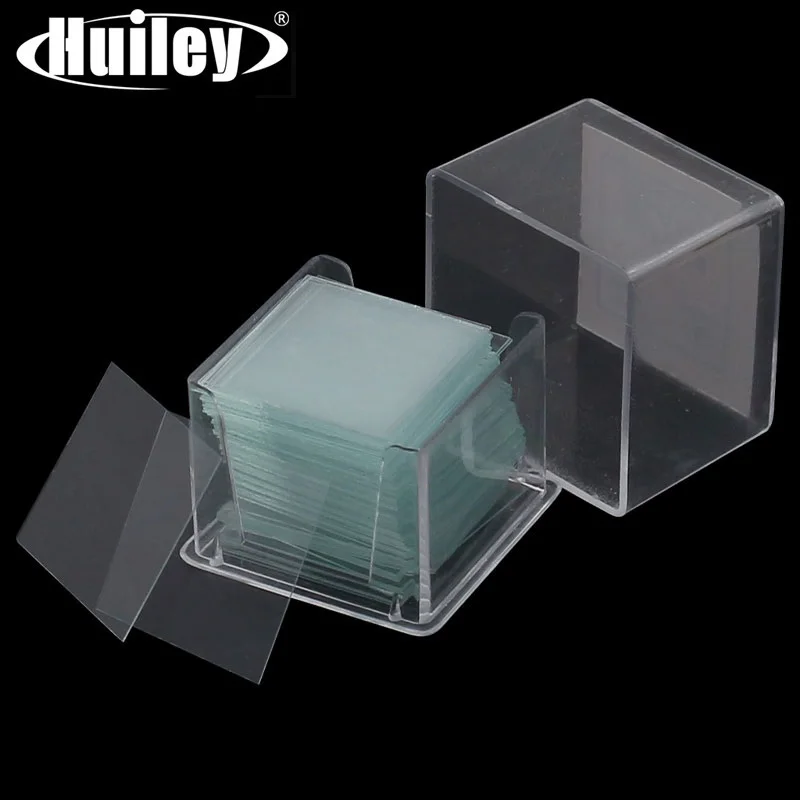
The provision of 100 pieces per pack in a clear, robust plastic box addresses a key operational need in any active laboratory: consistent supply, organized storage, and immediate accessibility. Running out of essential consumables mid-experiment is a common frustration that can lead to costly delays and interruptions in research. This generous bulk quantity minimizes such disruptions. It ensures that a sufficient stock is readily available for continuous research, educational activities, or high-volume diagnostic work, preventing workflow bottlenecks.The clear plastic box serves a crucial dual purpose: superior protection and immediate visual inventory. It meticulously shields the delicate glass slips from environmental contaminants such as dust, fibers, and airborne debris, as well as from physical damage during storage, transport, and handling within the lab. The transparent nature of the box allows for quick and effortless visual inventory checks, enabling laboratory managers to anticipate and prevent unexpected shortages before they occur. Proper storage is essential. This thoughtful packaging design directly contributes to maintaining the pristine, optically clean condition of the cover slips until they are needed, which in turn directly impacts their ultimate optical performance and the quality of the microscopic images obtained.
Unlike cover slips packaged in less robust materials, such as cardboard boxes, or opaque containers that hide their contents, this clear, protective box offers immediate access and easy identification. It significantly reduces the risk of contamination from environmental factors or from repeated handling of individual slips. This packaging design is an upgrade, ensuring that each cover slip maintains its factory-fresh quality and is ready for immediate use. It supports an efficient and organized laboratory environment, where every component, down to the smallest consumable, contributes to a smooth, uninterrupted workflow and reliable experimental outcomes. The secure closure of the box further prevents accidental spills or loss of slips.
Quality Assurance and Traceability: The Promise of "Professional Glass"
The product's designation as "Professional Glass" and the visible "SAIL BRAND" on the label imply a commitment to certain manufacturing standards and quality control processes. While specific certification documents, such as ISO compliance or material safety data sheets, are not explicitly provided with the visual information, these indicators suggest an intent for a higher standard of quality than generic, unbranded alternatives. Professional-grade materials are expected. In a scientific field where precision, reliability, and consistency are paramount, the reputation of the manufacturer and the proven consistency of their product lines are often key considerations for procurement decisions.The "Made in China" label provides geographical origin, which, in the context of global manufacturing, often signifies access to large-scale production capabilities and efficient supply chains. For high-volume consumables like microscope cover slips, this can translate to significant cost-effectiveness and a consistent, readily available supply. Understanding the manufacturing origin helps contextualize the product's market position and its potential for scalability. It also allows for potential traceability in case of quality control inquiries or batch-specific performance issues, though direct contact information for the manufacturer is not immediately visible on the packaging itself. This information is a standard identifier.
Compared to unbranded or generic cover slips with no discernible origin or quality claims, the presence of a brand name like "SAIL BRAND" offers a degree of accountability and a point of reference for quality expectations. It suggests a manufacturer willing to put their name on the product and stand behind its specifications. This can be a subtle but important differentiator for laboratories seeking reliable suppliers and consistent product performance over time. It provides a baseline for expected quality and can influence purchasing decisions where long-term supply chain stability is a concern. The implied quality control measures during manufacturing are crucial for ensuring the uniformity of thickness and surface finish.
Value Proposition for Consistent Research: Maximizing Return on Investment
The pricing of these 100-piece packs, especially when considered in a wholesale context, positions them as a highly cost-effective and strategically valuable solution for laboratories with ongoing, high-volume microscopy needs. The initial investment is modest. When considering the "cost-per-use" for each individual cover slip, which is a more accurate metric for consumables, the exceptional value proposition becomes immediately clear. This bulk purchase strategy significantly reduces the administrative overhead and logistical costs associated with frequent, smaller orders, thereby optimizing the overall budget for laboratory supplies.Investing in a reliable and consistent supply of quality cover slips is not merely an expense; it is a strategic investment that actively prevents costly experimental failures due to substandard materials. A single ruined sample, requiring repeat preparation, staining, and analysis, can far outweigh the cumulative cost of a hundred cover slips, not to mention the invaluable researcher time and instrument usage. These slips are an investment. The consistent quality, particularly the precise thickness and optical clarity, ensures that precious time and resources are spent on meaningful scientific inquiry, rather than on troubleshooting optical artifacts or re-running experiments caused by poor-quality consumables. This directly contributes to the efficiency of data logging and analysis.
Unlike purchasing smaller, more expensive packs that necessitate constant reordering and incur higher per-unit costs, these 100-piece units offer a practical economic advantage. They minimize administrative burden, reduce shipping costs over time, and ensure that essential supplies are always at hand, preventing any interruption to critical research timelines. This approach aligns perfectly with the operational efficiency and fiscal responsibility required in modern research environments. It ensures that laboratories can maintain a steady pace of discovery, supported by reliable and readily available components. The long-term savings in time, labor, and avoided experimental errors make these cover slips a smart procurement choice.
Imagine the clarity of your next microscopic observation, free from the distortions and aberrations that inconsistent cover glass can introduce. Envision a laboratory workflow where sample preparation is swift, reliable, and utterly predictable, knowing that each cover slip will perform precisely as expected, contributing to an uninterrupted flow of discovery. Picture the unwavering confidence in your experimental data, built upon a foundation of precise, repeatable measurements and optically pristine samples. These professional glass cover slips contribute directly to that vision, enabling more focused research, more accurate analyses, and ultimately, more impactful scientific discoveries. They are a small but mighty component. Their consistent quality empowers researchers to push the boundaries of their work, ensuring that the tools support, rather than hinder, the pursuit of knowledge.