Precision Resistor Lead Bending Tool
Official Store Deal
Expert Analysis Overview
Mastering Component Preparation: A Restoration Tech's View
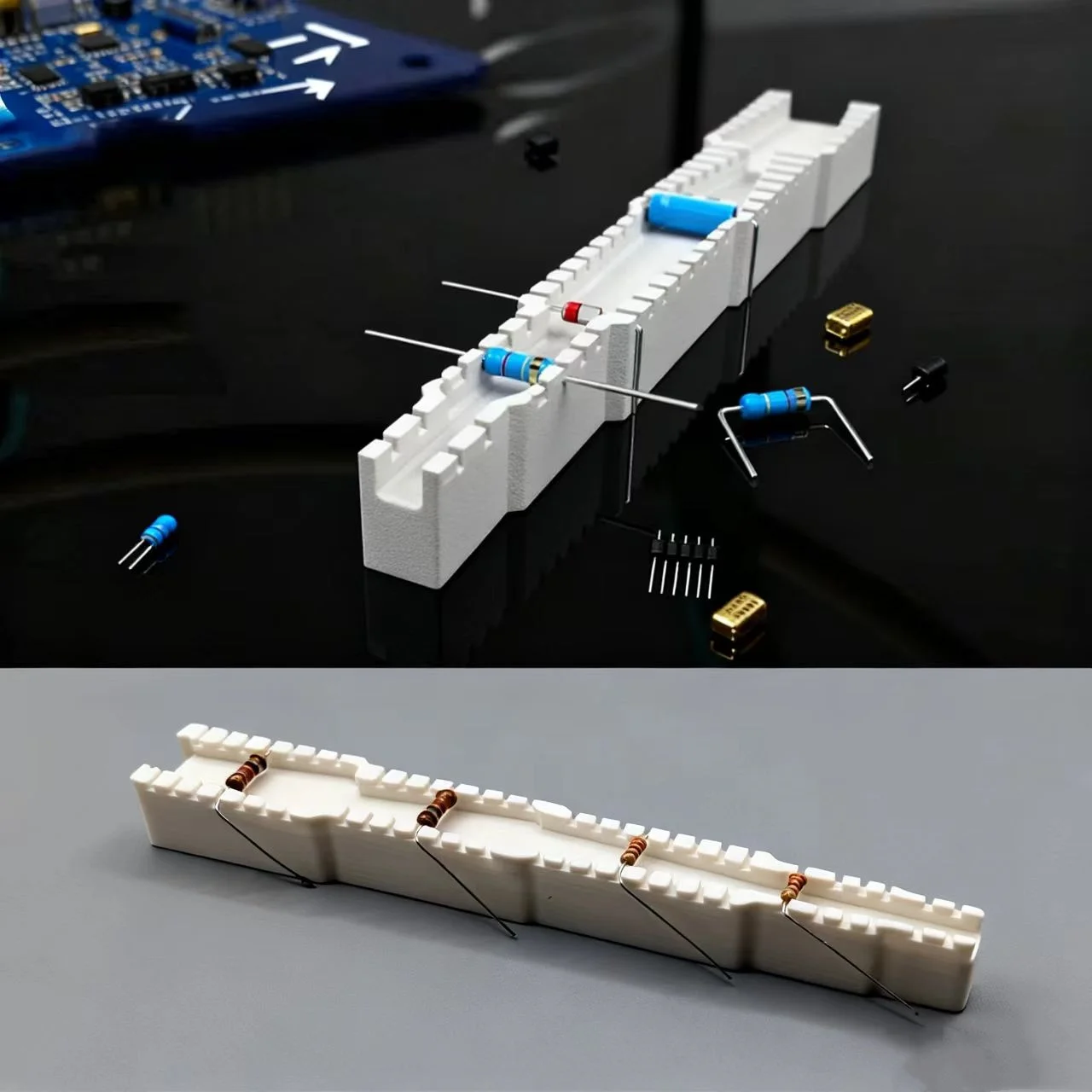
The Precision Resistor Lead Bending Tool is an indispensable workshop accessory engineered for hobbyists and professional technicians seeking consistent, repeatable component preparation. This tool addresses a fundamental need in electronics assembly: the precise and uniform bending of axial component leads. Its design directly tackles the variability often encountered when preparing components manually, offering a structured approach to a critical step in circuit board population. This consistency is vital.Manual lead bending, without a dedicated tool, frequently results in uneven bends, inconsistent lead lengths, and undue stress on component bodies or leads. Such inconsistencies can complicate PCB insertion, lead to poor solder joints, and even cause premature component failure. The visual evidence of resistors neatly seated in the tool's grooves demonstrates its core function: to eliminate these common pitfalls. It's a simple solution to a pervasive problem.
Unlike ad-hoc methods involving pliers or makeshift guides, this dedicated tool provides a standardized jig. This standardization ensures that every component processed through it will have its leads bent to the exact same dimensions, crucial for maintaining high quality in both repair and new construction projects. The consistency it provides far surpasses what can be achieved by eye or with general-purpose tools.
The Engineering Behind Consistent Spacing
The tool's primary function revolves around its precisely spaced slots and measurement markings. Images clearly show increments such as "100 mil," "200 mil," up to "700 mil." These markings are not merely decorative; they represent standard pitch distances for through-hole components on printed circuit boards (PCBs). A mil, or thou, is one-thousandth of an inch, a common unit in electronics design.When a resistor or diode is placed into the appropriate slot, its leads are guided into a perfect bend radius and spacing. This ensures that the component will sit flush against the PCB, with its leads perfectly aligned with the solder pads. Proper alignment is critical for efficient soldering, whether by hand or via wave soldering processes. It makes the job easier.
Compared to bending leads with needle-nose pliers, which often results in crimped leads or inconsistent angles, this tool maintains the integrity of the lead wire. The smooth, rounded edges of the bending slots prevent sharp kinks, which can weaken the lead and potentially lead to breaks over time, especially during vibration or thermal cycling. This is a significant upgrade for component longevity.
Material Integrity and Longevity
The visible construction suggests a high-density plastic, likely ABS or a similar polymer known for its rigidity and durability. This choice of material is strategic for a tool that will see repetitive use in a workshop environment. Plastic offers several advantages: it is non-conductive, preventing accidental shorts when handling live components (though this tool is primarily for pre-assembly), and it is lightweight.While metal tools might offer superior ultimate strength, they also introduce the risk of scratching component coatings or shorting leads. The plastic construction mitigates these risks, making it a safer and more component-friendly option. Its lightweight nature also contributes to reduced hand fatigue during prolonged use, a subtle but important ergonomic benefit. It is easy to handle.
This material choice also contributes to the tool's cost-effectiveness. Manufacturing plastic injection-molded parts is generally more economical than machining metal, allowing for a lower price point while still delivering essential functionality. The robust nature of the plastic ensures it can withstand the typical knocks and drops of a busy workbench without significant damage.
Ergonomics in the Workshop
From the various images, the tool presents a straightforward, elongated form factor. Its design is inherently ergonomic, fitting comfortably in the hand for manual operation. The absence of complex moving parts or intricate mechanisms simplifies its use, reducing the learning curve for new users. Simplicity is key.The textured or ribbed sides visible in some images suggest a design intended for a secure grip, even when hands might be slightly oily or gloppy from other workshop tasks. This attention to tactile feedback is crucial for maintaining control and precision during the bending process. A secure grip prevents slips.
For restoration technicians often working with delicate vintage components, a tool that offers both precision and comfortable handling is invaluable. It minimizes the risk of damaging irreplaceable parts due to fumbling or imprecise movements. This tool enhances control.
Versatility Across Electronic Projects
While primarily marketed for resistors, the design's generic nature for axial-leaded components extends its utility. Diodes, small capacitors, and even some inductors with similar lead structures can benefit from its precise bending capabilities. This broad compatibility makes it a versatile addition to any electronics toolkit.For hobbyists building custom circuits or repairing consumer electronics, this versatility means fewer specialized tools are needed. A single tool can handle a range of common through-hole components, simplifying inventory and reducing clutter. It serves multiple purposes.
Professional repair shops, particularly those dealing with legacy equipment, will find this tool essential for replicating original component layouts. Maintaining the original lead spacing is often critical for thermal management or specific circuit performance characteristics, which this tool facilitates effortlessly. It ensures historical accuracy.
Optimizing Assembly and Soldering Workflows
The direct impact on workflow efficiency is substantial. By pre-bending component leads to exact specifications, the time spent during the actual assembly phase is dramatically reduced. Components can be quickly inserted into the PCB without needing on-the-fly adjustments or re-bending. This speeds up assembly.For soldering, perfectly spaced and aligned leads present an ideal target for the soldering iron. This leads to cleaner, stronger, and more consistent solder joints, reducing the likelihood of cold joints, bridges, or rework. High-quality solder joints are fundamental to circuit reliability and longevity. It improves reliability.
In a production environment, even small efficiencies compound over time. This tool, by standardizing a preparatory step, contributes to a smoother, faster, and more reliable assembly line, even for manual operations. It’s a small investment with a large return in productivity and quality control, especially for smaller batch runs or prototyping where automation isn't feasible.
Cost-Efficiency in Component Handling
At its accessible price point, this tool represents an exceptional value proposition. The cost of replacing damaged components due to improper handling or the time spent troubleshooting poor solder joints can quickly outweigh the initial investment. This tool pays for itself quickly.Consider the scenario of a restoration project involving rare or expensive vintage components. The risk of damaging such parts during manual bending is high. This tool acts as a safeguard, protecting valuable components and preventing costly setbacks. It minimizes risk.
Furthermore, the improved quality of solder joints and component placement reduces the need for rework, which saves both time and consumables like solder and flux. The long-term savings in materials, labor, and reduced frustration make this a highly economical choice for any electronics enthusiast or professional. It saves money and time.
Addressing Common Workshop Frustrations
One of the most common frustrations in electronics assembly is battling with component leads that don't quite fit the PCB holes, or components that sit crookedly. This tool directly eliminates these annoyances. It provides a simple, direct solution.Imagine trying to insert a dozen resistors into a board, each requiring slight adjustments and re-bends. This process is tedious and prone to error. With the bending tool, all twelve can be prepared uniformly in moments, ready for seamless insertion. This streamlines the process.
For those who value neatness and precision in their work, this tool delivers satisfyingly uniform results. The visual appeal of a well-populated PCB with all components sitting perfectly straight is not just aesthetic; it's an indicator of quality workmanship and attention to detail. It shows pride in work.
The Role in Electronics Restoration
For the restoration tech, this tool is particularly significant. Vintage electronics often feature specific component layouts that are critical to their original function and appearance. Replicating these layouts precisely is a hallmark of quality restoration. This tool aids in faithful reproduction.When replacing aged components, ensuring the new part fits exactly as the original minimizes stress on the PCB traces and pads, which can be fragile on older boards. The ability to match original lead spacing helps preserve the integrity of the vintage circuit board. It protects old boards.
Furthermore, the consistent bends contribute to an authentic aesthetic. A restored piece of equipment should not only function correctly but also look as close to its original state as possible. This tool helps achieve that visual fidelity, a key aspect of high-quality restoration work. It maintains authenticity.
Aiding in Prototyping and Production
In prototyping, rapid iteration is essential. This tool accelerates the preparation of components for breadboarding or initial PCB layouts, allowing engineers and designers to quickly test ideas without being bogged down by manual component prep. It speeds up iteration.For small-batch production runs where full automation is not cost-effective, this manual bending tool provides a level of consistency approaching automated processes. It bridges the gap between purely manual and fully automated assembly, offering a semi-automated feel. It offers a middle ground.
This makes it an ideal choice for educational settings, maker spaces, or small businesses that produce specialized electronic devices. It allows for high-quality output without the prohibitive cost of industrial machinery. It's a smart investment.
Beyond the Basic Bend
The tool's design, with its multiple spacing options, encourages best practices in component placement. Users are prompted to consider the optimal lead spacing for each component, which can vary depending on power dissipation, thermal considerations, or proximity to other components. It promotes thoughtful design.For instance, components that generate heat might benefit from slightly wider lead spacing to allow for better airflow underneath the component body. The tool provides the flexibility to implement such considerations easily. This enhances thermal management.
It also supports the creation of uniform stress relief bends, which are crucial for components that might experience vibration or mechanical stress. A proper stress relief bend prevents the entire force from being concentrated at the solder joint, extending the component's lifespan. It adds durability.
Integrating into Existing Toolsets
This tool is designed to seamlessly integrate into any existing electronics workbench. Its compact size means it doesn't take up much valuable space, and its straightforward operation requires no special training or power source. It's ready to use immediately.It complements other common tools like wire strippers, cutters, and soldering irons, forming a complete suite for through-hole component assembly. Its presence simplifies the entire process, making each subsequent step more efficient. It completes the toolkit.
For technicians who frequently work on different projects or move between workstations, its portability is a distinct advantage. It can be easily tossed into a tool bag without concern for damage or bulk. It is highly portable.
Ensuring Repeatable Quality
Ultimately, the value of this tool lies in its ability to ensure repeatable quality. Every component, every bend, every spacing becomes consistent. This consistency translates directly into higher quality finished products and more reliable repairs. Consistency means quality.In a field where precision is paramount, relying on guesswork or inconsistent manual methods is a recipe for frustration and failure. This tool removes that element of chance, providing a dependable method for component preparation. It removes guesswork.
For anyone serious about electronics work, from the casual hobbyist to the seasoned professional, investing in tools that enhance precision and consistency is a wise decision. This resistor lead bending tool is exactly that kind of investment, delivering tangible improvements in work quality and efficiency. It's a worthy addition.