PQZULK TF Thermal Fuses: Precision Overheat Protection
Official Store Deal
Expert Analysis Overview
The TF Thermal Fuse is a critical safety component, meticulously engineered to provide definitive, one-time over-temperature protection for a vast array of electronic devices and appliances. From the perspective of an electronics repair technician, these fuses are not merely circuit breakers; they are the last line of defense against catastrophic thermal runaway, safeguarding expensive equipment from irreversible damage. Their function is simple: permanently interrupt the circuit when a predetermined temperature threshold is exceeded, preventing fires and component destruction. This proactive measure extends the operational lifespan of machinery, offering peace of mind in high-stress thermal environments. It is a small component with immense protective capability.
Thermal fuses operate on a fundamental principle of thermal expansion and material properties. Internally, a heat-sensitive pellet or alloy holds a spring-loaded contact in place. When the ambient temperature around the fuse reaches its specified trip point, this pellet melts, releasing the spring and causing the electrical contacts to separate. The circuit opens instantly. This action is irreversible, demanding replacement of the fuse once activated. Unlike resettable thermal cutoffs, these devices provide a clear indication of an over-temperature event, forcing an investigation into the root cause rather than merely allowing a temporary reset. This permanent disruption ensures that a dangerous thermal condition cannot persist unnoticed.
Imagine a scenario where a motor in a household appliance, such as a microwave or a coffee maker, begins to overheat due to a bearing failure or a blocked vent. Without a thermal fuse, the motor could continue to generate heat, potentially leading to smoke, fire, or the complete destruction of the appliance and surrounding property. The thermal fuse intervenes precisely at the critical moment. It acts as an inexpensive sentinel. This prevents a minor mechanical issue from escalating into a major safety hazard. The fuse sacrifices itself to save the system.
Compared to standard electrical fuses, which primarily protect against overcurrents, thermal fuses address a distinct failure mode: excessive heat. While an overcurrent can generate heat, not all overheating situations are caused by overcurrents. For instance, a fan motor with seized bearings will draw more current, but its primary failure mode might be excessive heat buildup. The thermal fuse offers a specialized layer of protection. This dual-layer approach ensures comprehensive circuit safety. It is a vital distinction in circuit design.
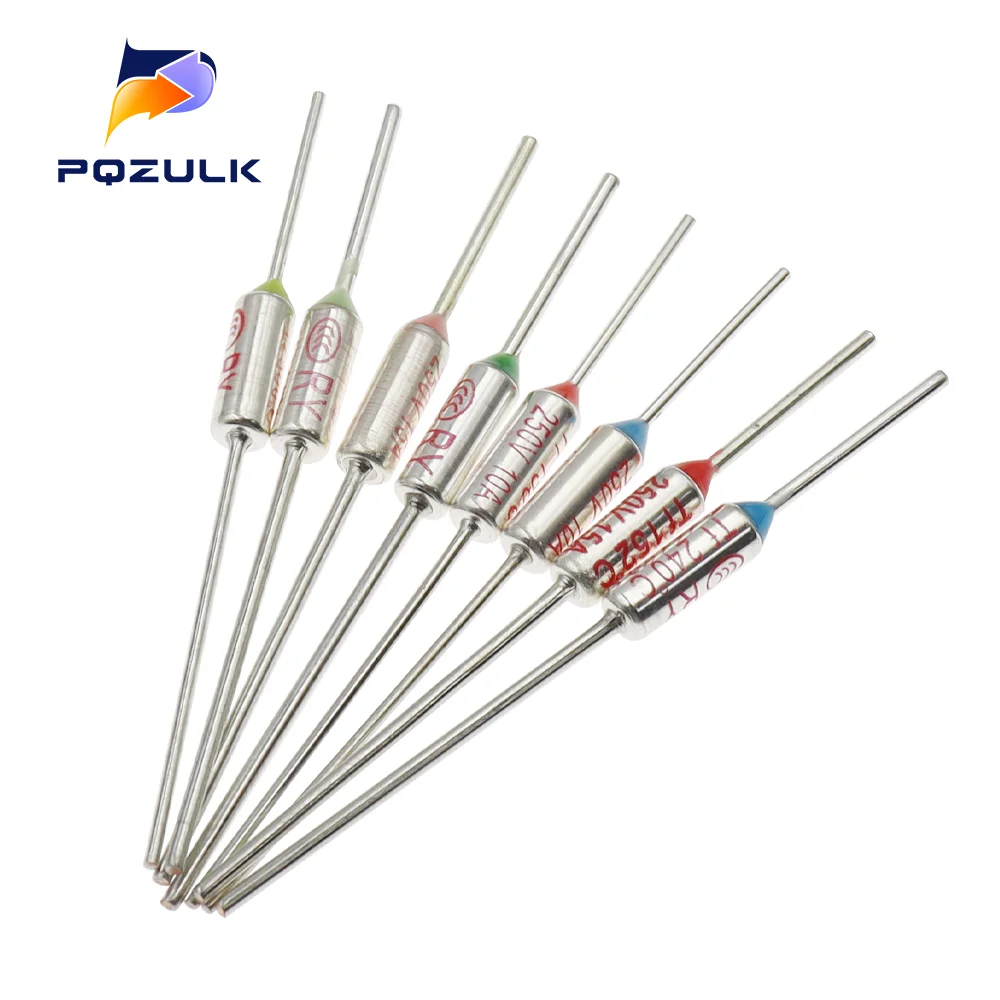
These TF Thermal Fuses are available across an exceptionally wide range of precise temperature trip points, spanning from a low of 73°C up to a scorching 300°C. Each fuse is factory-calibrated to activate at a specific temperature, ensuring that the protection offered is exactly what the application demands. The color-coded end caps, visible in the product imagery, often serve as a quick visual indicator for different temperature ratings, streamlining identification during installation or replacement. This granular control over the thermal threshold is paramount for sensitive electronics. Specificity is key.
For instance, a fuse rated at 94°C might be ideal for protecting a small transformer in a power supply, where even moderate overheating could degrade insulation or cause component drift. Conversely, a 240°C fuse would be more appropriate for high-temperature applications like industrial heaters or certain types of ovens, where normal operating temperatures are significantly higher. The ability to select such precise trip points means that equipment is protected without nuisance tripping during normal, albeit warm, operation. This prevents unnecessary downtime. The component performs exactly as intended.
Unlike generic thermal cutoffs that offer imprecise temperature thresholds or wider tolerance bands, these TF Thermal Fuses provide specific, factory-calibrated trip points. This precision minimizes the risk of premature activation, which can lead to frustrating and costly service calls. It also prevents delayed activation, which could allow components to suffer damage before the fuse intervenes. The consistent activation temperature ensures reliable performance. This is a significant advantage over less refined alternatives. Accuracy saves money.
These thermal fuses are rated for significant current loads, specifically 10A and 15A, at a voltage of 250V AC. The amperage rating indicates the maximum continuous current the fuse can safely carry without activating under normal operating temperatures. The 250V AC rating signifies compatibility with standard household and many industrial power systems, making them suitable for a broad spectrum of applications. These ratings are critical for ensuring the fuse itself does not become a point of failure under normal load conditions. They handle the load effectively.
For an appliance like a high-wattage toaster oven or a powerful hair dryer, a 15A fuse would be appropriate, as these devices draw substantial current during operation. Conversely, a smaller electronic device, such as a power adapter for a laptop or a low-power motor, might only require a 10A fuse. Selecting the correct amperage rating is as important as choosing the right temperature. An undersized fuse could trip prematurely, while an oversized fuse might not offer adequate protection against overcurrent-induced heat. Matching specifications is non-negotiable.
Compared to fuses with lower amperage capabilities, the 10A and 15A ratings of these TF Thermal Fuses offer enhanced versatility for higher-power applications. This eliminates the need for multiple fuse types in an inventory for different power requirements, simplifying procurement and reducing complexity for repair technicians. The robust current handling ensures that the thermal protection is not compromised by the electrical load itself. This broadens their utility significantly. Power capacity is excellent.
The physical construction of these thermal fuses is designed for both durability and ease of integration. The metallic casing, likely a nickel-plated copper or aluminum alloy, provides a robust enclosure for the sensitive thermal element, protecting it from physical damage and environmental factors. The cylindrical form factor is compact, measuring approximately 11.5mm in length and 4mm in diameter, allowing for easy placement within tight circuit boards or appliance compartments. The leads are long, straight, and made of tinned copper. This facilitates secure soldering.
The tinned copper leads, approximately 64mm in overall length, are a critical feature for reliable electrical connections. Tinning the copper improves solderability, ensuring a strong, low-resistance joint when integrated into a circuit board or wired connection. The rigidity of the leads allows for precise positioning during installation, which is essential in densely packed electronic assemblies. The leads resist bending. This prevents accidental short circuits or stress on the fuse body. The tactile feel of the metallic casing suggests a quality component, not a flimsy, easily damaged part. It feels solid and well-made.
Unlike brittle stock plastic clips or poorly tinned leads found on some generic components, these fuses utilize tinned copper for superior electrical conductivity and mechanical strength. This attention to material quality ensures that the connection points remain stable over time, resisting corrosion and mechanical stress. The precision of the manufacturing is evident in the clear, legible markings on the fuse body, which include voltage, amperage, and temperature ratings. This clarity is often lacking in lower-quality alternatives. Markings are sharp and clear.
Proper installation of a thermal fuse is paramount for its effective operation and the overall safety of the equipment. The long, tinned copper leads are designed to be cut to the appropriate length and then soldered into the circuit. When soldering, it is crucial to use a low-wattage soldering iron and, if possible, employ heat sinks (such as alligator clips) on the fuse leads between the solder joint and the fuse body. This precaution prevents excessive heat from traveling up the lead and prematurely activating or damaging the thermal element within the fuse. Careful technique is essential.
Imagine you are repairing a faulty power supply in a high-end audio amplifier. The original thermal fuse has blown, indicating an issue. After diagnosing and fixing the primary fault, installing the new thermal fuse requires precision. The fuse must be placed in close proximity to the component it is protecting, such as a transformer or a power transistor, to accurately sense the temperature. Ensuring adequate creepage distance from other high-voltage components is also important to prevent arcing. The physical placement is critical.
Compared to simply crimping connections, which can introduce resistance and potential points of failure, proper soldering provides a more robust and reliable electrical connection for these thermal fuses. The secure bond ensures minimal voltage drop and maximum heat transfer efficiency to the fuse body, allowing it to react accurately to temperature changes. This meticulous approach to installation differentiates a professional repair from a temporary fix. Reliability depends on it. The connection must be perfect.
While a thermal fuse is a one-time use device, its reliability in detecting and responding to an over-temperature event is critical. These fuses are designed to maintain their integrity and precise trip point over extended periods, even when exposed to the normal operating temperatures of the equipment they protect. The metallic casing and internal construction are engineered to resist degradation from typical environmental factors, such as humidity and minor vibrations, ensuring that the fuse remains dormant and ready for activation for years. Its readiness is constant.
Consider a refrigerator compressor that cycles on and off repeatedly in a warm climate. The thermal fuse protecting its motor will experience fluctuating temperatures, but it must not degrade or prematurely activate under these normal conditions. Only when a genuine fault causes the temperature to exceed the specified threshold should it trip. The robust design ensures that the fuse's internal components remain stable and accurate throughout the equipment's expected lifespan, providing reliable protection without false positives. This prevents unnecessary service calls. It performs its duty silently.
Unlike cheaper, poorly constructed thermal cutoffs that might exhibit drift in their trip temperature over time or fail prematurely due to internal corrosion, these TF Thermal Fuses are built for consistent performance. The quality of the internal thermal pellet and the precision of its assembly contribute to its long-term stability. This means fewer unexpected failures of the fuse itself, allowing it to reliably protect the more expensive components it guards. Consistency is paramount. It is a dependable guardian.
At a price point of approximately 1.75 USD, these thermal fuses represent an incredibly cost-effective solution for preventing significantly more expensive repairs or outright equipment replacement. The value proposition is clear: a small investment in a protective component can save hundreds, if not thousands, of dollars in appliance or electronic device costs. This is a classic example of preventative maintenance paying dividends. The initial outlay is minimal.
Picture a scenario where a power tool, perhaps an expensive angle grinder, begins to overheat due to heavy use or a jammed mechanism. If its motor is protected by one of these thermal fuses, the fuse will trip, shutting down the tool before the motor windings burn out. Replacing the fuse and addressing the underlying issue is a relatively simple and inexpensive repair. Without this protection, the motor would likely be destroyed, necessitating a costly motor replacement or the purchase of an entirely new tool. This component saves the day.
Framing the cost of these fuses not as an expense, but as an insurance policy, highlights their true value. Unlike the sticker price of a new appliance, which can be substantial, the cost-per-use of a thermal fuse, even if it trips once, is negligible compared to the asset it protects. This long-term value perspective makes the investment in quality thermal protection an obvious choice for any repair or manufacturing application. It is an intelligent financial decision. Protection is affordable.
Choosing the correct thermal fuse involves careful consideration of several key parameters: the required trip temperature, the maximum operating voltage, and the maximum continuous current. The product offers a wide array of temperature ratings, from 73°C to 300°C, and two common current ratings, 10A and 15A, all at 250V. It is imperative to match these specifications precisely to the original fuse or the requirements of the circuit being protected. Deviating from these specifications can compromise safety and performance. Exact matching is crucial.
For instance, if an appliance originally used a 99°C, 10A thermal fuse, replacing it with a 113°C, 15A fuse, even if it fits physically, could lead to problems. A higher temperature rating might allow the appliance to overheat to dangerous levels before the fuse trips, potentially damaging other components or creating a fire hazard. A higher amperage rating might not protect against overcurrent-induced heat as effectively. Conversely, a lower temperature or amperage rating could lead to nuisance tripping under normal operating conditions. Precision prevents problems. The right choice is vital.
Compared to a generic
Safeguarding Circuits: The Core Function
Thermal fuses operate on a fundamental principle of thermal expansion and material properties. Internally, a heat-sensitive pellet or alloy holds a spring-loaded contact in place. When the ambient temperature around the fuse reaches its specified trip point, this pellet melts, releasing the spring and causing the electrical contacts to separate. The circuit opens instantly. This action is irreversible, demanding replacement of the fuse once activated. Unlike resettable thermal cutoffs, these devices provide a clear indication of an over-temperature event, forcing an investigation into the root cause rather than merely allowing a temporary reset. This permanent disruption ensures that a dangerous thermal condition cannot persist unnoticed.
Imagine a scenario where a motor in a household appliance, such as a microwave or a coffee maker, begins to overheat due to a bearing failure or a blocked vent. Without a thermal fuse, the motor could continue to generate heat, potentially leading to smoke, fire, or the complete destruction of the appliance and surrounding property. The thermal fuse intervenes precisely at the critical moment. It acts as an inexpensive sentinel. This prevents a minor mechanical issue from escalating into a major safety hazard. The fuse sacrifices itself to save the system.
Compared to standard electrical fuses, which primarily protect against overcurrents, thermal fuses address a distinct failure mode: excessive heat. While an overcurrent can generate heat, not all overheating situations are caused by overcurrents. For instance, a fan motor with seized bearings will draw more current, but its primary failure mode might be excessive heat buildup. The thermal fuse offers a specialized layer of protection. This dual-layer approach ensures comprehensive circuit safety. It is a vital distinction in circuit design.
Precision in Protection: Understanding Thermal Trip Points
These TF Thermal Fuses are available across an exceptionally wide range of precise temperature trip points, spanning from a low of 73°C up to a scorching 300°C. Each fuse is factory-calibrated to activate at a specific temperature, ensuring that the protection offered is exactly what the application demands. The color-coded end caps, visible in the product imagery, often serve as a quick visual indicator for different temperature ratings, streamlining identification during installation or replacement. This granular control over the thermal threshold is paramount for sensitive electronics. Specificity is key.
For instance, a fuse rated at 94°C might be ideal for protecting a small transformer in a power supply, where even moderate overheating could degrade insulation or cause component drift. Conversely, a 240°C fuse would be more appropriate for high-temperature applications like industrial heaters or certain types of ovens, where normal operating temperatures are significantly higher. The ability to select such precise trip points means that equipment is protected without nuisance tripping during normal, albeit warm, operation. This prevents unnecessary downtime. The component performs exactly as intended.
Unlike generic thermal cutoffs that offer imprecise temperature thresholds or wider tolerance bands, these TF Thermal Fuses provide specific, factory-calibrated trip points. This precision minimizes the risk of premature activation, which can lead to frustrating and costly service calls. It also prevents delayed activation, which could allow components to suffer damage before the fuse intervenes. The consistent activation temperature ensures reliable performance. This is a significant advantage over less refined alternatives. Accuracy saves money.
Current Handling Capabilities: Amperage Ratings Explained
These thermal fuses are rated for significant current loads, specifically 10A and 15A, at a voltage of 250V AC. The amperage rating indicates the maximum continuous current the fuse can safely carry without activating under normal operating temperatures. The 250V AC rating signifies compatibility with standard household and many industrial power systems, making them suitable for a broad spectrum of applications. These ratings are critical for ensuring the fuse itself does not become a point of failure under normal load conditions. They handle the load effectively.
For an appliance like a high-wattage toaster oven or a powerful hair dryer, a 15A fuse would be appropriate, as these devices draw substantial current during operation. Conversely, a smaller electronic device, such as a power adapter for a laptop or a low-power motor, might only require a 10A fuse. Selecting the correct amperage rating is as important as choosing the right temperature. An undersized fuse could trip prematurely, while an oversized fuse might not offer adequate protection against overcurrent-induced heat. Matching specifications is non-negotiable.
Compared to fuses with lower amperage capabilities, the 10A and 15A ratings of these TF Thermal Fuses offer enhanced versatility for higher-power applications. This eliminates the need for multiple fuse types in an inventory for different power requirements, simplifying procurement and reducing complexity for repair technicians. The robust current handling ensures that the thermal protection is not compromised by the electrical load itself. This broadens their utility significantly. Power capacity is excellent.
Build Quality and Connection Integrity
The physical construction of these thermal fuses is designed for both durability and ease of integration. The metallic casing, likely a nickel-plated copper or aluminum alloy, provides a robust enclosure for the sensitive thermal element, protecting it from physical damage and environmental factors. The cylindrical form factor is compact, measuring approximately 11.5mm in length and 4mm in diameter, allowing for easy placement within tight circuit boards or appliance compartments. The leads are long, straight, and made of tinned copper. This facilitates secure soldering.
The tinned copper leads, approximately 64mm in overall length, are a critical feature for reliable electrical connections. Tinning the copper improves solderability, ensuring a strong, low-resistance joint when integrated into a circuit board or wired connection. The rigidity of the leads allows for precise positioning during installation, which is essential in densely packed electronic assemblies. The leads resist bending. This prevents accidental short circuits or stress on the fuse body. The tactile feel of the metallic casing suggests a quality component, not a flimsy, easily damaged part. It feels solid and well-made.
Unlike brittle stock plastic clips or poorly tinned leads found on some generic components, these fuses utilize tinned copper for superior electrical conductivity and mechanical strength. This attention to material quality ensures that the connection points remain stable over time, resisting corrosion and mechanical stress. The precision of the manufacturing is evident in the clear, legible markings on the fuse body, which include voltage, amperage, and temperature ratings. This clarity is often lacking in lower-quality alternatives. Markings are sharp and clear.
Installation Considerations for Optimal Performance
Proper installation of a thermal fuse is paramount for its effective operation and the overall safety of the equipment. The long, tinned copper leads are designed to be cut to the appropriate length and then soldered into the circuit. When soldering, it is crucial to use a low-wattage soldering iron and, if possible, employ heat sinks (such as alligator clips) on the fuse leads between the solder joint and the fuse body. This precaution prevents excessive heat from traveling up the lead and prematurely activating or damaging the thermal element within the fuse. Careful technique is essential.
Imagine you are repairing a faulty power supply in a high-end audio amplifier. The original thermal fuse has blown, indicating an issue. After diagnosing and fixing the primary fault, installing the new thermal fuse requires precision. The fuse must be placed in close proximity to the component it is protecting, such as a transformer or a power transistor, to accurately sense the temperature. Ensuring adequate creepage distance from other high-voltage components is also important to prevent arcing. The physical placement is critical.
Compared to simply crimping connections, which can introduce resistance and potential points of failure, proper soldering provides a more robust and reliable electrical connection for these thermal fuses. The secure bond ensures minimal voltage drop and maximum heat transfer efficiency to the fuse body, allowing it to react accurately to temperature changes. This meticulous approach to installation differentiates a professional repair from a temporary fix. Reliability depends on it. The connection must be perfect.
Longevity and Reliability in Harsh Environments
While a thermal fuse is a one-time use device, its reliability in detecting and responding to an over-temperature event is critical. These fuses are designed to maintain their integrity and precise trip point over extended periods, even when exposed to the normal operating temperatures of the equipment they protect. The metallic casing and internal construction are engineered to resist degradation from typical environmental factors, such as humidity and minor vibrations, ensuring that the fuse remains dormant and ready for activation for years. Its readiness is constant.
Consider a refrigerator compressor that cycles on and off repeatedly in a warm climate. The thermal fuse protecting its motor will experience fluctuating temperatures, but it must not degrade or prematurely activate under these normal conditions. Only when a genuine fault causes the temperature to exceed the specified threshold should it trip. The robust design ensures that the fuse's internal components remain stable and accurate throughout the equipment's expected lifespan, providing reliable protection without false positives. This prevents unnecessary service calls. It performs its duty silently.
Unlike cheaper, poorly constructed thermal cutoffs that might exhibit drift in their trip temperature over time or fail prematurely due to internal corrosion, these TF Thermal Fuses are built for consistent performance. The quality of the internal thermal pellet and the precision of its assembly contribute to its long-term stability. This means fewer unexpected failures of the fuse itself, allowing it to reliably protect the more expensive components it guards. Consistency is paramount. It is a dependable guardian.
The Economics of Component Replacement
At a price point of approximately 1.75 USD, these thermal fuses represent an incredibly cost-effective solution for preventing significantly more expensive repairs or outright equipment replacement. The value proposition is clear: a small investment in a protective component can save hundreds, if not thousands, of dollars in appliance or electronic device costs. This is a classic example of preventative maintenance paying dividends. The initial outlay is minimal.
Picture a scenario where a power tool, perhaps an expensive angle grinder, begins to overheat due to heavy use or a jammed mechanism. If its motor is protected by one of these thermal fuses, the fuse will trip, shutting down the tool before the motor windings burn out. Replacing the fuse and addressing the underlying issue is a relatively simple and inexpensive repair. Without this protection, the motor would likely be destroyed, necessitating a costly motor replacement or the purchase of an entirely new tool. This component saves the day.
Framing the cost of these fuses not as an expense, but as an insurance policy, highlights their true value. Unlike the sticker price of a new appliance, which can be substantial, the cost-per-use of a thermal fuse, even if it trips once, is negligible compared to the asset it protects. This long-term value perspective makes the investment in quality thermal protection an obvious choice for any repair or manufacturing application. It is an intelligent financial decision. Protection is affordable.
Selecting the Right Fuse for Your Application
Choosing the correct thermal fuse involves careful consideration of several key parameters: the required trip temperature, the maximum operating voltage, and the maximum continuous current. The product offers a wide array of temperature ratings, from 73°C to 300°C, and two common current ratings, 10A and 15A, all at 250V. It is imperative to match these specifications precisely to the original fuse or the requirements of the circuit being protected. Deviating from these specifications can compromise safety and performance. Exact matching is crucial.
For instance, if an appliance originally used a 99°C, 10A thermal fuse, replacing it with a 113°C, 15A fuse, even if it fits physically, could lead to problems. A higher temperature rating might allow the appliance to overheat to dangerous levels before the fuse trips, potentially damaging other components or creating a fire hazard. A higher amperage rating might not protect against overcurrent-induced heat as effectively. Conversely, a lower temperature or amperage rating could lead to nuisance tripping under normal operating conditions. Precision prevents problems. The right choice is vital.
Compared to a generic