NerdMiner V2 ESP32 Bitcoin Lottery Miner with 2.8-inch Display
Official Store Deal
Expert Analysis Overview
The NerdMiner V2 ESP32 is a specialized, low-power Bitcoin solo mining device designed for enthusiasts and educational purposes, offering a tangible entry point into the mechanics of cryptocurrency hashing. This compact unit, built around the versatile ESP32 microcontroller, provides a real-time visual interface for monitoring mining statistics, making the abstract concept of blockchain validation accessible. It serves as an excellent tool for those curious about the underlying technology without the prohibitive cost or energy demands of industrial-scale mining operations.
At its foundation, the NerdMiner V2 leverages an ESP32-2432S028R microcontroller. This specific variant integrates a powerful dual-core processor, capable of handling network communication and computational tasks concurrently. Its architecture is well-suited for embedded applications requiring both processing capability and wireless connectivity.
This choice of microcontroller dictates the device's operational ceiling. While not designed for high-throughput industrial data processing, the ESP32 provides sufficient power for its intended niche. It manages the hashing algorithms and drives the display effectively.
Compared to dedicated ASIC (Application-Specific Integrated Circuit) miners, which are engineered solely for maximum hashing power, the ESP32 offers a general-purpose computing environment. This flexibility allows for firmware updates and potential customization, a feature absent in most rigid ASIC designs. It's a different class of hardware entirely.
The device achieves a maximum hashrate of approximately 49 kH/s (kilohashes per second). This figure represents the number of SHA-256 calculations the unit can perform per second. It's a modest number.
For context, this processing power is orders of magnitude lower than even entry-level industrial-grade Bitcoin miners. However, the ESP32's strength lies in its power efficiency. It consumes minimal electricity, making it an ideal candidate for continuous operation without a significant impact on energy bills.
Unlike power-hungry industrial servers that demand specialized cooling and high-capacity power supplies, this miner operates comfortably on a standard 5V USB connection. This drastically reduces the operational overhead, positioning it as a low-cost, low-maintenance alternative for hobbyists.
Integrated Wi-Fi connectivity is a core feature of the ESP32. This allows the NerdMiner V2 to connect to local networks and, subsequently, to Bitcoin mining pools or solo mining nodes over the internet. Network stability is crucial for consistent operation.
This wireless capability simplifies deployment significantly. Users avoid the need for cumbersome Ethernet cables, enabling flexible placement within a home or office environment. Setup often involves scanning a QR code for network credentials.
Traditional industrial computers often rely on wired Ethernet for maximum reliability and security in harsh environments. The Wi-Fi integration here, while convenient, positions the device firmly outside the realm of mission-critical industrial control systems where wired connections are paramount for uptime and data integrity.
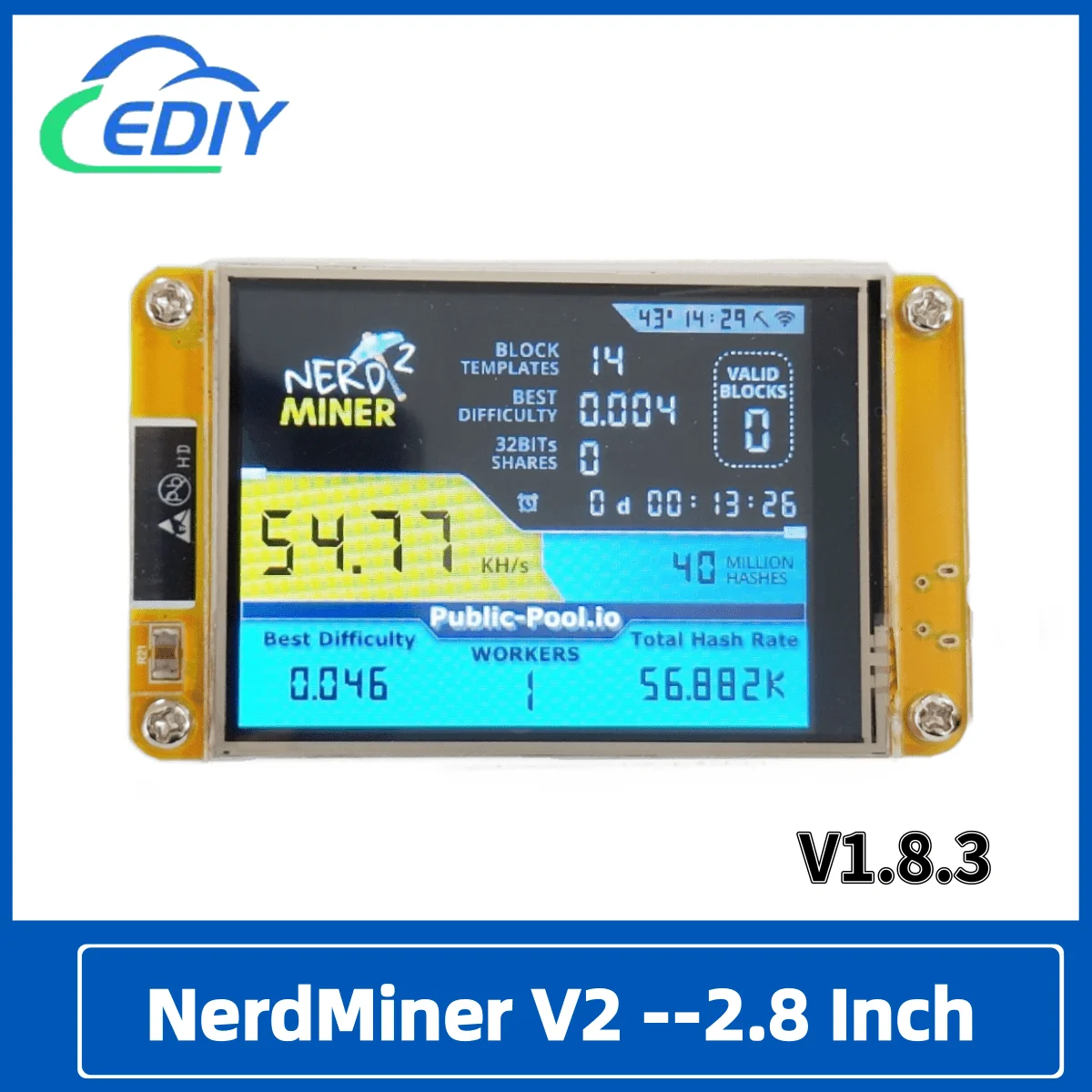
The most striking feature of the NerdMiner V2 is its 2.8-inch LCD display. This screen provides a clear, real-time readout of various mining statistics. Visual feedback is immediate.
This display is critical for user engagement, showcasing metrics such as current hashrate, network difficulty, valid blocks found, and connected workers. It transforms abstract data into an easily digestible format. Imagine seeing your device actively participating in the Bitcoin network.
Many industrial automation systems utilize similar small displays for local status monitoring or basic parameter adjustments. While the NerdMiner's display is consumer-oriented, the principle of immediate, on-device data visualization is a shared characteristic with industrial HMI (Human-Machine Interface) panels, albeit on a much smaller scale.
The display dynamically updates with critical information. Users can observe the current hashrate, best difficulty, and the total hash rate of the connected pool. These numbers provide immediate feedback.
Monitoring these metrics in real-time allows enthusiasts to understand the fluctuating nature of the Bitcoin network and their device's contribution. It's a constant stream of data. The visual representation makes the process tangible, moving beyond abstract command-line outputs.
In an industrial context, real-time data feeds are essential for process control and fault detection. While the NerdMiner's data is purely informational for the user, the concept of a dedicated display for critical operational parameters mirrors the requirements of industrial sensors and controllers that provide instant feedback to operators.
Initial setup often involves a QR code displayed on the screen. This simplifies the process of connecting to Wi-Fi and configuring mining pool details. User interaction is streamlined.
This method of configuration is highly accessible, requiring only a smartphone to scan the code and input network credentials. It removes the barrier of complex command-line interfaces or dedicated software. Simplicity is key.
Unlike legacy industrial equipment that might require specialized programming tools or serial console access for configuration, the NerdMiner embraces modern, user-friendly setup methods. This approach prioritizes ease of use over the robust, often complex, configuration protocols found in industrial settings.
The NerdMiner V2 is primarily marketed as a Bitcoin solo lottery miner. This implies an attempt to find a block independently. The odds are incredibly low.
Solo mining means the device is trying to solve a block on its own. If successful, the entire block reward goes to the miner. This is the
The Hashing Core: ESP32 Architecture
At its foundation, the NerdMiner V2 leverages an ESP32-2432S028R microcontroller. This specific variant integrates a powerful dual-core processor, capable of handling network communication and computational tasks concurrently. Its architecture is well-suited for embedded applications requiring both processing capability and wireless connectivity.
This choice of microcontroller dictates the device's operational ceiling. While not designed for high-throughput industrial data processing, the ESP32 provides sufficient power for its intended niche. It manages the hashing algorithms and drives the display effectively.
Compared to dedicated ASIC (Application-Specific Integrated Circuit) miners, which are engineered solely for maximum hashing power, the ESP32 offers a general-purpose computing environment. This flexibility allows for firmware updates and potential customization, a feature absent in most rigid ASIC designs. It's a different class of hardware entirely.
Processing Power and Efficiency
The device achieves a maximum hashrate of approximately 49 kH/s (kilohashes per second). This figure represents the number of SHA-256 calculations the unit can perform per second. It's a modest number.
For context, this processing power is orders of magnitude lower than even entry-level industrial-grade Bitcoin miners. However, the ESP32's strength lies in its power efficiency. It consumes minimal electricity, making it an ideal candidate for continuous operation without a significant impact on energy bills.
Unlike power-hungry industrial servers that demand specialized cooling and high-capacity power supplies, this miner operates comfortably on a standard 5V USB connection. This drastically reduces the operational overhead, positioning it as a low-cost, low-maintenance alternative for hobbyists.
Connectivity and Network Integration
Integrated Wi-Fi connectivity is a core feature of the ESP32. This allows the NerdMiner V2 to connect to local networks and, subsequently, to Bitcoin mining pools or solo mining nodes over the internet. Network stability is crucial for consistent operation.
This wireless capability simplifies deployment significantly. Users avoid the need for cumbersome Ethernet cables, enabling flexible placement within a home or office environment. Setup often involves scanning a QR code for network credentials.
Traditional industrial computers often rely on wired Ethernet for maximum reliability and security in harsh environments. The Wi-Fi integration here, while convenient, positions the device firmly outside the realm of mission-critical industrial control systems where wired connections are paramount for uptime and data integrity.
Visual Interface: The 2.8-inch Smart Display
The most striking feature of the NerdMiner V2 is its 2.8-inch LCD display. This screen provides a clear, real-time readout of various mining statistics. Visual feedback is immediate.
This display is critical for user engagement, showcasing metrics such as current hashrate, network difficulty, valid blocks found, and connected workers. It transforms abstract data into an easily digestible format. Imagine seeing your device actively participating in the Bitcoin network.
Many industrial automation systems utilize similar small displays for local status monitoring or basic parameter adjustments. While the NerdMiner's display is consumer-oriented, the principle of immediate, on-device data visualization is a shared characteristic with industrial HMI (Human-Machine Interface) panels, albeit on a much smaller scale.
Real-time Operational Metrics
The display dynamically updates with critical information. Users can observe the current hashrate, best difficulty, and the total hash rate of the connected pool. These numbers provide immediate feedback.
Monitoring these metrics in real-time allows enthusiasts to understand the fluctuating nature of the Bitcoin network and their device's contribution. It's a constant stream of data. The visual representation makes the process tangible, moving beyond abstract command-line outputs.
In an industrial context, real-time data feeds are essential for process control and fault detection. While the NerdMiner's data is purely informational for the user, the concept of a dedicated display for critical operational parameters mirrors the requirements of industrial sensors and controllers that provide instant feedback to operators.
User Interaction and Setup
Initial setup often involves a QR code displayed on the screen. This simplifies the process of connecting to Wi-Fi and configuring mining pool details. User interaction is streamlined.
This method of configuration is highly accessible, requiring only a smartphone to scan the code and input network credentials. It removes the barrier of complex command-line interfaces or dedicated software. Simplicity is key.
Unlike legacy industrial equipment that might require specialized programming tools or serial console access for configuration, the NerdMiner embraces modern, user-friendly setup methods. This approach prioritizes ease of use over the robust, often complex, configuration protocols found in industrial settings.
Operational Profile: Solo Mining Dynamics
The NerdMiner V2 is primarily marketed as a Bitcoin solo lottery miner. This implies an attempt to find a block independently. The odds are incredibly low.
Solo mining means the device is trying to solve a block on its own. If successful, the entire block reward goes to the miner. This is the