MPPT Solar Battery Charger Module
Official Store Deal
Expert Analysis Overview
The MPPT Solar Battery Charger Module is a highly adaptable power management solution designed for hobbyists, electronics repair technicians, and DIY enthusiasts seeking efficient solar charging for various lithium battery chemistries. This compact printed circuit board (PCB) integrates Maximum Power Point Tracking (MPPT) functionality, ensuring optimal energy harvest from solar panels. Its core capability lies in converting variable solar input into stable, regulated charging current for multi-cell lithium-ion, LiFePO4, and lithium titanate batteries.
This module prominently features an MPPT circuit, a critical component for maximizing solar panel efficiency. The visible design incorporates a buck converter topology, indicative of its step-down voltage regulation capabilities. This allows the module to efficiently charge lower voltage battery packs from higher voltage solar panels.
In practical applications, a solar panel's output voltage and current fluctuate significantly with sunlight intensity and temperature. The MPPT algorithm continuously adjusts the load presented to the solar panel, forcing it to operate at its peak power point. This optimization translates directly into more energy delivered to the battery, even under suboptimal lighting conditions. More power is extracted.
Unlike simpler, non-MPPT charge controllers that merely regulate voltage, this module actively seeks the point of maximum power. Generic PWM controllers often waste a significant portion of available solar energy, especially when the panel's voltage does not perfectly match the battery's charging requirements. The MPPT approach ensures a higher return on investment for the solar panel itself, making it a superior choice for serious off-grid or portable power projects.
Visual inspection of the module reveals an adjustable resistor, labeled R5, which directly controls the MPPT voltage setting. The product imagery clearly outlines options for 9V, 12V, and 18V MPPT points. This is a crucial design choice.
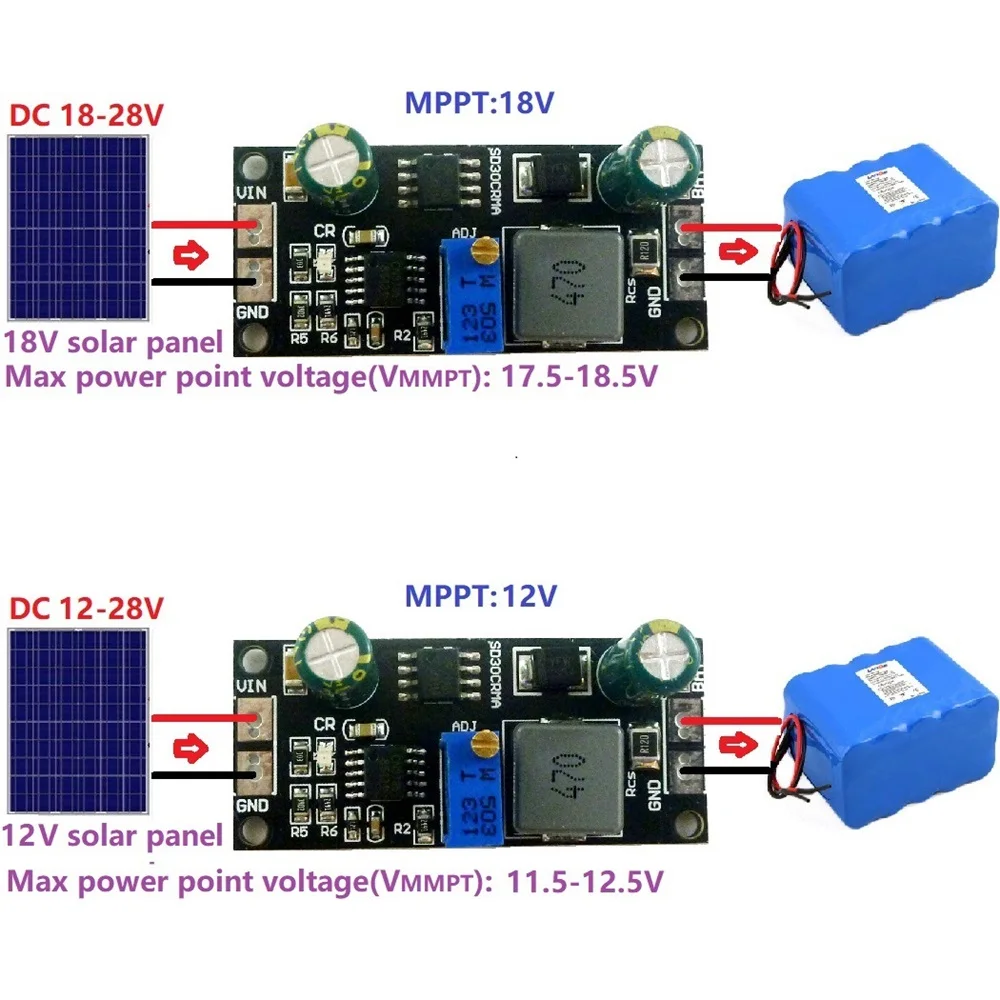
This configurability allows the module to be precisely matched to the nominal voltage of the solar panel being used. For instance, an 18V MPPT setting is ideal for solar panels with a maximum power point voltage (VMPPT) between 17.5V and 18.5V, typically found in 36-cell configurations. Similarly, the 12V setting accommodates panels with a VMPPT around 11.5V-12.5V, common in 24-cell designs. Such flexibility prevents energy loss.
Compared to fixed-MPPT modules, this adjustable feature significantly broadens the range of compatible solar panels. Users are not locked into a specific panel type, offering greater freedom in component selection or repurposing existing solar assets. It's an upgrade from rigid, single-setting controllers.
Another key feature is the programmable charging current, managed via the RCS resistor. The provided tables illustrate how different resistor values correspond to various charging currents, including 1A, 2A, and 3A. This enables precise control.
This current programmability is vital for battery health and longevity. Charging a battery at an excessively high current can lead to overheating, reduced lifespan, and even safety hazards. Conversely, too low a current extends charging times unnecessarily. The ability to set the charge rate ensures the battery is charged within its manufacturer-specified limits, preventing premature degradation. Optimal charging is achieved.
Many entry-level charge controllers offer only a fixed charging current, which may not be suitable for all battery capacities. This module's customizable current stands out, allowing the user to tailor the charge rate to the specific battery pack, whether it's a small 1000mAh pack or a larger 5000mAh assembly. It offers superior battery care.
Close examination of the PCB images reveals a clean layout and what appears to be machine-soldered components. The inductors, capacitors, and integrated circuits are standard surface-mount devices (SMD). The overall component density is appropriate for a compact power module.
While specific component brands are not explicitly visible, the general construction suggests a functional and reliable assembly for its intended application. The visible soldering points appear consistent, minimizing the risk of cold solder joints that could lead to intermittent connections or premature failure. Clean signal transmission is crucial here.
Unlike hand-assembled prototypes or poorly manufactured boards, the visible quality implies a reasonable level of manufacturing consistency. This contributes to the long-term reliability of connections, a critical factor for any power electronics. It avoids common failure points.
The module is designed to support a wide array of lithium battery chemistries, including multi-cell Lithium-ion, LiFePO4, and Lithium Titanate batteries. This broad compatibility is a significant advantage. It simplifies inventory.
This versatility means the module can be used in diverse projects, from powering portable electronics with Li-ion packs to more robust applications utilizing the stable characteristics of LiFePO4 or the rapid charge/discharge capabilities of Lithium Titanate. The charging voltage range of 3.2V to 18.5V further underscores its adaptability to various series configurations of these battery types. This is a flexible solution.
Furthermore, the module incorporates battery overvoltage protection. This feature is essential for preventing damage to the connected battery pack by terminating the charge cycle once the battery reaches its full voltage. Overcharging can severely degrade battery performance and pose safety risks. This protection is a standard, yet vital, safeguard against common battery failures. It protects expensive equipment.
The compact form factor of the module makes it suitable for integration into various projects where space is a constraint. The clearly labeled VIN, GND, and BAT terminals simplify wiring. An onboard CR LED indicator provides visual feedback on the charging status. This is a small board.
While the module requires some basic electronics knowledge for configuration (adjusting resistors for MPPT and current), the process is straightforward with the provided tables and diagrams. This hands-on approach caters to users who prefer fine-tuning their power systems rather than relying on fixed, often suboptimal, settings. Customization is key.
This level of user control differentiates it from consumer-grade, plug-and-play chargers. It empowers the user to build more optimized and efficient solar charging systems tailored to specific needs. The module provides the capability to fix or upgrade existing solar charging setups with affordable components, extending the life and utility of valuable equipment.
Imagine a scenario where a portable solar generator needs an upgrade to its charging efficiency, or a custom power bank requires precise solar input management. This module enables such enhancements, transforming a standard setup into a highly optimized power solution. Its ability to extract maximum power from a solar panel means longer operational times for your devices, more reliable off-grid power, and the satisfaction of a perfectly tuned electrical system. This is about capability. The user gains control over their power sources, ensuring their devices are always ready, powered by the sun's energy, efficiently and safely. It's a foundational component for robust, self-sufficient power systems, offering peace of mind through its protective features and adaptable performance.
Precision Power Harvesting: MPPT Functionality
This module prominently features an MPPT circuit, a critical component for maximizing solar panel efficiency. The visible design incorporates a buck converter topology, indicative of its step-down voltage regulation capabilities. This allows the module to efficiently charge lower voltage battery packs from higher voltage solar panels.
In practical applications, a solar panel's output voltage and current fluctuate significantly with sunlight intensity and temperature. The MPPT algorithm continuously adjusts the load presented to the solar panel, forcing it to operate at its peak power point. This optimization translates directly into more energy delivered to the battery, even under suboptimal lighting conditions. More power is extracted.
Unlike simpler, non-MPPT charge controllers that merely regulate voltage, this module actively seeks the point of maximum power. Generic PWM controllers often waste a significant portion of available solar energy, especially when the panel's voltage does not perfectly match the battery's charging requirements. The MPPT approach ensures a higher return on investment for the solar panel itself, making it a superior choice for serious off-grid or portable power projects.
Configurable MPPT Voltage Settings
Visual inspection of the module reveals an adjustable resistor, labeled R5, which directly controls the MPPT voltage setting. The product imagery clearly outlines options for 9V, 12V, and 18V MPPT points. This is a crucial design choice.
This configurability allows the module to be precisely matched to the nominal voltage of the solar panel being used. For instance, an 18V MPPT setting is ideal for solar panels with a maximum power point voltage (VMPPT) between 17.5V and 18.5V, typically found in 36-cell configurations. Similarly, the 12V setting accommodates panels with a VMPPT around 11.5V-12.5V, common in 24-cell designs. Such flexibility prevents energy loss.
Compared to fixed-MPPT modules, this adjustable feature significantly broadens the range of compatible solar panels. Users are not locked into a specific panel type, offering greater freedom in component selection or repurposing existing solar assets. It's an upgrade from rigid, single-setting controllers.
Charging Current Management: Programmable Output
Another key feature is the programmable charging current, managed via the RCS resistor. The provided tables illustrate how different resistor values correspond to various charging currents, including 1A, 2A, and 3A. This enables precise control.
This current programmability is vital for battery health and longevity. Charging a battery at an excessively high current can lead to overheating, reduced lifespan, and even safety hazards. Conversely, too low a current extends charging times unnecessarily. The ability to set the charge rate ensures the battery is charged within its manufacturer-specified limits, preventing premature degradation. Optimal charging is achieved.
Many entry-level charge controllers offer only a fixed charging current, which may not be suitable for all battery capacities. This module's customizable current stands out, allowing the user to tailor the charge rate to the specific battery pack, whether it's a small 1000mAh pack or a larger 5000mAh assembly. It offers superior battery care.
Component Quality and Assembly
Close examination of the PCB images reveals a clean layout and what appears to be machine-soldered components. The inductors, capacitors, and integrated circuits are standard surface-mount devices (SMD). The overall component density is appropriate for a compact power module.
While specific component brands are not explicitly visible, the general construction suggests a functional and reliable assembly for its intended application. The visible soldering points appear consistent, minimizing the risk of cold solder joints that could lead to intermittent connections or premature failure. Clean signal transmission is crucial here.
Unlike hand-assembled prototypes or poorly manufactured boards, the visible quality implies a reasonable level of manufacturing consistency. This contributes to the long-term reliability of connections, a critical factor for any power electronics. It avoids common failure points.
Comprehensive Battery Compatibility and Protection
The module is designed to support a wide array of lithium battery chemistries, including multi-cell Lithium-ion, LiFePO4, and Lithium Titanate batteries. This broad compatibility is a significant advantage. It simplifies inventory.
This versatility means the module can be used in diverse projects, from powering portable electronics with Li-ion packs to more robust applications utilizing the stable characteristics of LiFePO4 or the rapid charge/discharge capabilities of Lithium Titanate. The charging voltage range of 3.2V to 18.5V further underscores its adaptability to various series configurations of these battery types. This is a flexible solution.
Furthermore, the module incorporates battery overvoltage protection. This feature is essential for preventing damage to the connected battery pack by terminating the charge cycle once the battery reaches its full voltage. Overcharging can severely degrade battery performance and pose safety risks. This protection is a standard, yet vital, safeguard against common battery failures. It protects expensive equipment.
Integration and User Experience
The compact form factor of the module makes it suitable for integration into various projects where space is a constraint. The clearly labeled VIN, GND, and BAT terminals simplify wiring. An onboard CR LED indicator provides visual feedback on the charging status. This is a small board.
While the module requires some basic electronics knowledge for configuration (adjusting resistors for MPPT and current), the process is straightforward with the provided tables and diagrams. This hands-on approach caters to users who prefer fine-tuning their power systems rather than relying on fixed, often suboptimal, settings. Customization is key.
This level of user control differentiates it from consumer-grade, plug-and-play chargers. It empowers the user to build more optimized and efficient solar charging systems tailored to specific needs. The module provides the capability to fix or upgrade existing solar charging setups with affordable components, extending the life and utility of valuable equipment.
Imagine a scenario where a portable solar generator needs an upgrade to its charging efficiency, or a custom power bank requires precise solar input management. This module enables such enhancements, transforming a standard setup into a highly optimized power solution. Its ability to extract maximum power from a solar panel means longer operational times for your devices, more reliable off-grid power, and the satisfaction of a perfectly tuned electrical system. This is about capability. The user gains control over their power sources, ensuring their devices are always ready, powered by the sun's energy, efficiently and safely. It's a foundational component for robust, self-sufficient power systems, offering peace of mind through its protective features and adaptable performance.