MKS TMC2209 Stepper Motor Driver
Official Store Deal
Expert Analysis Overview
The MKS TMC2209 Stepper Motor Driver is a highly regarded and versatile stepper motor driver module designed for 3D printer enthusiasts and DIY makers seeking quieter, more precise motion control. This component represents a significant leap forward from older driver technologies, addressing common frustrations associated with noisy operation and limited print quality. Its adoption facilitates deep customization and performance tuning, appealing directly to the tinkerer who enjoys modifying and improving their machines.
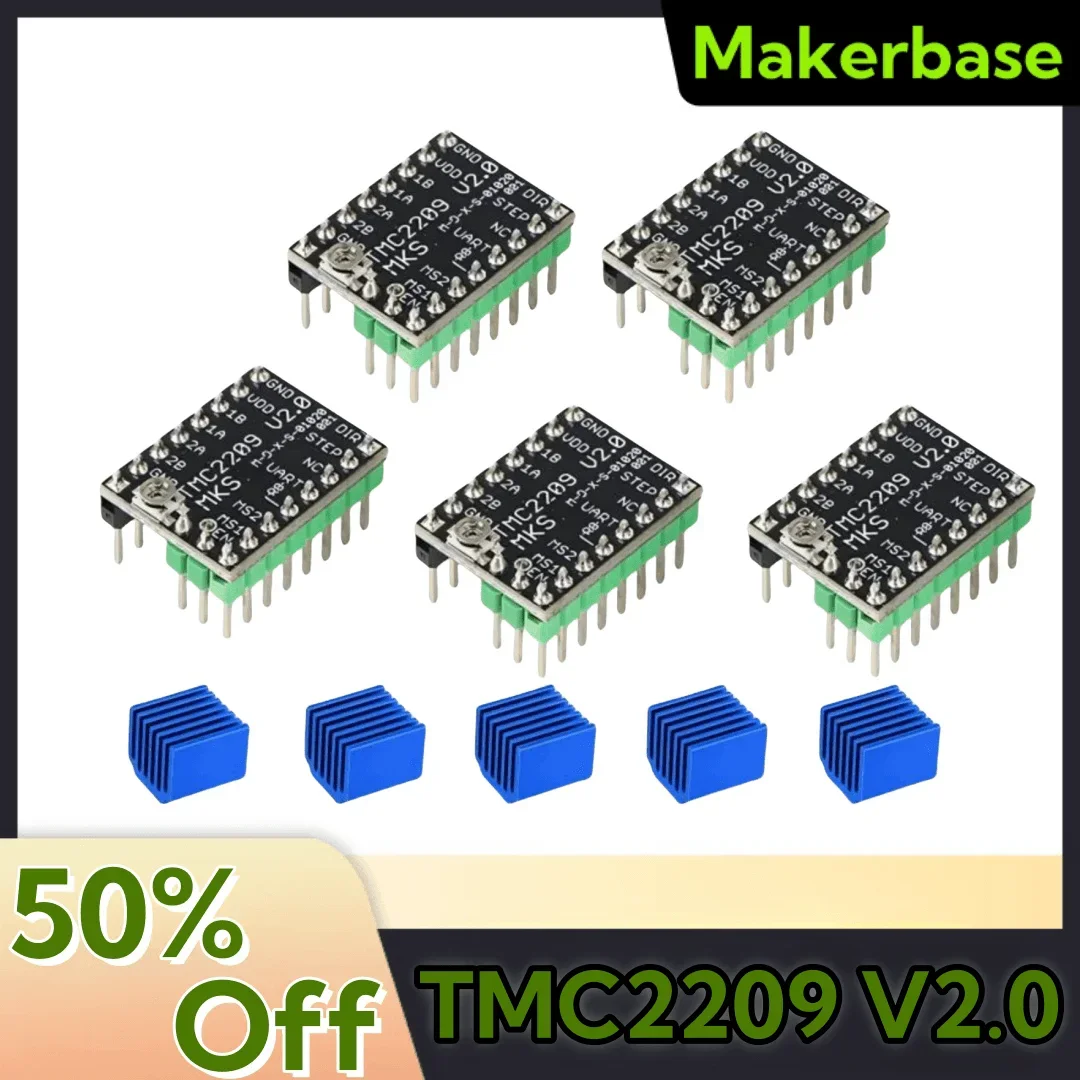
The TMC2209 V2.0 driver module, visible in its compact StepStick form factor, is engineered around the Trinamic TMC2209 chip. These modules are typically supplied with pre-soldered pins, ensuring straightforward integration into compatible mainboards. The inclusion of blue aluminum heatsinks, as prominently featured, is a standard and critical accessory.
This design directly translates to a dramatically quieter 3D printing experience. Unlike older drivers that often produce audible whining or chattering from stepper motors, the TMC2209's advanced stealthChop2™ technology minimizes motor noise to almost imperceptible levels. Smoother motor movements also reduce vibrations, which in turn leads to a noticeable improvement in overall print quality, especially on delicate surfaces where artifacts are easily visible. It's truly a quiet operator.
Compared to the loud, often grating operation of standard A4988 or DRV8825 drivers, the TMC2209 offers a transformative upgrade. The common pain point of a noisy printer, which can be disruptive in a home or workshop environment, is effectively mitigated, allowing for prints to run overnight without disturbance. This driver solves the noise problem definitively.
The MKS TMC2209 drivers prominently feature support for UART mode (Universal Asynchronous Receiver-Transmitter). The pin configuration clearly shows dedicated pins for this communication protocol, alongside the standard STEP/DIR pins. This is a key differentiator for advanced users.
UART capability allows the 3D printer's mainboard to communicate directly with the driver, enabling dynamic control over various parameters. Makers can fine-tune microstepping levels, adjust motor current, and even monitor driver diagnostics through firmware, eliminating the need for physical jumpers or potentiometers for many settings. This level of granular control empowers users to optimize performance for specific motor types or printing scenarios. Fine-tuning becomes a simple firmware adjustment.
In stark contrast, many older stepper drivers rely solely on physical jumpers to set microstepping and require manual adjustment of a tiny potentiometer (VREF) to set motor current. This limits flexibility and often necessitates physical access to the mainboard for any changes. The TMC2209's UART integration provides a significant upgrade in terms of ease of configuration and real-time adaptability, making it far more appealing for iterative machine improvements.
Each MKS TMC2209 driver in the product images is accompanied by a blue aluminum heatsink. These heatsinks are designed to be attached to the top of the TMC2209 chip, which is the primary heat-generating component. The physical dimensions of both the driver (20.5mm x 15.3mm) and the heatsink (15mm x 13.3mm) are clearly illustrated.
Effective thermal management is critical for sustaining optimal driver performance, especially during prolonged print jobs or when driving higher current stepper motors. The heatsink helps to dissipate heat away from the TMC2209 chip, preventing it from reaching thermal shutdown temperatures. This ensures consistent motor operation, prevents skipped steps, and ultimately extends the lifespan of the driver module. Cooler components last longer.
Many generic or lower-cost stepper drivers often omit heatsinks entirely, or provide inadequate ones. This can lead to premature thermal throttling, where the driver automatically reduces current to prevent overheating, resulting in inconsistent motor performance or even print failures. The inclusion of dedicated heatsinks with the MKS TMC2209 is a testament to its design for reliable and sustained high-performance operation, a vital consideration for any maker pushing their machine's limits.
The product description explicitly highlights compatibility with popular 3D printer mainboards such as "Skr V2.0 Gen L StepStick," "Sgenl Genl Robin Nano." These mainboards are widely used in the open-source 3D printing community, known for their versatility and support for advanced features.
This broad compatibility means the MKS TMC2209 drivers can be easily dropped into many existing printer setups as an upgrade. Makers looking to improve their current machines don't have to overhaul their entire control system; they can simply replace their older drivers. This facilitates a modular approach to upgrades, allowing for gradual improvements and experimentation with different configurations. It's an easy upgrade path.
Unlike proprietary systems that might lock users into specific, often less capable, stepper motor drivers, the MKS TMC2209's compatibility with open-source mainboards fosters a vibrant ecosystem of community support and readily available firmware modifications. This makes the path to customization and optimization much smoother for the average tinkerer, encouraging further experimentation rather than frustration.
Beyond quiet operation, the TMC2209 is renowned for its advanced microstepping capabilities. While basic drivers typically offer up to 1/16th or 1/32nd microstepping, the TMC2209 can achieve up to 1/256th microstepping through interpolation (often referred to as SpreadCycle™). This is a significant factor in print quality.
This high level of microstepping translates to incredibly smooth motor movements, virtually eliminating the tiny, often visible, imperfections known as "salmon skin" or "vertical banding" on printed surfaces. Each tiny step is broken down into many even smaller increments, resulting in a much finer resolution of movement for the print head or bed. The resulting prints exhibit superior surface finish and dimensional accuracy, particularly crucial for detailed models or functional parts where precision is paramount. Smoothness defines the output.
Standard drivers with lower microstepping resolutions often produce more noticeable layer lines and subtle artifacts due to the coarser motor movements. For makers obsessed with achieving the highest possible print quality, the TMC2209's ability to deliver such fine control over stepper motors is a compelling advantage. It elevates the visual appeal and functional integrity of 3D printed objects considerably, making high-quality results more attainable.
As a component frequently used within the open-source 3D printing ecosystem, the MKS TMC2209 benefits from extensive community support. Its widespread adoption on platforms like Marlin, Klipper, and RepRapFirmware means that a wealth of information, tutorials, and troubleshooting guides are readily available online.
This strong community backing empowers makers to confidently integrate, configure, and troubleshoot these drivers. If a user encounters an issue, the likelihood of finding a solution or receiving assistance from fellow enthusiasts is extremely high. This collective knowledge base reduces the learning curve and provides a safety net for those experimenting with new configurations or custom builds. Help is always at hand.
Compared to components with limited or proprietary support, the open-source nature of the TMC2209 and its associated mainboards creates an environment where knowledge is freely shared and problems are collectively solved. This is a significant advantage for the tinkerer, allowing for deeper engagement with the technology and faster progress in their projects, fostering innovation and continuous improvement within the hobby.
The product is often offered in multi-packs, and promotional banners indicate significant discounts, such as "50% Off." This pricing strategy, combined with the inherent benefits of the TMC2209, frames a strong value proposition. The per-unit cost becomes highly attractive, particularly for multi-axis printers.
Investing in these drivers, especially when available at a discount, is a strategic move for any maker. The long-term value stems from improved print success rates, reduced material waste due to fewer failed prints, and the extended lifespan of both the drivers and potentially the motors themselves due to smoother operation and better thermal management. The initial outlay is offset by these ongoing benefits. It's a smart long-term investment.
While cheaper, basic drivers might offer a lower initial sticker price, the hidden costs of noise pollution, print quality compromises, and potential early failures can quickly erode any perceived savings. The MKS TMC2209, particularly when acquired through advantageous bulk pricing, provides a superior return on investment by delivering a premium printing experience that saves time, materials, and frustration in the long run. The value extends far beyond the price tag.
Imagine your 3D printer operating with barely a whisper, producing prints with an unprecedented level of smoothness and detail. Visualize effortlessly tuning your motor settings through a simple firmware adjustment, rather than fumbling with tiny potentiometers. Consider the satisfaction of knowing your machine is running efficiently, quietly, and reliably, allowing you to focus purely on the creative aspects of your projects. This driver doesn't just move motors; it elevates the entire making experience, turning your workshop into a hub of quiet innovation and precise craftsmanship.
The Silent Revolution in Motion Control
The TMC2209 V2.0 driver module, visible in its compact StepStick form factor, is engineered around the Trinamic TMC2209 chip. These modules are typically supplied with pre-soldered pins, ensuring straightforward integration into compatible mainboards. The inclusion of blue aluminum heatsinks, as prominently featured, is a standard and critical accessory.
This design directly translates to a dramatically quieter 3D printing experience. Unlike older drivers that often produce audible whining or chattering from stepper motors, the TMC2209's advanced stealthChop2™ technology minimizes motor noise to almost imperceptible levels. Smoother motor movements also reduce vibrations, which in turn leads to a noticeable improvement in overall print quality, especially on delicate surfaces where artifacts are easily visible. It's truly a quiet operator.
Compared to the loud, often grating operation of standard A4988 or DRV8825 drivers, the TMC2209 offers a transformative upgrade. The common pain point of a noisy printer, which can be disruptive in a home or workshop environment, is effectively mitigated, allowing for prints to run overnight without disturbance. This driver solves the noise problem definitively.
Connectivity and Modularity: Opening the Door to Customization
The MKS TMC2209 drivers prominently feature support for UART mode (Universal Asynchronous Receiver-Transmitter). The pin configuration clearly shows dedicated pins for this communication protocol, alongside the standard STEP/DIR pins. This is a key differentiator for advanced users.
UART capability allows the 3D printer's mainboard to communicate directly with the driver, enabling dynamic control over various parameters. Makers can fine-tune microstepping levels, adjust motor current, and even monitor driver diagnostics through firmware, eliminating the need for physical jumpers or potentiometers for many settings. This level of granular control empowers users to optimize performance for specific motor types or printing scenarios. Fine-tuning becomes a simple firmware adjustment.
In stark contrast, many older stepper drivers rely solely on physical jumpers to set microstepping and require manual adjustment of a tiny potentiometer (VREF) to set motor current. This limits flexibility and often necessitates physical access to the mainboard for any changes. The TMC2209's UART integration provides a significant upgrade in terms of ease of configuration and real-time adaptability, making it far more appealing for iterative machine improvements.
Thermal Management: Keeping Cool Under Pressure
Each MKS TMC2209 driver in the product images is accompanied by a blue aluminum heatsink. These heatsinks are designed to be attached to the top of the TMC2209 chip, which is the primary heat-generating component. The physical dimensions of both the driver (20.5mm x 15.3mm) and the heatsink (15mm x 13.3mm) are clearly illustrated.
Effective thermal management is critical for sustaining optimal driver performance, especially during prolonged print jobs or when driving higher current stepper motors. The heatsink helps to dissipate heat away from the TMC2209 chip, preventing it from reaching thermal shutdown temperatures. This ensures consistent motor operation, prevents skipped steps, and ultimately extends the lifespan of the driver module. Cooler components last longer.
Many generic or lower-cost stepper drivers often omit heatsinks entirely, or provide inadequate ones. This can lead to premature thermal throttling, where the driver automatically reduces current to prevent overheating, resulting in inconsistent motor performance or even print failures. The inclusion of dedicated heatsinks with the MKS TMC2209 is a testament to its design for reliable and sustained high-performance operation, a vital consideration for any maker pushing their machine's limits.
Seamless Integration with Modern Mainboards
The product description explicitly highlights compatibility with popular 3D printer mainboards such as "Skr V2.0 Gen L StepStick," "Sgenl Genl Robin Nano." These mainboards are widely used in the open-source 3D printing community, known for their versatility and support for advanced features.
This broad compatibility means the MKS TMC2209 drivers can be easily dropped into many existing printer setups as an upgrade. Makers looking to improve their current machines don't have to overhaul their entire control system; they can simply replace their older drivers. This facilitates a modular approach to upgrades, allowing for gradual improvements and experimentation with different configurations. It's an easy upgrade path.
Unlike proprietary systems that might lock users into specific, often less capable, stepper motor drivers, the MKS TMC2209's compatibility with open-source mainboards fosters a vibrant ecosystem of community support and readily available firmware modifications. This makes the path to customization and optimization much smoother for the average tinkerer, encouraging further experimentation rather than frustration.
Precision Engineering: Microstepping for Flawless Prints
Beyond quiet operation, the TMC2209 is renowned for its advanced microstepping capabilities. While basic drivers typically offer up to 1/16th or 1/32nd microstepping, the TMC2209 can achieve up to 1/256th microstepping through interpolation (often referred to as SpreadCycle™). This is a significant factor in print quality.
This high level of microstepping translates to incredibly smooth motor movements, virtually eliminating the tiny, often visible, imperfections known as "salmon skin" or "vertical banding" on printed surfaces. Each tiny step is broken down into many even smaller increments, resulting in a much finer resolution of movement for the print head or bed. The resulting prints exhibit superior surface finish and dimensional accuracy, particularly crucial for detailed models or functional parts where precision is paramount. Smoothness defines the output.
Standard drivers with lower microstepping resolutions often produce more noticeable layer lines and subtle artifacts due to the coarser motor movements. For makers obsessed with achieving the highest possible print quality, the TMC2209's ability to deliver such fine control over stepper motors is a compelling advantage. It elevates the visual appeal and functional integrity of 3D printed objects considerably, making high-quality results more attainable.
Community and Open Source: The Shared Knowledge Advantage
As a component frequently used within the open-source 3D printing ecosystem, the MKS TMC2209 benefits from extensive community support. Its widespread adoption on platforms like Marlin, Klipper, and RepRapFirmware means that a wealth of information, tutorials, and troubleshooting guides are readily available online.
This strong community backing empowers makers to confidently integrate, configure, and troubleshoot these drivers. If a user encounters an issue, the likelihood of finding a solution or receiving assistance from fellow enthusiasts is extremely high. This collective knowledge base reduces the learning curve and provides a safety net for those experimenting with new configurations or custom builds. Help is always at hand.
Compared to components with limited or proprietary support, the open-source nature of the TMC2209 and its associated mainboards creates an environment where knowledge is freely shared and problems are collectively solved. This is a significant advantage for the tinkerer, allowing for deeper engagement with the technology and faster progress in their projects, fostering innovation and continuous improvement within the hobby.
Value Proposition: Investing in Print Quality and Longevity
The product is often offered in multi-packs, and promotional banners indicate significant discounts, such as "50% Off." This pricing strategy, combined with the inherent benefits of the TMC2209, frames a strong value proposition. The per-unit cost becomes highly attractive, particularly for multi-axis printers.
Investing in these drivers, especially when available at a discount, is a strategic move for any maker. The long-term value stems from improved print success rates, reduced material waste due to fewer failed prints, and the extended lifespan of both the drivers and potentially the motors themselves due to smoother operation and better thermal management. The initial outlay is offset by these ongoing benefits. It's a smart long-term investment.
While cheaper, basic drivers might offer a lower initial sticker price, the hidden costs of noise pollution, print quality compromises, and potential early failures can quickly erode any perceived savings. The MKS TMC2209, particularly when acquired through advantageous bulk pricing, provides a superior return on investment by delivering a premium printing experience that saves time, materials, and frustration in the long run. The value extends far beyond the price tag.
Imagine your 3D printer operating with barely a whisper, producing prints with an unprecedented level of smoothness and detail. Visualize effortlessly tuning your motor settings through a simple firmware adjustment, rather than fumbling with tiny potentiometers. Consider the satisfaction of knowing your machine is running efficiently, quietly, and reliably, allowing you to focus purely on the creative aspects of your projects. This driver doesn't just move motors; it elevates the entire making experience, turning your workshop into a hub of quiet innovation and precise craftsmanship.