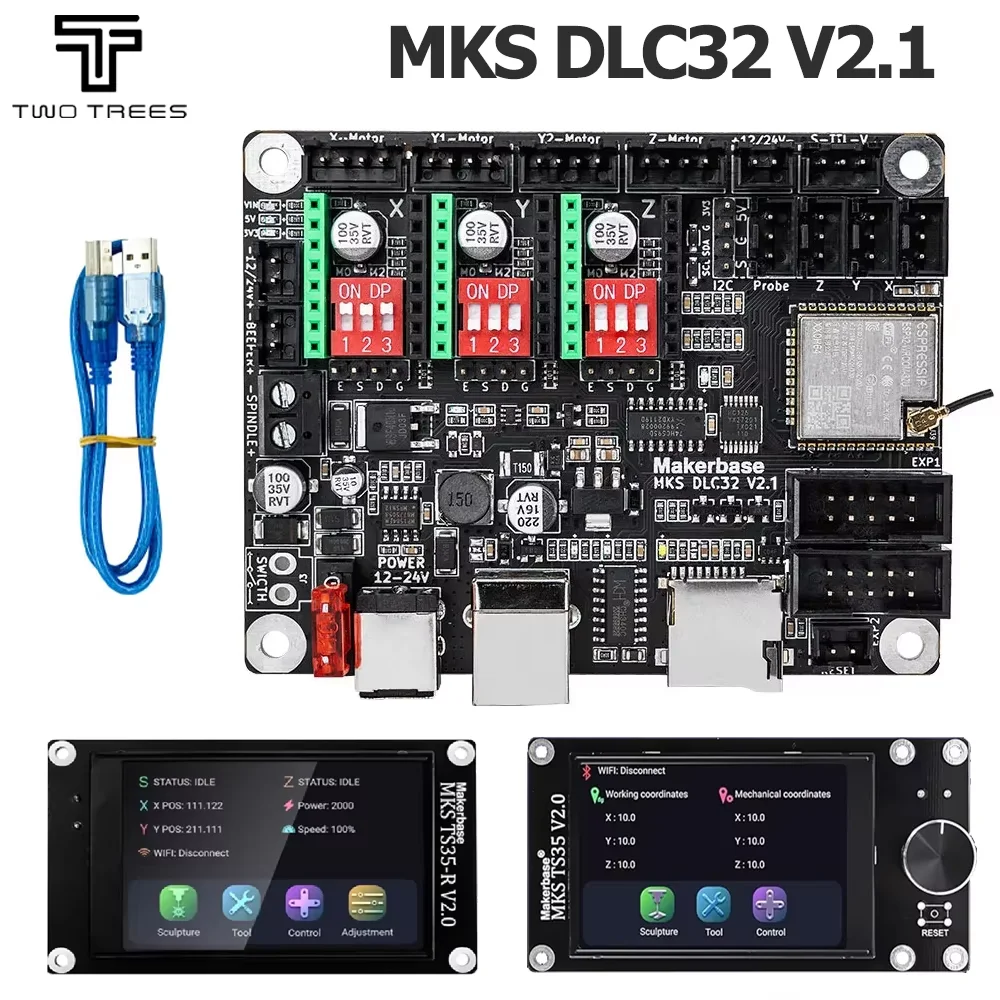
MKS DLC32 V2.1 GRBL Controller Kit with TS35 Touch Screen
Official Store Deal
Expert Analysis Overview
The MKS DLC32 V2.1 GRBL Controller Kit is a highly adaptable control solution for laser engravers and CNC machines, specifically engineered for makers seeking advanced offline capabilities and straightforward integration. This board leverages the powerful ESP32-WROOM-32U chip, offering a significant upgrade path for hobbyists and professionals alike who demand robust processing and wireless connectivity. Its design prioritizes expandability, making it a foundational component for custom machine builds and iterative improvements.
At the heart of the MKS DLC32 V2.1 board lies the ESP32-WROOM-32U 32-bit DOWD-V3 chip. This central processing unit is renowned for its dual-core architecture and integrated Wi-Fi and Bluetooth capabilities, establishing a robust foundation for precision control. The 32-bit processing power is crucial; it allows the controller to handle complex G-code instructions with far greater efficiency than its 8-bit predecessors. This ensures smoother interpolation of curves and faster execution of intricate engraving paths.
The computational muscle of the ESP32 provides substantial headroom for demanding tasks, preventing lag or stutter even during high-speed operations. For users previously frustrated by the occasional pauses or compromised motion quality with less powerful controllers, the ESP32-WROOM-32U offers a noticeably smoother and more reliable operational experience. Imagine a continuous, fluid motion across your workpiece. The board processes commands quickly. This responsiveness translates directly into higher quality output and reduced job times.
Compared to standard 8-bit ATmega-based GRBL controllers, which often reach their processing limits with complex geometries or high feed rates, the MKS DLC32 V2.1 with its ESP32 core represents a significant architectural upgrade. This not only enhances current performance but also future-proofs the system, allowing it to adapt to more sophisticated GRBL features and advanced motion planning algorithms that may emerge. It's a clear step up for serious builders.
A standout feature, directly stemming from the ESP32's capabilities, is the integrated WiFi functionality. This enables seamless wireless communication with the controller board, facilitating remote control, file transfer, and real-time monitoring without the need for a physical USB connection. This eliminates cable clutter and expands operational flexibility.
For makers with larger workshops or those who prefer to keep their computer separate from the dust and debris of a CNC machine, wireless control offers immense practical benefits. Users can initiate jobs, monitor progress, and even fine-tune settings from a tablet or smartphone connected to the local network. This capability dramatically streamlines the workflow, allowing for greater freedom of movement and multitasking. No more tripping over cables. The convenience is undeniable.
Traditional CNC and laser controllers often demand a constant, tethered connection to a PC, which can be restrictive. The MKS DLC32 V2.1’s wireless option provides a modern, clean, and flexible setup, aligning perfectly with contemporary workshop practices where multiple machines might be controlled from a central point or operated from a distance. This reduces setup time.
The kit's inclusion of the MKS TS35 V2.0 touch screen display provides an intuitive graphical user interface for comprehensive offline control. This 3.5-inch screen offers direct access to machine functions, G-code files stored on a TF card, and real-time status monitoring. Its design prioritizes ease of use and immediate feedback.
This touch screen significantly simplifies machine operation by eliminating the need for a continuously connected computer. Users can navigate menus, select G-code files directly from the TF card, perform axis jogging, set work offsets, and start or pause jobs with simple, tactile interactions. This direct, hands-on interaction enhances the user experience, particularly for repetitive tasks or quick adjustments that demand immediate attention. Control is at your fingertips.
Unlike systems that rely solely on command-line interfaces via serial terminals or require a full PC setup, the TS35 touch screen provides a dedicated, self-contained control panel. This integrated approach not only reduces initial setup complexity but also offers immediate visual feedback and error reporting, making the machine more approachable for new users while retaining advanced features for seasoned operators. It's a complete package.
The TS35 touch screen further enhances its user-friendliness by supporting six languages for online switching, including English, Chinese, French, Spanish, Italian, and Russian. This broad linguistic coverage caters to a diverse, global user base. It ensures clear communication.
This multilingual feature is a crucial advantage, significantly lowering the barrier to entry for non-English speaking users. Operating the machine in one's native language reduces ambiguity, minimizes potential misinterpretations of instructions or error messages, and generally makes the entire process more comfortable and efficient. Clarity is paramount.
Many DIY and even some commercial controllers often provide limited language options, primarily English, which can create a significant hurdle for international users. The MKS DLC32 V2.1's comprehensive multilingual interface demonstrates a thoughtful commitment to wider accessibility, fostering a more inclusive and global maker community.
The DLC32 V2.1 board is equipped with three dedicated stepper motor driver slots, signifying robust support for up to three axes of motion (typically X, Y, and Z, or a dual-Y configuration for larger gantries). These slots are designed for common plug-in stepper drivers, offering unparalleled flexibility in motor current and micro-stepping settings. Each axis has dedicated connections.
This modularity is a critical advantage for makers. It allows users to select stepper drivers precisely tailored to their specific motors and application requirements. Whether using standard A4988/DRV8825 drivers for basic tasks or upgrading to advanced TMC series drivers for ultra-quiet operation and higher micro-stepping precision, the board accommodates various choices. The system can be finely tuned. This ensures optimal performance for different machine types and sizes, from small desktop engravers to more substantial CNC routers.
Many integrated controller boards come with fixed, often undersized, stepper drivers, which can limit upgrade paths or compatibility with higher-torque motors. The MKS DLC32 V2.1's approach of utilizing plug-in drivers empowers the user to customize their setup for peak performance, ensuring the motion system precisely matches the mechanical demands of the project.
Beyond the convenient on-board slots, the controller also provides interfaces for external stepper drivers. This feature is absolutely essential for applications that demand high-current motors or specialized drivers that cannot be directly plugged into the board due to size or power requirements. Expansion capabilities are robust.
For larger CNC machines, plasma cutters, or systems utilizing heavy NEMA 23/34 motors, external drivers are often a necessity. These larger drivers typically offer higher current output, better heat dissipation, and sometimes more advanced features like closed-loop control. The inclusion of dedicated pinouts for external drivers ensures that the MKS DLC32 V2.1 can seamlessly scale up to more demanding mechanical systems without becoming a limiting factor. Powering larger motors becomes straightforward.
Generic entry-level controllers frequently lack robust external driver support, forcing users to implement complex workarounds or severely limiting the potential size and power of their machines. The DLC32 V2.1, however, anticipates the needs of advanced makers, providing a direct and reliable pathway for integrating high-power motion components, offering true scalability.
The board offers a versatile range of input/output options, including endstop/gyroscope interfaces and I2C interfaces. These connections facilitate the integration of critical safety features like limit switches, homing sensors, and various other peripherals, significantly enhancing both machine safety and overall functionality. Versatility is built-in.
Endstops are fundamental for protecting machine components from overtravel, preventing crashes into the physical limits of the machine's travel, and enabling precise homing sequences. These are crucial for repeatable and accurate multi-job operations. The I2C interface, a common serial bus, opens up possibilities for connecting a wide array of sensors or expansion modules, such as temperature sensors for monitoring spindle heat, dust detection sensors, or even additional displays for specific data. Safety is improved.
Many basic controllers might skimp on comprehensive I/O, often requiring users to implement custom, sometimes unreliable, wiring solutions or forgo certain advanced features. The MKS DLC32 V2.1 provides well-defined, easily accessible interfaces, simplifying the process of adding both essential safety features and more advanced functionalities, fostering a more complete and intelligent machine.
The MKS DLC32 V2.1 features specific, optimized outputs for TTL (Transistor-Transistor Logic) control and 12V/24V power output for laser and CNC modules. These dedicated pins ensure proper power delivery and precise control signal modulation to the cutting or engraving head. Clean power is supplied.
These outputs are meticulously designed to interface directly with common laser modules and CNC spindles. The TTL output provides the necessary pulse-width modulation (PWM) signal for precise laser power control, crucial for achieving varied shades and depths in engraving. The direct 12V/24V power output simplifies the electrical connection for the tool itself. This significantly streamlines wiring and ensures robust compatibility, allowing users to integrate various tools effectively. Setup is streamlined.
Unlike general-purpose microcontroller boards that might require custom circuitry, level shifters, or complex wiring for effective tool control, the DLC32 V2.1 provides ready-to-use, purpose-built connections. This significantly reduces the complexity for makers building or upgrading their laser engravers and CNC machines, allowing them to focus more on their projects and less on intricate electronics.
The board includes a power switch interface and a fuse input (12V/24V), components that underscore the emphasis on safety and protection for the intricate electronics. A dedicated fuse acts as a critical failsafe, helping to prevent catastrophic damage from overcurrents or short circuits. Protection is paramount.
The fuse input provides an indispensable safety mechanism, safeguarding the controller board itself and all connected components from potentially damaging electrical faults. The power switch interface, while seemingly minor, allows for convenient and safe system power management, which is absolutely crucial for maintaining a secure and efficient workshop environment. Components are safe. Proper power delivery is essential.
Some DIY control solutions might unfortunately overlook integrated fusing or dedicated power switch connections, leaving the entire system vulnerable to electrical damage and potential fire hazards. The MKS DLC32 V2.1's thoughtful inclusion of these features reflects a more robust, professional, and user-friendly design, prioritizing long-term reliability and operational safety.
A USB-PC interface allows for direct connection to a computer, useful for initial setup, flashing firmware updates, and direct G-code streaming if a tethered workflow is preferred. Complementing this, a TF Card slot facilitates true offline operation by storing G-code files directly on the board. Data transfer is flexible.
The USB connection remains an invaluable tool for flashing new firmware versions, troubleshooting, or for those who prefer to manage jobs directly from their CAD/CAM software. The TF card slot, however, is essential for the board's offline capabilities, allowing users to upload G-code files once and then run jobs independently of a computer, enhancing convenience and reducing potential communication errors that can occur over long USB runs. Files are easily accessible.
This dual approach, offering both USB and TF card options, provides a versatile data management system that caters to different user preferences and operational scenarios. From direct, real-time control to fully autonomous, unplugged operation, the board offers complete flexibility.
This MKS DLC32 V2.1 board, meticulously built around the widely supported ESP32 platform and running GRBL firmware, inherently provides a strong foundation for community troubleshooting and extensive modification. The open-source nature of GRBL and the vast, well-documented ecosystem surrounding ESP32 chips mean a wealth of resources, tutorials, and shared knowledge are readily available. Help is always near.
Makers frequently encounter unique challenges when building or customizing their machines. The ability to tap into a large, active community for advice, custom firmware modifications, or innovative hardware hacks is an invaluable asset. The pervasive popularity of the ESP32 ensures that solutions, enhancements, and creative applications are continuously discussed and developed by a global network of enthusiastic users. Customization is encouraged.
Unlike proprietary systems with closed ecosystems that limit user intervention, the MKS DLC32 V2.1 thrives on the collaborative spirit of the open-source hardware and software community. This makes it an ideal platform for individuals who not only want to operate a machine efficiently but also deeply understand, modify, and continuously improve its underlying systems.
The board's inherently modular design, featuring plug-in drivers and a variety of expansion ports, actively encourages experimentation with custom parts and unique configurations. Whether the goal is to try out different stepper drivers for ultra-quiet operation, integrate custom environmental sensors via the I2C bus, or add specialized tool heads like pen plotters or drag knives, the board provides the necessary interfaces. Tinkering is effortless.
For the true tinkerer, the MKS DLC32 V2.1 transcends being merely a controller; it serves as a dynamic canvas for innovation. The freedom to swap components, flash custom firmware, and connect non-standard peripherals allows for rapid iterative design and continuous performance optimization. This empowers users to push the boundaries of what a desktop CNC or laser machine can achieve, adapting it to novel applications. Upgrades are simple.
Many off-the-shelf machines or simpler controllers offer limited avenues for deep customization, often locking users into specific components or software ecosystems. This controller, however, fully embraces the maker ethos, providing the freedom and flexibility required to build a truly personalized, high-performance, and evolving system.
Imagine a refined operational workflow facilitated by the MKS DLC32 V2.1. A complex design is meticulously finalized in your preferred CAD/CAM software, and the G-code is generated. Instead of connecting a potentially cumbersome long USB cable to a laptop that must remain exposed near the machine, the user simply saves the G-code to a readily available TF card. The card is then effortlessly inserted into the dedicated slot on the controller.
The TS35 touch screen immediately provides intuitive access to the stored G-code files. With a few quick taps, the user can load the desired program, precisely set the work origin, and confidently initiate the engraving or cutting process. The machine then comes to life, its motors humming, precisely following the programmed path. Monitoring can occur wirelessly from a smartphone or tablet, allowing the operator the freedom to attend to other tasks in the workshop or simply observe from a safe distance. Progress is clear.
Should any unforeseen issue arise, the clear, descriptive error messages displayed on the touch screen, coupled with the vast resources of the active online community, offer quick diagnostic pathways and potential solutions. This streamlined, integrated process not only significantly saves time and reduces frustration but also inherently enhances safety by keeping the operator at a comfortable and clear distance from moving parts and laser emissions. The entire system feels responsive, intelligent, and deeply integrated.
The MKS DLC32 V2.1 GRBL Controller Kit with its TS35 Touch Screen display presents an exceptionally compelling package for anyone looking to build or significantly upgrade a laser engraver or small CNC machine. Its powerful ESP32 core delivers robust processing power and integrated wireless capabilities, definitively moving beyond the inherent limitations of older 8-bit controllers. The dedicated touch screen provides an excellent, intuitive interface for offline operation, making the machine more accessible and profoundly user-friendly.
This controller is particularly well-suited for makers who place a high value on flexibility, expandability, and the fundamental ability to customize their machines to meet evolving project demands. The comprehensive support for both plug-in and external stepper drivers, coupled with a wide array of I/O options, means the board can effortlessly adapt to a vast range of motors and peripherals. Furthermore, the open-source GRBL firmware and the large, active ESP32 community ensure a rich ecosystem for support, continuous development, and shared innovation.
For the individual who thrives on understanding the intricate inner workings of their tools and constantly seeks to optimize performance, this board provides an outstanding foundation. It is a dynamic platform that genuinely grows with your skills and projects, offering a reliable, powerful, and highly adaptable control solution that truly empowers the creative maker to bring their visions to life.
Imagine the profound satisfaction of seeing your most intricate designs flawlessly rendered, controlled with unparalleled precision from a dedicated touch screen or even wirelessly from your tablet. This controller empowers you to achieve faster iterations, tackle more complex projects, and cultivate a workshop environment gloriously free from the constraints of tethered computers. Your machine will respond with an agility that fundamentally transforms your creative ideas into tangible, high-quality creations, making every project a resounding testament to both your evolving skill and the exceptional capability of your meticulously chosen tools.
The Intelligent Core: ESP32-WROOM-32U Architecture
At the heart of the MKS DLC32 V2.1 board lies the ESP32-WROOM-32U 32-bit DOWD-V3 chip. This central processing unit is renowned for its dual-core architecture and integrated Wi-Fi and Bluetooth capabilities, establishing a robust foundation for precision control. The 32-bit processing power is crucial; it allows the controller to handle complex G-code instructions with far greater efficiency than its 8-bit predecessors. This ensures smoother interpolation of curves and faster execution of intricate engraving paths.
The computational muscle of the ESP32 provides substantial headroom for demanding tasks, preventing lag or stutter even during high-speed operations. For users previously frustrated by the occasional pauses or compromised motion quality with less powerful controllers, the ESP32-WROOM-32U offers a noticeably smoother and more reliable operational experience. Imagine a continuous, fluid motion across your workpiece. The board processes commands quickly. This responsiveness translates directly into higher quality output and reduced job times.
Compared to standard 8-bit ATmega-based GRBL controllers, which often reach their processing limits with complex geometries or high feed rates, the MKS DLC32 V2.1 with its ESP32 core represents a significant architectural upgrade. This not only enhances current performance but also future-proofs the system, allowing it to adapt to more sophisticated GRBL features and advanced motion planning algorithms that may emerge. It's a clear step up for serious builders.
Untethered Operation: Integrated Wireless Connectivity
A standout feature, directly stemming from the ESP32's capabilities, is the integrated WiFi functionality. This enables seamless wireless communication with the controller board, facilitating remote control, file transfer, and real-time monitoring without the need for a physical USB connection. This eliminates cable clutter and expands operational flexibility.
For makers with larger workshops or those who prefer to keep their computer separate from the dust and debris of a CNC machine, wireless control offers immense practical benefits. Users can initiate jobs, monitor progress, and even fine-tune settings from a tablet or smartphone connected to the local network. This capability dramatically streamlines the workflow, allowing for greater freedom of movement and multitasking. No more tripping over cables. The convenience is undeniable.
Traditional CNC and laser controllers often demand a constant, tethered connection to a PC, which can be restrictive. The MKS DLC32 V2.1’s wireless option provides a modern, clean, and flexible setup, aligning perfectly with contemporary workshop practices where multiple machines might be controlled from a central point or operated from a distance. This reduces setup time.
Direct Control: The TS35 Touch Screen Interface
The kit's inclusion of the MKS TS35 V2.0 touch screen display provides an intuitive graphical user interface for comprehensive offline control. This 3.5-inch screen offers direct access to machine functions, G-code files stored on a TF card, and real-time status monitoring. Its design prioritizes ease of use and immediate feedback.
This touch screen significantly simplifies machine operation by eliminating the need for a continuously connected computer. Users can navigate menus, select G-code files directly from the TF card, perform axis jogging, set work offsets, and start or pause jobs with simple, tactile interactions. This direct, hands-on interaction enhances the user experience, particularly for repetitive tasks or quick adjustments that demand immediate attention. Control is at your fingertips.
Unlike systems that rely solely on command-line interfaces via serial terminals or require a full PC setup, the TS35 touch screen provides a dedicated, self-contained control panel. This integrated approach not only reduces initial setup complexity but also offers immediate visual feedback and error reporting, making the machine more approachable for new users while retaining advanced features for seasoned operators. It's a complete package.
Global Accessibility: Multilingual Support
The TS35 touch screen further enhances its user-friendliness by supporting six languages for online switching, including English, Chinese, French, Spanish, Italian, and Russian. This broad linguistic coverage caters to a diverse, global user base. It ensures clear communication.
This multilingual feature is a crucial advantage, significantly lowering the barrier to entry for non-English speaking users. Operating the machine in one's native language reduces ambiguity, minimizes potential misinterpretations of instructions or error messages, and generally makes the entire process more comfortable and efficient. Clarity is paramount.
Many DIY and even some commercial controllers often provide limited language options, primarily English, which can create a significant hurdle for international users. The MKS DLC32 V2.1's comprehensive multilingual interface demonstrates a thoughtful commitment to wider accessibility, fostering a more inclusive and global maker community.
Precision Motion: Configurable Stepper Motor Control
The DLC32 V2.1 board is equipped with three dedicated stepper motor driver slots, signifying robust support for up to three axes of motion (typically X, Y, and Z, or a dual-Y configuration for larger gantries). These slots are designed for common plug-in stepper drivers, offering unparalleled flexibility in motor current and micro-stepping settings. Each axis has dedicated connections.
This modularity is a critical advantage for makers. It allows users to select stepper drivers precisely tailored to their specific motors and application requirements. Whether using standard A4988/DRV8825 drivers for basic tasks or upgrading to advanced TMC series drivers for ultra-quiet operation and higher micro-stepping precision, the board accommodates various choices. The system can be finely tuned. This ensures optimal performance for different machine types and sizes, from small desktop engravers to more substantial CNC routers.
Many integrated controller boards come with fixed, often undersized, stepper drivers, which can limit upgrade paths or compatibility with higher-torque motors. The MKS DLC32 V2.1's approach of utilizing plug-in drivers empowers the user to customize their setup for peak performance, ensuring the motion system precisely matches the mechanical demands of the project.
Scaling Up: External Driver Integration
Beyond the convenient on-board slots, the controller also provides interfaces for external stepper drivers. This feature is absolutely essential for applications that demand high-current motors or specialized drivers that cannot be directly plugged into the board due to size or power requirements. Expansion capabilities are robust.
For larger CNC machines, plasma cutters, or systems utilizing heavy NEMA 23/34 motors, external drivers are often a necessity. These larger drivers typically offer higher current output, better heat dissipation, and sometimes more advanced features like closed-loop control. The inclusion of dedicated pinouts for external drivers ensures that the MKS DLC32 V2.1 can seamlessly scale up to more demanding mechanical systems without becoming a limiting factor. Powering larger motors becomes straightforward.
Generic entry-level controllers frequently lack robust external driver support, forcing users to implement complex workarounds or severely limiting the potential size and power of their machines. The DLC32 V2.1, however, anticipates the needs of advanced makers, providing a direct and reliable pathway for integrating high-power motion components, offering true scalability.
Comprehensive Connectivity: Beyond Basic I/O
The board offers a versatile range of input/output options, including endstop/gyroscope interfaces and I2C interfaces. These connections facilitate the integration of critical safety features like limit switches, homing sensors, and various other peripherals, significantly enhancing both machine safety and overall functionality. Versatility is built-in.
Endstops are fundamental for protecting machine components from overtravel, preventing crashes into the physical limits of the machine's travel, and enabling precise homing sequences. These are crucial for repeatable and accurate multi-job operations. The I2C interface, a common serial bus, opens up possibilities for connecting a wide array of sensors or expansion modules, such as temperature sensors for monitoring spindle heat, dust detection sensors, or even additional displays for specific data. Safety is improved.
Many basic controllers might skimp on comprehensive I/O, often requiring users to implement custom, sometimes unreliable, wiring solutions or forgo certain advanced features. The MKS DLC32 V2.1 provides well-defined, easily accessible interfaces, simplifying the process of adding both essential safety features and more advanced functionalities, fostering a more complete and intelligent machine.
Dedicated Tool Control: Laser and CNC Module Support
The MKS DLC32 V2.1 features specific, optimized outputs for TTL (Transistor-Transistor Logic) control and 12V/24V power output for laser and CNC modules. These dedicated pins ensure proper power delivery and precise control signal modulation to the cutting or engraving head. Clean power is supplied.
These outputs are meticulously designed to interface directly with common laser modules and CNC spindles. The TTL output provides the necessary pulse-width modulation (PWM) signal for precise laser power control, crucial for achieving varied shades and depths in engraving. The direct 12V/24V power output simplifies the electrical connection for the tool itself. This significantly streamlines wiring and ensures robust compatibility, allowing users to integrate various tools effectively. Setup is streamlined.
Unlike general-purpose microcontroller boards that might require custom circuitry, level shifters, or complex wiring for effective tool control, the DLC32 V2.1 provides ready-to-use, purpose-built connections. This significantly reduces the complexity for makers building or upgrading their laser engravers and CNC machines, allowing them to focus more on their projects and less on intricate electronics.
Robust Power Management: Safety and Durability
The board includes a power switch interface and a fuse input (12V/24V), components that underscore the emphasis on safety and protection for the intricate electronics. A dedicated fuse acts as a critical failsafe, helping to prevent catastrophic damage from overcurrents or short circuits. Protection is paramount.
The fuse input provides an indispensable safety mechanism, safeguarding the controller board itself and all connected components from potentially damaging electrical faults. The power switch interface, while seemingly minor, allows for convenient and safe system power management, which is absolutely crucial for maintaining a secure and efficient workshop environment. Components are safe. Proper power delivery is essential.
Some DIY control solutions might unfortunately overlook integrated fusing or dedicated power switch connections, leaving the entire system vulnerable to electrical damage and potential fire hazards. The MKS DLC32 V2.1's thoughtful inclusion of these features reflects a more robust, professional, and user-friendly design, prioritizing long-term reliability and operational safety.
Flexible Data Handling: USB and TF Card Options
A USB-PC interface allows for direct connection to a computer, useful for initial setup, flashing firmware updates, and direct G-code streaming if a tethered workflow is preferred. Complementing this, a TF Card slot facilitates true offline operation by storing G-code files directly on the board. Data transfer is flexible.
The USB connection remains an invaluable tool for flashing new firmware versions, troubleshooting, or for those who prefer to manage jobs directly from their CAD/CAM software. The TF card slot, however, is essential for the board's offline capabilities, allowing users to upload G-code files once and then run jobs independently of a computer, enhancing convenience and reducing potential communication errors that can occur over long USB runs. Files are easily accessible.
This dual approach, offering both USB and TF card options, provides a versatile data management system that caters to different user preferences and operational scenarios. From direct, real-time control to fully autonomous, unplugged operation, the board offers complete flexibility.
The Maker's Edge: Community and Customization
This MKS DLC32 V2.1 board, meticulously built around the widely supported ESP32 platform and running GRBL firmware, inherently provides a strong foundation for community troubleshooting and extensive modification. The open-source nature of GRBL and the vast, well-documented ecosystem surrounding ESP32 chips mean a wealth of resources, tutorials, and shared knowledge are readily available. Help is always near.
Makers frequently encounter unique challenges when building or customizing their machines. The ability to tap into a large, active community for advice, custom firmware modifications, or innovative hardware hacks is an invaluable asset. The pervasive popularity of the ESP32 ensures that solutions, enhancements, and creative applications are continuously discussed and developed by a global network of enthusiastic users. Customization is encouraged.
Unlike proprietary systems with closed ecosystems that limit user intervention, the MKS DLC32 V2.1 thrives on the collaborative spirit of the open-source hardware and software community. This makes it an ideal platform for individuals who not only want to operate a machine efficiently but also deeply understand, modify, and continuously improve its underlying systems.
Unleashing Creativity: Experimentation with Custom Parts
The board's inherently modular design, featuring plug-in drivers and a variety of expansion ports, actively encourages experimentation with custom parts and unique configurations. Whether the goal is to try out different stepper drivers for ultra-quiet operation, integrate custom environmental sensors via the I2C bus, or add specialized tool heads like pen plotters or drag knives, the board provides the necessary interfaces. Tinkering is effortless.
For the true tinkerer, the MKS DLC32 V2.1 transcends being merely a controller; it serves as a dynamic canvas for innovation. The freedom to swap components, flash custom firmware, and connect non-standard peripherals allows for rapid iterative design and continuous performance optimization. This empowers users to push the boundaries of what a desktop CNC or laser machine can achieve, adapting it to novel applications. Upgrades are simple.
Many off-the-shelf machines or simpler controllers offer limited avenues for deep customization, often locking users into specific components or software ecosystems. This controller, however, fully embraces the maker ethos, providing the freedom and flexibility required to build a truly personalized, high-performance, and evolving system.
A Seamless Operational Workflow: From Concept to Creation
Imagine a refined operational workflow facilitated by the MKS DLC32 V2.1. A complex design is meticulously finalized in your preferred CAD/CAM software, and the G-code is generated. Instead of connecting a potentially cumbersome long USB cable to a laptop that must remain exposed near the machine, the user simply saves the G-code to a readily available TF card. The card is then effortlessly inserted into the dedicated slot on the controller.
The TS35 touch screen immediately provides intuitive access to the stored G-code files. With a few quick taps, the user can load the desired program, precisely set the work origin, and confidently initiate the engraving or cutting process. The machine then comes to life, its motors humming, precisely following the programmed path. Monitoring can occur wirelessly from a smartphone or tablet, allowing the operator the freedom to attend to other tasks in the workshop or simply observe from a safe distance. Progress is clear.
Should any unforeseen issue arise, the clear, descriptive error messages displayed on the touch screen, coupled with the vast resources of the active online community, offer quick diagnostic pathways and potential solutions. This streamlined, integrated process not only significantly saves time and reduces frustration but also inherently enhances safety by keeping the operator at a comfortable and clear distance from moving parts and laser emissions. The entire system feels responsive, intelligent, and deeply integrated.
The Verdict: A Maker's Companion
The MKS DLC32 V2.1 GRBL Controller Kit with its TS35 Touch Screen display presents an exceptionally compelling package for anyone looking to build or significantly upgrade a laser engraver or small CNC machine. Its powerful ESP32 core delivers robust processing power and integrated wireless capabilities, definitively moving beyond the inherent limitations of older 8-bit controllers. The dedicated touch screen provides an excellent, intuitive interface for offline operation, making the machine more accessible and profoundly user-friendly.
This controller is particularly well-suited for makers who place a high value on flexibility, expandability, and the fundamental ability to customize their machines to meet evolving project demands. The comprehensive support for both plug-in and external stepper drivers, coupled with a wide array of I/O options, means the board can effortlessly adapt to a vast range of motors and peripherals. Furthermore, the open-source GRBL firmware and the large, active ESP32 community ensure a rich ecosystem for support, continuous development, and shared innovation.
For the individual who thrives on understanding the intricate inner workings of their tools and constantly seeks to optimize performance, this board provides an outstanding foundation. It is a dynamic platform that genuinely grows with your skills and projects, offering a reliable, powerful, and highly adaptable control solution that truly empowers the creative maker to bring their visions to life.
Imagine the profound satisfaction of seeing your most intricate designs flawlessly rendered, controlled with unparalleled precision from a dedicated touch screen or even wirelessly from your tablet. This controller empowers you to achieve faster iterations, tackle more complex projects, and cultivate a workshop environment gloriously free from the constraints of tethered computers. Your machine will respond with an agility that fundamentally transforms your creative ideas into tangible, high-quality creations, making every project a resounding testament to both your evolving skill and the exceptional capability of your meticulously chosen tools.