Miniature Multi-Frequency Band Pass Filter
Official Store Deal
Expert Analysis Overview
The Miniature Multi-Frequency Band Pass Filter is a critical passive component engineered for precise signal isolation across a broad spectrum of radio frequencies. This device serves as an essential tool for radio enthusiasts, drone operators, and anyone requiring clean signal transmission or reception in complex RF environments.
Band pass filters are specialized electronic circuits designed to allow signals within a specific frequency range to pass through, while significantly attenuating signals outside that range. This particular filter is available in ten distinct frequency options, ranging from 315Mhz up to 5.8Ghz, catering to a diverse array of wireless communication standards and applications.
Such precise filtering is indispensable in applications where multiple radio signals coexist. The filter ensures that only the desired frequency band reaches the receiver or is transmitted by the amplifier, effectively eliminating interference from adjacent channels or broadband noise. This capability translates directly into improved signal-to-noise ratio, clearer communications, and enhanced system reliability.
Unlike setups that rely solely on software-defined radio (SDR) processing for noise reduction, a dedicated hardware band pass filter provides a physical barrier against unwanted frequencies at the input stage. This pre-filtering reduces the processing load on subsequent stages and can dramatically improve the performance of sensitive receivers or the efficiency of power amplifiers. It's a foundational step for robust RF system design.
The physical dimensions of this filter are notably compact, measuring approximately 35mm in length, 8mm in width, and 7mm in height. This mini size is a significant advantage for integration into space-constrained projects and portable equipment.
Its diminutive footprint means it can be easily incorporated into drone payloads, handheld SDR setups, or integrated directly into the antenna lines of ham radio transceivers without adding significant bulk. This design choice supports field deployment and minimizes the physical impact on the overall system architecture. Achieving precise signal isolation without complex setups is a key benefit.
Compared to larger, often bulkier, cavity filters or older LC filter designs, this miniature form factor offers unparalleled flexibility. It allows for more streamlined designs, lighter assemblies, and easier installation in tight enclosures, making it a practical choice for modern, compact electronic projects.
This filter is offered in a comprehensive range of frequencies, including 315Mhz, 403Mhz, 433Mhz, 868Mhz, 915Mhz, 1090Mhz, 1.2Ghz, 1.5Ghz, 2.4Ghz, and 5.8Ghz. This wide selection addresses numerous common and specialized RF applications.
Each frequency variant targets specific use cases: 315/433Mhz are common for short-range device control and IoT; 868/915Mhz for LoRa and other ISM band applications; 1090Mhz is critical for ADS-B aircraft tracking; 1.2Ghz for some video transmission and amateur radio; 1.5Ghz for GPS/GNSS; 2.4Ghz for Wi-Fi, Bluetooth, and many drones; and 5.8Ghz for high-bandwidth video links and specific Wi-Fi channels. This breadth of choice ensures a suitable filter for almost any common wireless need.
Unlike general-purpose RF components, the availability of specific frequency options eliminates the need for users to design or tune their own filters, saving considerable time and effort. This targeted approach ensures optimal performance for the intended application, providing a tailored solution rather than a compromise.
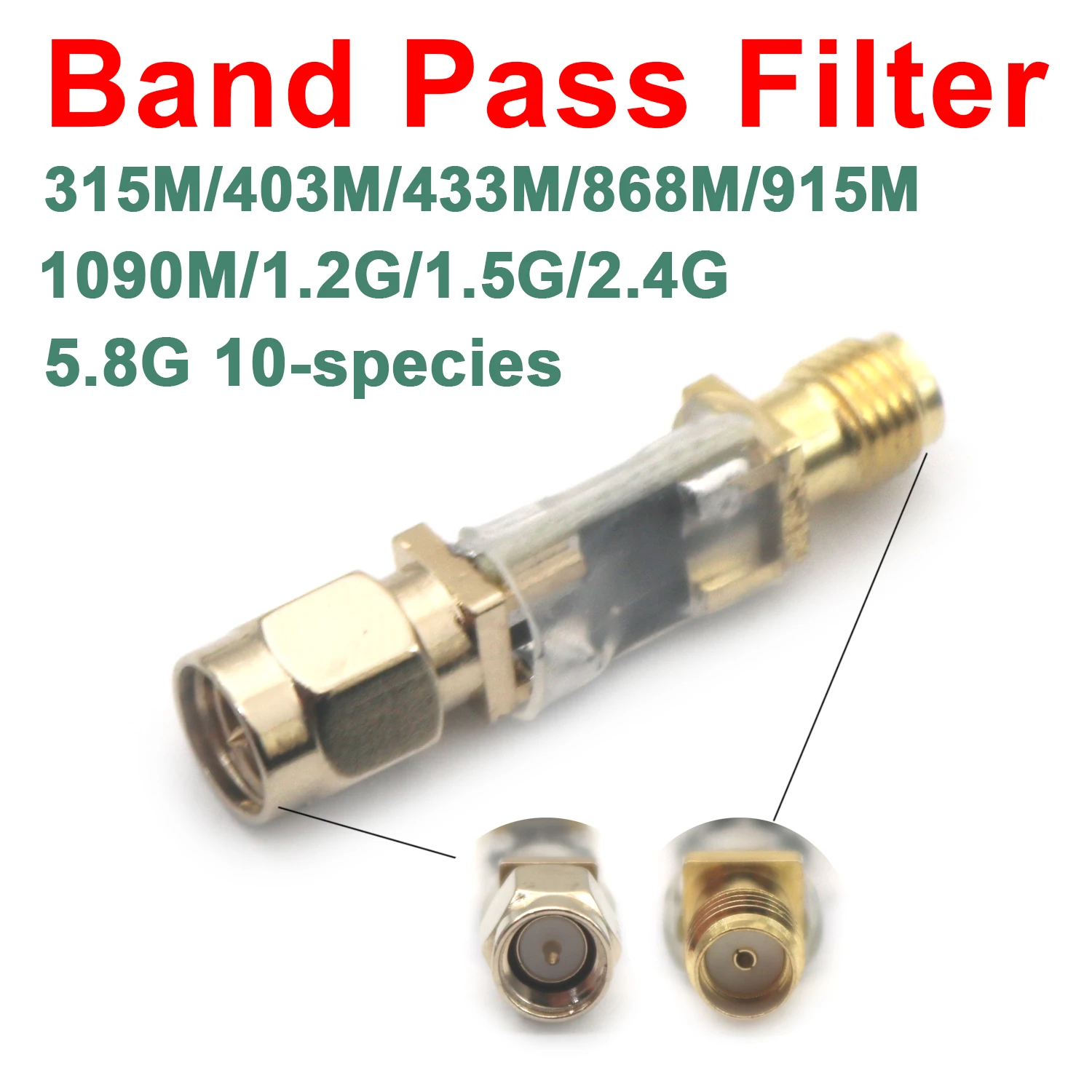
The filter features gold-plated SMA connectors, a standard choice for RF applications due to their excellent electrical performance and mechanical durability. The internal components, likely an LC (inductor-capacitor) network, are visible through a transparent housing section.
Gold plating on connectors offers superior conductivity and corrosion resistance, which is crucial for maintaining signal integrity over time, especially in environments exposed to moisture or varying temperatures. The transparent housing allows for visual inspection of the internal construction, providing a degree of confidence in the component's assembly. Built to withstand the rigors of field deployment, its construction implies reliability.
Many entry-level RF components often use nickel-plated connectors, which can degrade faster and introduce higher insertion loss. The choice of gold-plated SMA connectors on this filter indicates a commitment to higher performance and longevity, aligning with professional and enthusiast-grade requirements.
Accompanying spectrum analyzer graphs illustrate the performance of various frequency models, including 2.4Ghz, 433Mhz, 868Mhz, 915Mhz, 1090Mhz, 1200Mhz, 1575Mhz, and 5.8Ghz. These graphs visually confirm the filter's effectiveness.
The plots typically show a clear passband with minimal insertion loss, indicating that signals within the desired frequency range pass through efficiently. Crucially, they also demonstrate steep attenuation slopes outside the passband, signifying strong rejection of unwanted frequencies. This characteristic is vital for isolating specific signals and preventing interference. Clear performance metrics allow for straightforward analysis.
Compared to filters with gentler slopes or higher in-band loss, the depicted performance suggests a well-designed LC network. Effective out-of-band rejection ensures that adjacent channel interference is minimized, leading to a cleaner RF spectrum for the connected device and improving overall system stability.
This filter is explicitly marketed for use with Ham Radio, Amplifiers, SDR (Software Defined Radio) setups, and Drones. These applications all share a common need for precise frequency management and interference mitigation.
For ham radio operators, a band pass filter can significantly improve reception by reducing strong out-of-band signals that might overload the receiver, leading to clearer communications. In amplifier circuits, it ensures that only the intended frequency is amplified, preventing unwanted harmonics or broadband noise from being transmitted. SDR users benefit from cleaner input signals, which enhances the dynamic range and decoding capabilities of their software. Drone operators can achieve more reliable control and video links by filtering out interference from other onboard electronics or external sources.
Integrating this filter into an existing setup means upgrading the system's resilience against the noisy RF environment. It's a proactive measure to enhance performance, often leading to extended range, improved data rates, and a more stable operational experience across all listed applications.
Priced at approximately 6.61 USD, this miniature band pass filter offers a cost-effective solution for critical signal integrity challenges. Its affordability makes high-performance filtering accessible to a broader audience.
Considering the potential issues caused by RF interference—such as reduced range, data loss, or even system failure—the small investment in a dedicated filter can prevent much larger costs associated with troubleshooting, equipment damage, or operational downtime. It represents a high return on investment for maintaining reliable wireless links.
Many specialized RF components can command premium prices. This filter, however, provides a professional-grade solution at a price point that encourages experimentation and widespread adoption, allowing enthusiasts and professionals alike to implement robust filtering without significant budget constraints.
Imagine your drone's video feed becoming crystal clear, free from the jitters of interference, or your ham radio conversations cutting through the static with newfound clarity. Envision your SDR setup effortlessly isolating faint signals, unburdened by adjacent noise. This miniature filter provides the clean signal foundation required for such reliable and high-performance wireless operations, allowing your RF systems to perform at their absolute best.
Filtering the Airwaves: The Core Function
Band pass filters are specialized electronic circuits designed to allow signals within a specific frequency range to pass through, while significantly attenuating signals outside that range. This particular filter is available in ten distinct frequency options, ranging from 315Mhz up to 5.8Ghz, catering to a diverse array of wireless communication standards and applications.
Such precise filtering is indispensable in applications where multiple radio signals coexist. The filter ensures that only the desired frequency band reaches the receiver or is transmitted by the amplifier, effectively eliminating interference from adjacent channels or broadband noise. This capability translates directly into improved signal-to-noise ratio, clearer communications, and enhanced system reliability.
Unlike setups that rely solely on software-defined radio (SDR) processing for noise reduction, a dedicated hardware band pass filter provides a physical barrier against unwanted frequencies at the input stage. This pre-filtering reduces the processing load on subsequent stages and can dramatically improve the performance of sensitive receivers or the efficiency of power amplifiers. It's a foundational step for robust RF system design.
Precision in a Small Package: Design and Dimensions
The physical dimensions of this filter are notably compact, measuring approximately 35mm in length, 8mm in width, and 7mm in height. This mini size is a significant advantage for integration into space-constrained projects and portable equipment.
Its diminutive footprint means it can be easily incorporated into drone payloads, handheld SDR setups, or integrated directly into the antenna lines of ham radio transceivers without adding significant bulk. This design choice supports field deployment and minimizes the physical impact on the overall system architecture. Achieving precise signal isolation without complex setups is a key benefit.
Compared to larger, often bulkier, cavity filters or older LC filter designs, this miniature form factor offers unparalleled flexibility. It allows for more streamlined designs, lighter assemblies, and easier installation in tight enclosures, making it a practical choice for modern, compact electronic projects.
Versatility Across the Spectrum: Frequency Options
This filter is offered in a comprehensive range of frequencies, including 315Mhz, 403Mhz, 433Mhz, 868Mhz, 915Mhz, 1090Mhz, 1.2Ghz, 1.5Ghz, 2.4Ghz, and 5.8Ghz. This wide selection addresses numerous common and specialized RF applications.
Each frequency variant targets specific use cases: 315/433Mhz are common for short-range device control and IoT; 868/915Mhz for LoRa and other ISM band applications; 1090Mhz is critical for ADS-B aircraft tracking; 1.2Ghz for some video transmission and amateur radio; 1.5Ghz for GPS/GNSS; 2.4Ghz for Wi-Fi, Bluetooth, and many drones; and 5.8Ghz for high-bandwidth video links and specific Wi-Fi channels. This breadth of choice ensures a suitable filter for almost any common wireless need.
Unlike general-purpose RF components, the availability of specific frequency options eliminates the need for users to design or tune their own filters, saving considerable time and effort. This targeted approach ensures optimal performance for the intended application, providing a tailored solution rather than a compromise.
The Build: More Than Meets the Eye
The filter features gold-plated SMA connectors, a standard choice for RF applications due to their excellent electrical performance and mechanical durability. The internal components, likely an LC (inductor-capacitor) network, are visible through a transparent housing section.
Gold plating on connectors offers superior conductivity and corrosion resistance, which is crucial for maintaining signal integrity over time, especially in environments exposed to moisture or varying temperatures. The transparent housing allows for visual inspection of the internal construction, providing a degree of confidence in the component's assembly. Built to withstand the rigors of field deployment, its construction implies reliability.
Many entry-level RF components often use nickel-plated connectors, which can degrade faster and introduce higher insertion loss. The choice of gold-plated SMA connectors on this filter indicates a commitment to higher performance and longevity, aligning with professional and enthusiast-grade requirements.
Ensuring Clean Signals: Performance Characteristics
Accompanying spectrum analyzer graphs illustrate the performance of various frequency models, including 2.4Ghz, 433Mhz, 868Mhz, 915Mhz, 1090Mhz, 1200Mhz, 1575Mhz, and 5.8Ghz. These graphs visually confirm the filter's effectiveness.
The plots typically show a clear passband with minimal insertion loss, indicating that signals within the desired frequency range pass through efficiently. Crucially, they also demonstrate steep attenuation slopes outside the passband, signifying strong rejection of unwanted frequencies. This characteristic is vital for isolating specific signals and preventing interference. Clear performance metrics allow for straightforward analysis.
Compared to filters with gentler slopes or higher in-band loss, the depicted performance suggests a well-designed LC network. Effective out-of-band rejection ensures that adjacent channel interference is minimized, leading to a cleaner RF spectrum for the connected device and improving overall system stability.
Application Horizons: Who Benefits?
This filter is explicitly marketed for use with Ham Radio, Amplifiers, SDR (Software Defined Radio) setups, and Drones. These applications all share a common need for precise frequency management and interference mitigation.
For ham radio operators, a band pass filter can significantly improve reception by reducing strong out-of-band signals that might overload the receiver, leading to clearer communications. In amplifier circuits, it ensures that only the intended frequency is amplified, preventing unwanted harmonics or broadband noise from being transmitted. SDR users benefit from cleaner input signals, which enhances the dynamic range and decoding capabilities of their software. Drone operators can achieve more reliable control and video links by filtering out interference from other onboard electronics or external sources.
Integrating this filter into an existing setup means upgrading the system's resilience against the noisy RF environment. It's a proactive measure to enhance performance, often leading to extended range, improved data rates, and a more stable operational experience across all listed applications.
The Investment in Clarity: Value Proposition
Priced at approximately 6.61 USD, this miniature band pass filter offers a cost-effective solution for critical signal integrity challenges. Its affordability makes high-performance filtering accessible to a broader audience.
Considering the potential issues caused by RF interference—such as reduced range, data loss, or even system failure—the small investment in a dedicated filter can prevent much larger costs associated with troubleshooting, equipment damage, or operational downtime. It represents a high return on investment for maintaining reliable wireless links.
Many specialized RF components can command premium prices. This filter, however, provides a professional-grade solution at a price point that encourages experimentation and widespread adoption, allowing enthusiasts and professionals alike to implement robust filtering without significant budget constraints.
Imagine your drone's video feed becoming crystal clear, free from the jitters of interference, or your ham radio conversations cutting through the static with newfound clarity. Envision your SDR setup effortlessly isolating faint signals, unburdened by adjacent noise. This miniature filter provides the clean signal foundation required for such reliable and high-performance wireless operations, allowing your RF systems to perform at their absolute best.