Mini DC-DC Boost Converter Module
Official Store Deal
Expert Analysis Overview
Precision Power Elevation for Compact Systems
The Mini DC-DC Boost Converter Module is a compact, fixed-output voltage regulator designed for low-power electronic projects requiring a stable, stepped-up voltage from a lower DC source. This module addresses the common challenge of powering higher voltage components from standard battery supplies, offering a practical solution for embedded systems and portable devices. Its small form factor allows for integration into space-constrained applications, a critical consideration for modern electronics design. The module's primary function is to convert a lower DC input voltage into a higher, regulated DC output voltage. This process is essential in many battery-powered applications where the battery voltage might be insufficient for certain components. For instance, a 3.7V Li-ion battery often needs to power 5V or 12V microcontrollers or sensors. This module facilitates that conversion efficiently.
Configurable Output Voltage Stability
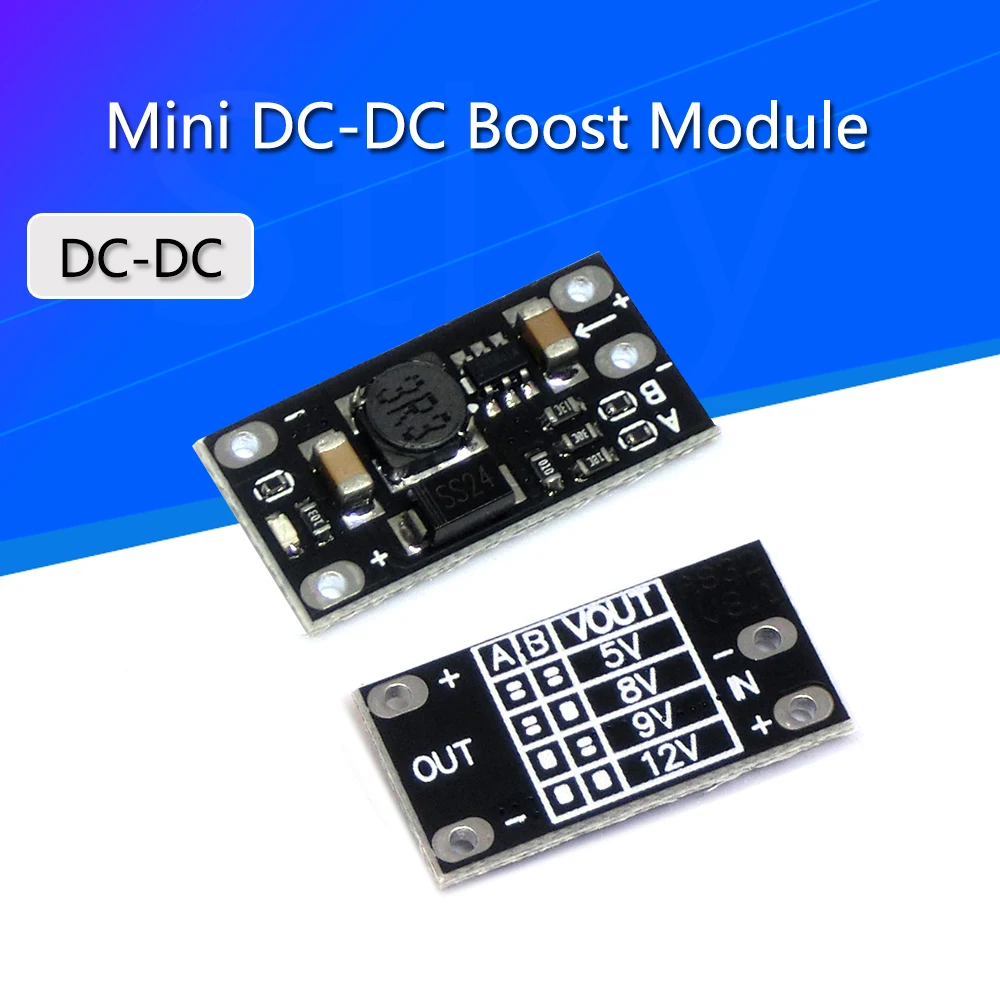
Visible markings on the module clearly indicate selectable output voltages: 5V, 8V, 9V, and 12V. These options are configured by bridging specific solder pads labeled "A" and "B" or leaving them open, as depicted on the PCB. This flexibility allows users to tailor the module's output to precise project requirements without needing external components. A stable output is crucial. The ability to select discrete output voltages simplifies power management for various microcontrollers, sensors, and small motors.
The implication of these fixed output options is a simplified design process for the end-user. Instead of requiring a variable resistor or complex feedback loop adjustments, the user simply selects the desired voltage by making a solder bridge. This reduces potential points of failure and streamlines assembly. Consistent voltage delivery is key. A stable output voltage is paramount for the reliable operation of digital circuits, preventing erratic behavior or damage to sensitive components.
Compared to adjustable boost converters that often require a multimeter and careful tuning, this fixed-output design offers a "set-and-forget" convenience. While adjustable modules provide greater versatility, they introduce complexity and potential for misconfiguration. This module prioritizes ease of use and reliability for common voltage requirements, making it an excellent choice for repetitive builds or educational projects. It simplifies power integration.
Broad Input Voltage Adaptability
Product specifications indicate an input voltage range from 3V to 12V, encompassing common battery chemistries such as single-cell Li-ion (3.7V nominal), multiple AA/AAA batteries (3V, 4.5V), and even 9V batteries. This broad compatibility makes the module highly adaptable to various power sources. Low voltage sources are supported. The module's ability to operate from such low input voltages is a significant advantage for portable applications, extending device utility.
This wide input range implies that the module can effectively utilize power from nearly depleted batteries, extending the operational life of a device. For example, a 3.0V input from a nearly discharged Li-ion cell can still be boosted to a stable 5V or 12V output. This capability is crucial for maintaining system functionality as battery voltage sags under load or over time. Power remains consistent.
Many generic boost converters have a narrower input range, often requiring a minimum of 3.7V or 4V. This module's lower minimum input voltage provides greater flexibility, especially when working with power sources that might experience significant voltage drops. It offers a more robust solution for battery-powered projects. This is a clear upgrade.
Compact Physical Design and Component Quality
The module's compact PCB, visible in the images, features surface-mount components, including an inductor (marked "3R3"), several capacitors, and what appears to be a switching regulator IC. The black PCB substrate suggests a standard FR-4 material, common for cost-effective electronic assemblies. Connections are clearly labeled. The soldering pads for input and output connections are clearly labeled "+" and "OUT" respectively, along with "IN" and "N" (likely negative).
Small dimensions are ideal for integration into tight enclosures or directly onto larger project boards. This minimizes the overall footprint of the power conversion stage, which is often a critical design constraint in miniaturized electronics. The visible components appear to be standard, off-the-shelf parts, indicating a design focused on reliability and availability. Space is often limited.
Unlike larger, through-hole component-based boost converters, this module's surface-mount design allows for a much smaller form factor. This makes it superior for wearable electronics, small IoT devices, or any application where space is at a premium. The clear labeling of input and output terminals simplifies wiring, reducing potential connection errors. This design is efficient.
Performance and Energy Efficiency
While specific efficiency figures are not provided, boost converters generally operate with efficiencies ranging from 80% to 95%, depending on the load and voltage differential. The visible inductor and capacitors are key components in the switching process, storing and releasing energy to step up the voltage. The "3R3" marking on the inductor indicates a 3.3 microhenry inductance, a common value for compact boost circuits. Efficiency is paramount.
High efficiency is critical for battery-powered applications as it directly impacts battery life. Less energy wasted as heat means more energy delivered to the load. For a module of this size, maintaining good efficiency across its specified input and output range is a design challenge that, if met, significantly enhances its utility. Component choice matters. The choice of components implies a balance between size, cost, and performance, aiming for optimal energy transfer.
Compared to linear regulators, which dissipate excess voltage as heat, switching boost converters are inherently more efficient for stepping up voltage. This module, by its very nature as a boost converter, offers a more energy-conscious solution than attempting to achieve similar voltage increases through less efficient methods. It delivers power effectively. This is a smarter choice.
Critical Electrical Safety and Installation Practices
Proper installation is paramount for any power conversion module. Users must ensure correct polarity when connecting the input voltage, as reverse polarity can damage the module and connected components. The input and output current ratings, though not explicitly stated, must be respected to prevent overheating and potential component failure. Overloading the module can lead to thermal runaway. Safety protocols are essential.
The small size of the soldering pads requires careful soldering techniques to ensure robust and reliable connections. Cold solder joints or solder bridges can lead to intermittent operation or short circuits. Adequate ventilation should be considered if the module is expected to operate at its maximum current capacity, especially within an enclosed space. Proper wiring prevents hazards.
Unlike modules with screw terminals, this PCB requires direct soldering. This demands a certain level of soldering proficiency from the user. While screw terminals offer easier connection, soldered joints, when done correctly, provide a more permanent and vibration-resistant connection, which is beneficial for long-term reliability in embedded applications. This ensures secure connections.
Value Proposition and Application Scope
At its price point, this mini DC-DC boost module represents a highly cost-effective solution for a wide array of electronic projects. Its ability to provide stable, higher voltages from common low-voltage sources makes it an invaluable tool for hobbyists, students, and professional engineers alike. The module simplifies power supply design, allowing more focus on the core functionality of the project. It offers great utility.
The long-term value of this module lies in its ability to enable projects that would otherwise require more complex or expensive power solutions. By providing a reliable voltage step-up, it extends the utility of existing battery supplies and simplifies component selection. This reduces overall project costs and development time. It is an economical choice. This module saves resources.
This module stands as a superior alternative to attempting custom boost converter designs for every project, which can be time-consuming and prone to errors. It offers a pre-engineered, tested solution that integrates seamlessly, saving both effort and resources. This makes it an essential component for rapid prototyping and small-scale production. It streamlines development.
Imagine your next portable device, powered reliably and efficiently, its internal components receiving precisely the voltage they need from a compact, unobtrusive module. Envision the satisfaction of completing complex projects with simplified power management, knowing your circuits are operating within optimal parameters. This module empowers creators to bring their innovative ideas to life, ensuring stable power delivery for every endeavor.