MECHANIC DT3 Multi-Port Cable Tester
Official Store Deal
Expert Analysis Overview
The MECHANIC DT3 Data Cable Detection Board is a foundational diagnostic tool aimed at anyone needing to verify the integrity of their charging and data cables. This compact device eliminates the guesswork often associated with malfunctioning cables, providing clear visual feedback on connectivity and power delivery. It serves as an essential item for the first apartment renter, ensuring that all devices from smartphones to portable chargers maintain reliable connections. Troubleshooting becomes straightforward. This board is a practical solution for common tech frustrations, making it a valuable addition to any basic toolkit. It helps prevent device damage.
Modern electronics rely heavily on functional cables for both power and data transfer. A faulty cable can lead to slow charging, interrupted data syncs, or even damage to connected devices. The MECHANIC DT3 directly addresses these common pain points by offering a quick and reliable method to test various cable types. This board acts as a diagnostic hub. It supports a wide array of connectors, including Type-C, Lightning, and Micro USB, covering the majority of portable electronics in use today. This broad compatibility is key. Users no longer need to cycle through multiple cables or devices to pinpoint a problem. The DT3 provides an immediate, visual diagnosis.
Unlike simply swapping cables blindly, which can be time-consuming and frustrating, this device offers precise feedback. It saves valuable time. The clear LED indicators on the board illuminate to show the status of different pins within the cable, indicating whether VCC (power), GND (ground), D+ (data positive), D(data negative), and CC (configuration channel for Type-C) are functioning correctly. This level of detail is crucial for identifying specific faults. A quick glance informs the user of the cable's health. This capability is a significant upgrade from generic troubleshooting methods.
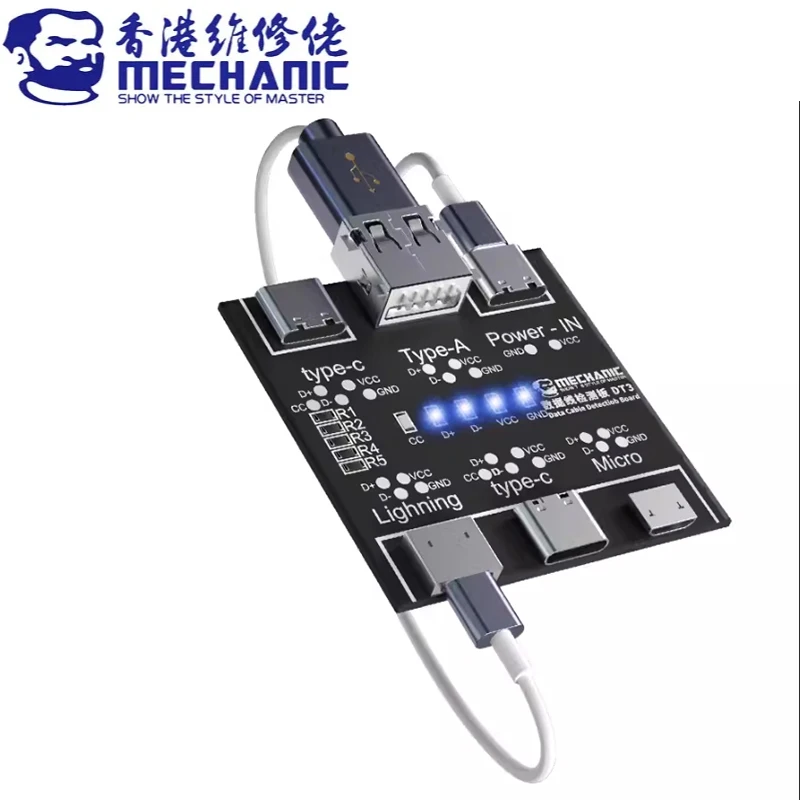
At the heart of the MECHANIC DT3's functionality is its intuitive interface. The board features clearly labeled input and output ports for various cable types. These include a Type-A power input, a Type-C power input, and multiple testing ports for Lightning, Type-C, and Micro USB. Each port is robustly designed. The layout is logical, guiding the user through the connection process. This design minimizes user error. The board's compact size, measuring approximately 48.5 x 45 mm, makes it highly portable, fitting easily into a small toolbox or a desk drawer. Its footprint is minimal.
The visual data provided by the LED indicators is straightforward. Five distinct LEDs correspond to different connection lines within the cable. When a cable is connected and power is supplied, these LEDs light up to confirm continuity. If an LED remains unlit, it signifies a broken or faulty line. This system simplifies complex diagnostics. For instance, if VCC or GND is not bright, the charging function is abnormal. If D+ or Dis off, data transmission is affected. This direct visual feedback is invaluable for quick assessments. It provides immediate answers.
Compared to basic continuity testers, which might only confirm a circuit, the DT3 offers a more granular view of a cable's internal structure. This is a significant advantage. It allows users to differentiate between a cable that can charge but not transfer data, and one that is completely dead. This precision helps in making informed decisions about cable replacement or repair. The board itself feels sturdy.
The primary capability of the MECHANIC DT3 is its ability to quickly identify short circuits and open circuits within a data cable. This is its core function. When a cable is suspected of being faulty, connecting it to the DT3 provides an immediate visual diagnosis via the LED indicators. A fully functional cable will show all relevant LEDs lit, confirming proper connectivity for power and data. Any unlit LED indicates a specific fault. This speeds up troubleshooting.
In a scenario where a user experiences slow charging or intermittent data transfer, the DT3 can pinpoint if the cable is the culprit. For example, if a Type-C cable is connected and only the VCC and GND LEDs illuminate, but D+ and Ddo not, it means the cable can charge but cannot transmit data. This information is critical. It prevents users from spending time troubleshooting their devices or chargers when the cable is the actual issue. The device is a time-saver.
Unlike the trial-and-error method of replacing cables one by one, the DT3 offers a definitive answer. This capability is especially beneficial for those who rely on multiple devices and cables, like a first apartment renter setting up their new space. It ensures that every connection is reliable. The tool provides a clear path to resolution.
While identifying charging faults is crucial, the DT3's ability to test data lines (D+ and D-) extends its utility significantly. Many cables today are designed for both power delivery and data synchronization. If you are trying to transfer photos from a phone to a computer, a faulty data line in the cable will prevent the transfer, even if the phone is charging. The DT3 identifies this specific problem. This prevents frustration.
For Type-C cables, the device also checks the CC (Configuration Channel) lines, which are vital for modern USB-C functionalities like fast charging protocols and alternate modes. A non-functional CC line can lead to compatibility issues or limit power delivery. The DT3 provides visibility into these advanced cable features. It supports quick diagnosis. This comprehensive testing capability makes it suitable for a wide range of devices, from new smartphones to older micro-USB gadgets. Its versatility is notable.
This broad testing capability contrasts sharply with simple voltage meters that only confirm power presence. The DT3 delves deeper. It provides a holistic view of cable integrity, ensuring that both power and data pathways are fully operational. This is essential for modern device ecosystems. It ensures seamless connectivity.
At a price point around $5.27 USD, the MECHANIC DT3 represents a highly cost-effective solution for cable diagnostics. This is an affordable tool. Considering the cost of repeatedly purchasing new cables or the inconvenience of unreliable connections, this board quickly pays for itself. It offers significant long-term value. The compact design and comprehensive testing capabilities make it an indispensable tool for anyone managing multiple electronic devices. It fits easily in a drawer.
The investment in a DT3 board prevents the common cycle of buying a new cable, only to find the problem persists because the original cable was not the issue, or the new one is also faulty. This tool provides clarity. It saves money in the long run by ensuring that only genuinely faulty cables are replaced. The device is a wise purchase. Its utility extends to various everyday scenarios, from ensuring a reliable connection for a smart home device to preparing for a trip where dependable charging is paramount. It offers peace of mind.
Compared to the frustration and wasted time of guessing which cable is bad, the DT3 offers a definitive and efficient solution. This makes it an excellent value proposition for the first apartment renter or any tech-savvy individual. It is a practical addition to any toolkit. The ability to diagnose cables quickly means less downtime for devices.
Using the MECHANIC DT3 is straightforward, designed for ease of use even for those with minimal technical expertise. The process involves connecting a power source to the board's Type-A or Type-C Power-IN port, then plugging the cable to be tested into the appropriate input and output sockets. The LEDs light up immediately. The visual feedback is instant. The clear labeling on the board ensures that users connect cables to the correct ports. This prevents incorrect usage.
For Type-C to Type-C cables, the board specifically indicates that all four LEDs (VCC, GND, D+, D-) should be on for a normal connection. If five LEDs are on, it indicates an abnormal connection, providing detailed diagnostic information. This level of instruction is helpful. The device provides precise feedback. The included instructions, though sometimes translated, clearly outline these conditions.
This simple, plug-and-play operation stands in contrast to more complex diagnostic equipment that might require software or specialized knowledge. The DT3 is accessible. It offers a quick, on-the-spot assessment without complicated setup. This makes it ideal for everyday troubleshooting. The design prioritizes user convenience.
The physical construction of the MECHANIC DT3 suggests a design focused on durability and practicality. The PCB (Printed Circuit Board) is exposed, but the components appear well-soldered and robust enough for repeated use on a workbench. Its small size contributes to its resilience. The board's compact dimensions mean it doesn't take up much space. This is a compact case.
The visible ports – Type-A, Type-C, Lightning, and Micro USB – are standard connectors, implying broad compatibility with everyday cables. The connections feel secure. The board is designed to handle common cable types, making it a universal tool for various devices. This broad utility is a major benefit. Its lightweight nature, at 120g including packaging, further enhances its portability.
Unlike flimsy, disposable testers, the DT3 appears built for consistent, repeated use. This is crucial for a tool. The robust design ensures it can withstand the rigors of a home workshop or a repair bench. It is a reliable piece of equipment. The board's construction supports its role as a long-term diagnostic asset.
Envision a home where connectivity issues are quickly resolved, where slow charging is a thing of the past, and where every data transfer is seamless. The MECHANIC DT3 Data Cable Detection Board brings this efficiency to your fingertips. It transforms the frustrating task of cable troubleshooting into a simple, visual process. No more guessing. This tool ensures that your devices are always connected with reliable, functional cables, saving you time, money, and unnecessary headaches. It is an investment in consistent performance for all your electronics. Imagine the ease of quickly identifying a bad cable and replacing it, keeping all your gadgets running smoothly without interruption. This diagnostic board empowers users to maintain peak performance across their entire tech ecosystem, making device management effortless and efficient.
Cable Integrity Unveiled
Modern electronics rely heavily on functional cables for both power and data transfer. A faulty cable can lead to slow charging, interrupted data syncs, or even damage to connected devices. The MECHANIC DT3 directly addresses these common pain points by offering a quick and reliable method to test various cable types. This board acts as a diagnostic hub. It supports a wide array of connectors, including Type-C, Lightning, and Micro USB, covering the majority of portable electronics in use today. This broad compatibility is key. Users no longer need to cycle through multiple cables or devices to pinpoint a problem. The DT3 provides an immediate, visual diagnosis.
Unlike simply swapping cables blindly, which can be time-consuming and frustrating, this device offers precise feedback. It saves valuable time. The clear LED indicators on the board illuminate to show the status of different pins within the cable, indicating whether VCC (power), GND (ground), D+ (data positive), D
The Diagnostic Interface
At the heart of the MECHANIC DT3's functionality is its intuitive interface. The board features clearly labeled input and output ports for various cable types. These include a Type-A power input, a Type-C power input, and multiple testing ports for Lightning, Type-C, and Micro USB. Each port is robustly designed. The layout is logical, guiding the user through the connection process. This design minimizes user error. The board's compact size, measuring approximately 48.5 x 45 mm, makes it highly portable, fitting easily into a small toolbox or a desk drawer. Its footprint is minimal.
The visual data provided by the LED indicators is straightforward. Five distinct LEDs correspond to different connection lines within the cable. When a cable is connected and power is supplied, these LEDs light up to confirm continuity. If an LED remains unlit, it signifies a broken or faulty line. This system simplifies complex diagnostics. For instance, if VCC or GND is not bright, the charging function is abnormal. If D+ or D
Compared to basic continuity testers, which might only confirm a circuit, the DT3 offers a more granular view of a cable's internal structure. This is a significant advantage. It allows users to differentiate between a cable that can charge but not transfer data, and one that is completely dead. This precision helps in making informed decisions about cable replacement or repair. The board itself feels sturdy.
Decoding Connection Issues
The primary capability of the MECHANIC DT3 is its ability to quickly identify short circuits and open circuits within a data cable. This is its core function. When a cable is suspected of being faulty, connecting it to the DT3 provides an immediate visual diagnosis via the LED indicators. A fully functional cable will show all relevant LEDs lit, confirming proper connectivity for power and data. Any unlit LED indicates a specific fault. This speeds up troubleshooting.
In a scenario where a user experiences slow charging or intermittent data transfer, the DT3 can pinpoint if the cable is the culprit. For example, if a Type-C cable is connected and only the VCC and GND LEDs illuminate, but D+ and D
Unlike the trial-and-error method of replacing cables one by one, the DT3 offers a definitive answer. This capability is especially beneficial for those who rely on multiple devices and cables, like a first apartment renter setting up their new space. It ensures that every connection is reliable. The tool provides a clear path to resolution.
Beyond Simple Charging
While identifying charging faults is crucial, the DT3's ability to test data lines (D+ and D-) extends its utility significantly. Many cables today are designed for both power delivery and data synchronization. If you are trying to transfer photos from a phone to a computer, a faulty data line in the cable will prevent the transfer, even if the phone is charging. The DT3 identifies this specific problem. This prevents frustration.
For Type-C cables, the device also checks the CC (Configuration Channel) lines, which are vital for modern USB-C functionalities like fast charging protocols and alternate modes. A non-functional CC line can lead to compatibility issues or limit power delivery. The DT3 provides visibility into these advanced cable features. It supports quick diagnosis. This comprehensive testing capability makes it suitable for a wide range of devices, from new smartphones to older micro-USB gadgets. Its versatility is notable.
This broad testing capability contrasts sharply with simple voltage meters that only confirm power presence. The DT3 delves deeper. It provides a holistic view of cable integrity, ensuring that both power and data pathways are fully operational. This is essential for modern device ecosystems. It ensures seamless connectivity.
A Smart Investment for the DIYer
At a price point around $5.27 USD, the MECHANIC DT3 represents a highly cost-effective solution for cable diagnostics. This is an affordable tool. Considering the cost of repeatedly purchasing new cables or the inconvenience of unreliable connections, this board quickly pays for itself. It offers significant long-term value. The compact design and comprehensive testing capabilities make it an indispensable tool for anyone managing multiple electronic devices. It fits easily in a drawer.
The investment in a DT3 board prevents the common cycle of buying a new cable, only to find the problem persists because the original cable was not the issue, or the new one is also faulty. This tool provides clarity. It saves money in the long run by ensuring that only genuinely faulty cables are replaced. The device is a wise purchase. Its utility extends to various everyday scenarios, from ensuring a reliable connection for a smart home device to preparing for a trip where dependable charging is paramount. It offers peace of mind.
Compared to the frustration and wasted time of guessing which cable is bad, the DT3 offers a definitive and efficient solution. This makes it an excellent value proposition for the first apartment renter or any tech-savvy individual. It is a practical addition to any toolkit. The ability to diagnose cables quickly means less downtime for devices.
Operational Clarity
Using the MECHANIC DT3 is straightforward, designed for ease of use even for those with minimal technical expertise. The process involves connecting a power source to the board's Type-A or Type-C Power-IN port, then plugging the cable to be tested into the appropriate input and output sockets. The LEDs light up immediately. The visual feedback is instant. The clear labeling on the board ensures that users connect cables to the correct ports. This prevents incorrect usage.
For Type-C to Type-C cables, the board specifically indicates that all four LEDs (VCC, GND, D+, D-) should be on for a normal connection. If five LEDs are on, it indicates an abnormal connection, providing detailed diagnostic information. This level of instruction is helpful. The device provides precise feedback. The included instructions, though sometimes translated, clearly outline these conditions.
This simple, plug-and-play operation stands in contrast to more complex diagnostic equipment that might require software or specialized knowledge. The DT3 is accessible. It offers a quick, on-the-spot assessment without complicated setup. This makes it ideal for everyday troubleshooting. The design prioritizes user convenience.
Built for the Bench
The physical construction of the MECHANIC DT3 suggests a design focused on durability and practicality. The PCB (Printed Circuit Board) is exposed, but the components appear well-soldered and robust enough for repeated use on a workbench. Its small size contributes to its resilience. The board's compact dimensions mean it doesn't take up much space. This is a compact case.
The visible ports – Type-A, Type-C, Lightning, and Micro USB – are standard connectors, implying broad compatibility with everyday cables. The connections feel secure. The board is designed to handle common cable types, making it a universal tool for various devices. This broad utility is a major benefit. Its lightweight nature, at 120g including packaging, further enhances its portability.
Unlike flimsy, disposable testers, the DT3 appears built for consistent, repeated use. This is crucial for a tool. The robust design ensures it can withstand the rigors of a home workshop or a repair bench. It is a reliable piece of equipment. The board's construction supports its role as a long-term diagnostic asset.
Making the Right Connection
Envision a home where connectivity issues are quickly resolved, where slow charging is a thing of the past, and where every data transfer is seamless. The MECHANIC DT3 Data Cable Detection Board brings this efficiency to your fingertips. It transforms the frustrating task of cable troubleshooting into a simple, visual process. No more guessing. This tool ensures that your devices are always connected with reliable, functional cables, saving you time, money, and unnecessary headaches. It is an investment in consistent performance for all your electronics. Imagine the ease of quickly identifying a bad cable and replacing it, keeping all your gadgets running smoothly without interruption. This diagnostic board empowers users to maintain peak performance across their entire tech ecosystem, making device management effortless and efficient.