Makerbase VESC 75200 V2 High-Current Motor Controller
Official Store Deal
Expert Analysis Overview
The Makerbase MKSECS 75200 V2 is a high-power, robust electronic speed controller engineered for demanding applications in robotics, electric propulsion, and industrial automation. This device is not merely a component; it represents a foundational element for projects requiring precise, high-current motor management. Its design prioritizes thermal efficiency and electrical stability, crucial for sustained operation under significant loads. The VESC platform provides advanced control capabilities.
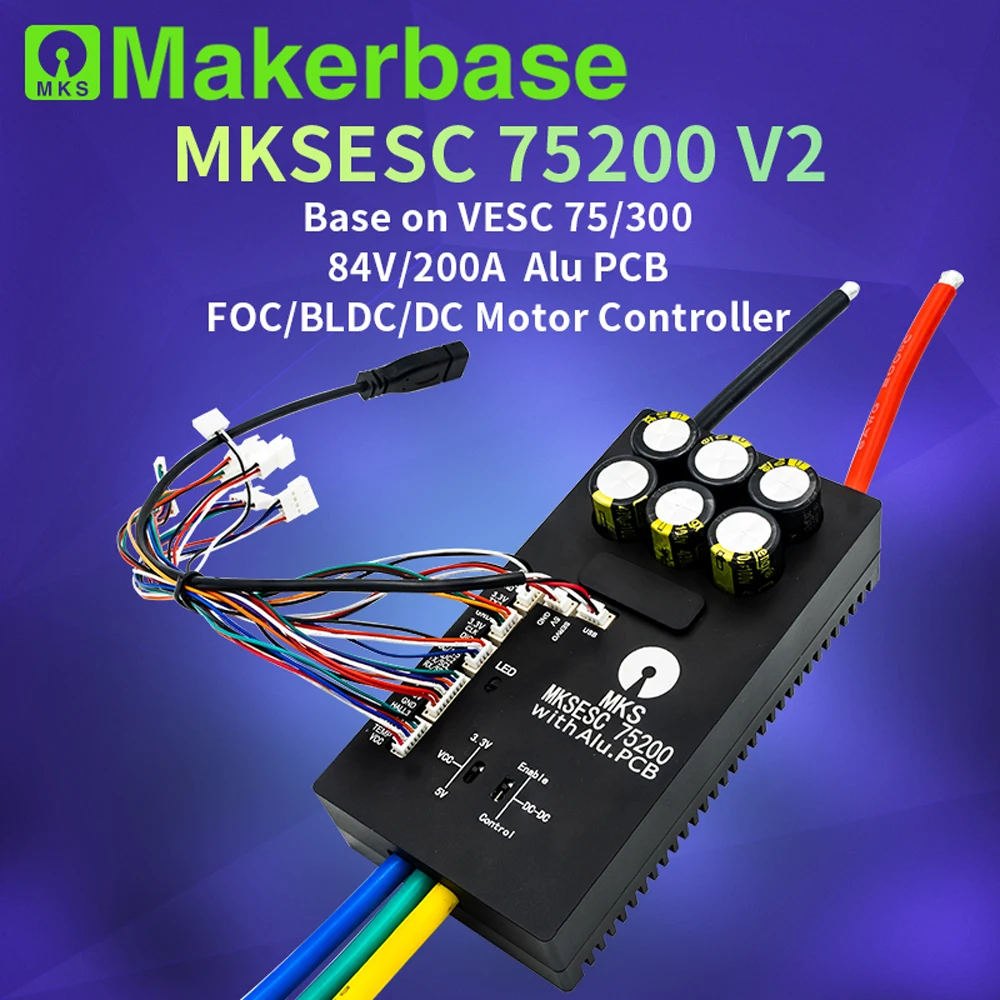
This controller is specified for 84V and 200A continuous current, built upon the VESC 75/300 architecture. These are substantial ratings. The visible array of six large electrolytic capacitors on the board's surface indicates robust power filtering and energy storage. Such components are essential for handling the rapid current fluctuations inherent in high-power motor control.
Operating at 84V allows for configurations with up to 20S LiPo battery packs, providing considerable power density for electric vehicles or heavy-duty robotics. A 200A continuous current rating means the controller can drive powerful motors without immediate thermal throttling or component stress. This capability is critical for applications like e-foils or combat robots, where instantaneous torque and sustained output are paramount. Lower-rated ESCs would quickly fail or enter protection modes under such strenuous conditions, leading to project downtime and potential damage to other components. This unit prevents such issues.
Compared to standard hobby-grade electronic speed controllers, which often cap out at 6S or 12S battery configurations and significantly lower current limits, the Makerbase 75200 V2 operates in a different league. It offers the headroom necessary for professional and advanced DIY projects that push the boundaries of electric propulsion. Generic controllers simply cannot match this power density.
The MKSECS 75200 V2 incorporates an Aluminum PCB (Alu PCB) and a prominently finned aluminum heatsink on its underside. This is a deliberate engineering choice. The aluminum substrate directly aids in dissipating heat from power-intensive components like MOSFETs.
Efficient heat removal is vital for the longevity and reliable performance of any high-current electronic device. The Alu PCB acts as a direct thermal path, moving heat away from critical semiconductors much faster than traditional FR4 fiberglass PCBs. The external heatsink further increases the surface area for convective cooling, allowing the controller to maintain optimal operating temperatures even during prolonged high-power discharge cycles. Overheating is a common failure point for lesser controllers. This design mitigates that risk.
Conventional ESCs often rely on minimal heatsinking or simply passive cooling through the enclosure, which becomes inadequate at higher power levels. The integrated aluminum PCB and substantial heatsink of the Makerbase 75200 V2 provide a superior thermal solution. This ensures the controller can deliver its rated current without premature thermal shutdown, a significant advantage for demanding applications where reliability is key. It handles the heat.
The controller features a variety of input and output ports, including multiple signal wires for sensors and communication, as well as robust power input and motor phase outputs. These connections are clearly labeled on the PCB, indicating thoughtful design for integration.
Such a comprehensive array of connectors facilitates integration into complex control systems, supporting various sensor feedback loops for precise motor positioning and speed control. The VESC platform is known for its extensive configurability, allowing users to fine-tune motor parameters, current limits, and regenerative braking. This flexibility is invaluable for optimizing performance across diverse applications. It offers deep customization.
Unlike simpler motor drivers that offer only basic PWM control, the VESC-based Makerbase 75200 V2 provides advanced communication protocols and telemetry data. This enables real-time monitoring and diagnostics, which are crucial for troubleshooting and optimizing high-performance electric systems. The ability to connect various peripherals expands its utility significantly. This is not a basic driver.
The product is explicitly marketed for e-foils, fight robots, surfboards, and AGV robots. These applications share a common requirement: high power, precise control, and often operation in challenging environments.
For e-foils and electric surfboards, the controller must withstand high current surges during acceleration and maintain efficiency for extended ride times. Fight robots demand instantaneous torque delivery and robust construction to survive impacts and continuous high-stress operation. AGV robots require precise speed and position control for navigation and payload handling. The 75200 V2 is designed to meet these rigorous demands. It delivers consistent performance.
Many general-purpose motor controllers are not designed for the specific environmental or performance stresses of these niche applications. The Makerbase 75200 V2's robust power handling, thermal management, and VESC-based control algorithms make it a specialized solution. It stands apart from generic industrial motor drivers. This unit is purpose-built.
This controller supports FOC (Field-Oriented Control), BLDC (Brushless DC), and DC motor control modes. The inclusion of FOC is a significant advantage for modern electric propulsion systems.
Field-Oriented Control provides highly efficient and smooth motor operation, particularly for brushless motors. FOC precisely controls the magnetic field within the motor, leading to reduced energy consumption, quieter operation, and more linear torque delivery across the entire speed range. This results in a more refined and responsive user experience, whether on an e-foil or controlling a robotic arm. Efficiency is greatly improved.
Compared to simpler trapezoidal (BLDC) control, FOC minimizes torque ripple and acoustic noise, making it ideal for applications where smooth acceleration and quiet operation are desired. While BLDC control is effective, FOC offers a superior level of precision and efficiency, translating directly into longer battery life and better overall system performance. It offers superior control. The flexibility to also drive traditional DC motors broadens its application scope.
The initial investment in a high-quality controller like the Makerbase 75200 V2 translates into significant long-term savings and reliability. This is an investment in project stability.
By utilizing a controller designed for high current and robust thermal management, users minimize the risk of component failure, costly repairs, and project delays. The enhanced efficiency of FOC also contributes to longer battery life and reduced energy consumption over time. This reduces operational costs and increases the lifespan of associated components. Downtime is expensive.
Opting for a lower-cost, under-spec'd controller often leads to a cycle of replacements, troubleshooting, and suboptimal performance. The Makerbase 75200 V2, with its focus on durability and advanced control, offers a superior return on investment by ensuring consistent, reliable operation from the outset. It avoids hidden costs. This is a smart choice for serious builders.
Imagine the confidence of piloting an e-foil with a motor controller that responds instantly and reliably, or deploying a combat robot knowing its propulsion system can withstand the most intense maneuvers without faltering. Picture an AGV robot navigating its environment with unparalleled precision, its motors humming efficiently thanks to optimized control. This controller provides the robust foundation needed to bring ambitious projects to life, ensuring peak performance and enduring reliability in the most demanding scenarios. It empowers innovation.
Unyielding Power Delivery
This controller is specified for 84V and 200A continuous current, built upon the VESC 75/300 architecture. These are substantial ratings. The visible array of six large electrolytic capacitors on the board's surface indicates robust power filtering and energy storage. Such components are essential for handling the rapid current fluctuations inherent in high-power motor control.
Operating at 84V allows for configurations with up to 20S LiPo battery packs, providing considerable power density for electric vehicles or heavy-duty robotics. A 200A continuous current rating means the controller can drive powerful motors without immediate thermal throttling or component stress. This capability is critical for applications like e-foils or combat robots, where instantaneous torque and sustained output are paramount. Lower-rated ESCs would quickly fail or enter protection modes under such strenuous conditions, leading to project downtime and potential damage to other components. This unit prevents such issues.
Compared to standard hobby-grade electronic speed controllers, which often cap out at 6S or 12S battery configurations and significantly lower current limits, the Makerbase 75200 V2 operates in a different league. It offers the headroom necessary for professional and advanced DIY projects that push the boundaries of electric propulsion. Generic controllers simply cannot match this power density.
Advanced Thermal Management
The MKSECS 75200 V2 incorporates an Aluminum PCB (Alu PCB) and a prominently finned aluminum heatsink on its underside. This is a deliberate engineering choice. The aluminum substrate directly aids in dissipating heat from power-intensive components like MOSFETs.
Efficient heat removal is vital for the longevity and reliable performance of any high-current electronic device. The Alu PCB acts as a direct thermal path, moving heat away from critical semiconductors much faster than traditional FR4 fiberglass PCBs. The external heatsink further increases the surface area for convective cooling, allowing the controller to maintain optimal operating temperatures even during prolonged high-power discharge cycles. Overheating is a common failure point for lesser controllers. This design mitigates that risk.
Conventional ESCs often rely on minimal heatsinking or simply passive cooling through the enclosure, which becomes inadequate at higher power levels. The integrated aluminum PCB and substantial heatsink of the Makerbase 75200 V2 provide a superior thermal solution. This ensures the controller can deliver its rated current without premature thermal shutdown, a significant advantage for demanding applications where reliability is key. It handles the heat.
Comprehensive Connectivity and Control
The controller features a variety of input and output ports, including multiple signal wires for sensors and communication, as well as robust power input and motor phase outputs. These connections are clearly labeled on the PCB, indicating thoughtful design for integration.
Such a comprehensive array of connectors facilitates integration into complex control systems, supporting various sensor feedback loops for precise motor positioning and speed control. The VESC platform is known for its extensive configurability, allowing users to fine-tune motor parameters, current limits, and regenerative braking. This flexibility is invaluable for optimizing performance across diverse applications. It offers deep customization.
Unlike simpler motor drivers that offer only basic PWM control, the VESC-based Makerbase 75200 V2 provides advanced communication protocols and telemetry data. This enables real-time monitoring and diagnostics, which are crucial for troubleshooting and optimizing high-performance electric systems. The ability to connect various peripherals expands its utility significantly. This is not a basic driver.
Versatility Across High-Performance Platforms
The product is explicitly marketed for e-foils, fight robots, surfboards, and AGV robots. These applications share a common requirement: high power, precise control, and often operation in challenging environments.
For e-foils and electric surfboards, the controller must withstand high current surges during acceleration and maintain efficiency for extended ride times. Fight robots demand instantaneous torque delivery and robust construction to survive impacts and continuous high-stress operation. AGV robots require precise speed and position control for navigation and payload handling. The 75200 V2 is designed to meet these rigorous demands. It delivers consistent performance.
Many general-purpose motor controllers are not designed for the specific environmental or performance stresses of these niche applications. The Makerbase 75200 V2's robust power handling, thermal management, and VESC-based control algorithms make it a specialized solution. It stands apart from generic industrial motor drivers. This unit is purpose-built.
Advanced Motor Control Algorithms
This controller supports FOC (Field-Oriented Control), BLDC (Brushless DC), and DC motor control modes. The inclusion of FOC is a significant advantage for modern electric propulsion systems.
Field-Oriented Control provides highly efficient and smooth motor operation, particularly for brushless motors. FOC precisely controls the magnetic field within the motor, leading to reduced energy consumption, quieter operation, and more linear torque delivery across the entire speed range. This results in a more refined and responsive user experience, whether on an e-foil or controlling a robotic arm. Efficiency is greatly improved.
Compared to simpler trapezoidal (BLDC) control, FOC minimizes torque ripple and acoustic noise, making it ideal for applications where smooth acceleration and quiet operation are desired. While BLDC control is effective, FOC offers a superior level of precision and efficiency, translating directly into longer battery life and better overall system performance. It offers superior control. The flexibility to also drive traditional DC motors broadens its application scope.
Long-Term Value Proposition
The initial investment in a high-quality controller like the Makerbase 75200 V2 translates into significant long-term savings and reliability. This is an investment in project stability.
By utilizing a controller designed for high current and robust thermal management, users minimize the risk of component failure, costly repairs, and project delays. The enhanced efficiency of FOC also contributes to longer battery life and reduced energy consumption over time. This reduces operational costs and increases the lifespan of associated components. Downtime is expensive.
Opting for a lower-cost, under-spec'd controller often leads to a cycle of replacements, troubleshooting, and suboptimal performance. The Makerbase 75200 V2, with its focus on durability and advanced control, offers a superior return on investment by ensuring consistent, reliable operation from the outset. It avoids hidden costs. This is a smart choice for serious builders.
Imagine the confidence of piloting an e-foil with a motor controller that responds instantly and reliably, or deploying a combat robot knowing its propulsion system can withstand the most intense maneuvers without faltering. Picture an AGV robot navigating its environment with unparalleled precision, its motors humming efficiently thanks to optimized control. This controller provides the robust foundation needed to bring ambitious projects to life, ensuring peak performance and enduring reliability in the most demanding scenarios. It empowers innovation.