Makerbase MKS XDrive Mini Brushless Servo Controller
Official Store Deal
Expert Analysis Overview
The Precision Core: Unpacking the XDrive Mini
The Makerbase MKS XDrive Mini is a specialized brushless servo motor controller engineered for high-precision motion control applications, targeting advanced robotics, CNC, and 3D printing systems requiring exacting positional accuracy. This compact board represents a significant advancement over traditional stepper motor drivers, offering a closed-loop control system that fundamentally changes how motion is managed. Its design integrates critical components for robust performance. It is a powerful tool.At its foundation, the XDrive Mini is based on the ODrive V3.6 architecture, a well-regarded open-source platform known for its sophisticated Field-Oriented Control (FOC) algorithms. FOC is a control method that mathematically transforms the three-phase AC currents into a two-coordinate system, allowing for independent control of torque and flux. This transformation simplifies the control problem, enabling the motor to operate with greater efficiency, smoother rotation, and significantly improved dynamic response compared to simpler control strategies like trapezoidal commutation. Such precise current control is vital for demanding tasks. This method minimizes torque ripple.
Unlike many entry-level motor controllers that rely on open-loop stepper systems, the XDrive Mini's ODrive foundation provides a robust framework for real-time feedback and correction. This capability is paramount for applications where maintaining exact positions and speeds under varying loads is critical. For instance, in a high-performance 3D printer, this translates directly to superior layer consistency, reduced artifacts, and the ability to handle complex geometries with greater fidelity, even when printing at higher speeds or with challenging materials. The system actively monitors and adjusts. This prevents positional errors.
Engineering for Exaction: Motion Control Fundamentals
The core function of the MKS XDrive Mini is to provide precise, dynamic control over brushless DC (BLDC) servo motors. These motors, unlike their stepper counterparts, offer continuous rotation and require sophisticated electronics to manage their commutation and position. The XDrive Mini delivers this through its integrated hardware and firmware, providing a complete solution for advanced motion control. It is a powerful solution.Brushless servo systems excel in applications demanding high torque at low speeds, rapid acceleration, and the ability to hold position against external forces without losing steps. This is a critical distinction for creating dimensionally accurate engineering parts. Stepper motors, while cost-effective for many applications, can suffer from skipped steps under excessive load, during rapid direction changes, or when encountering unexpected resistance, leading to cumulative dimensional inaccuracies and ultimately, print failures. The XDrive Mini mitigates these issues through its continuous closed-loop feedback, ensuring the motor's actual position always matches the commanded position. Precision is maintained.
The controller's ability to maintain precise control under varying loads directly addresses the challenge of printing difficult materials reliably. Materials like flexible filaments (e.g., TPU, TPE) or high-temperature composites (e.g., Nylon, PEEK, Carbon Fiber reinforced plastics) often require very consistent extrusion and exceptionally precise axis movements to prevent common issues such as warping, stringing, delamination, or nozzle clogging. The stable, feedback-driven motion provided by the XDrive Mini ensures that the print head and build platform move exactly as commanded, regardless of minor mechanical resistances or filament drag. This significantly enhances print quality and reliability.
The Encoder Advantage: AS5047P Integration
A standout feature of the MKS XDrive Mini is the integrated AS5047P magnetic encoder. This high-resolution, 14-bit absolute position encoder is crucial for the closed-loop operation of the servo system. An encoder provides real-time feedback on the motor's exact angular position, allowing the controller to constantly adjust its output to maintain the desired state. Position feedback is instant.The AS5047P's 14-bit resolution translates to 16,384 distinct positions per revolution, offering exceptionally fine granularity for positional control. This level of detail is far superior to typical optical encoders found in many hobby-grade servo systems, which often have lower resolutions or are incremental, meaning they lose position on power loss. For applications like high-precision CNC machining, robotic arms, or advanced 3D printing, this means significantly smoother motion profiles, reduced micro-stepping artifacts, and the ability to achieve much tighter tolerances on finished parts. It ensures accuracy.
Integrating the encoder directly onto the board simplifies wiring, reduces potential sources of electrical noise, and minimizes the risk of signal degradation that can arise from external encoder connections. This design choice underscores the controller's focus on reliability and precision from the ground up. Furthermore, the magnetic nature of the AS5047P makes it inherently more robust against dust, debris, and light interference compared to optical encoders, which can be sensitive to environmental contamination. This enhances long-term stability and operational consistency in diverse workshop environments.
Powering Performance: Input and Output Dynamics
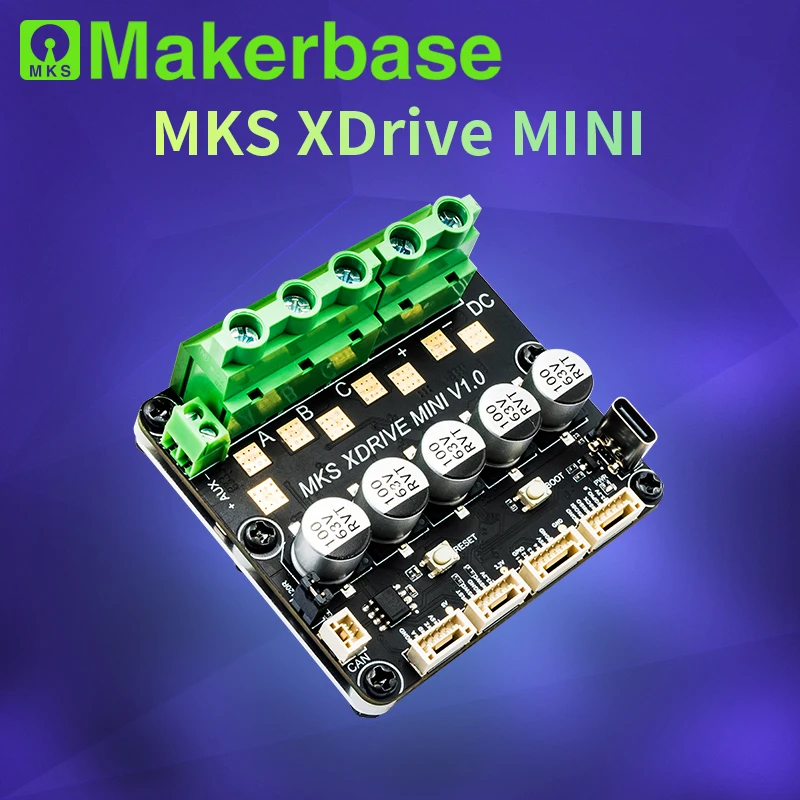
The MKS XDrive Mini features robust power input terminals, designed to handle the significant current demands of brushless servo motors. These green screw terminals provide a secure and reliable connection for the main DC power supply, which is absolutely essential for stable and high-performance operation of the entire system. Proper power delivery is non-negotiable.The board incorporates several high-capacity 100V 63RVT electrolytic capacitors. These critical components play a vital role in filtering and stabilizing the incoming power, effectively reducing voltage ripple and providing instantaneous current bursts when the motor rapidly accelerates, decelerates, or encounters sudden load changes. This ensures that the motor receives clean, consistent power, which is vital for smooth FOC operation, preventing electrical noise from affecting other sensitive electronics, and maintaining peak performance under dynamic conditions. Stable power prevents issues.
Understanding the power requirements is crucial for system builders and integrators. While the controller itself is compact, the connected motors can draw substantial current, especially under peak load conditions. Users must carefully select a power supply that can meet or exceed the combined peak current demands of all connected motors, along with providing the appropriate voltage range specified for the ODrive system. Overlooking these specifications can lead to performance degradation, system instability, or even permanent damage to the controller or motors. Adequate power is key for reliability.
Connectivity and Customization: Interfacing Options
The MKS XDrive Mini offers a comprehensive suite of communication interfaces, providing unparalleled flexibility for integration into diverse control systems. These include CAN (Controller Area Network), USB-C, SPI (Serial Peripheral Interface), GPIO (General Purpose Input/Output), and SWD (Serial Wire Debug) ports. Such versatility is a major asset for complex projects.The USB-C port is primarily utilized for initial configuration, flashing firmware updates, and real-time debugging. It allows direct connection to a host computer for setting motor parameters, tuning control loops, and monitoring performance metrics using the powerful ODrive toolchain and software utilities. This direct interface significantly simplifies the initial setup and ongoing maintenance processes. It offers easy access.
CAN bus connectivity is particularly valuable for multi-axis systems, which are common in advanced robotics, industrial automation, and sophisticated CNC machines. CAN allows multiple controllers to communicate efficiently and reliably over a single bus, significantly reducing wiring complexity, improving system synchronization, and enabling distributed control architectures. This is crucial for coordinated motion and complex robotic movements.
The GPIO and SPI interfaces offer additional avenues for integrating external sensors, limit switches, emergency stop buttons, or communicating with other microcontrollers and peripheral devices. SWD provides a low-level debugging interface for developers who wish to delve deeper into the firmware, customize its behavior, or develop their own control algorithms. These extensive options expand functionality and adaptability for specialized applications.
Beyond Steppers: A Leap in Control
The transition from traditional stepper motors to brushless servo systems, facilitated by advanced controllers like the MKS XDrive Mini, represents a significant leap in motion control capability. Stepper motors are inherently open-loop devices; they move a fixed number of steps per electrical pulse, assuming no external forces impede their movement or cause them to lose synchronization. This assumption often fails in real-world scenarios.In contrast, a brushless servo system, with its continuous closed-loop feedback from a high-resolution encoder, constantly knows its exact position, velocity, and even acceleration. If an external force attempts to move the motor shaft, or if the motor encounters unexpected resistance, the controller immediately detects the deviation and applies corrective torque to maintain the commanded position or trajectory. This active correction prevents skipped steps, a common cause of print failures, dimensional inaccuracies, and poor surface finish in 3D printing. It ensures consistent output.
For applications requiring high dynamic response, such as rapid tool changes in CNC machining, fast acceleration and deceleration in robotic manipulators, or high-speed printing, servo motors significantly outperform steppers. They can achieve higher speeds and accelerations without losing synchronization, leading to faster cycle times, improved productivity, and the ability to execute more complex motion profiles. The XDrive Mini unlocks this potential for advanced users.
Crafting Flawless Prints: Real-World Impact
For the realm of 3D printing, the MKS XDrive Mini directly addresses the critical need for dimensionally accurate engineering parts. The exceptional precision offered by the integrated AS5047P encoder, combined with the stability and responsiveness of Field-Oriented Control, means that print layers are placed with unparalleled consistency and repeatability. This minimizes deviations from the original CAD model, ensuring that functional prototypes and end-use parts meet stringent engineering specifications. Accuracy is paramount.The ability to print difficult materials reliably is another profound benefit derived from this advanced control system. Filaments prone to warping, shrinking, or requiring precise temperature and flow control, such as ABS, Nylon, Polycarbonate, or PEEK, demand a remarkably stable and predictable motion system. The XDrive Mini's robust, feedback-driven control prevents micro-stutters, positional errors, or unexpected torque fluctuations that can lead to common issues like layer shifting, delamination, poor surface finish, or nozzle clogging with these challenging materials. It significantly enhances material compatibility and success rates.
Ultimately, the overarching goal for any serious additive manufacturing endeavor is to minimize print failures. By effectively eliminating skipped steps, substantially reducing vibrations, and providing consistent, high-torque motion that precisely follows the commanded path, the XDrive Mini significantly reduces the likelihood of failed prints. This translates directly into substantial savings in both expensive material costs and valuable production time, making complex or long-duration prints much more feasible and reliable. Fewer failures mean more success and greater project efficiency.
The Builder's Edge: Why This Controller Matters
The Makerbase MKS XDrive Mini is not merely a component; it is an enabler for advanced projects that demand the highest echelons of motion control performance. Its seamless integration of proven ODrive technology with a high-resolution absolute encoder positions it as a premium choice for those who cannot compromise on precision, speed, or reliability in their motion systems. This board offers a distinct advantage.For engineers developing custom robotics, researchers building experimental platforms, or serious hobbyists pushing the boundaries of 3D printing and CNC machining, the investment in a controller of this caliber translates into tangible and measurable benefits. It provides the robust foundation for systems that operate with greater speed, unparalleled precision, and superior reliability than what is achievable with less sophisticated, open-loop solutions. The performance gains are clear and immediate.
Imagine a scenario where your custom-built CNC machine carves intricate details into challenging materials with unprecedented smoothness and accuracy, or your next-generation 3D printer produces functional engineering parts with tolerances previously thought impossible on desktop machines. This controller makes such ambitious aspirations achievable, transforming conceptual designs into physical realities with exacting precision and consistent quality. The future of your projects becomes more robust, more accurate, and ultimately, more successful, allowing for complex creations to come to life with professional-grade execution and consistent, repeatable results, pushing the boundaries of what is possible in precision manufacturing.