LD06AJSA Adjustable Constant Current LED Driver Module
Official Store Deal
Expert Analysis Overview
Precision Power Regulation for LED Applications
The LD06AJSA is a compact, adjustable constant current LED driver module, specifically engineered for applications requiring precise current delivery to light-emitting diodes. This buck power module is designed to step down an input voltage, providing a stable current output crucial for LED longevity and consistent illumination. Its primary function is to maintain a constant current through a series or parallel array of LEDs, regardless of minor fluctuations in input voltage or LED forward voltage variations. This module represents a practical solution for hobbyists and small-scale lighting projects.
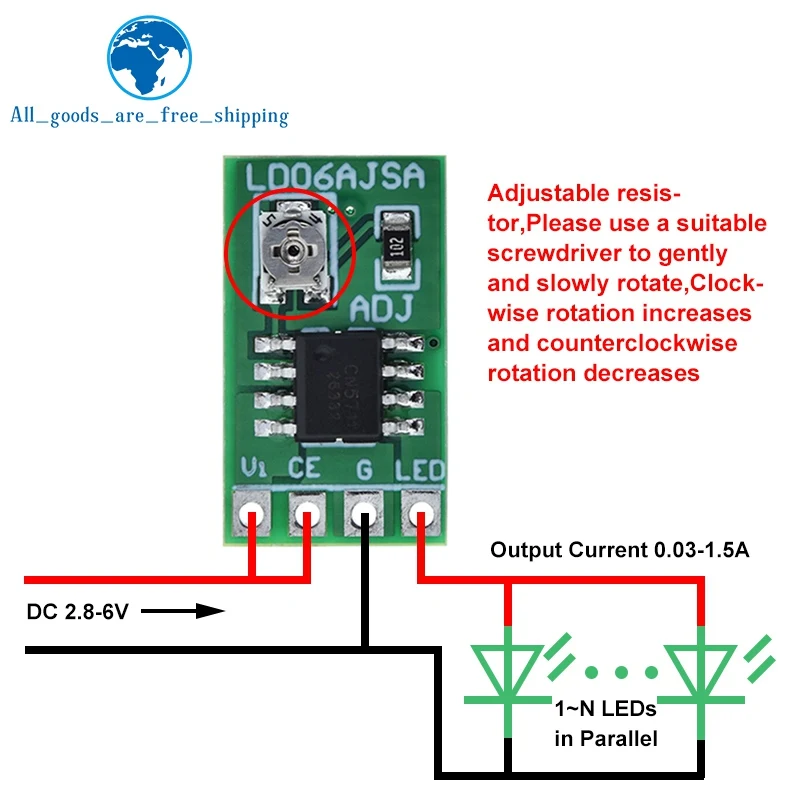
The module's design prioritizes efficient power conversion. It operates within a DC input range of 2.8V to 6V, making it compatible with common power sources such as single-cell Li-ion batteries, 3.3V, 3.7V, 4.2V, and 5V power supplies. The output current is adjustable from 30mA to 1500mA, offering significant flexibility for various LED configurations. Such a broad range allows for driving anything from small indicator LEDs to more powerful lighting arrays. This adaptability is a key advantage for custom lighting designs.
Compared to simple current-limiting resistors, which dissipate excess energy as heat and offer poor regulation, this constant current driver actively manages the current flow. Resistors are inefficient. This active regulation ensures that LEDs operate at their optimal current, preventing premature degradation due to overcurrent conditions. It also allows for consistent brightness across multiple LEDs, even if their individual forward voltages differ slightly. This is a significant upgrade over passive current limiting.
Input Voltage Flexibility and Output Current Management
The LD06AJSA module accepts a DC input voltage spanning from 2.8V to 6V. This wide input range accommodates various power sources commonly found in portable electronics and low-voltage systems. The module efficiently converts this input to a regulated current output. This flexibility simplifies power supply selection for many projects.
The output current, adjustable between 30mA and 1500mA, is controlled via an onboard potentiometer. Clockwise rotation increases the current, while counter-clockwise rotation decreases it. This allows for fine-tuning the brightness of connected LEDs. Proper adjustment is critical for LED lifespan. The ability to precisely set the current ensures that LEDs are not overdriven, which can lead to thermal runaway and early failure. This level of control is often absent in simpler, fixed-current drivers.
Unlike linear regulators, which can be inefficient, especially when there is a large difference between input and output voltage, this buck converter topology is more power-efficient. It minimizes heat generation, which is vital for compact electronic assemblies. The efficiency gain translates directly into longer battery life for portable applications. It also reduces the need for extensive heatsinking. This is a clear advantage in constrained spaces.
Integrated PWM Control Capability
This driver module incorporates Pulse Width Modulation (PWM) control capability. PWM is a modulation technique used to encode a message into a pulsing signal. This feature allows for dynamic brightness adjustment or dimming of the connected LEDs. A separate control input (CE pin) is provided for this purpose. This enables sophisticated lighting effects.
By applying a PWM signal to the CE pin, users can vary the average current supplied to the LEDs, thereby controlling their perceived brightness. A higher duty cycle results in brighter illumination, while a lower duty cycle dims the LEDs. This method is far superior to simply reducing the voltage, which can alter the LED's color temperature and efficiency. PWM maintains color consistency. It also allows for flicker-free dimming, which is important for visual comfort and certain photographic applications.
Many basic LED drivers offer only on/off functionality. The inclusion of PWM control elevates this module beyond simple current regulation. It provides an advanced interface for integration into micro-controller-based projects, smart lighting systems, or any application requiring variable light output. This expands the module's utility significantly. It offers a level of sophistication not typically found in modules of this size and price point.
Component Quality and Thermal Considerations
The visible components on the LD06AJSA PCB include a surface-mount potentiometer for current adjustment, a main integrated circuit (IC) chip, and various passive components. The PCB itself appears to be a standard FR-4 substrate. The soldering points for the terminals are clearly marked. Component density is high. The overall build quality appears consistent with mass-produced electronic modules.
Thermal management is a critical aspect of any power conversion circuit. While the module is compact, the underside of the PCB features a large, exposed copper pad, likely intended for heat dissipation from the main IC. This design suggests that for continuous operation at higher currents (e.g., 1.5A), external heatsinking or adequate airflow might be necessary to prevent overheating. Overheating can lead to reduced efficiency and component failure. Users must consider the operating environment.
Unlike larger, more robust LED drivers that often include dedicated heatsinks or thermal pads, this miniature module relies on its PCB layout for heat transfer. For applications pushing the upper limits of its current output, monitoring the operating temperature is advisable. Ensuring proper ventilation or adding a small heatsink to the underside can significantly improve reliability and lifespan. This proactive approach prevents thermal stress. Neglecting thermal management can compromise performance.
Terminal Quality and Wiring Practices
The module features clearly labeled solder pads for input (U1, CE, G) and output (LED, G). These pads are designed for direct soldering of wires. The quality of these pads appears standard for through-hole components. Proper soldering technique is essential for reliable connections. Cold solder joints can lead to intermittent operation.
When connecting wires, it is imperative to use appropriate wire gauges for the expected current load. For the maximum output of 1.5A, a wire gauge of at least 22 AWG is recommended for short runs, with thicker gauges preferred for longer distances or higher currents to minimize voltage drop and heat generation in the wires themselves. Undersized wires pose a fire hazard. Always verify wire gauge accuracy. The terminals themselves are robust enough for typical hobbyist use.
Unlike screw terminals or quick-connectors found on larger industrial modules, these solder pads require a permanent connection. This can be a pro for vibration resistance but a con for quick prototyping. Ensuring clean, secure solder joints is paramount for both electrical performance and safety. Adherence to best wiring practices, including proper insulation and strain relief, is non-negotiable. This prevents accidental shorts. Always double-check polarity before applying power.
Safety and Compliance Considerations
While the module itself does not display explicit UL or CE certifications, its design principles align with common practices for low-voltage DC electronics. The buck converter topology inherently offers some protection against overcurrent conditions to the LEDs, as it actively regulates current. However, external protection for the input side, such as a fuse, is always a prudent addition. Safety standards compliance is crucial for any electrical component. This ensures operational integrity.
Users must be aware of the potential for reverse polarity connection. Connecting the input voltage incorrectly can damage the module and potentially the power source. The absence of visible reverse polarity protection on the board necessitates careful wiring. Double-checking connections before power-up is a fundamental safety practice. This prevents costly component failures. Always confirm positive and negative terminals.
For any application involving multiple LEDs, especially in parallel, ensuring that each LED is rated for the maximum current output of the driver is vital. While the driver provides constant current, individual LEDs in a parallel array can still draw different currents if their forward voltages are not perfectly matched, potentially leading to uneven brightness or premature failure of some LEDs. Proper load balancing is essential. This module is a tool for precise current delivery, but the overall system design remains the user's responsibility. It is a powerful component for those who understand its capabilities and limitations.
Imagine the satisfaction of bringing your custom lighting projects to life with perfectly consistent and dimmable illumination. This module empowers you to create sophisticated LED setups, from accent lighting to functional indicators, with the confidence that your LEDs are driven optimally and safely. Its compact size allows for seamless integration into even the most space-constrained designs, making your vision a tangible reality.