LCR TC1 Multifunction Component Tester
Official Store Deal
Expert Analysis Overview
The All-in-One Workshop Diagnostic
The LCR TC1 Multifunction Component Tester is a compact, indispensable diagnostic tool for hobbyists and professionals needing quick, accurate identification of electronic components. This device consolidates the functions of multiple dedicated testers into a single, portable unit, making it an ideal addition to any workbench or toolkit. Its ability to rapidly identify and characterize various components streamlines troubleshooting processes, saving valuable time and effort in electrical and electronic repair tasks. The integrated display provides clear, immediate feedback, simplifying complex diagnostics.
Component Identification Prowess
This tester excels at identifying a wide array of discrete electronic components. It can automatically detect NPN and PNP bipolar transistors, N-channel and P-channel MOSFETs, JFETs, diodes (including dual diodes), thyristors, SCRs, resistors, capacitors, and inductors. The device intelligently analyzes the component connected to its test points, providing not just the component type but also its pinout configuration. This automatic recognition removes guesswork, a common frustration with unmarked or salvaged parts. It's a significant upgrade from manual testing with a standard multimeter, which often requires multiple steps and a deeper understanding of component characteristics.
For transistors, the LCR TC1 measures the current amplification factor (hFE) and the base-emitter forward voltage. This data is crucial for matching transistors in amplifier circuits or verifying their operational status. A quick test provides essential parameters. Unlike simple continuity checks, this tester offers comprehensive characterization. It ensures components meet specifications before integration into a circuit.
Capacitor testing is another strong suit, providing capacitance values, equivalent series resistance (ESR), and voltage loss (Vloss). The ESR measurement is particularly valuable for diagnosing electrolytic capacitors, which often fail due to increased ESR, leading to circuit instability or malfunction. This feature alone can pinpoint common power supply issues that might otherwise be difficult to track down. Many standard multimeters lack ESR measurement capabilities. This unit provides critical diagnostic data.
Resistors are measured with high precision, displaying their resistance value. Inductors also receive similar treatment, with their inductance value presented on the screen. The ability to test a range of components with one device simplifies inventory and reduces the need for specialized equipment. This consolidation is a substantial benefit for any workshop.
Display and Interface Clarity
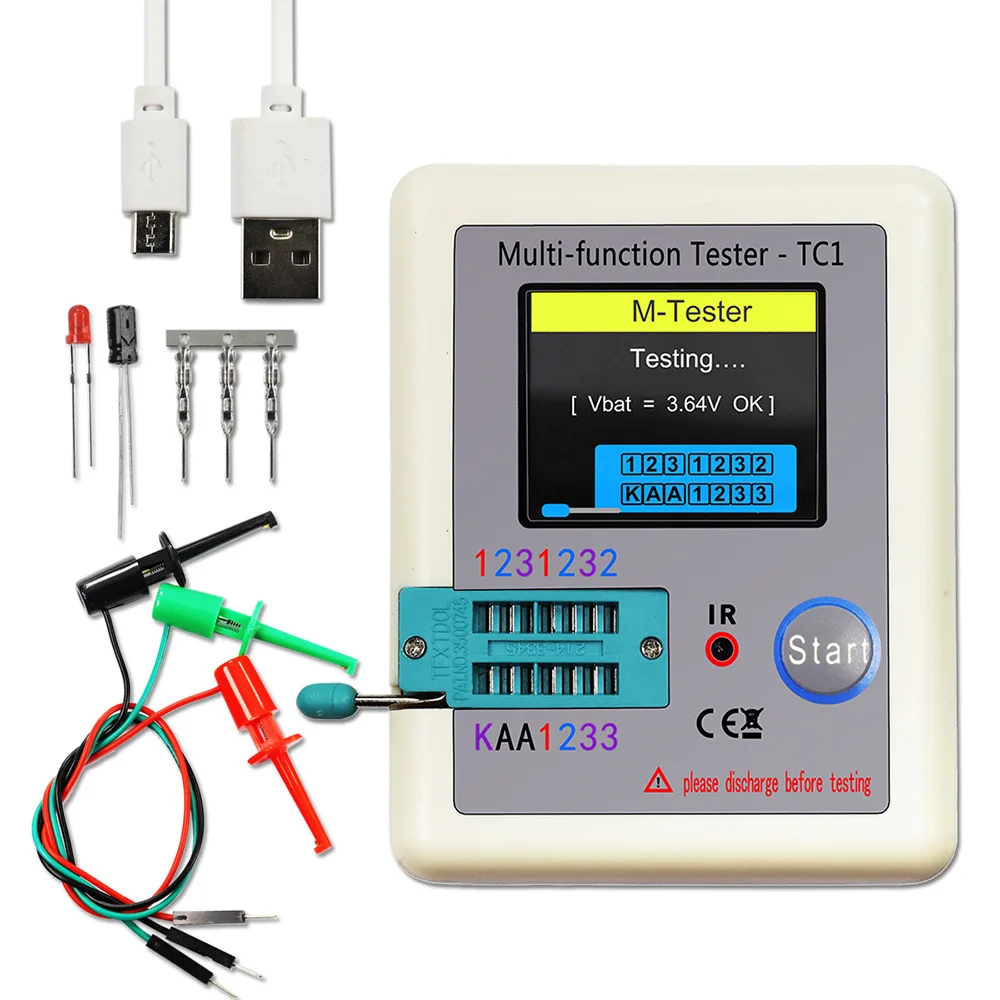
Central to the LCR TC1's usability is its 160x128 TFT LCD display. This color screen presents test results in a clear, easy-to-read format, displaying component type, pinout, and measured parameters simultaneously. The visual representation of pin assignments is particularly helpful, eliminating the need to consult datasheets for common components. Information is immediately accessible. The bright display ensures readability even in varied lighting conditions, a practical consideration for different workshop environments. This is a distinct advantage over older testers that rely on monochrome or segmented displays, which offer less information at a glance.
Operation is simplified through a single 'Start' button. This intuitive design means users can quickly initiate a test without navigating complex menus or selecting component types manually. The device handles the identification automatically. This ease of use reduces the learning curve, allowing even novice electronics enthusiasts to perform accurate tests. Simplicity enhances workflow efficiency. Compared to traditional multimeters requiring range selection and function switching, the LCR TC1 offers a streamlined experience.
An IR receiver window is also integrated, allowing the tester to decode infrared remote control signals. This function displays the user code and data code of IR remotes, a useful feature for troubleshooting remote controls or reverse-engineering IR protocols. It provides diagnostic feedback for common household devices. This capability extends the tester's utility beyond basic component checks. It's an unexpected but welcome addition for many users.
Portability and Power Management
The LCR TC1 is designed for portability, featuring a compact form factor that fits comfortably in a hand or tool bag. Its dimensions, approximately 90mm x 70mm x 27mm, make it unobtrusive on a crowded workbench or when carried to different job sites. This small footprint is a practical advantage. The device operates on an internal rechargeable battery, eliminating the need for constant external power during use. This freedom of movement is crucial for field diagnostics or working in areas without readily available power outlets.
Recharging is convenient via a Micro USB charging interface. This ubiquitous charging standard means users can power up the device using common smartphone chargers or a computer's USB port. A charge indicator LED provides visual feedback on the charging status. This universal charging method simplifies power management. The inclusion of a rechargeable battery ensures the tester is always ready for use, unlike devices that rely on disposable batteries, which can run out unexpectedly. The internal battery provides sustained operation.
Construction and Durability Considerations
The tester features a white plastic casing that appears robust enough for typical workshop use. The compact design inherently offers some protection against minor bumps and drops, as there are fewer protruding parts. While not explicitly ruggedized for extreme industrial environments, its construction is suitable for hobbyist and light professional applications. The main test socket is a ZIF (Zero Insertion Force) socket, which protects component leads from bending or damage during insertion and removal. This socket design extends the lifespan of both the tester and the components being tested. It is a thoughtful design choice for frequent use.
Included accessories, such as test hooks and a Micro USB cable, enhance its immediate utility. The test hooks allow for flexible connections to components that might not fit directly into the ZIF socket, or for in-circuit testing (with appropriate precautions). These accessories ensure the tester is ready for diverse tasks right out of the box. The overall package provides good value. The visible components suggest careful consideration for practical application.
Value Proposition for the Practical User
For the carpenter or tradesperson who frequently encounters electrical systems, power tools, or electronic controls in their work, the LCR TC1 offers significant value. Instead of guessing if a motor controller has a faulty capacitor or if a switch uses a working transistor, this device provides definitive answers. Its ability to quickly identify component types and their basic parameters means less time spent on trial-and-error diagnostics and more time on actual repairs or installations. This efficiency translates directly into cost savings and improved productivity. It's an investment that pays for itself by reducing diagnostic time.
Imagine troubleshooting a faulty power tool charger. Instead of replacing the entire unit, this tester can quickly identify if a specific diode or capacitor has failed, allowing for a targeted, inexpensive repair. This capability empowers users to perform component-level repairs, extending the life of equipment and reducing waste. The tester provides actionable insights. Its multi-functionality, combined with ease of use and portability, makes it an excellent choice for anyone who needs reliable electronic component diagnostics without the complexity or cost of multiple specialized instruments. This tool simplifies complex tasks.
This LCR TC1 Multifunction Component Tester will streamline your diagnostic workflow, empowering you to quickly identify faulty electronic components and perform precise repairs. Envision the satisfaction of rapidly pinpointing issues in power tools, workshop equipment, or home electronics, saving both time and money. This compact device will become an indispensable part of your toolkit, providing confidence in every repair and project, ensuring your electronics are always operating at their best. Your workbench will feel more capable and organized with this single, versatile instrument at your disposal.