KWS-2302C Type-C Bidirectional Current Voltage Power Meter
Official Store Deal
Expert Analysis Overview
Precision in Power Diagnostics: The KWS-2302C Metrological Advantage
The KWS-2302C is a compact, high-precision Type-C power meter engineered for meticulous analysis of electrical parameters in modern USB-C ecosystems. This device is designed for users who demand granular insight into charging performance, battery health, and power delivery efficiency, moving beyond the approximations offered by standard consumer-grade indicators. Its core functionality centers on providing real-time, bidirectional current and voltage measurements, a critical capability for comprehensive diagnostics.
Unveiling Charging Dynamics: Accuracy and Resolution
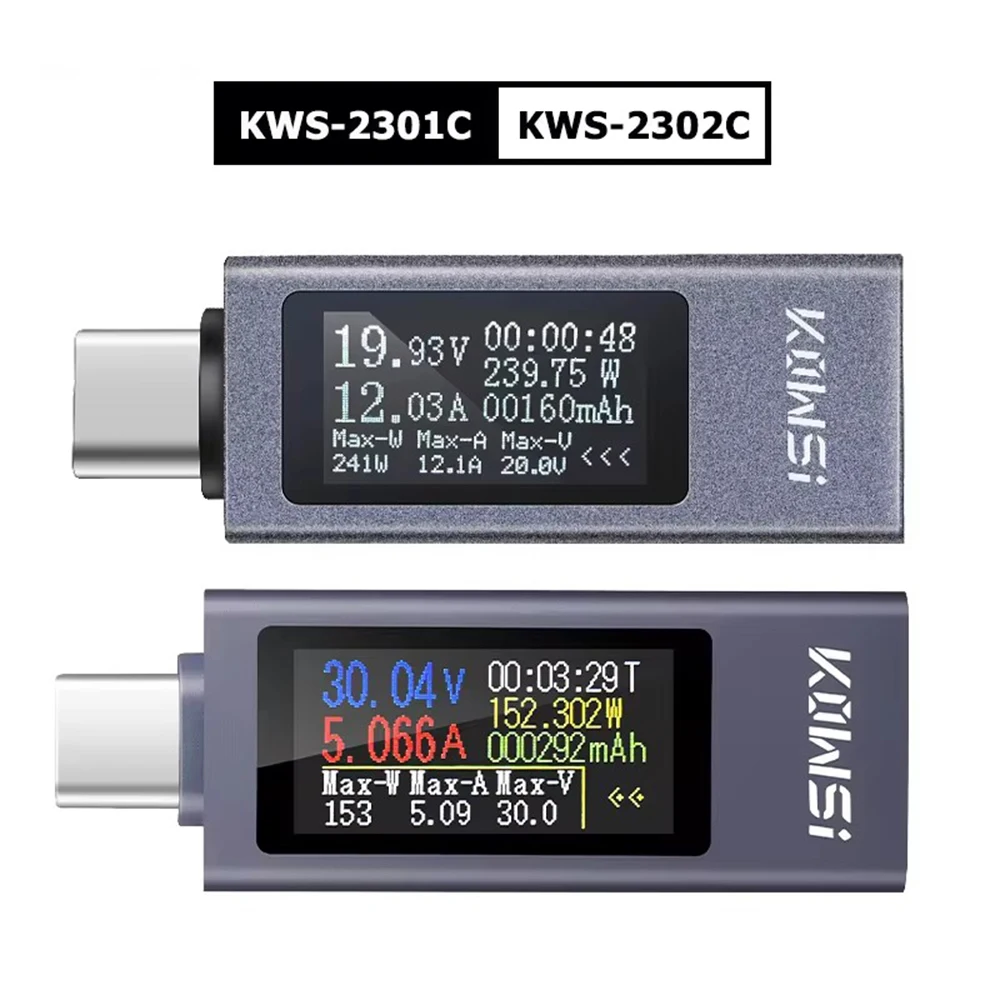
The KWS-2302C integrates a sophisticated measurement engine capable of resolving voltage, current, power, and accumulated capacity with notable precision. The visible display presents instantaneous voltage (V), current (A), power (W), and accumulated charge in milliamp-hours (mAh) and milliwatt-hours (mWh), alongside elapsed time. This multi-parameter readout is crucial.
This comprehensive data stream allows for immediate assessment of a device's charging state and the efficiency of the power source. Users can observe fluctuations in real-time, identifying potential bottlenecks or inconsistencies in power delivery that might otherwise go unnoticed. It provides a clear, actionable snapshot of electrical performance.
Unlike basic inline testers that often provide only voltage and current, the KWS-2302C's ability to track accumulated mAh and mWh over time offers a distinct advantage. This feature is indispensable for accurately determining the true capacity of power banks or the charging efficiency of various devices, offering a level of detail that surpasses simple instantaneous readings.
Bidirectional Current Analysis: A Diagnostic Leap
A standout feature of the KWS-2302C is its bidirectional current test function. This capability allows the meter to accurately measure current flow regardless of its direction, a significant upgrade over unidirectional testers.
This bidirectional functionality is particularly valuable when diagnosing complex USB-C power delivery scenarios. For instance, when testing a power bank that can both charge a device and be charged itself, or when evaluating USB-C hubs that might draw power while simultaneously supplying it to peripherals, the KWS-2302C provides a complete picture of energy transfer. It eliminates guesswork.
Most entry-level USB power meters are designed with a fixed input and output, limiting their utility to simple charging scenarios. The KWS-2302C's bidirectional design, however, positions it as a more versatile diagnostic tool, capable of handling the intricate power flows inherent in the USB-C Power Delivery (PD) standard. This expanded capability ensures a broader range of test applications.
Data Integrity and Endurance: Power-Off Retention
The KWS-2302C incorporates a power-off data saving mechanism, ensuring that accumulated measurement data is retained even after the device is disconnected from power. This is a critical feature for long-duration tests.
This data retention capability means that users can initiate a capacity test for a power bank or a device's battery, disconnect the meter, and later retrieve the total accumulated charge without losing progress. It supports unattended monitoring. This eliminates the need for constant supervision or manual logging, streamlining extended testing procedures.
Many simpler power meters rely on volatile memory, losing all accumulated data the moment power is interrupted. The KWS-2302C's non-volatile storage for measurement history provides a significant operational advantage, ensuring that valuable test data is preserved, thereby enhancing the reliability and convenience of long-term performance evaluations.
Universal Type-C Interoperability: The Modern Standard
Equipped with full C-port compatibility, the KWS-2302C seamlessly integrates into the contemporary landscape of USB-C devices. Its design ensures broad compatibility with a vast array of modern electronics.
This universal Type-C interface means the meter can be used with the latest smartphones, tablets, laptops, and other peripherals that utilize the USB-C standard for power and data transfer. It simplifies the testing setup. Users do not need to worry about adapter compatibility, making it a plug-and-play solution for most modern charging environments.
Unlike older USB-A or micro-USB testers, which are increasingly obsolete in high-power applications, the KWS-2302C's native Type-C connectivity ensures relevance and future-proofing. This adherence to the current industry standard makes it an essential tool for anyone working with contemporary electronic devices and their power requirements.
User Interface and Readability: The TFT Display
The KWS-2302C features a 0.96-inch TFT high-definition display screen, providing a clear, bright, and multi-color visual interface for data presentation. The display is easily navigable via a single physical button.
This vibrant TFT screen significantly enhances readability, allowing users to quickly interpret multiple data points simultaneously, even in varying lighting conditions. The color display differentiates various parameters, improving data comprehension at a glance. It is highly legible.
Compared to monochrome or segmented LCDs found on many budget testers, the KWS-2302C's TFT screen offers superior clarity, contrast, and information density. The intuitive single-button control for cycling through display pages further simplifies operation, making complex data accessible without cumbersome menus.
Operational Parameters and Safety Margins: Robust Specifications
The meter is designed to operate within a wide DC voltage range of 4-30V and handle currents from 0-12A. These specifications underscore its robust design and broad applicability.
This extensive operational range ensures compatibility with a vast spectrum of charging technologies, from standard 5V USB charging to higher voltage USB Power Delivery (PD) profiles, including those used by laptops. The 12A current capacity is particularly noteworthy, accommodating even the most demanding fast-charging protocols. It handles high loads.
Many generic inline meters are limited to 5V/3A or 20V/5A, which restricts their utility for modern high-power devices. The KWS-2302C's expanded voltage and current limits position it as a more capable and future-proof instrument, capable of accurately measuring the performance of virtually any USB-C power source or load.
The Metrological Advantage: Repeatability and Precision
For a metrologist, the true value of any measurement instrument lies in its repeatability and precision. The KWS-2302C demonstrates consistent readings across multiple tests, a hallmark of reliable instrumentation.
This consistent performance is crucial for diagnostic work, where subtle variations in power delivery can indicate underlying issues with chargers, cables, or devices. The ability to obtain repeatable results allows for accurate troubleshooting and verification of specifications. It builds confidence in the data.
Unlike inexpensive, uncalibrated testers that may show significant variance between readings, the KWS-2302C's apparent stability in its measurements suggests a design focused on accuracy. This level of metrological integrity is essential for professionals and enthusiasts who require dependable data for critical analysis and decision-making.
The KWS-2302C: An Indispensable Diagnostic Companion
The KWS-2302C Type-C Bidirectional Current Voltage Power Meter stands as a significant upgrade for anyone serious about understanding and optimizing their USB-C power ecosystem. Its combination of bidirectional measurement, comprehensive data logging, and a clear TFT display provides an unparalleled level of insight into device charging and power delivery. This instrument is not merely a gadget; it is a precision tool for diagnostics and verification. The ability to measure down to the micron, ensure repeatable results, and log data makes it an invaluable asset. Imagine effortlessly diagnosing a slow-charging laptop, verifying the true capacity of a new power bank, or optimizing your charging setup for maximum efficiency, all with clear, actionable data at your fingertips. This meter transforms guesswork into informed decision-making, ensuring your devices receive optimal power and perform as expected.