KSD301/KSD302 Bimetallic Disc Thermostat Temperature Control Switch
Official Store Deal
Expert Analysis Overview
Precision Thermal Guardians: An Electrician's Review
The KSD301/KSD302 bimetallic disc thermostat is a critical safety component designed for precise thermal management in electrical systems. This device is aimed at engineers, appliance repair technicians, and DIY enthusiasts requiring reliable overheat protection. Its fundamental operation relies on a bimetallic disc, which deforms at a predetermined temperature, opening or closing an electrical circuit. This mechanical simplicity contributes to its inherent reliability and rapid response to thermal excursions.
Operational Modalities: Normally Closed vs. Normally Open
These thermostats are available in two primary configurations: Normally Closed (NC) and Normally Open (NO). The choice between these modes dictates the circuit behavior under normal operating conditions. A Normally Closed (NC) thermostat maintains a closed circuit, allowing current to flow, until its activation temperature is reached. Upon reaching this threshold, the bimetallic disc snaps open, interrupting the circuit. This is ideal for applications where power needs to be cut off when a temperature limit is exceeded, such as in heating elements or motor protection. The circuit remains open until the temperature drops sufficiently, allowing the disc to reset and close the circuit again. This automatic reset functionality is a significant advantage over single-use thermal fuses.
Conversely, a Normally Open (NO) thermostat keeps the circuit open under normal conditions. It closes the circuit only when its specified activation temperature is met. This configuration is typically employed in systems that require an action to be initiated upon reaching a certain temperature, such as activating a cooling fan or triggering an alarm. The distinction between NC and NO is paramount for correct system design and safety implementation. Misapplication can lead to system failure or, critically, a lack of protection. Understanding the intended function of each type is non-negotiable for safe electrical practice.
Current Handling Capabilities and Voltage Ratings
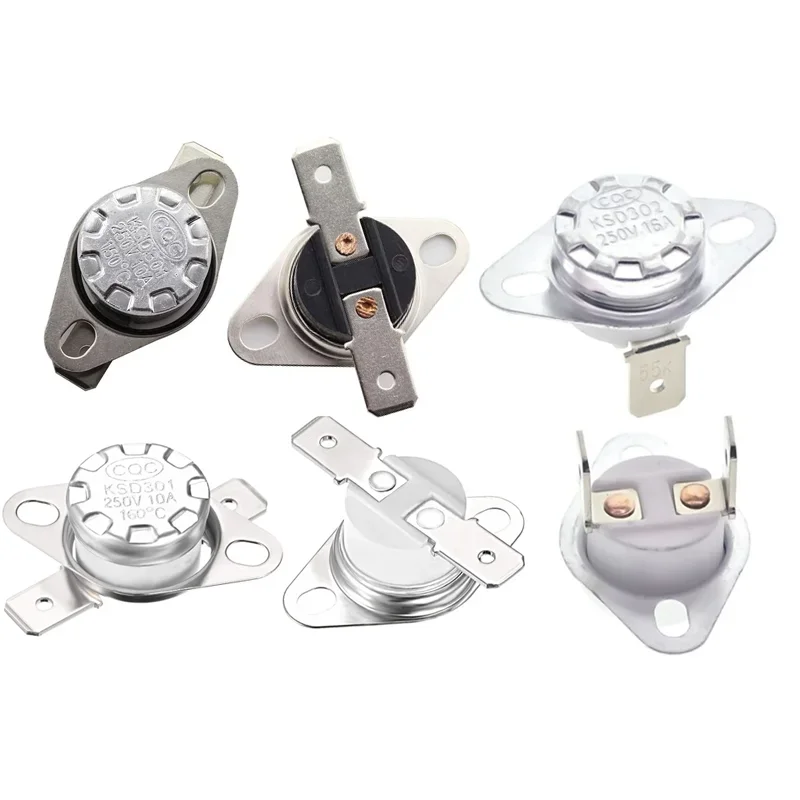
The KSD301/KSD302 series is rated for 250V operation, with current capacities of either 10A or 16A. These ratings are clearly stamped on the metal casing of each unit, providing essential information for safe integration. The 250V rating indicates suitability for standard line voltage applications in many regions. The current ratings, 10A and 16A, define the maximum continuous current the contacts can safely carry without degradation or overheating. Exceeding these limits can lead to contact welding, premature failure, or even fire hazards. Proper circuit design must account for both steady-state and inrush currents to ensure the thermostat operates within its specified parameters. This adherence to electrical specifications prevents catastrophic failures. The visible terminal quality appears robust enough for these stated current loads.
Unlike generic, unrated thermal switches, these units provide clear electrical specifications. This transparency allows for precise component selection. The terminals are typically spade connectors, designed for secure and low-resistance connections. Ensuring proper crimping or soldering techniques is vital to maintain the integrity of the current path. Loose connections can generate heat, leading to false trips or, worse, localized overheating that compromises the device itself or adjacent wiring. The physical construction supports reliable current transfer.
Temperature Activation Ranges
These thermostats are available across a broad spectrum of fixed activation temperatures, ranging from 25°C to 300°C. This extensive range makes them suitable for diverse applications, from low-temperature control in refrigeration units to high-temperature cut-offs in industrial ovens. Each unit is factory-calibrated to a specific temperature, which is permanently marked on its metallic cap. This fixed temperature setting ensures consistent and predictable thermal response. There is no user adjustment. The precision of these bimetallic discs is critical for maintaining system stability and preventing damage from thermal overloads. Selecting the correct activation temperature is paramount for the intended application. A slight miscalculation can render the protection ineffective.
For instance, a 60°C NC thermostat might be used in a small appliance to prevent internal components from exceeding a safe operating temperature. A 150°C NC unit could serve as an emergency cut-off in a heating element. The wide array of available set points eliminates the need for complex external circuitry for basic thermal protection. This simplifies design and reduces potential points of failure. The fixed nature of the set point also prevents accidental or unauthorized tampering, which is a significant safety feature in many industrial and consumer applications. This ensures consistent thermal protection.
Installation Considerations and Mounting
The KSD301/KSD302 thermostats typically feature a metallic mounting flange with two holes, allowing for secure attachment to a surface. This direct mounting ensures good thermal coupling between the thermostat's bimetallic disc and the component or area being monitored. Effective thermal transfer is essential for accurate temperature sensing and timely activation. Poor mounting can lead to delayed response or inaccurate readings, compromising the protective function. The physical design facilitates straightforward installation.
Proper mounting involves using appropriate fasteners that ensure firm contact without deforming the thermostat's casing. Thermal paste can be used to enhance heat transfer in critical applications, though it is not always necessary for general use. The orientation of the thermostat can also influence its response, particularly in environments with significant airflow or radiant heat sources. Positioning the device to accurately reflect the temperature of the protected component is crucial. Unlike adhesive-backed sensors, the bolted flange provides a mechanically robust and reliable connection. This ensures long-term stability and consistent thermal monitoring. The mounting holes are standard, simplifying integration into existing designs.
Durability Under Duress
The construction of these thermostats, primarily featuring a metallic casing and ceramic or phenolic base, suggests a robust design suitable for demanding environments. The metallic cap protects the bimetallic disc from physical damage and helps in heat transfer. The ceramic or phenolic base provides electrical insulation and structural integrity. These materials are chosen for their high-temperature resistance and electrical isolation properties. The overall build quality appears consistent with industrial and appliance-grade components. This ensures a long operational life.
Unlike cheaper plastic-bodied alternatives, the metallic and ceramic construction offers superior thermal stability and resistance to environmental factors. The snap-action mechanism of the bimetallic disc is designed for repeated cycling without significant degradation of performance. This makes them suitable for applications requiring frequent temperature regulation. The visible components indicate a focus on longevity and consistent performance. The units are designed to withstand the thermal and electrical stresses of their intended use. This contributes to overall system reliability.
The Value Proposition
Considering the critical safety function these thermostats perform, their cost-effectiveness is remarkable. For a relatively low investment, they provide essential overheat protection that can prevent costly equipment damage or, more importantly, mitigate fire hazards. The simplicity of their design translates to high reliability and minimal maintenance requirements. They are a definitive, problem-solving engineered fix for thermal control. This makes them an excellent choice for integrating fundamental safety into various electrical systems. The long-term value far outweighs the initial purchase price.
Unlike more complex digital temperature controllers that require programming and external sensors, these bimetallic thermostats offer a straightforward, set-and-forget solution. Their mechanical operation is less susceptible to electromagnetic interference or software glitches, providing a dependable failsafe. This makes them an upgrade in terms of reliability for many basic thermal protection needs. The cost-per-use over the lifespan of an appliance or system is exceptionally low. This ensures critical safety without significant overhead. The investment in these components safeguards more expensive equipment.
Imagine the peace of mind knowing that your appliances or industrial equipment are protected by a reliable, precisely calibrated thermal guardian. These KSD301/KSD302 switches ensure that critical temperature thresholds are never breached, safeguarding both your investment and operational continuity. Their robust construction and proven bimetallic technology provide a dependable layer of safety, allowing systems to operate within their design limits without constant manual oversight. Integrating these components means fewer unexpected shutdowns, reduced maintenance costs, and a significantly lower risk of thermal-related failures, contributing to a safer and more efficient electrical environment. The consistent performance of these switches ensures that thermal events are managed proactively, maintaining system integrity and preventing costly damage before it occurs.