K-II EMF Field Detector
Official Store Deal
Expert Analysis Overview
Precision in the Unseen: An EMF Detector Analysis
The K-II EMF Field Detector is a specialized instrument designed for the qualitative assessment of electromagnetic fields, primarily targeting enthusiasts in paranormal investigation and individuals concerned with ambient EMF levels from household electronics. This device offers a straightforward, visual indication of field strength, prioritizing ease of use over granular data logging. Its compact form factor ensures portability. The K-II detector represents a foundational tool for initial field assessments, providing immediate feedback on environmental electromagnetic fluctuations.
Operational Principles and Measurement Fidelity
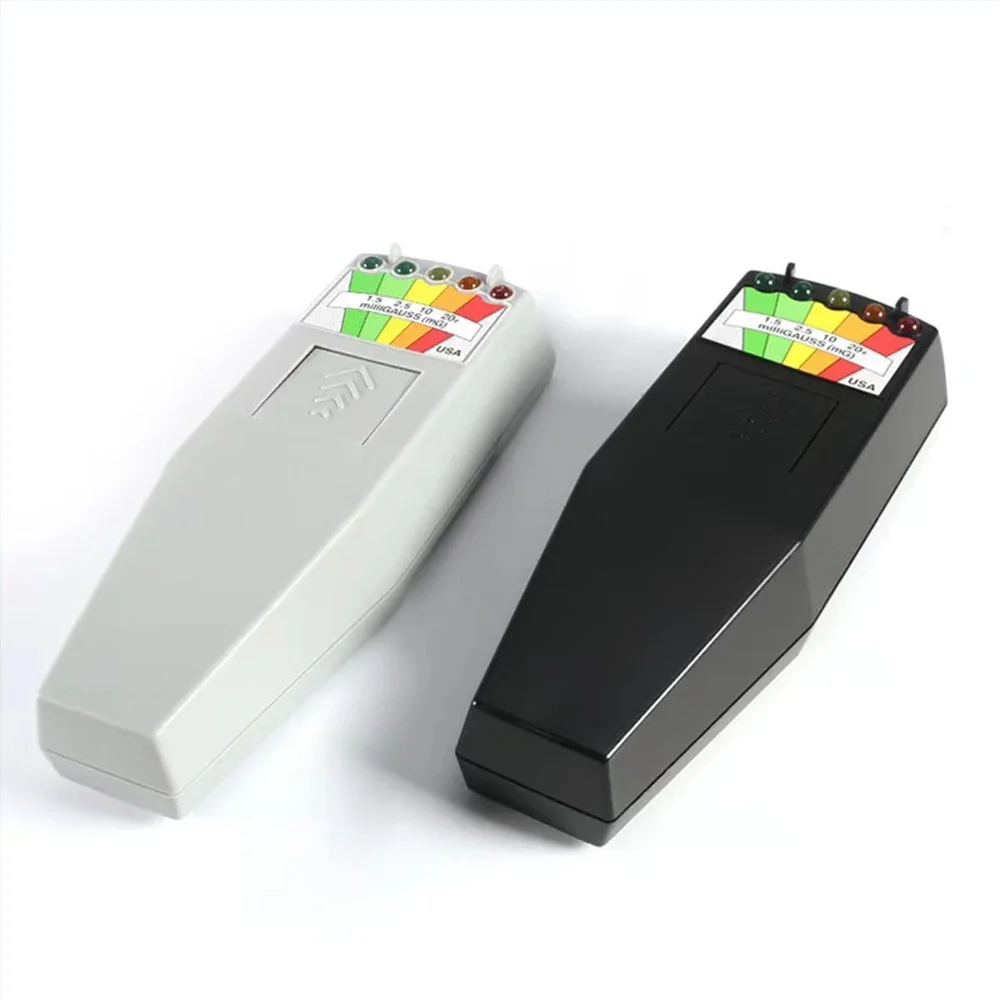
Electromagnetic field (EMF) detectors operate by sensing changes in magnetic flux. The K-II unit employs a series of five LED indicators, each illuminating at specific magnetic field thresholds. These thresholds are visibly marked on the device's face: 1.5, 2.5, 5, 10, and 20+ milligauss (mG). This graduated scale provides a rapid, visual representation of field intensity. The device's primary function is to offer a quick, qualitative assessment. It is not designed for precise quantitative measurements. The visual feedback is instant.
For a metrologist, the resolution of such a device is critical. The K-II's resolution is limited to these five discrete steps. This means that while it can indicate a field is, for instance, between 5 mG and 10 mG, it cannot differentiate between 6 mG and 9 mG. This characteristic positions the K-II as an indicator rather than a precision measurement tool. Its simplicity is a core design choice.
Compared to more advanced EMF meters that offer digital readouts in specific units (e.g., milligauss, microtesla, volts per meter) and often include frequency analysis, the K-II provides a more accessible, less intimidating interface. This makes it particularly suitable for users who require immediate, actionable feedback without needing to interpret complex numerical data. The device is easy to understand.
Ergonomics and Build Quality Assessment
Visually, the K-II detector presents a minimalist, ergonomic design. The casing appears to be constructed from injection-molded ABS plastic, available in both light grey and matte black finishes. This material choice suggests a balance between durability and cost-effectiveness. ABS plastic is known for its impact resistance and rigidity, making it suitable for a handheld device that might experience occasional bumps or drops during field use. The form factor is slender.
The physical dimensions, approximately 14.3 cm (5.6 inches) in length, 2.8 cm (1.1 inches) in width, and 2.5 cm (1 inch) in thickness, indicate a highly portable instrument. This compact size allows for easy storage in a pocket, bag, or equipment kit, which is a significant advantage for users who need to carry it for extended periods or in various locations. Portability is a key feature. The device's light weight, implied by its plastic construction, further enhances its carry-ability, reducing user fatigue during prolonged use.
In contrast to professional-grade EMF meters that often feature ruggedized housings, rubberized grips, and sealed enclosures for environmental protection, the K-II prioritizes simplicity and accessibility. While it may not withstand extreme conditions, its construction is adequate for typical indoor and light outdoor use. The design is straightforward.
Power Management and Longevity
The K-II detector is powered by a standard 9-volt battery, as evidenced by the internal view of the black unit. This power source is widely available and relatively inexpensive, ensuring that the device can be kept operational without specialized battery procurement. The use of a single 9V battery simplifies power management. Battery life will depend on usage frequency and the quality of the battery installed, but for intermittent use, a single battery should provide a reasonable operational duration. Power consumption is low.
Unlike devices with rechargeable lithium-ion batteries that require specific charging infrastructure, the K-II's reliance on disposable 9V batteries offers flexibility in remote locations where access to power outlets might be limited. Users can simply carry spare batteries. This design choice aligns with the device's portable and field-oriented application. It is a practical power solution.
Application Scenarios and Practical Utility
The primary application for the K-II EMF detector, as marketed, is in paranormal investigation. In this context, the device is used to detect sudden, localized fluctuations in electromagnetic fields, which some theories associate with paranormal activity. The immediate visual feedback from the LEDs allows investigators to quickly identify areas of interest. This provides rapid feedback.
Beyond its niche application, the K-II also serves as a practical tool for general EMF awareness in residential and office environments. It can be used to identify strong EMF emissions from common household appliances such as microwave ovens, computers, printers, hair dryers, and electric fans. Understanding these emission sources can help individuals make informed decisions about device placement or usage habits to potentially reduce long-term exposure. It helps identify sources.
Compared to more sophisticated EMF analysis tools that might offer frequency spectrum analysis or directional detection, the K-II provides a broad-stroke indication of field presence. Its simplicity makes it an excellent entry-level device for those new to EMF detection. The device is user-friendly.
Calibration and Measurement Standards
As a metrologist, the absence of explicit calibration certification or adjustable calibration features on the K-II is a notable observation. For a device of this price point and intended use, factory calibration to a specific standard is unlikely to be a primary feature. The LED thresholds are fixed. This implies that while the device provides consistent relative readings, its absolute accuracy against a certified standard might not be guaranteed or traceable. Repeatability is key for any measurement device.
For most users, particularly those in paranormal investigation, the consistency of the device's response to a given field strength is more critical than its absolute accuracy. If the device consistently illuminates the same LEDs for the same field, it serves its purpose as an indicator of change or presence. This consistency is generally expected. However, for scientific or regulatory compliance applications, a device with traceable calibration and higher measurement resolution would be required. This is not a scientific instrument.
Value Proposition and Market Positioning
The K-II EMF detector's value proposition lies in its affordability, simplicity, and immediate visual feedback. At its price point, it offers an accessible entry into EMF detection without the complexity or cost associated with professional-grade equipment. This makes it an attractive option for hobbyists, curious homeowners, or those on a budget. The cost is very low.
Unlike more expensive digital meters that can overwhelm new users with data, the K-II's LED interface provides an intuitive experience. The visual scale is easy to interpret, even for those without a technical background. This ease of use reduces the barrier to entry for EMF awareness. It simplifies complex data. The device effectively bridges the gap between basic curiosity and more serious investigation, offering enough functionality to be useful without being overly complicated.
This device is an upgrade from relying solely on anecdotal evidence or subjective feelings about electromagnetic environments. It provides a tangible, visual confirmation of field presence, allowing users to objectively identify areas of higher EMF activity. It offers objective data. The K-II empowers users to take a proactive step in understanding their electromagnetic surroundings, whether for personal health concerns or for exploring the unexplained.
Imagine confidently scanning your living space, instantly identifying the hidden electromagnetic hot spots from your Wi-Fi router or microwave, and making informed adjustments for peace of mind. Picture yourself on an investigation, the LEDs flickering in response to an unseen force, providing a tangible link to the unknown. This device offers a direct, intuitive connection to the invisible world of electromagnetic fields, empowering you with immediate insights and a sense of control over your environment. It provides clarity and insight. The K-II detector becomes an extension of your senses, revealing what was once imperceptible, allowing you to navigate your surroundings with a new level of awareness and confidence.