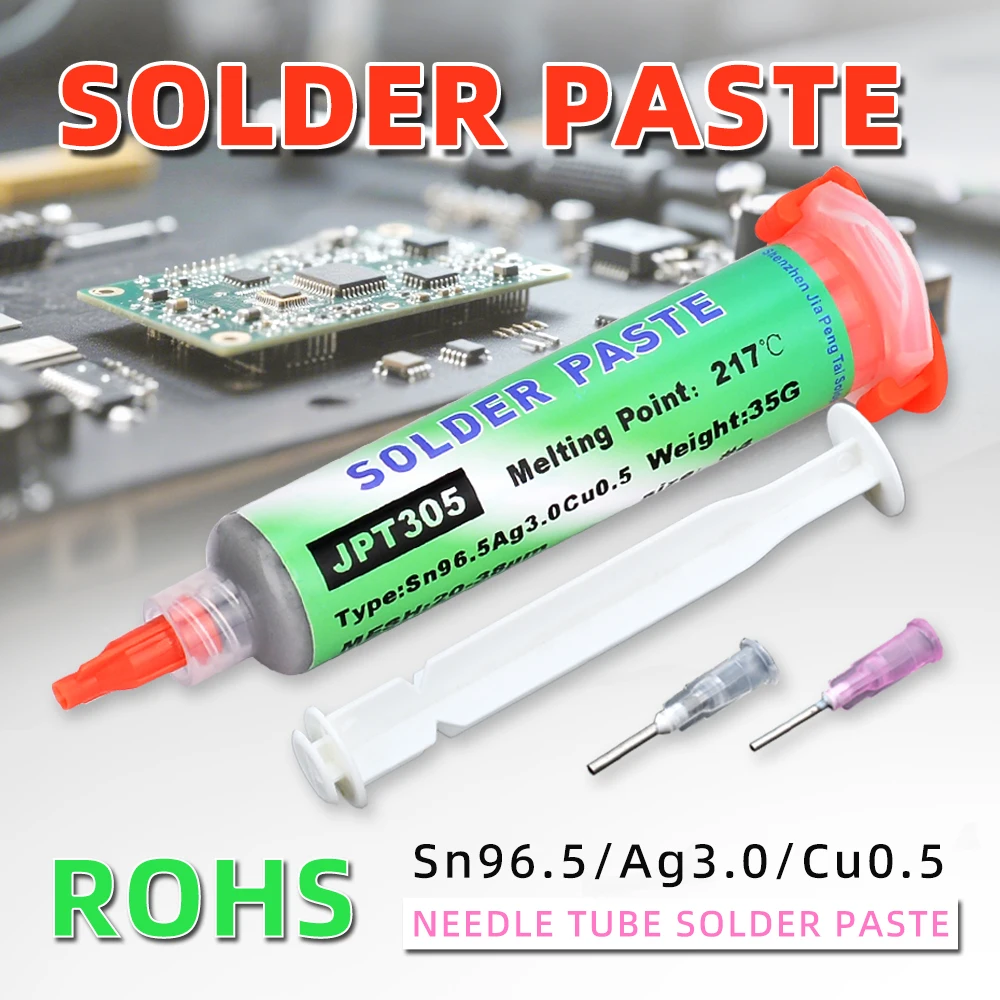
JPT305 Lead-Free Solder Paste Syringe
Official Store Deal
Expert Analysis Overview
The Precision Craft of Soldering
The JPT305 Lead-Free Solder Paste is a refined soldering medium, meticulously formulated for intricate electronic repair and artistic metalwork, aimed at precision artisans and electronics technicians demanding flawless bonds. This paste transcends typical soldering compounds, offering a consistency that allows for a sculptural approach to micro-assembly, where every joint is a deliberate, clean formation. Its fine texture means effortless application, even in the most constrained spaces.The Art of Application: Controlled Dispensing
This solder paste is delivered in a convenient needle tube syringe, a design choice critical for controlled dispensing. Unlike bulk solder pots or less precise applicators that often result in excessive material or accidental bridging, the syringe allows for micro-deposits, essential for surface-mount technology (SMT) components and fine-pitch integrated circuits. The included needle tips further enhance this control, offering varying apertures to match the scale of the work at hand. Imagine placing a bead of molten metal with the precision of a jeweler setting a stone. This method ensures optimal material usage, reducing waste and cleanup time.Compared to traditional solder wire, which requires a separate flux application and often results in larger, less aesthetically pleasing joints, the paste combines both solder and flux. This integration streamlines the process, leading to a cleaner workspace and more consistent results. The direct application onto pads before heating simplifies the workflow significantly.
Material Science: The Alloy Composition
Central to the paste's performance is its Sn96.5/Ag3.0/Cu0.5 alloy composition. This specific lead-free blend ensures robust electrical and mechanical connections. Tin (Sn) provides the primary melting and wetting characteristics, while silver (Ag) enhances strength, conductivity, and resistance to fatigue. Copper (Cu) further refines the grain structure, improving joint integrity and preventing whisker formation over time.This high-grade alloy powder is precisely formulated, creating durable, bright solder joints. Such a composition is a significant upgrade over older, leaded solders, which, while having a lower melting point, pose environmental and health risks. The shift to lead-free is not just about compliance; it is about future-proofing repairs and ensuring long-term reliability in sensitive electronics.
The melting point of 217°C is strategically chosen. This temperature allows for effective reflow without subjecting delicate components to excessive thermal stress, a common issue with higher melting point alloys. It is a critical factor for maintaining the integrity of sensitive semiconductors.
Thermal Dynamics and Joint Integrity
Effective heat management is paramount when working with solder paste. The JPT305's formulation is designed for optimal wetting and strong adhesion, which translates into firm, consistent solid solder joints. When heat is applied, the paste transitions smoothly from its thixotropic state to a molten form, flowing evenly across the pads. This minimizes voids and ensures complete coverage.Achieving perfect thermal profiling is a skill. The paste's consistent behavior under heat allows artisans to develop a predictable technique, leading to repeatable, high-quality results. Poor heat control can lead to cold joints or component damage. The paste's properties aid in mitigating these risks, offering a wider thermal window for successful reflow.
This stability is a marked improvement over generic, unbranded pastes. Those often exhibit inconsistent melting, leading to poor wetting or excessive splatter. The JPT305's controlled flow ensures a clean, professional finish, critical for both functionality and aesthetic appeal in visible repairs.
Versatility Across Micro-Applications
The utility of this solder paste extends across a broad spectrum of electronic repair tasks. It proves invaluable for PCB (Printed Circuit Board) rework, allowing for precise placement and reflow of surface-mount components. BGA (Ball Grid Array) reballing, a highly specialized and delicate process, benefits from the paste's fine particle size (20-38um) and consistent viscosity, ensuring uniform solder ball formation.USB socket repair, a common point of failure in modern devices, becomes a manageable task with this precision paste. The ability to deposit small, controlled amounts directly onto the tiny pads of a USB port minimizes the risk of bridging adjacent pins, a frequent challenge with traditional soldering methods. This precision prevents costly damage to the mainboard.
Consider a scenario where a vintage audio amplifier requires the replacement of a tiny, obsolete capacitor. Its leads are incredibly fine, and the board traces are delicate. Traditional soldering might overwhelm the area. This paste allows for micro-dabs, ensuring only the necessary material is applied, protecting the surrounding components and preserving the board's original aesthetic.
The Sculptural Advantage: Artistic Beads
Beyond functional electronics repair, the JPT305 solder paste provides an unexpected advantage for those engaging in micro-sculptural work or creating artistic solder beads. The fine texture and consistent flow allow for the deliberate formation of intricate patterns and structures. The bright, clean finish of the Sn96.5/Ag3.0/Cu0.5 alloy provides an attractive metallic sheen, making it suitable for visible decorative elements in custom electronics or small-scale metal art.The ability to control the application and reflow characteristics means a sculptor can achieve varied textures and forms. From smooth, rounded domes to sharp, defined lines, the paste responds predictably to heat, allowing for artistic expression. Its non-corrosive flux ensures the finished piece remains untarnished.
This application is a departure from purely functional soldering. It encourages experimentation with heat guns or controlled hot air stations to manipulate the molten metal, creating unique visual effects. The precise control offered by the needle tube is instrumental here, enabling the creation of intricate details that would be impossible with bulkier Tools.
Long-Term Value and Compliance
The lead-free nature of the JPT305 solder paste aligns with RoHS (Restriction of Hazardous Substances) directives, making it suitable for professional applications where environmental and safety standards are critical. This compliance is not merely a regulatory checkbox; it reflects a commitment to safer working conditions and environmentally responsible practices. The product's high-temperature stability ensures excellent print transfer and seamless integration into SMT processes, indicating its suitability for both repair and small-scale manufacturing.The durability of the solder joints created with this paste contributes to the longevity of repaired devices. By preventing cold joints and ensuring strong mechanical bonds, the paste reduces the likelihood of repeat repairs. This translates into significant cost savings over time, both in terms of labor and replacement parts.
This product offers a tangible return on investment for any technician. The initial price is offset by the reduced rework, faster job completion, and the higher quality of the final product. It is an investment in precision and reliability, critical for any professional or serious hobbyist.
Imagine the satisfaction of restoring a cherished electronic device, knowing that every solder joint is not just functional, but a testament to precision and craftsmanship. Picture the intricate details of a custom circuit board, where the solder gleams with a consistent, professional finish. This solder paste empowers technicians to achieve such results, transforming challenging repairs into satisfying successes and allowing for the creation of durable, aesthetically pleasing electronic assemblies.