JHCHMX Laser Protective Windows: Fused Silica Optics for High-Power Applications
Official Store Deal
Expert Analysis Overview
JHCHMX Laser Protective Windows are precision-engineered optical components designed for critical laser cutting and welding applications, ensuring the integrity of expensive laser optics. These windows are not merely transparent barriers; they are integral to maintaining beam quality and extending the operational lifespan of high-power laser systems. The selection of appropriate protective windows is a metrological decision, directly impacting the accuracy and repeatability of industrial laser processes.
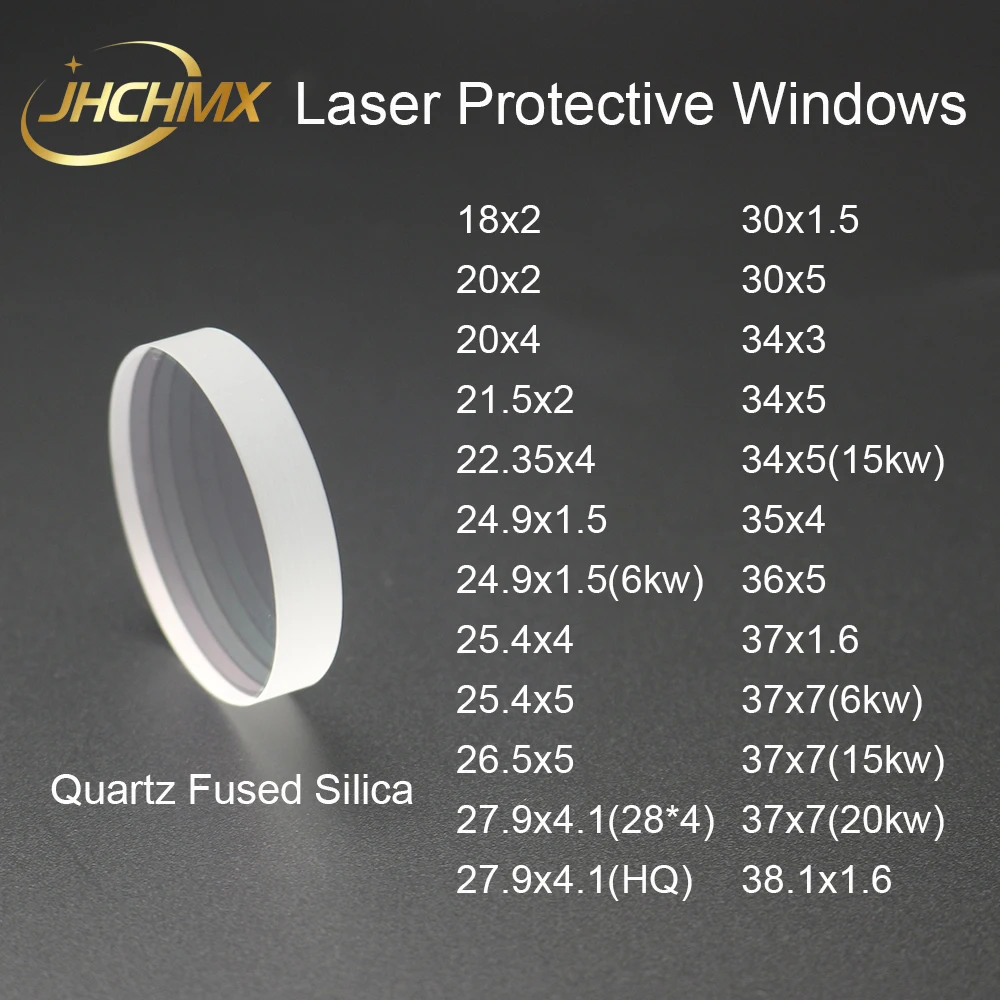
The primary function of a laser protective window is to shield the internal focusing lens from spatter, debris, and fumes generated during laser processing. This protection is paramount. Without a high-quality protective window, the focusing lens would quickly degrade, leading to compromised beam quality, reduced cutting efficiency, and costly replacements. The visible material, Quartz Fused Silica, or JGS1 Quartz, indicates a commitment to optical purity and thermal stability.
This material choice is critical for high-power applications. Fused silica exhibits excellent transmission characteristics at the specified 1064nm wavelength, minimizing energy loss and heat absorption within the window itself. Low thermal expansion is a key property. This ensures the window maintains its optical flatness and parallelism even under intense thermal loads, preventing beam distortion that could lead to imprecise cuts or welds. The material's inherent hardness also provides superior resistance to physical damage from molten metal particles.
Compared to standard glass or lower-grade quartz, fused silica offers a significantly higher damage threshold. This translates directly into longer service intervals and reduced downtime for maintenance. The consistency of the material across various units is essential for predictable performance. Each window contributes to the overall system's metrological stability.
The product title lists a comprehensive range of dimensions, such as 18x2, 20x4, 22.35x4, 27.9x4.1, 30x5, 36x5, and 37x7, with specific power ratings up to 20kW. These numbers represent the diameter and thickness in millimeters. Precise dimensions are non-negotiable for proper fitment within the laser head. An ill-fitting window can lead to misalignment, air gaps, and compromised sealing, allowing contaminants to bypass the protective layer.
Each dimension is critical. The thickness, for instance, influences the optical path length and mechanical stability. Thicker windows offer greater rigidity and resistance to thermal lensing, a phenomenon where heat absorption causes the window to act as a weak lens, altering the beam's focal point. Maintaining consistent thickness across the window's surface is a manufacturing challenge that directly impacts optical performance. This consistency is vital for repeatable results.
Unlike generic optical components, these protective windows are specified with tight tolerances. This ensures that when a window is replaced, the optical alignment of the laser system remains largely undisturbed, minimizing the need for extensive recalibration. The ability to swap windows without significant optical shifts is a major operational advantage. It saves valuable production time.
The mention of "1064nm" in the product title is crucial. This indicates the windows are optimized for Nd:YAG and fiber lasers, which commonly operate at this infrared wavelength. The anti-reflective (AR) coating, visible on some of the windows and implied by the packaging, is designed to maximize transmission at 1064nm while minimizing reflection. Reduced reflection means more laser power reaches the workpiece and less is reflected back into the laser cavity, which can cause instability or damage.
An effective AR coating is a complex engineering feat. It involves depositing multiple thin layers of dielectric materials with precise thicknesses. The quality of this coating directly impacts the window's efficiency and its resistance to laser-induced damage. A poorly applied coating can delaminate or absorb laser energy, leading to premature failure. The visual appearance of the coatings in the images suggests a professional application, often characterized by a subtle color tint.
For metrologists, the consistency of the AR coating across batches is as important as the base material. Variations in coating thickness or composition can lead to slight differences in transmission or reflection, which, in high-precision applications, can manifest as subtle changes in processing parameters. The goal is a uniform optical response. This ensures that process parameters developed with one window remain valid when another identical window is installed.
Specific power ratings, such as "34x5(15kw)" or "37x7(20kw)", highlight the robust design of these windows for high-power industrial lasers. These ratings are not arbitrary; they reflect the window's ability to withstand intense laser radiation without damage or significant thermal lensing. Operating a laser system with a protective window rated below the laser's actual power output is a significant risk, potentially leading to catastrophic failure of the window and damage to the internal optics.
The thickness of the window often correlates with its power handling capability. A thicker window provides more material to dissipate absorbed heat and greater mechanical stability against thermal stress. The choice of fused silica, with its low absorption coefficient at 1064nm, is fundamental to achieving these high power ratings. This material choice directly contributes to the window's longevity in demanding environments.
Investing in appropriately rated protective windows is a cost-effective strategy. While the initial cost may be higher than generic alternatives, the extended lifespan of the focusing lens and the reduced downtime for maintenance offer a substantial return on investment. These windows are consumables, but their durability directly impacts operational efficiency. They are designed for sustained performance.
Proper installation of these protective windows is crucial for their performance and the overall safety of the laser system. The window must be seated correctly within its holder, ensuring a tight seal to prevent contamination. Any dust or fingerprints on the window's surface can absorb laser energy, creating hot spots that lead to damage. Cleanliness is paramount.
Regular inspection of the protective window is a standard maintenance procedure. Operators should look for signs of spatter accumulation, scratches, cracks, or discoloration. Even minor damage can significantly degrade beam quality and increase the risk of catastrophic failure. A damaged window must be replaced immediately to prevent further issues. This proactive approach minimizes unexpected downtime.
Cleaning procedures must be followed meticulously, using only approved optical cleaning solutions and lint-free wipes. Abrasive materials or improper cleaning techniques can scratch the delicate AR coating, compromising the window's performance. The goal is to maintain the optical surface in pristine condition. This ensures peak laser performance.
From a metrological standpoint, these JHCHMX Laser Protective Windows offer a critical component for maintaining the precision and repeatability of laser processing. The specified material, precise dimensions, and wavelength optimization contribute to a stable optical path. This stability is essential for applications requiring micron-level accuracy and consistent output. The ability to achieve repeatable results across multiple production runs hinges on the reliability of every optical element.
These windows enable consistent data logging capability by ensuring the laser's output characteristics remain stable. When the protective window performs consistently, variations in process outcomes can be more accurately attributed to other parameters, simplifying troubleshooting and process optimization. This consistency is invaluable for quality control. It provides a reliable baseline.
Considering the cost of high-power laser systems and the precision required in modern manufacturing, these protective windows represent a strategic investment. They safeguard more expensive components and ensure continuous, high-quality production. The long-term value far outweighs the individual unit cost. Imagine a production line running smoothly, consistently hitting tight tolerances, all supported by reliable optical protection. This is the operational advantage these windows provide, allowing operators to focus on optimizing their processes rather than battling optical degradation. The peace of mind from knowing your laser's optics are well-protected is immeasurable, translating directly into higher throughput and superior product quality.
Precision in Optical Defense
The primary function of a laser protective window is to shield the internal focusing lens from spatter, debris, and fumes generated during laser processing. This protection is paramount. Without a high-quality protective window, the focusing lens would quickly degrade, leading to compromised beam quality, reduced cutting efficiency, and costly replacements. The visible material, Quartz Fused Silica, or JGS1 Quartz, indicates a commitment to optical purity and thermal stability.
This material choice is critical for high-power applications. Fused silica exhibits excellent transmission characteristics at the specified 1064nm wavelength, minimizing energy loss and heat absorption within the window itself. Low thermal expansion is a key property. This ensures the window maintains its optical flatness and parallelism even under intense thermal loads, preventing beam distortion that could lead to imprecise cuts or welds. The material's inherent hardness also provides superior resistance to physical damage from molten metal particles.
Compared to standard glass or lower-grade quartz, fused silica offers a significantly higher damage threshold. This translates directly into longer service intervals and reduced downtime for maintenance. The consistency of the material across various units is essential for predictable performance. Each window contributes to the overall system's metrological stability.
Dimensional Accuracy and Fitment
The product title lists a comprehensive range of dimensions, such as 18x2, 20x4, 22.35x4, 27.9x4.1, 30x5, 36x5, and 37x7, with specific power ratings up to 20kW. These numbers represent the diameter and thickness in millimeters. Precise dimensions are non-negotiable for proper fitment within the laser head. An ill-fitting window can lead to misalignment, air gaps, and compromised sealing, allowing contaminants to bypass the protective layer.
Each dimension is critical. The thickness, for instance, influences the optical path length and mechanical stability. Thicker windows offer greater rigidity and resistance to thermal lensing, a phenomenon where heat absorption causes the window to act as a weak lens, altering the beam's focal point. Maintaining consistent thickness across the window's surface is a manufacturing challenge that directly impacts optical performance. This consistency is vital for repeatable results.
Unlike generic optical components, these protective windows are specified with tight tolerances. This ensures that when a window is replaced, the optical alignment of the laser system remains largely undisturbed, minimizing the need for extensive recalibration. The ability to swap windows without significant optical shifts is a major operational advantage. It saves valuable production time.
Optical Performance and Wavelength Specificity
The mention of "1064nm" in the product title is crucial. This indicates the windows are optimized for Nd:YAG and fiber lasers, which commonly operate at this infrared wavelength. The anti-reflective (AR) coating, visible on some of the windows and implied by the packaging, is designed to maximize transmission at 1064nm while minimizing reflection. Reduced reflection means more laser power reaches the workpiece and less is reflected back into the laser cavity, which can cause instability or damage.
An effective AR coating is a complex engineering feat. It involves depositing multiple thin layers of dielectric materials with precise thicknesses. The quality of this coating directly impacts the window's efficiency and its resistance to laser-induced damage. A poorly applied coating can delaminate or absorb laser energy, leading to premature failure. The visual appearance of the coatings in the images suggests a professional application, often characterized by a subtle color tint.
For metrologists, the consistency of the AR coating across batches is as important as the base material. Variations in coating thickness or composition can lead to slight differences in transmission or reflection, which, in high-precision applications, can manifest as subtle changes in processing parameters. The goal is a uniform optical response. This ensures that process parameters developed with one window remain valid when another identical window is installed.
Power Handling and Longevity
Specific power ratings, such as "34x5(15kw)" or "37x7(20kw)", highlight the robust design of these windows for high-power industrial lasers. These ratings are not arbitrary; they reflect the window's ability to withstand intense laser radiation without damage or significant thermal lensing. Operating a laser system with a protective window rated below the laser's actual power output is a significant risk, potentially leading to catastrophic failure of the window and damage to the internal optics.
The thickness of the window often correlates with its power handling capability. A thicker window provides more material to dissipate absorbed heat and greater mechanical stability against thermal stress. The choice of fused silica, with its low absorption coefficient at 1064nm, is fundamental to achieving these high power ratings. This material choice directly contributes to the window's longevity in demanding environments.
Investing in appropriately rated protective windows is a cost-effective strategy. While the initial cost may be higher than generic alternatives, the extended lifespan of the focusing lens and the reduced downtime for maintenance offer a substantial return on investment. These windows are consumables, but their durability directly impacts operational efficiency. They are designed for sustained performance.
Installation and Maintenance Considerations
Proper installation of these protective windows is crucial for their performance and the overall safety of the laser system. The window must be seated correctly within its holder, ensuring a tight seal to prevent contamination. Any dust or fingerprints on the window's surface can absorb laser energy, creating hot spots that lead to damage. Cleanliness is paramount.
Regular inspection of the protective window is a standard maintenance procedure. Operators should look for signs of spatter accumulation, scratches, cracks, or discoloration. Even minor damage can significantly degrade beam quality and increase the risk of catastrophic failure. A damaged window must be replaced immediately to prevent further issues. This proactive approach minimizes unexpected downtime.
Cleaning procedures must be followed meticulously, using only approved optical cleaning solutions and lint-free wipes. Abrasive materials or improper cleaning techniques can scratch the delicate AR coating, compromising the window's performance. The goal is to maintain the optical surface in pristine condition. This ensures peak laser performance.
The Metrologist's Perspective on Value
From a metrological standpoint, these JHCHMX Laser Protective Windows offer a critical component for maintaining the precision and repeatability of laser processing. The specified material, precise dimensions, and wavelength optimization contribute to a stable optical path. This stability is essential for applications requiring micron-level accuracy and consistent output. The ability to achieve repeatable results across multiple production runs hinges on the reliability of every optical element.
These windows enable consistent data logging capability by ensuring the laser's output characteristics remain stable. When the protective window performs consistently, variations in process outcomes can be more accurately attributed to other parameters, simplifying troubleshooting and process optimization. This consistency is invaluable for quality control. It provides a reliable baseline.
Considering the cost of high-power laser systems and the precision required in modern manufacturing, these protective windows represent a strategic investment. They safeguard more expensive components and ensure continuous, high-quality production. The long-term value far outweighs the individual unit cost. Imagine a production line running smoothly, consistently hitting tight tolerances, all supported by reliable optical protection. This is the operational advantage these windows provide, allowing operators to focus on optimizing their processes rather than battling optical degradation. The peace of mind from knowing your laser's optics are well-protected is immeasurable, translating directly into higher throughput and superior product quality.